
Wait, but I'm not in a car! I have a Subaru Outback — a wagon with increased off-road capability, 200 mm ground clearance, and all-wheel drive. I calmly drive onto an obstacle that is insurmountable for most "ordinary" cars, and get out. For the first time in the last month, I parked closer than 50 meters from the entrance and saved myself a good half hour that I usually spend circling neighboring yards looking for a spot. So don't believe the talk that a small car is easier to park! In winter, the main thing is off-road capability, and that's why this wagon, over 4.7 meters long, turns out to be more practical in the city than the tiny VW Polo.
What is it?
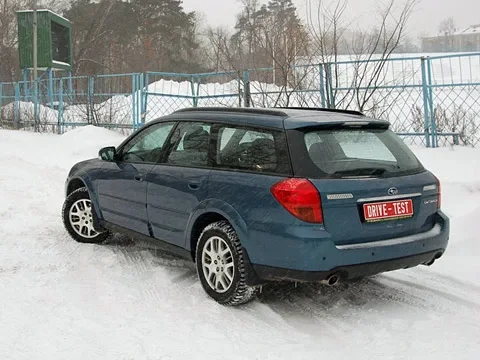
Essentially, the Outback is a Subaru Legacy wagon with increased ground clearance and slightly altered looks. Increased clearance, more massive bumpers with large fog lights, "ribs" on the hood, wheel arch extensions, and different wheels — these are, in fact, all the visual differences. Although geometric off-road capability is now like that of full-fledged crossovers, the appearance remains quite car-like. True, if you put a regular Legacy wagon next to the Outback, it will look as if it's pressed to the asphalt — as if a couple of tons of cargo were loaded into it.
But the difference between these cars is not only in the exterior and clearance. Two engines are offered for both. And if the senior, 245-horsepower unit is common to them, the more affordable 165-horsepower motors are different. With the same power, the displacements differ: 2 and 2.5 liters. This means the Outback 2.5 produces almost 40 Nm more torque — significant for a crossover.
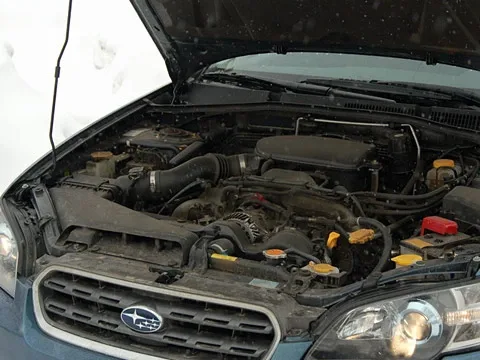
Boxer engines nowadays can only be found on some Porsches and all Subarus.
The gearboxes are almost the same, but there's a nuance: the three-liter Outback is available only with a five-speed automatic, while the Legacy can boast a six-speed manual from the Subaru Impreza WRX STi. Base versions are offered either with a four-speed automatic or a five-speed manual, which has a low range.
Even in the starting trim — climate control, a decent audio system (unfortunately, without MP3 support), heated seats, 8 airbags, and "five-star" passive safety. Electric windows and mirror adjustment on a car from $37840 need not be mentioned, but the heated windshield in the wiper area is a nice bonus that not everyone has.
The quality of materials will not yield to most premium cars. On test we had an almost "base" car, whose only option was a four-speed automatic (plus $1500 to the price). The list of additional equipment also includes a leather interior, a glass roof over half the roof, and navigation. That's probably all. But a dual-zone "climate" cannot be ordered on the Outback even for an extra charge. As, indeed, much else — Subaru has a "necessary minimum," but there are frankly few excesses.
Getting inside
Inside, the Outback feels like a car, and a sporty one at that. A comfortable three-spoke MOMO steering wheel with perforated leather, a center console slightly turned toward the driver, and a high tunnel — all this creates a cockpit feel. Materials are top-notch: soft plastic, pleasant fabric. True, the gray "aluminum-look" trim doesn't even pretend to be metal, but it looks neat.
The seat is comfortable. A driver of any height will fit behind the wheel — the seating position is very correct, all controls are at hand. The only nitpicks are the inconvenient power window block and the steering column, which adjusts only for height. Smokers might complain about the small ashtray. In the back, there's also enough space: two cupholders, an ashtray, an armrest.
The trunk is a dream for any dacha owner. The loading height is low, and under the floor is a full-size spare. And if you fold both parts of the rear seat back, the volume grows to 1649 liters! And you can load it to the brim — the pneumatic elements of the rear suspension keep the rear horizontal under any load.
Let's go!
Insert the key. When the ignition is turned on, the instrument needles effectively "sweep" to maximum marks. Turn further — a thoroughbred rumble of the boxer engine comes from under the hood. Well, let's go!
Even the "weakest" Outback engine gives the car quite confident acceleration. The main thing is not to get carried away: Subaru carefully hides the sensation of speed. Pressing the gas pedal at about a hundred, after a few seconds (not very intense, as it seemed to me) of acceleration, I glanced at the speedometer and immediately braked: the needle was somehow hurrying toward the "150" mark. Hey, I only wanted to reach 120! That's how you can lose your license!
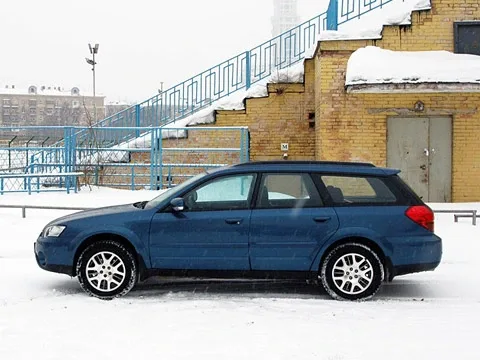
Apart from this "drawback," driving the Subaru is incredibly easy. Potholes, ruts? Forget it — the Outback simply doesn't notice such trifles. In general, everything in this car is subordinated to comfort, and driver comfort at that. It's not about a soft suspension or a spacious cabin (although that's all in order too). The point is that the Outback allows you not to think about what's under the wheels. Snow slush? The Outback will confidently accelerate on it and hold its course with the persistence of a freight train. A broken country road? You don't have to reduce speed — the energy-intensive suspension will remain silent, like a Yugoslav partisan, never bottoming out. Overtaking? The engine's thrust is enough, and the Sportshift automatic will "slot in" the right gear in time.
Compared to regular crossovers, the Subaru wagon advantageously features a low range (in the manual version), which allows slow crawling through snow without fear of burning the clutch. Automatic gearboxes (4-speed for the 2.5-liter version and 5-speed for the three-liter) don't have a low range, but they have a torque converter that practically replaces it. Although you shouldn't play at being a driver of a BTs-80 tracked tractor in the Outback. Or a racer, for that matter.
Of course, moving into the Outback from an Impreza WRX, you understand: this car is much softer and calmer. But the breed, the breed is felt! In the Outback's reactions, there are neither delays nor ambiguity. And in a slide, the car behaves quite predictably — if you exceed the speed in a corner, it will respond with understeer of all four wheels.
The "automatic" has two modes — normal and sport. The first, unnamed (I'd call it "evening rush hour") is needed for situations when you're "tired, fed up with everything" and want to get home with minimal effort. And if you turn on "sport," the delays in reactions disappear faster than comfort does. Finally, if something doesn't suit you in its operation, you can always shift "manually" — the manual mode here is honest: you can rev the engine to the limit, and the gearbox won't think of upshifting on its own.
Summing up
In general, Subaru, apparently, simply doesn't know how to make "non-driver's" cars. Even a large wagon with high clearance handles better than many good sedans. There's style, and there's comfort. And most importantly — the large ground clearance combined with all-wheel drive gives a feeling of freedom. With the Subaru Outback, you'll no longer be bothered by snowdrifts in parking lots, bad roads, or what the weather is like outside and whether the roads are slippery. And freedom, as we know, is priceless.