
Can a D-class wagon outrun, say, an Impreza STI? Surprisingly, yes. In terms of practicality, the Legacy almost catches up with the five-seat Tribeca, and its appetite is more modest than that of the Impreza 1.5. The small diesel pulls no worse than the older petrol units, and the turbo kick delights the driver before the brake lights flash ahead. In city traffic, it's an ideal choice. And finally, the new "wagon" is assembled more harmoniously than the sedan, which in turn handles far more intelligently than the Impreza STI.
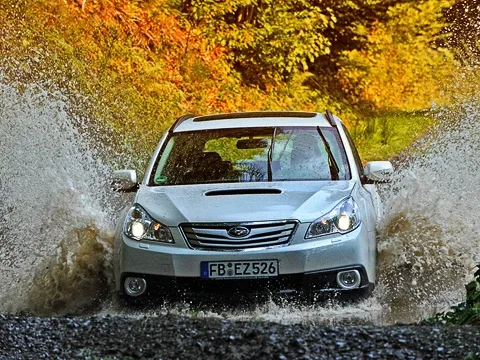
Outback prices range from 1,363,500 to 2,037,000 rubles. The flagship Outback 3.6R is equipped with a new 249-horsepower naturally aspirated "six."
But that doesn't matter. Instead of the Legacy "wagon," we'll only get the Outback anyway. It seems like the same wagon, but raised by 50 mm thanks to extended springs and shod with rugged Yokohama Geolandar tires. However, in spirit, it's a completely different car. Older, with a birdcage or a dog in the trunk. The Outback is about 55 — just like its average European buyer. On the move, you feel like you're driving a large crossover.

The suspension travel of the new Outback remains the same as its predecessor's. The springs have been lengthened, and the shock absorbers have become stiffer.
Unsurprisingly, the 3.6 "six" from the Tribeca is now placed under the hood (the cars even look similar). The Outback glides over the road while the asphalt under the wheels is smooth. On a straight line, the car holds its course confidently. The electric power steering clearly fixes the "zero." The cabin is surprisingly quiet for such a tall and, at first glance, not the most streamlined car. I start to yawn.
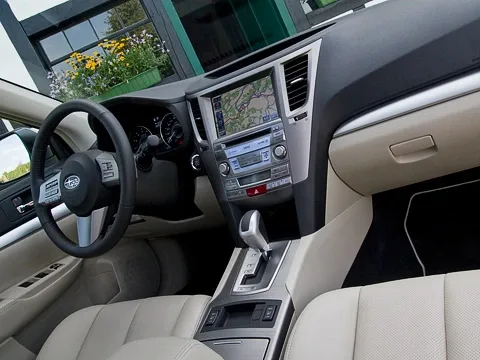
Finally, the Legacy has broken away from the Impreza in terms of cabin space, although the flagship hasn't advanced too far in the quality of finishing materials.
In corners, the Outback leans, and the reactive action on the steering wheel becomes more sluggish. However, that very Geolandar, which colleagues criticize for its low ultimate capabilities, pleased with a neat first response to turning the wheel. The Outback's place is still outside the city (even without a reduction gear). On dirt roads, the suspension demonstrates impressive energy intensity. But there's no talk of ride smoothness anymore. Disturbances from the suspension and unsprung masses are presented in the richest assortment — with corresponding noise accompaniment.
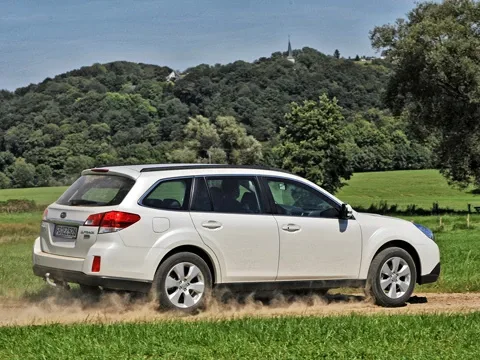
The Outback's length has grown by only 45 mm, it has added five centimeters in width, like all versions, and seven in height. The wheelbase has increased by 75 mm. The rear KYB shock absorbers — an analogue of Sachs Nivomat — maintain a constant ground clearance regardless of load.
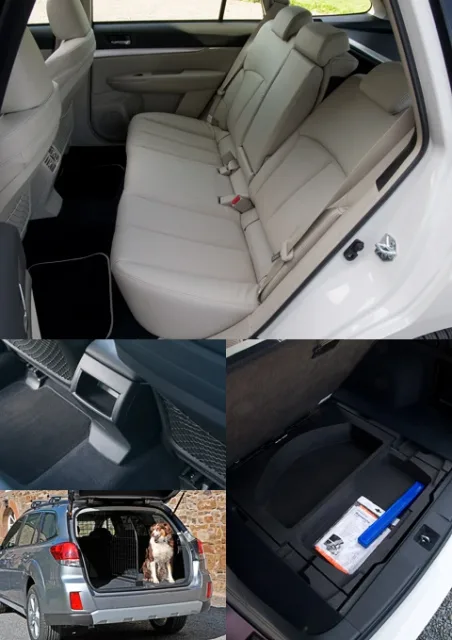
The angle of the rear split backrest is adjustable, allowing any posture: from a taut one, like a military school cadet in class, to a reclining one. When folded, the upper part of the seat creates a flat floor surface and frees up almost 1.8 cubic meters. However, rear passengers in the cheapest versions will have to suffer without air ducts on the central tunnel.

The trunk has gained 61 liters — now it amounts to 526. Under the false floor of the European version, there's only a repair kit with sealant. Cars for the Russian market (i.e., Outback) will get a spare tire.
Of course, if you drive onto such a dirt road in the regular Legacy wagon, which is unavailable to us, everything alive inside will likely die. After all, its suspension is tuned for good roads. But what difference does it make? On asphalt, the Legacy is just a celebration. Forget the low-power engines and imperfect transmissions: such perfectly neutral handling can't be found in any car in its class.
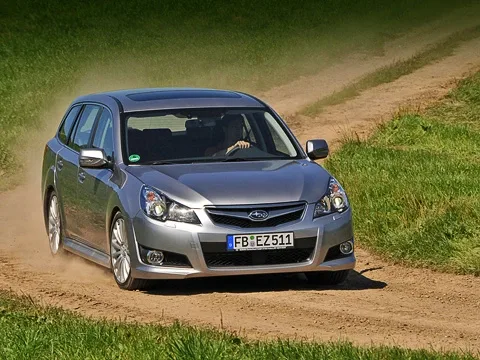
All civilian Subaru "boxers" sing about the same. The only difference is the diameter of the drill bit inserted into the drill. And to this un-neighborly buzzing, the wagon polishes corners and turns with the obsession of a crammer called to the blackboard. It knows the subject thoroughly and savors every opportunity to show itself, to push with the outer tire or hook with the inner one.
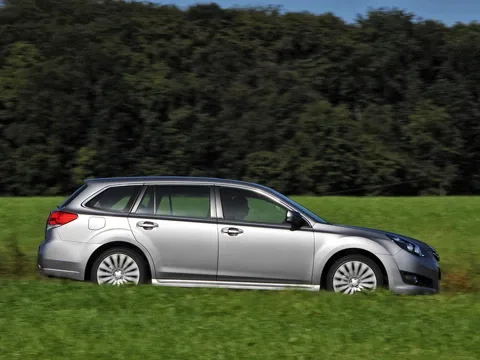
After the lanky Outback, the low-slung wagon on large 18-inch wheels looks even attractive. And it drives incomparably better.
The diesel modification, moreover, doesn't distract with shifts. You can hop over hills on one gear where on a petrol car you curse the vague "manual" drive with long lever throws and uninformative clutch, or you torment the paddle shifters of the sleepy CVT. Moreover, the responses are good not only to the steering wheel but also to the fuel supply. And that's already the merit of the new shortened exhaust manifold.
Meanwhile, the diesel tremor barely reaches the cabin. The secret of excellent vibration isolation is in the original engine mounting: the power unit is mounted on a subframe common with the front suspension via hydraulic mounts. That, in turn, is also attached to the body not rigidly, but through elastic elements. On this double rubber-metal filter, most of the parasitic disturbances settle.
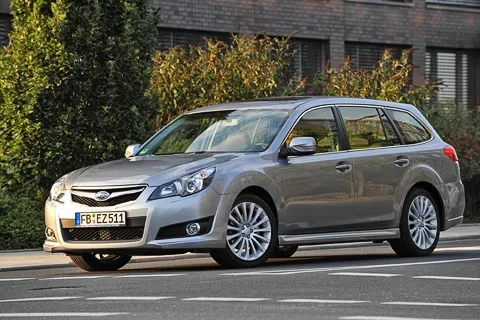
The wagon has gained the least in dimensions: 55 mm in length, 65 in height, and five centimeters in width. The wheelbase has increased by eight centimeters. As a result, the rear seats have shifted by 62 mm.
The steering mechanism is also mounted on the same subframe as the engine and suspensions. Apparently, this is the secret of why the Legacy is not at all prone to understeer. Moreover, the car is good not only at the moment of turning in. The body is rigid enough, and the kinematics of the rear multi-link (unified with the Impreza and Forester) seem perfectly coordinated. On an arc, already "on the tire," the wagon remains as responsive to the steering wheel as at the first moment.
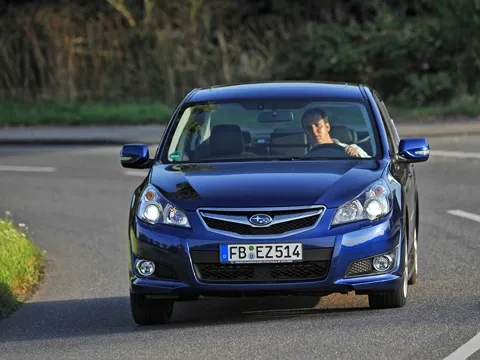
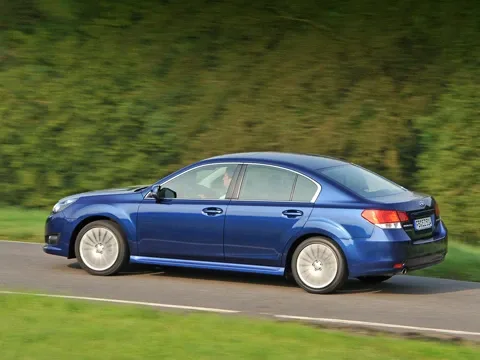
What difference does it make! The sedan, more attractive in appearance, isn't as good on the move: the rear is lighter here, so the rear tires are underloaded in corners. There's no feeling that the front and rear suspensions are in harmony. The pleasure comparable to the enjoyment of the wagon's handling will be given by the four-door only if it's equipped with a Bilstein suspension. But that turns out too stiff and expensive.
No, only the "wagon"! I also get a kick from the fact that the Legacy is an absolutely analog system. There are no trendy reducers that change the steering ratio or control the thrust vector, no electronically controlled shock absorbers. On cars with a "manual," even the center differential is locked the old-fashioned way, with a viscous coupling. With such a subtle handling character, the absence of overly powerful engines is perceived as a blessing. Poverty is not a vice — that's about the Legacy.
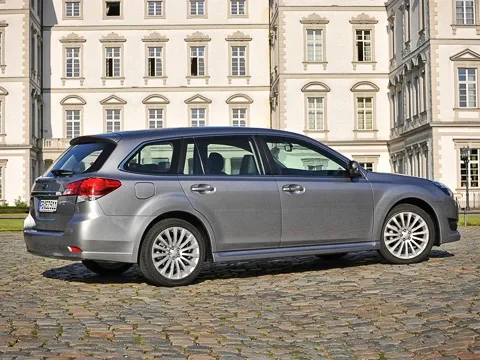
Can an ignorant person identify the brand of this car at a glance?
Subaru decided that from now on, the flagship would be enough with four-cylinder engines. Equally characterless naturally aspirated 2.0 (150 hp) and 2.5 (167 hp), the 150-horsepower turbo diesel 2.0 I liked, and a 265-horsepower "turbo-four" 2.5 instead of the previous three-liter "six." The top model Legacy 2.5 GT, by the way, is just a fast car. There's even less sport in it than status. Even despite the asymmetric differential in the transmission, which delivers 55% of the torque to the rear axle. The gearbox is only a five-speed "automatic." And the hydraulic power steering is tuned worse than the electric one on other versions.
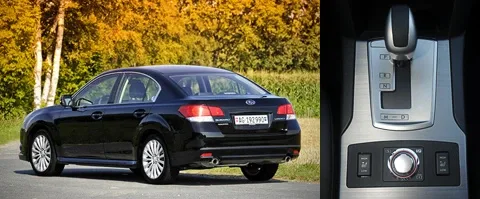
The top model 2.5 GT is easiest to recognize by a pair of exhaust pipes. And in the cabin, by the SI-DRIVE system controller perched on the central tunnel, which is responsible for the accelerator sensitivity. Like the Outback 3.6 version, the Legacy 2.5 GT transmission features permanent all-wheel drive with a free cylindrical differential distributing torque between the axles in a 45:55 ratio in favor of the rear wheels.
What difference does it make? For the international focus groups of the Legacy/Outback project, it's no longer important which particular opposed "boxer" is under the hood and by what means the "horse" symmetry of all-wheel drive is achieved. Nobody cares whether it's differential or whether torque is sent to the rear on demand, as on cars with an "automatic" and CVT. Much more important is that the Legacy and Outback have gotten rid of the cramped cabin, which was detrimental from a competitive standpoint. Previously, representatives of the Legacy family were only slightly more spacious than the Impreza.
In the base version's cabin, without navigation, rough plastic with a metallic sheen dominates. Carbon fiber imitation and aluminum pedal covers are details of the optional sport package.
It was the cabin layout that became the starting point for the model's development about five years ago. To give passengers more freedom, the Legacy was made wider and longer. Inside, it's now spacious and bright. Although class membership should be determined not only by centimeters in shoulders and knees, but also by the feeling of quality. And the quality of the Legacy's finish, alas, is only slightly higher than that of the Impreza. The Nissan Teana sedan, which the Japanese consider a direct rival, looks like an absolute premium against the Subaru.
The instrument panel is the brightest element of the interior. At the same time, beauty did not interfere with informativeness. A separate place is allocated for the economy meter: Subaru follows the fashionable eco-trend.
To place two cup holders on the central tunnel, the parking brake was made electromechanical, and its button was hidden in the blind spot to the left of the steering wheel. Nearby is the hill-holder button, which prevents the car from rolling back on an incline. The question is: why doesn't it turn on by itself? Just below is the traction control off button. But the stability system cannot be completely disabled.
The blue plastic reminds of the Camry. The information on the climate control display is hard to read.
From a design perspective, the standard radio with a six-disc changer fits best into the cabin. But the McIntosh multimedia turns the center console into something like a PlayStation joystick. The difference in sound does not justify the feeling of a foreign device in the interior.
Moreover, it seems that no one particularly thought about how to use the gained millimeters. The Legacy's design, both outside and inside, is the embodiment of "collective creativity." Neither to praise nor to scold. Even the Koreans give more reasons for discussion (I'm not even talking about the Chinese with their Italian outsourcing). The Legacy is a walking collection of quotes. The car clearly shows what was in fashion five years ago.
The nostril on the hood is a distinguishing mark of versions with turbo engines, including the diesel one.
Over the two years that designers went from the first sketches to the final decision (in Subaru this stage is called design fix), the car absorbed all trends drop by drop. It turned out cute, but secondary. A car company dreaming of success needs a strong hand of a leader-designer. Collective intelligence is faceless.
Or is it not important? Let there be no unified vision, but the cars are not similar to each other. This is how Subaru favorably differs from the widespread unification. Now the Japanese from the Pleiades declare: we do not want the model range to become monotonous, even if this does not increase brand recognition.
It is clear that every detail has its own author or, at least, a gifted plagiarist. But the Legacy/Outback design project as a whole lacks an owner.
Here you can't understand: either they are making excuses because they lack resources for a radical update, like Mazda or the "Koreans" who are gaining a face, or they are speaking seriously, because Subaru is indeed comfortable in the role of a small niche manufacturer. Indeed: sales in America (and this is, after all, the priority market) are growing, while others are failing at everything—and thank God.
Subaru Europe President Tomoo Takenaka is in a great mood: "If I had the opportunity to absorb Toyota, I would gladly start buying up its shares." That's Porsche-like. The opportunity, of course, is not there...
The Japanese say with obvious pleasure that Toyota, which owns part of Subaru, does not interfere in the affairs of its satellite: it helps (soon Subaru will have a hybrid with Toyota filling), but does not hinder. They say the Pleiades have a good share of the microcar market in Japan, and everyone is happy. Guaranteed bread. Subaru Europe President Tomoo Takenaka, with whom I spoke in Cologne, radiated such calm and confidence in the future, as if he were from Porsche, which had just bought Volkswagen.
"We are a little like Porsche," Takenaka smiles when we talk about Subaru's niche nature. I don't mind. Even if he said: "We are like Porsche." They were also bought. You can also look at the twenty-year life of the Legacy as a three-times-accelerated history of the Porsche 911. The Impreza, so be it, will pass for a Boxster, the Tribeca for a Cayenne. However, adherence to "boxer" traditions is not yet "Porsche-ness." There must be ambitions. And Subaru resembles a retrograde resting on sporting laurels. Unlike the controversial Impreza N14, the fifth-generation Legacy did not become an event for me at all. If I were a loyal owner of the sedan or Outback, I would definitely visit the dealer. But in the absence of a diesel wagon, what difference does it make to me?
Technical specifications
| Model | Subaru Legacy 2.0R | Subaru Legacy 2.5i | Subaru Legacy 2.5 GT | Subaru Legacy 2.0D |
|---|---|---|---|---|
| **Body** | | | | |
| Body type | sedan (wagon)* | sedan (wagon) | sedan (wagon) | sedan (wagon) |
| Number of doors/seats | 4/5 (5/5) | 4/5 (5/5) | 4/5 (5/5) | 4/5 (5/5) |
| Length, mm | 4730 (4775) | 4730 (4775) | 4730 (4775) | 4730 (4775) |
| Width, mm | 1780 | 1780 | 1780 | 1780 |
| Height, mm | 1505 (1535) | 1505 (1535) | 1505 (1535) | 1505 (1535) |
| Wheelbase, mm | 2750 | 2750 | 2750 | 2750 |
| Track front/rear, mm | 1545/1550 (1545/1545) | 1530/1535 (1530/1530) | 1530/1535 | 1545/1550 (1545/1545) |
| Curb weight, kg | 1420–1460** (1463–1503**) | 1462 (1507) | 1542 (1586) | 1501 (1557) |
| Maximum trunk volume, l | 486 (1726) | 486 (1726) | 486 (1726) | 486 (1726) |
| **Engine** | | | | |
| Type | petrol | petrol | petrol, turbocharged | turbodiesel |
| Location | front, longitudinal | front, longitudinal | front, longitudinal | front, longitudinal |
| Number and arrangement of cylinders | 4, opposed | 4, opposed | 4, opposed | 4, opposed |
| Number of valves | 16 | 16 | 16 | 16 |
| Displacement, cm³ | 1994 | 2457 | 2457 | 1998 |
| Max power, hp/rpm | 150/6000 | 167/5600 | 265/5600 | 150/3600 |
| Max torque, N•m/rpm | 196/3000 | 229/4000 | 350/2400–5200 | 350/1800–2400 |
| **Transmission** | | | | |
| Gearbox | 6MT/CVT | CVT | 5AT | 6MT |
| Drive | all-wheel, with center differential, locked by viscous coupling/plug-in | | | |
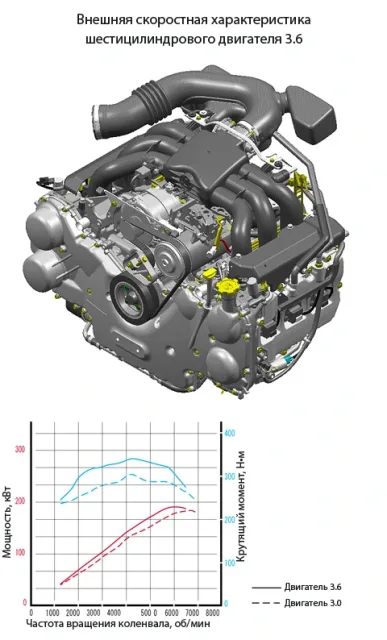
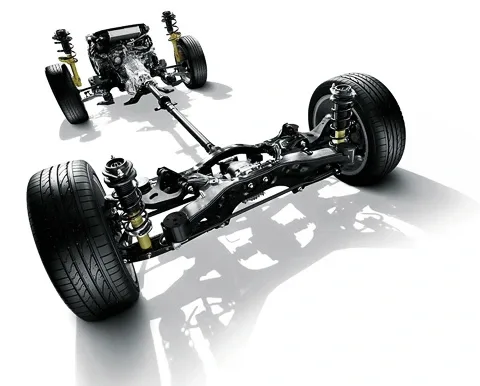
The key technical feature of the new Subaru flagship is a single subframe on which both the front suspension and the powertrain are mounted (via special hydraulic mounts). The diagram shows that only the rear gearbox mount is now attached directly to the body. At the same time, the subframe itself, unlike European trends, is connected to the body not rigidly, but through elastic elements.
When you open the Outback's hood, you get the impression that the engine has fallen down—so clearly the new mounting scheme is demonstrated. After all, the Outback differs from the regular Legacy wagon not only in increased springs, but also in the subframe mounting points.
The new engine position freed up space under it for an updated exhaust system and, for turbocharged versions, the turbocharger. The short manifold provides a faster response to the gas pedal and allows catalysts to work more efficiently.
The new subframe design entailed refinement of the front McPherson strut arms. The rear multi-link suspension is like the Forester and new Impreza. For the characteristic A-shape of the upper arms, the Japanese, in a sporty style, call it double-wishbone.
The body of the new-generation Legacy sedan and wagon consists of approximately 46% high-strength and ultra-high-strength steels (yield strength from 440 to 980 MPa).
The new subframe also became the basis for the steering rack with variable gear ratio, on which the electric power steering motor is installed. The exception is the 265-horsepower turbocharged Legacy 2.5 GT version, where the power steering is traditional, hydraulic.
The Subaru Lineatronic CVT with a chain from Luk (like the Multitronic gearbox from Audi) is the only continuously variable transmission today capable of working with a longitudinal installation paired with all-wheel drive. The role of the friction packs usual for CVTs here is played by a conventional torque converter. Simply put, the Japanese made a hybrid of a CVT and an "automatic." It cannot be said that such a combination is distinguished by agility. But, according to the manufacturers, locking the torque converter at speeds above 8 km/h allows saving fuel. In addition, Lineatronic pleases with short shift times in the pseudo-manual mode: virtual steps change in just 0.1 s.
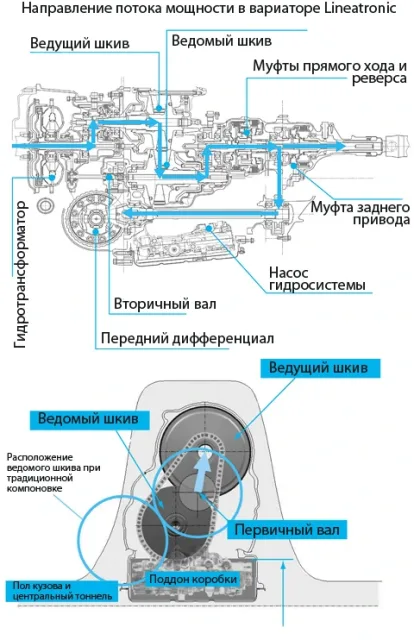
To save space inside the body, engineers from Japan shifted the primary pulley of the continuously variable transmission relative to the crankshaft axis, adding an intermediate gear pair to the design. The transfer of torque to the rear wheels is entrusted to a multi-disc clutch with electronic control.
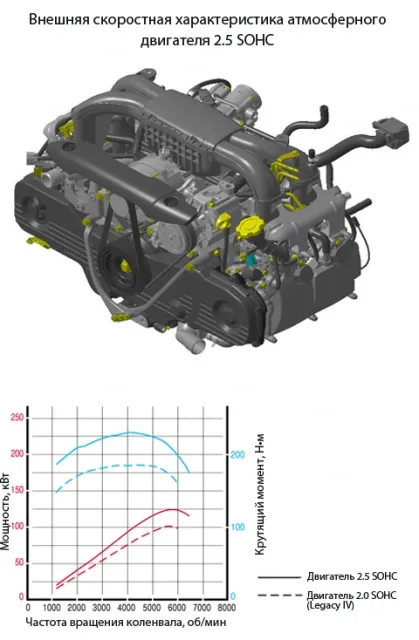
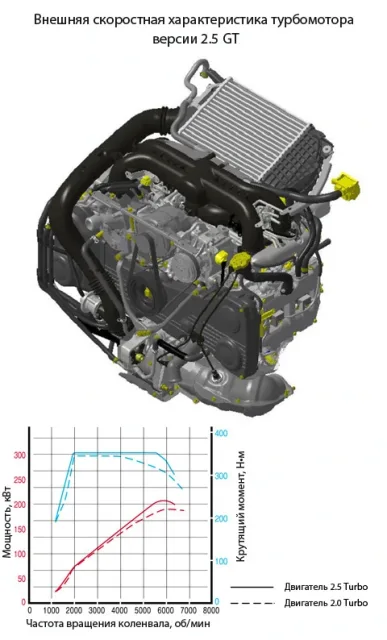
The increased displacement to 2.5 liters endowed the powertrain with greater output and a longer torque plateau than the two-liter turbo engine that was installed on some versions of the previous-generation Legacy.
For an additional charge, the Legacy is available with a sport package that includes stiffer Bilstein shock absorbers (KYB are standard) and more "driver-oriented" Bridgestone Potenza RE050 tires in size 225/45 R18. But, in my opinion, the sedan on Bilsteins is in no way superior to the regular wagon. Except that it has become stiffer.
Safety 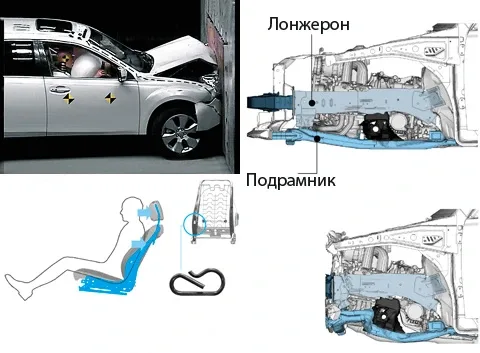
In a collision, the new subframe works according to a programmed sequence — it deforms and pushes the engine downward, helping the side rails absorb impact energy. The Legacy also features specially designed easily replaceable beams that protect the structural framework from damage in impacts at speeds up to 15 km/h. The Japanese engineers also paid special attention to protection against the consequences of rear-end collisions: the front seat frames are mounted on deformable brackets that help distribute the load on the spine more evenly.
Design 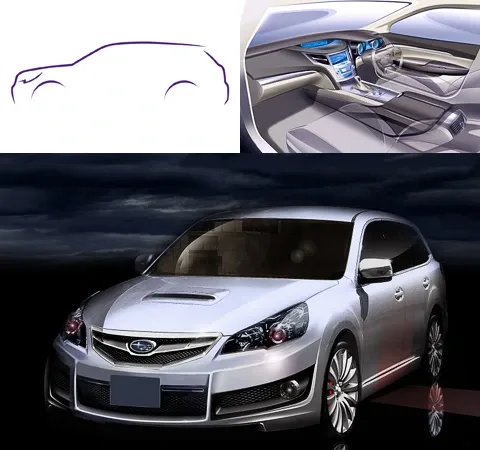
The connection between the living car and the designer sketches is easily discernible, but this is exactly the case where small details radically change the overall mood.
History (Kirill Ivanov) 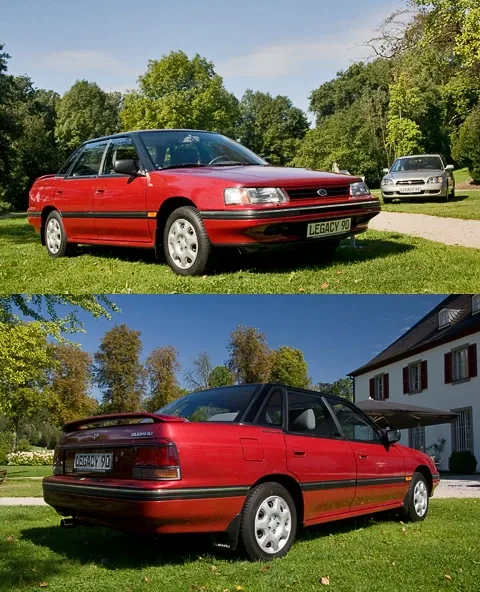
The world premiere of the concept under the name Legacy took place in 1987 at the Chicago Auto Show. The production version, which replaced the Leone model, hit the market two years later. The Legacy became the first Subaru model to feature a two-liter engine under the hood. The flagship was offered in sedan and wagon body styles, with optional all-wheel drive and adjustable suspension, as well as generous equipment for its time — including four-channel ABS. The engine lineup consisted of naturally aspirated and turbocharged flat-four engines ranging from 102 to 280 hp. The first-generation Legacy also made its mark in the World Rally Championship and, thanks to Colin McRae, became an object of adoration for fans and tuners.
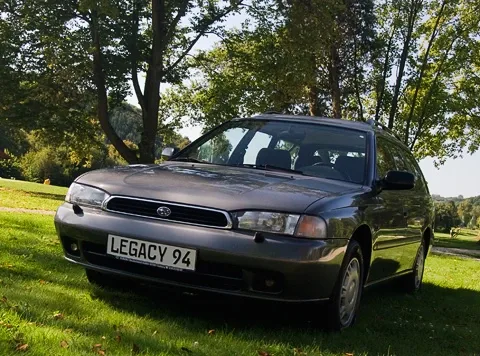
In 1993, the second generation debuted — the same car but with a more attractive appearance. The design was worked on by Olivier Boulay, better known for the "nose" style of Mitsubishi. The Legacy's wheelbase grew by 50 mm to 2630 mm, and the body dimensions also increased slightly. For the key US market, all cars were equipped with all-wheel drive even in base trim. The engines remained four-cylinder, but the weakest variants disappeared from the lineup. At the top, as before, was a 2.2-liter turbo engine producing 280 hp. The transmissions remained the same — a five-speed manual and a four-speed automatic. It was in this generation that the off-road modification Outback appeared in sedan and wagon bodies — with permanent all-wheel drive, adjustable suspension, and increased ground clearance of up to 185 mm.
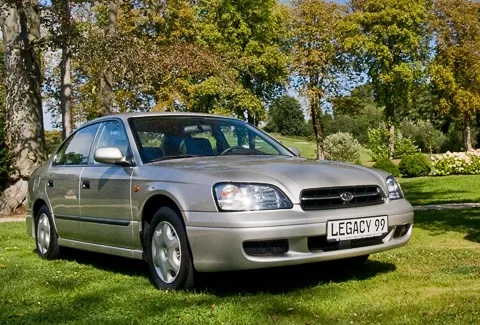
The third generation of the model was released in June 1998. Starting with this generation, the Legacy was equipped with permanent all-wheel drive as standard for all global markets. In 2000, the Japanese introduced a version with a rare engine type — a 3-liter flat-six producing 209 hp. In the same year, the all-wheel-drive Outback wagon was separated into its own model, losing the Legacy prefix. In 2001, a special version of the Blitzen sedan was unveiled, created in collaboration with Porsche engineers: the Germans not only designed the wheels and aerodynamic body kit but also shared the sequential algorithm for the automatic transmission. The most extreme modification was the STI (S400 and S401) with a 2-liter turbo engine producing 289 hp (343 N•m) and a six-speed manual, which was unavailable for regular versions. A total of 800 such cars were produced. Another curious variation on the Legacy theme was the Baja pickup, built on the Outback base for the American market, but due to weak demand (just over 30,000 units sold), production was discontinued after four years — in 2006.
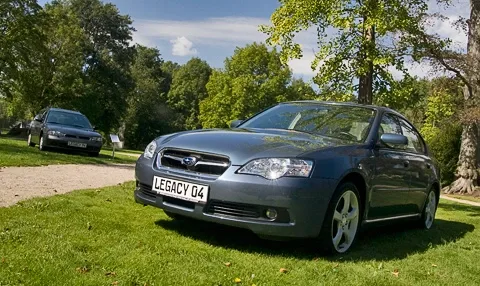
The fourth generation, which appeared in 2003, was essentially a refined third generation: the wheelbase was increased by 20 mm (to 2670 mm), the suspension was made more comfortable, the all-wheel drive was improved, and aerodynamics were enhanced. For regular versions of the Legacy, a six-speed manual finally became available. However, the Japanese abandoned the twin-turbo engine due to CO2 emission requirements, replacing it with a turbocharged 2-liter unit from the Impreza. At the end of the fourth generation's career, in spring 2008, to boost European sales, a version with a 150 hp (350 N•m) flat-four turbodiesel appeared. In the same year, for the Japanese market, the "hottest" STI modification was released — the S402 with Bilstein suspension, Brembo brakes, and a 285 hp (392 N•m) supercharged 2.5-liter engine from the Impreza WRX STI. The production run was 402 units. The total production of all Legacy models throughout its history exceeded 3.6 million units.
Behind the Scenes 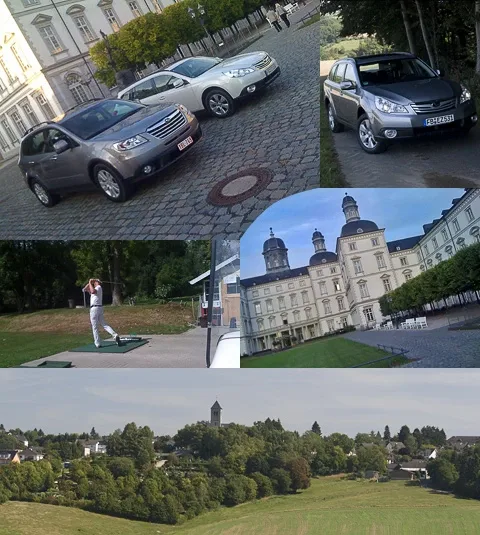
I am not being disingenuous when I claim that the new Outback, in spirit and dimensions, closely resembles the Tribeca crossover. And both of them look like outsiders in the courtyard of an old Westphalian castle — even if it has been converted into a hotel. Although, they say that European aristocracy, especially the English, has a fondness for Outbacks — for their good manners and lack of pretentiousness.