
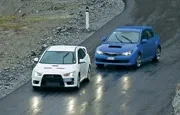
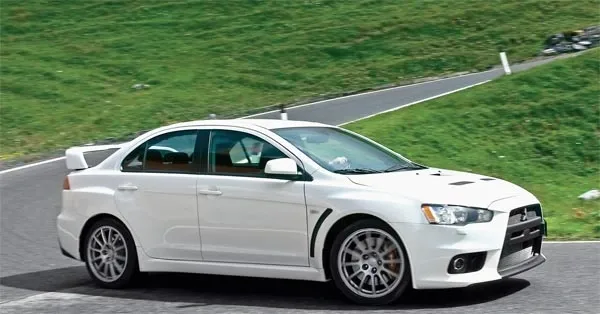
These two cars are far from ordinary test participants. It's not even about their memorable appearance. Of course, wide wheel rims, spoilers, and exhaust pipes immediately catch the eye. But the real essence is hidden much deeper — it comes from the world of rally, where Subaru and Mitsubishi have been setting the tone for many years. The current Lancer Evolution is a fresh model, but with a huge baggage of traditions: nine whole generations of Evo behind it. The tenth incarnation is the essence of all that history. It looks truly aggressive. Huge air intakes, hood slits, and elongated headlights create an image unlike anything else. The windshield is tilted at a very sharp angle, the sloping roof is crowned with a small spoiler, and right behind it rises a giant rear wing. The picture is completed by massive wheel arches, into which 18-inch wheels barely fit.
Inside, everything is much more modest than outside. You immediately notice the Recaro seats, frankly racing. The driver's seating position is almost ideal for the track. The pedals — bare metal — are set evenly and close together. There is a convenient footrest for the left foot. The gearshift lever lies right in the hand, the steering wheel is small in diameter. But here's the problem — it doesn't adjust for reach, which clearly hinders finding the perfect driving position.
Under the hood is a fresh four-cylinder unit: both the block and the head are made of aluminum, and the bore-to-stroke ratio is exactly 1:1 (the previous engine was long-stroke, had a cast-iron construction, and weighed 12 kg more). The turbocharger, intercooler, and two-phase variable valve timing allow extracting 295 hp at 6500 rpm from two liters of displacement. That's almost 148 "horses" per liter!
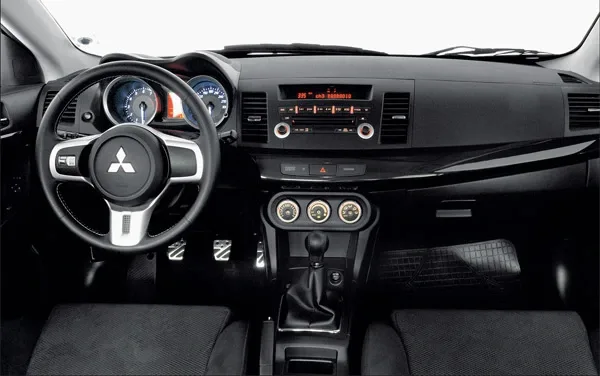
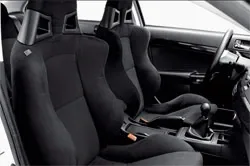 | WHITE CROW. The Evolution's exterior is so bright that the car is guaranteed to stand out from any traffic. Left in the photo: comfortable sports seats and a turbocharged "four" with 295 hp. |
| Lancer Evolution X • Top speed — 244.4 km/h • 0-100 km/h — 5.3 s • 0-160 km/h — 13.0 s • 70-120 km/h in 5th — 9.4 s | 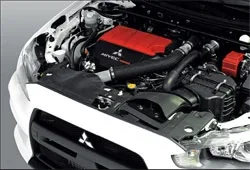 |
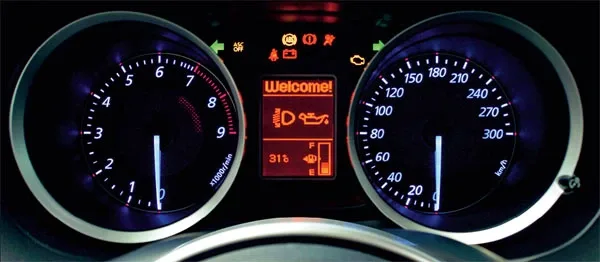
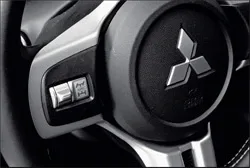 | SPORTS AMBIENCE. Key details of racing attributes — metal pedals and a compact steering wheel with tilt adjustment only. The instruments differ from standard ones, and on the steering wheel spokes there is a switch for electronic assistants and transmission settings. |
HOT HATCHBACK
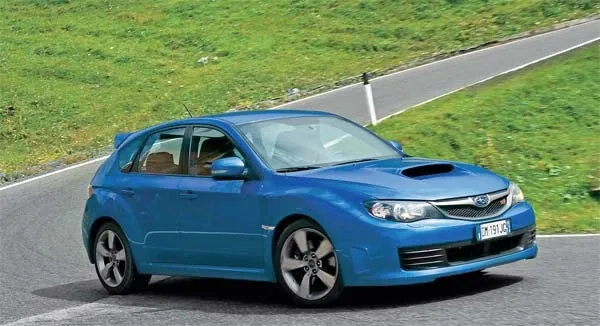
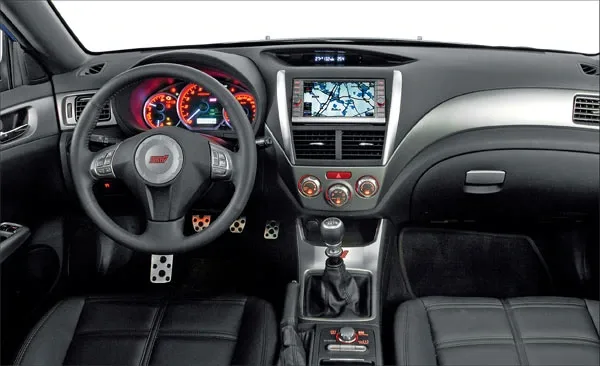
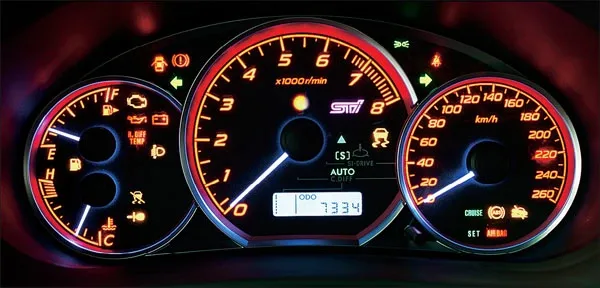
The five-door WRX STi body is borrowed from the new Impreza, but calling it family-friendly is no longer possible. Everything here is also reworked in a sporty key. The front track is widened by 40 mm, the rear by 45 mm. 18-inch wheels with 245/40 tires are installed, spoilers front and rear, additional air intakes. Through the largest of them, located on the hood, air is supplied to the intercooler. The Subaru's interior is finished more solidly and with higher quality than the Evo's. The leather-trimmed seats, of course, cannot compare with real racing "buckets", but they firmly hug the body. On the center console — multimedia with GPS navigation, in front of the driver — instruments with bright red backlighting. The instrument cluster is created specifically for the STi. In the center is a tachometer, on whose dial a red indicator periodically flashes, hinting that it's time to shift up.
Under the hood is a classic boxer turbo engine with four cylinders. The solution is technically complex and expensive, but it allows simultaneously reducing dimensions, lowering weight, and lowering the car's center of gravity. The two-liter unit with two-phase variable valve timing produces 300 hp at 6000 rpm, and maximum torque reaches 397 Nm. In character, the rivals are similar, but their temperaments are different. Both engines confidently pick up closer to 3000 rpm, and after the 4000 rpm mark they show their wild nature. True, the Subaru's limiter kicks in already at 6500 rpm, while the Mitsubishi engine can be revved to 7500 rpm. But the Subaru can boast more torque, and it would suit a gearbox with "longer" ratios.
The Evolution has only five gears, but the first four are short enough to fully utilize the engine's potential. And although the Subaru engine is more powerful, and the Evolution turned out to be 56 kg heavier after weighing, it was the Mitsubishi that accelerated faster. A few fractions of a second — it would seem a trifle, but it's better not to say that out loud in front of fans! The Evo's movement is controlled by the AYC system — during acceleration it distributes torque between the rear wheels asymmetrically. When braking, ABS and the ASC system help to turn the car. We approach the northern bend of the track, where we test handling. Fourth gear, approach at speed, sharply press the brake (overload — 1g) and downshift to second. We keep the brake pedal pressed and enter the corner like that. The system increases the load on the right wheels — this makes it easier to exit the bend without understeer. Having reached the middle of the corner, without further ado, we floor the gas. The torque on the rear left wheel is greater than on the right, and the Evolution, furiously biting into the asphalt, flies out of the bend with absolutely straight wheels. Fantastic!
The Impreza doesn't have such a system, but on the rear axle there is a Torsen differential capable of transferring up to 100% of the torque, and on the front — a self-locking differential. The center differential distributes force between the axles with filigree precision, and if necessary, instantly locks. And the result is no worse than the Evo's. The Impreza's handling is more complex than the Evolution's — here you need a truly experienced driver capable of extracting everything the engineers put into the car. It takes time to get used to the Subaru. But if traction suddenly deteriorates, it's enough, having selected the right settings, to drive the car competently — and not a single horsepower will be wasted.
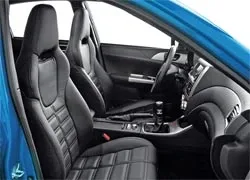 | REQUIRED PROGRAM. Track widened by 45 mm, 18-inch wheels, huge hood air intake for better cooling of the boxer engine. Seats — in racing style. At the rear, the roof spoiler and twin exhaust pipes stand out. |
| Impreza WRX STI • Top speed — 250.5 km/h • 0-100 km/h — 5.7 s • 0-160 km/h — 13.3 s • 70-120 km/h in 6th — 14.6 s | 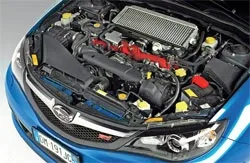 |
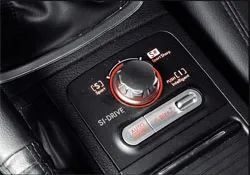 | CHANGES FOR THE BETTER. The Impreza's instrument panel looks quite decent. The quality of finishing has noticeably improved. The central place in the instrument cluster is given to the tachometer. Switches for engine settings and center differential modes are located on the tunnel behind the gearshift lever. |
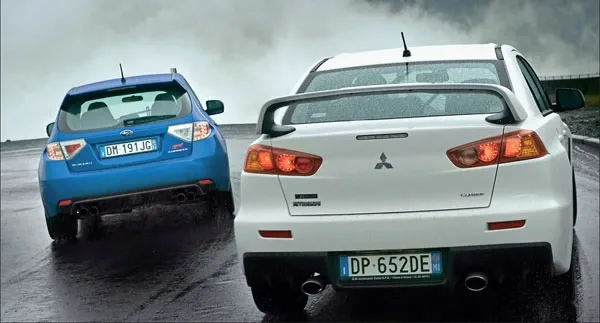
ALL FOR DRIVE. In both cases, we have an excellent combination of chassis and engine.
All the rest of the work is taken over by all-wheel drive and electronics. They help out when
the tires' grip on the road becomes insufficient.