
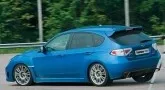
This summer, the scorching air was torn by a low predatory roar — this is how the new Subaru Impreza WRX STI of the 2008 model year announced itself, the heiress of glorious rally traditions and one of the strongest production cars of its time.
The previous generation of the Impreza WRX stayed on the assembly line for quite a long time — during its entire life it only underwent a light modernization in 2006. The new model, however, has transformed radically: not only the technology has changed, but also the body type — now it is a five-door hatchback. Subaru, like many automotive giants, decided to expand its audience and bet on the most popular segment.
The design of the regular Impreza may be debatable, but the STI version looks solid and harmonious. The hatchback body not only became stiffer than that of the civilian modification, but also received a different visual. Due to the increased tracks, the wheel arches had to be widened — as a result, the car acquired aggressive muscular fenders.
Even if you seat a person in the STI cabin with their eyes blindfolded, they will instantly feel that they are dealing with something special. Recaro seats with pronounced lateral support securely hold the body, although full-figured people may find them a bit cramped. The sporty steering wheel has convenient anatomical bulges in the grip area — the palm rests firmly and confidently. And if you lower your right hand lower, it will encounter the cool aluminum gear knob. It seems that after starting the engine, this element will remain the only part that will not heat up to the limit.
Starting the engine in the base configuration is with a key, but we, as expected, have the most expensive version, here the engine comes to life by pressing a button. You won't be able to enjoy the deep bass of the tuned exhaust system at idle with the windows closed — the sound is so dense that it keeps waking up the alarms of neighboring cars. During acceleration, the exhaust tone barely changes, but the cabin fills with the rumble of the engine and the howl of the transmission. Measurements confirm this: at idle, 50 dB in the cabin — slightly more than competitors. At medium speeds, the noise is close to normal, but when the tachometer needle goes over 4000 rpm and the speed exceeds 140 km/h, the noise level rises above 77 dB and can reach 80 dB. On short dynamic accelerations, this even spurs you on, but on a long highway trip it starts to tire.
Under the hood of the new model is an even more powerful engine than its predecessor. This is a 2.5-liter turbocharged engine with 16 valves, producing 300 hp at 6000 rpm. Torque is 407 Nm at 4000 rpm. The claimed factory acceleration to 100 km/h is 5.2 seconds, our measurements showed 5.6 s, which is not critical at all. The car accelerates to 200 km/h in 23.9 s, and covers a kilometer distance from a standstill in 13.9 s, reaching 162 km/h at the finish.
Special mention deserves the SI-Drive (Subaru Intelligent Drive) system with three modes — Intelligent, Sport, and Sport Sharp. They are switched by a regulator near the gear lever, and each changes the character of the car through engine settings. In Intelligent, the response to the gas pedal is soft and smooth — passengers are comfortable and calm. With the transition to the next mode, the reaction to the accelerator sharpens, and the dynamics noticeably change (our acceleration measurement to 100 km/h was carried out in Sport Sharp mode).
Despite such power, the STI behaves predictably in maneuvers. There are rolls, but the results on the figures are impressive: the moose test according to VDA standards the car passes at a speed of 72 km/h at the entrance and 52 km/h at the exit, and the long ISO lane change is conquered at almost 135 km/h. This is close to the maximum possible values. It is pleasant that even in a loaded state, the speeds of these exercises drop by only 1–2 km/h.
Small rolls are a consequence of the new Subaru DC (Dynamic Control) chassis concept. The idea is to install a rigid body on a flexible suspension that can adapt to any surface. At the front — inverted struts with a large stroke, which in combination with a modified stabilizer, an aluminum lower arm, and optimized wheel alignment angles give precise and sharp steering. At the rear — double wishbones: a simple but capable of holding large loads scheme. The rear suspension also has an increased stroke for better adaptation to the road. The result — on an 18-meter slalom, the STI in an unloaded state shows 68.3 km/h. The new approach to the chassis provokes fast driving, hence the rolls.
Summing up, we can say: the Impreza STI demonstrates excellent handling. Thanks to many settings, it can be both a docile city car and an aggressive sports projectile. Compared to the previous generation, the new model has become noticeably more comfortable — this is not a drawback, but rather a feature of the new generation.
Locking
The multi-mode DCCD center differential controls the operation of the center differential and the self-locking clutch. Three automatic modes and a manual one are provided. Auto is suitable for most roads and conditions, Auto “+” increases the locking force and improves stability on slippery surfaces, while Auto “-” weakens the locking for better handling on winding tracks. In manual mode, the locking force is adjusted in six steps.
Our opinion
The new STI no longer has that angry, unbridled nature that was before. The Impreza STI’08 holds the road perfectly, allows you to drive quickly and confidently, while controlling the driver's actions and giving maximum comfort for such a car. This is very good — the new STI can be easily used every day in the city.
Body
+ reinforced body
- low sound insulation
Ride comfort
+ moderately comfortable suspension
+ good brakes
Ecology
- high CO2 indicator
Powertrain
+ very torquey engine
- stiff gearbox shifts
Handling
+ good handling
- presence of rolls
Safety
+ reinforced body