
Subaru Impreza

ALL-WHEEL DRIVE AND MANUAL
Engine — 1.5 L
Max power — 107 hp/6000 rpm
Max torque — 142 Nm/3200 rpm
Max speed — 175 km/h
Fuel consumption:
combined cycle — 7.5 L
city — 9.6 L
highway — 6.3 L
5-speed manual transmission,
permanent all-wheel drive
Curb weight — 1310 kg
Length — 4415 mm
Width — 1740 mm
Height — 2620 mm
Ground clearance — 155 mm
Tires 195/65R15
Equipment:
Central locking with remote control, power steering, immobilizer, 4 power windows, power-adjustable and folding mirrors, climate control, AM/FM radio + 1 CD (MP3) + 4 speakers, alloy wheels, ABS/EBD, 2 front + side airbags and curtain airbags, winter package, leather steering wheel, heated seats, cruise control, fog lights
Price — $21,769 (174,150 UAH)
Service interval:
15,000 km
TO0 — 1500 km — $136 (1080 UAH)
TO1 — $213 (1701 UAH)
TO2 — $460 (3673 UAH)
TO3 — $213 (1701 UAH)
TO4 — $757 (6048 UAH)
TO5 — $213 (1701 UAH)
TO6 — $460 (3673 UAH)
Warranty — 3 years or 100,000 km
Competitors:
Suzuki SX4
Suzuki Liana

Marat Makhmutov
The Subaru Impreza in its new generation appeared in an unexpected role for itself — a hatchback. The history of the model from Fuji Heavy Industries began back in 1992, and all these years — more than a decade and a half — the car was produced exclusively as a sedan or station wagon (although in 1994 a two-door coupe also appeared). Brand fans did not greet the body change with much enthusiasm, but the European buyer, with his pragmatism, votes for the hatchback — especially since in terms of luggage capacity it is almost as good as the station wagon.
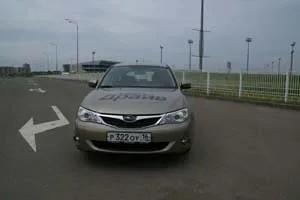
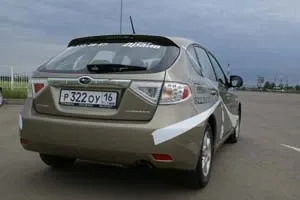
The STi and WRX versions are a completely different story, for rally or track. But our subject is designed to touch the legend of motorsport for quite modest money for this class. There are few all-wheel-drive passenger cars on the market: SX4, Swift, Ignis, Liana from Suzuki, all-wheel-drive S40 from Volvo and A3 from Audi, plus the Golf variant from Volkswagen. Suzuki offers democratic prices, but they lack charisma. And premium brands cost noticeably more.
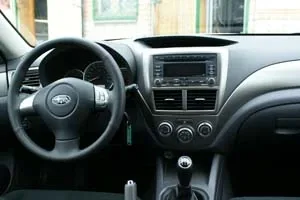
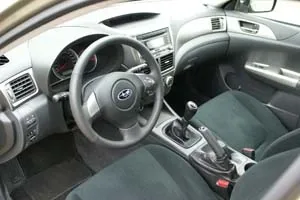
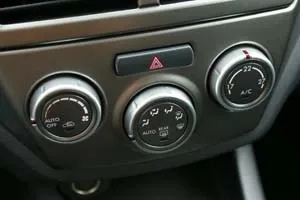
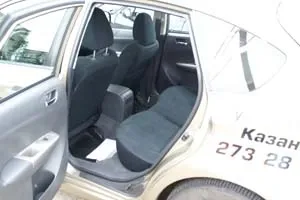
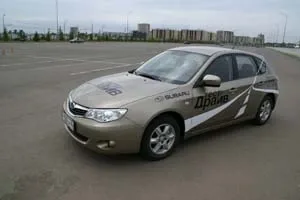
We picked up the test Subaru from the official dealer. While we were processing the documents, we noticed an Impreza in the showroom in the classic bright blue color for the brand's stars. This shade reminds of the victories of Carlos Sainz, Colin McRae, and Petter Solberg, who at different times drove blue cars. We were not going to consider ourselves among the ranks of racers, and we were given a beige car, so we look at things through the eyes of an ordinary buyer. The first thing that catches the eye after the body change is the shape of the front optics: instead of round headlights, they are now elongated. The rear lights have also changed — they are dotted with LED points. It looks modern and nice. For safety, door frames appeared on the doors — also a new feature of Subaru. Inside it has become more spacious: the wheelbase has grown by 95 mm, so five passengers of average build will fit without problems. The interior pulls a solid "four." Round instruments with "chrome" rims look cute and are well readable, but the engine temperature gauge is missing. But the climate control "knobs" surpass the button solutions of competitors in convenience and clarity. The front panel is made of hard plastic, like the rest of the trim, but it is decorated with a nice silver insert resembling spread seagull wings.
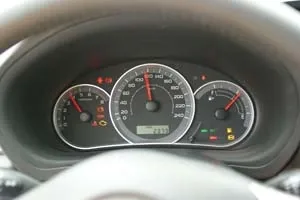
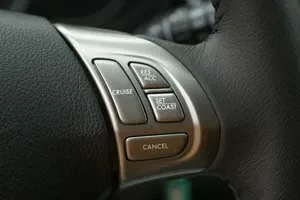
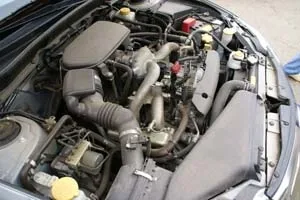
The same inserts are on the tunnel near the gear lever, on the door handles, and on the three-spoke steering wheel. True, there are no radio control buttons on the steering wheel, but cruise control is placed there — convenient on the highway. It seems to me that for a car with a manual transmission, it would be more logical to put audio system controls on the steering wheel — it's more practical. However, the standard music did not impress us: during the entire test it was never needed, we just turned it off. Perhaps the manufacturer himself understands the sound quality and believes that the main accompaniment for the driver is the voice of the engine. Under the hood we have a 1.5-liter BOXER flat engine with 107 hp with DOHC system and active valve control (AVCS). Paired with it is a 5-speed manual with a reduction row, which is engaged by a lever to the right of the driver, and at any speed! The proprietary symmetrical all-wheel drive (Symmetrical AWD) works through a center differential with a self-locking viscous coupling. In theory, everything is coherent, but the power for an all-wheel-drive car raises doubts — clearly not enough. Looking ahead, I will say: the fears were confirmed. But first about the good. When starting, the speedometer and tachometer needles pass a semicircle and return to their place — such a sporty gesture. At idle, the flat engine is almost inaudible, but at high revs a rumble appears that caresses the ear.
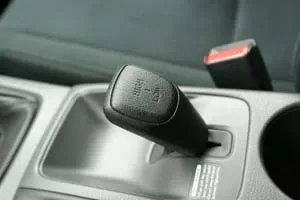
The heritage of rally cars is felt! But the gearbox, in our common opinion, is not distinguished by clarity: either Alfred could not engage reverse, or I did not get third gear the first time, and Vadim had similar difficulties. Maybe it will break in over time? I don't argue. The smoothness of the ride pleasantly surprised — for a sporty-tuned chassis this is unexpected. At the rear there are double wishbones for better handling. The Impreza adequately digested our broken roads and gave no reason for irritation. The sound insulation also pleased: even the huge mirrors, which we love for excellent visibility, did not make a sound on the highway at the permitted speed. But there was a fly in the ointment — the engine and its behavior on the highway. In the city with calm driving, the Subaru is an ideal car: you smoothly press the gas, without revving to the limiter — and the car confidently picks up speed. But overtaking on the highway or merging into a fast flow is sheer torment: the engine clearly does not like being "spurred," it starts to "go sour." It seems that European ecology has strangled an already not-too-powerful engine so that only charged versions can save the situation. At the same time, the Impreza handles very, very well, obediently following any commands. The high-speed slalom showed excellent stability — the chassis is superb.
Overall, the car left a mixed impression. There are more positive emotions: modern, comfortable, excellent handling, and I think it will feel confident both in snowy slush and on an autumn dirt road. There are two drawbacks: the so-so audio system and, more importantly, the weak engine. An engine of at least two liters and 150 horsepower is needed here — then there would be an ideal balance between engine and chassis.
But this is my personal opinion. For the city and undemanding buyers, the Impreza with a 1.5-liter engine is an excellent purchase. Where else can you touch the world of motorsport for reasonable money? And the music can be changed.

Vadim Sadykov, "Avtoclub-Kazan"
From the outside, this car seems to be woven from continuous inconsistencies. The budget segment of the C-class usually dictates its own rules of the game, forcing you to put up with cheap trim. However, everything is different here: the doors close with a pleasant, weighty sound, the plastic on the panels is perhaps even better than in the Toyota Camry, and you simply don't expect such a level of sound insulation. The second portion of contradictions: the Impreza brand, all-wheel drive, a truly sporty and angry engine voice, impressive passport data — and at the same time rather sluggish acceleration. However, one could have been offended by the slowness in advance, even before the trip, looking at the numbers: the car takes a long 14 seconds to reach 100 km/h, and the top speed is 175 km/h. Add to this a curb weight of 1310 kg and an all-wheel-drive transmission — the picture becomes clear. In real life, it looks like this. We leave the second intersection with a right turn, press the gas — the engine menacingly hums in bass, but the rear seems glued to the asphalt. Another scenario: in third gear at 60 km/h, we crawl up a hill with a barely noticeable slope. The instrument needles, it seems, do not move at all. Well, and my signature test — overtaking a truck on the highway: fourth gear (better to keep quiet about fifth) makes going into the oncoming lane deadly dangerous. But when there are two lanes in one direction, the Impreza turns into an ideal companion for a long journey. The suspension is elastic, but not at all stiff, the wind does not howl, there is plenty of space in the back — you can even recline half-lying, settling in comfortably. And you know, with this slow acceleration, not everything is clear-cut. Yes, you won't get a sharp jerk here. But the car instantly and easily responds to the slightest movement of the gas pedal, and holds the selected speed without the slightest hint of strain. Knowing these nuances, in city traffic the Impreza behaves quite decently.
The suspension deserves a separate mention. Tastes vary, of course, but personally, it's tuned so perfectly that I couldn't ask for better. On a washboard road, there's no annoying shaking like in stiff cars; on potholes, there's no bottoming out — a common ailment of either too-soft or short-travel suspensions — and body roll in corners is barely noticeable. After tackling the slalom, I was convinced: in normal everyday driving, the car is predictable and responds to the steering without question. And the all-wheel drive (the very thing partly responsible for the sluggish acceleration) will be your best friend in rain, ice, and slush. The only downside is that this setup's appetite is noticeably higher than that of the two-wheel-drive versions.
Did I like this car? Absolutely, it has a whole host of pluses. The main drawback is the dynamics, but, you'll agree, for many this parameter is far from a priority.

Alfred Mardanov, "Avtoclub-Kazan"
Since I had already driven the same Impreza but with an automatic, getting to know this Subaru went without surprises. Inside, everything was familiar, the controls were in their places, except I didn't find the low-range lever that was in the automatic version. Looking ahead, I'll say: we never found a suitable place to test that low-range. The weather had been dry for several days before the test, and finding any mud or slush was impossible. However, we had a training area with slalom and lane-change exercises. After getting the keys, contrary to our usual practice, we headed not to the test site but straight into the city. The urban hustle immediately revealed a pleasant feature: when you press the gas, the engine growls deeply like a race car. These ear-pleasing notes penetrate the cabin through excellent sound insulation — not typical for this class. And the doors close with such a juicy thud, as if this were a D-segment car, not a C-segment one.
In short, this above-class sound insulation wins you over from the first minutes. Later, on a dirt road, during a smoke break, Marat was shouting something at me, and I, sitting in the car a couple of meters away, heard nothing — like in a silent movie, I understood only through gestures. I remember how this car handled winter slush, and I'll be honest: its off-road capability is limited only by ground clearance. It's a Subaru, after all! It's a pity we never found a place to romp the Impreza in the mud and once again confirm the capabilities of the all-wheel drive. Another surprise came from the suspension, or rather its behavior. It's not stiff at all, yet it holds the car on course perfectly. The supple and energy-intensive suspension work pleased all test participants. The weighted steering, precise and informative brakes are taken for granted — they're that natural. The large, burdock-like mirrors leave almost no blind spots and, surprisingly, don't "hum" at speeds around 170 km/h. The secret, apparently, lies in the shape of the mirrors on the leeward side: like a ship's bow, they cut through the air and distribute flows properly, completely sparing passengers from wind whistle. After driving on dirt just for the record, I'll give owners advice: be careful with uneven surfaces. I didn't even feel scraping the underbody — thanks to that same sound insulation. The scraping sounds came only from outside, which surprised me greatly: I was sure I was driving on clean ground.
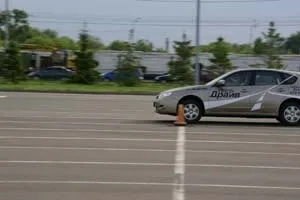
Time to hit the test site — I can't wait to check the handling and drift resistance. The comfortable suspension setup showed a slight tendency to body roll, but that didn't hinder keeping the car under control in the slalom. With proper throttle work, the car navigates all corners, limited only by the length of the straight and common sense. Moreover, I couldn't provoke a slide right away — I had to try hard, and when I finally did, I easily caught the car. Thanks to the permanent all-wheel drive, the handling is commendable, reactions to the steering are predictable, and the whole car is very predictable and friendly. That's understandable: Japanese cars, originally designed as all-wheel drive, are created not for off-roading but for safe driving. Hokkaido Island with its mountainous terrain and capricious climate (rain by day, frost by evening) pushed the Japanese to build cars on all-wheel-drive platforms, and, you'll agree, this idea fits our conditions perfectly.