
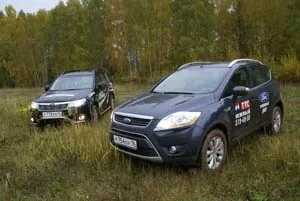
Subaru Forester and Ford Kuga
CLASSMATES
Subaru Forester
Engine - 2.0 L
Max power -
150 hp/6000 rpm
Max torque - 196 Nm/3200 rpm
Max speed (km/h) - 184
Acceleration 0-100 km/h - 11.9
Fuel consumption (L/100 km):
city - 11.2
highway - 6.9
combined - 8.4
Symmetrical all-wheel drive
4-speed automatic
Length - 4560 mm
Width - 1780 mm
Height - 1700 mm
Curb weight - 1500 kg
Tires 215/65R16
Ground clearance - 215 mm
Price $34,338 (274,698 UAH), base trim price $31,172 (249,373 UAH)
Maintenance cost:
Service interval:
15,000 km
Service 1 1500 km - $119 (946 UAH)
Service 2 15,000 km - $220 (1,756 UAH)
Service 3 30,000 km - $406 (3,240 UAH)
Service 4 45,000 km - $220 (1,756 UAH)
Service 5 60,000 km - $507 (4,051 UAH)
Standard hour - $34 (270 UAH)
Warranty 3 years or 100,000 km
Ford Kuga
Engine - 2.0 L TDCi
Max power -
136 hp
Max torque - 320 Nm
Max speed (km/h) - 184
Fuel consumption (L/100 km):
city - 8.1
highway - 5.4
combined - 6.4
Front-wheel drive, rear-wheel drive plug-in
6-speed manual
Length - 4443 mm
Width - 1842 mm
Height - 1710 mm
Gross weight - 2130 kg
Tires 235/55R17
Ground clearance - 195 mm
Price $34,615 (276,912 UAH), base trim price $29,734 (237,871 UAH)
Maintenance cost:
Service interval:
20,000 km
Service $531 (4,245 UAH)
Service $869 (6,945 UAH)
Service $1,206 (9,645 UAH)
Service $1,544 (12,345 UAH)
Service $1,881 (15,045 UAH)
Standard hour - $38 (297 UAH)
Warranty 2 years or 100,000 km
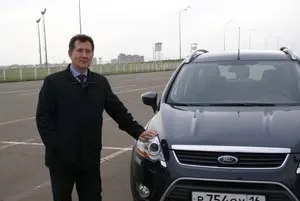
Marat Makhmutov, Deputy Director of the Kazan School of Higher Driving Skills
In the world of crossovers, two fresh models have appeared: the updated Subaru — the "forester" (as its name translates) and a completely new development by Ford engineers — the Kuga. I got acquainted with the latter earlier, seeing it in the lobby of the Mega shopping center, not far from our test site. But I got a real look at the new Japanese car only here — fleeting encounters in city traffic didn't give me a chance to form an impression. A paired comparison of two cars with similar philosophy is always primarily a comparison, and only then an individual assessment. Although appearance, build quality, and equipment are not indifferent to me, so I'll start, as usual, "by the clothes."
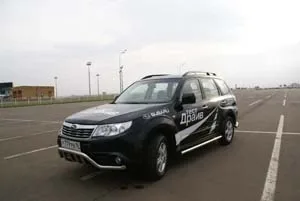
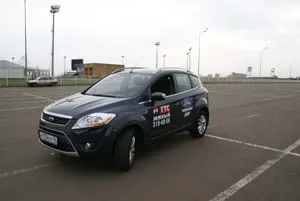
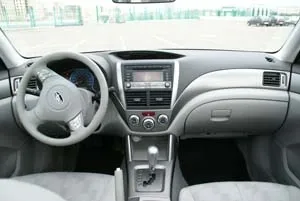
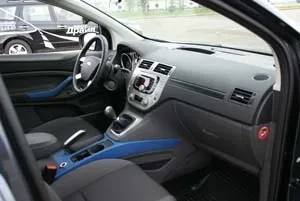
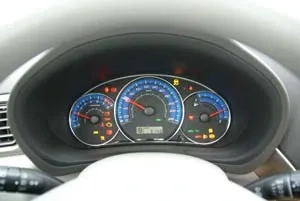
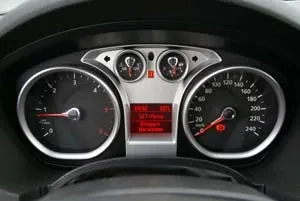
The fresh Forester has noticeably improved in looks compared to its predecessor. The previous model, though it had a distinctive appearance, looked somewhat unfinished: either a station wagon raised too high, or a jeep lowered too low. The new look of the Subaru has become more proportional, modern, and solid — now the car definitely won't let you down. It's immediately noticeable that the doors have window frames — unlike the frameless old version. Apparently, they decided to increase passive safety this way. Against this background, the Kuga looks like a dapper, sportily toned young man. Apparently, Ford marketers were targeting an audience under 35, though that's just my assumption. The build quality of both cars is top-notch — here there's full parity between Japanese and European production (the Kuga is assembled in Europe). But I liked the trim materials more in the Ford: they are softer both in appearance and touch. The Kuga's interior overall looks richer, especially in the top version, which has electric driver's seat adjustment. In the Subaru, when the ignition is turned on, the instrument needles make a smooth circle around the scale and return to their place. A beautiful sight! In the Ford, the main gauges — speedometer and tachometer — are large and easy to read, but the temperature and fuel indicators with their chrome rims, though they look impressive, are too small and hard to read on the go.
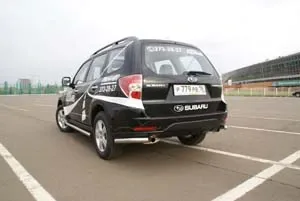
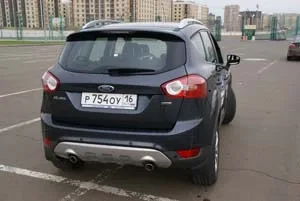
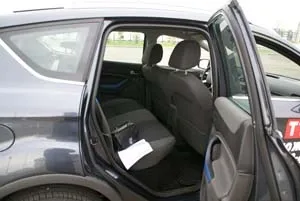
Speaking of rear seats, for a long trip with four or five people (on both cars it's better to go with four), the Japanese car is more comfortable. In the European with an American name, the rear row is installed almost vertically, and even adjusting the backrest tilt doesn't save it. Moreover, the headrests are designed so that you have to tilt your head forward. Sitting in the back of the Kuga was frankly uncomfortable for me! The trunks of both crossovers are spacious, but they can't be called volume record holders. When the task arose to transport a dozen and a half cones for the "slalom," the choice was obvious: only the Ford. Its trunk is finished with practical dark material, while the Subaru has both the interior and cargo area light-colored, meaning easily soiled.
Now I'll move directly to the driving qualities of each participant. The rivals are close in class but different in powertrains and transmissions. The Forester has a proprietary boxer naturally aspirated engine of 2 liters, an automatic gearbox, and permanent all-wheel drive. The Kuga responded with a diesel of the same volume, but with a six-speed manual and plug-in all-wheel drive (in normal conditions, the car is front-wheel drive). I'll say right away: the diesel is simply excellent! It revs almost like a gasoline engine, providing excellent dynamics and a good reserve of torque in almost any hands. Fifth gear is working for steady city driving. The Subaru's gasoline engine doesn't reach for the stars, but it can't be called weak either. During the slalom, I expected worse than it turned out. During acceleration, there's a slight delay in upshifts — but it's an automatic! Yes, engine noise is audible, but not critical. But the "forester" briskly and confidently gains speed, unlike some cars with engines of the same volume that we've tested. By the way, the most noise came from the slightly open huge sunroof — its howl during acceleration I didn't even associate with the sunroof until I paid attention. The speed of passing the control slalom turned out to be low — for both cars no more than 55 km/h. But how they did it! When Alfred on the Forester in the first run put the car on three wheels, I decided he made a mistake with the steering. Getting behind the wheel myself, I understood: it's not the driver, but the car — soft suspension, too light and vague steering. The Kuga against this background showed itself much better: elastic suspension and precise steering allowed passing the slalom more calmly and confidently, although at high speed there were also knocked-down cones. In this exercise, my preference is clearly on the Ford's side.
The second part of the tests took place on city streets and a suburban highway, from where we headed to the mud polygon — it became the final chord of the day. The universally disliked "washboard" on the way to Samosyrovo demonstrated that the Kuga quite tolerably digests bumps like a washboard, though it reacts a bit stiffly to small transverse waves. The Forester, on the other hand, is a complete contradiction: at low speed it's soft and comfortable, with only the tires barely audibly pattering. But as soon as you add gas, some incomprehensible and unpleasant stiffness appears, and vibrations start to wander on the steering wheel. On the suburban highway, the Japanese car at 150 km/h with cruise control on is stable and predictable, confidently holding the wet road. And, by the way, it noticeably less splashes dirt on cars following behind, while the American-European leaves a trail that is only slightly more modest than a KamAZ. However, this is the only minus of the Ford noticed on the highway: otherwise it behaved impeccably, not lagging a meter, and sixth gear on the highway was clearly not superfluous.
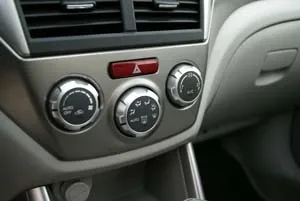
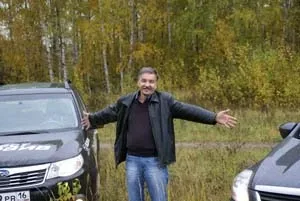
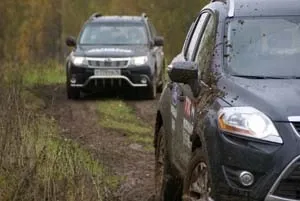
The final stage took place on an already familiar section with light off-road conditions. Again wet weather, again clothes not at all suited for such adventures — no jeans, no rubber boots. Realizing that we had crossovers on road tires, we didn't set up a serious mud test but limited ourselves to climbing a hill along a winding slippery road. The Kuga went first, playing the role of pioneer on untouched mud. Acceleration at the bottom, second gear, we climb to the middle of the slope — revs drop, I shift to first, but it's too late: a stop. The Forester pulled up behind, calmly stopped and patiently waited for the road to clear. With creaking brakes, the Ford, on the second attempt, slowly in first gear, reached the top. And the Subaru? It imperturbably, as if confirming its famous rally genes, simply moved off and just as calmly climbed up behind. It must be said that the ESP on the Kuga is turned off through the onboard computer menu, while the Forester has a separate button to the left of the steering wheel, which is certainly more convenient. For moderate off-roading, the combination of permanent all-wheel drive and an automatic transmission, in my opinion, is optimal — it allows precise dosing of traction, and therefore in mud the Forester gets a slight but advantage. The only drawback of the Japanese test car is the dealer-installed side steps, which were impossible not to get dirty on when exiting. So this option is useless and even harmful. Further driving along the same road was no longer difficult for either car: the top layer of mud was pressed down to hard ground, over which an ordinary single-axle drive car with increased ground clearance would have passed.

Summing up this comparative test, we can say that in our unofficial competition, based on the totality of consumer qualities, the Ford Kuga wins by a small margin. It offers an optimal balance between design, driving characteristics, build quality, off-road capability, and fuel efficiency. Perhaps, for the complete happiness of the average city dweller, it only lacks an automatic transmission. The Subaru Forester is more suitable for an established family man who doesn't chase fashionable design trends and doesn't indulge in driver ambitions — there are completely different cars for that. And its task — to reliably deliver the owner with family and luggage from a country house, not to mention daily city routine — it will perform in any weather.
Vadim Sadykov, "Autoclub-Kazan"
The world is ruled by stereotypes: just say Subaru, and most immediately imagine a civilian version of a racing car. Oddly enough, those who haven't tried the new model yet but knew the previous generation well, like the Forester, are more conservative. However, the three of us have already been taught by bitter experience: new versions of all cars radically differ from old ones. A trend!
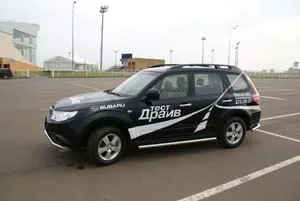

This time we took two crossovers and compared them on a variety of roads. Who won? You decide.
"Washboard road." If you drive very slowly (40 km/h), the Forester is more comfortable — it handles bumps softer. But as speed increases, unpleasant impacts appear in the suspension, and the car starts to rock with increasing amplitude. The Kuga behaves much more honestly. The suspension here is stiffer, each longitudinal crack in the asphalt is punctually counted. As speed grows, it becomes clear that the suspension is more energy-intensive than stiff — comfort hardly deteriorates.
"Slalom." This time we placed the cones quite close to each other, so the passing speed was low. The Kuga in second gear at 50 km/h completes the exercise playfully — thanks to the stiff suspension and elastic steering. True, when Marat tried third gear, the cones flew to the sides. With the Forester everything was simpler and clearer: soft suspension, vague steering, large body rolls.
"Pothole after pothole." I didn't drive on such a road myself — on purpose. But I was able to assess the sensations of a rear passenger, hopefully objectively: the same driver (Marat), the same passenger in the back seat, the same road in different cars. The speed, of course, was low. Therefore, the stiffness of the Kuga is almost not felt here. But in the Forester, I got motion sickness — classic "sea rolling." Good thing my vestibular system is fine: I used to ride buses without holding onto handrails. Otherwise, I'd have to urgently move to the front seat.
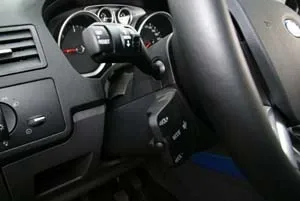
"Wet dirt road." There's a subtlety here. Both cars are equipped with ESP. Accordingly, when entering snow, mud, or sand, you need to disable the traction control system. In the Forester, the disable button is in a prominent place, but in the Kuga, for some reason, it's not there. Probably that's why the Forester climbed the hill on a wet clay road much more cheerfully than the Kuga. Good thing Alfred likes to dig into the electronic menu, and he quickly found how to disable traction control. An amazing solution! Knowing our drivers who don't read manuals, I'm sure in advance: 99% of Kuga owners won't even know about such a possibility. Not to mention that manipulating the menu takes much more time than simply pressing a button. In my unprofessional opinion (I'm a lousy off-roader), the Forester is preferable on such a road. I didn't even notice a big difference in behavior with traction control on and off. And don't forget: the Forester has permanent all-wheel drive.
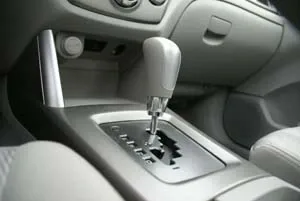
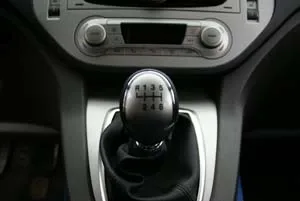
"Highway." The Kuga is in its element here. It holds the road superbly, accelerates easily — even uphill on a small incline in sixth gear. Marat ahead in the Forester slowed down before a turn, and I in the Kuga easily overtook him in the left lane. The steering is quite heavy and very informative. Suffice it to say that I took the entire turn without changing the steering wheel position. On the way back, I took the same turn in the Forester. Hmm, I didn't slow down enough; for safety, I should have slowed more. The steering is vague, uninformative. Acceleration also doesn't impress — the gearbox hesitates. This is where the advantage of the Kuga's 6MT over the Forester's 4AT is clearly visible.
"City." With an automatic transmission in the city is more comfortable — that's indisputable. One can argue only about the type of "automatic": torque converter, robot, or CVT. Alas, manufacturers usually install only one type of transmission on a specific model. Subaru's decision to use a 4AT sends us straight back to the last century. And given the rapid development of technology, it's more like the century before last. There's no point in elaborating on the drawbacks of this approach: those interested in details can always read the article "Gear Ratios of Transmissions" on the "Autoclub-Kazan" website. The Kuga has a different problem: besides the 6MT, there's nothing yet. It seems that next year an automatic paired with a diesel will appear, as well as a gasoline engine. For now, I've noticed only one drawback: first gear is too short.
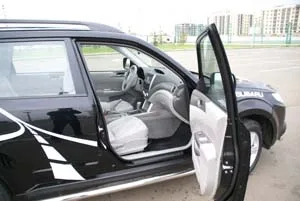
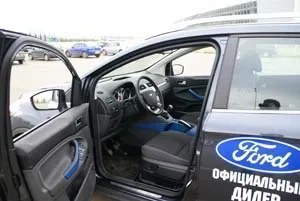
Now a few words about the drawbacks of the interiors. In the Kuga, the trim materials are indeed top-notch, possibly even surpassing the new Mondeo. However, sitting in the back row is uncomfortable: the seatback is too upright, and there's frankly little knee room. Also, the fabric insert near the window on the door surprised me — it's a dirty thing, already covered in dust. The Forester's interior is noticeably more comfortable and spacious, but the quality of materials and design are simpler than in the Kuga.

Alfred Mardanov, "Autoclub-Kazan"
On one hand, these two crossovers came to us by chance, but on the other hand, quite naturally. We proceeded from the principle of a "hot pie": both cars were the most anticipated premieres and hit the market almost simultaneously, and they compete in the same segment. Of course, comparing them directly is not entirely correct, but still, let's try at least in general terms. The difference in dimensions immediately catches the eye: the Forester is noticeably longer. Rear passengers will surely appreciate this — in the Subaru, they'll have much more freedom. But the too-upright seating in the Kuga clearly doesn't contribute to comfort: sitting there is cramped and uncomfortable, and getting into the back row through a narrow opening is a real pleasure. In the Forester, everything is different: the wide door opens almost 90 degrees, leaving a huge passage. When I first saw the Kuga, it seemed to me that a Ford Focus had somehow been stretched onto a Toyota RAV4. The proportions clearly echo the "Rafik," although the cars look very different externally, but there's definitely something in common, especially in the rear. The Ford looks brisk and sportily playful.
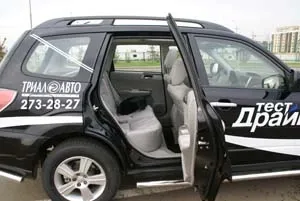
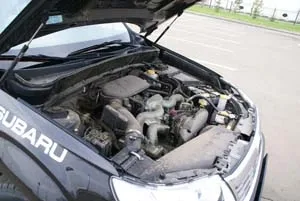
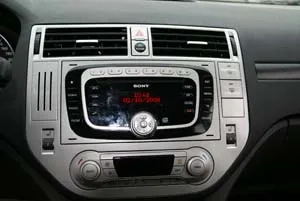
It is noticeably taller than the Subaru, but, as I already said, shorter. Next to the handsome Ford, the Subaru looks somewhat gloomy, and the same applies to the interior. Subaru's conservatism brings boredom compared to the cheerful atmosphere inside the Ford. There, the materials look richer and feel nicer to the touch. But the abundance of analog gauges on the dashboard with chrome trim looks somewhat childish and too small. Moreover, the clever menu hides the ESP deactivation function. Hmm, they hid it so that the driver would think twice about whether it is worth leaving the asphalt at all?! With the Subaru, everything is logical in this regard: the button is in plain sight — press it as much as you want. There were two cars, so Vadym and I agreed to pick them up separately. I went for the Subaru and rooted for it until the very end of the test. From the first meters, I was surprised by the behavior of the two-liter naturally aspirated engine. The previous Forester was the only crossover with an automatic transmission that had enough two liters for decent dynamics. For other similar cars, such an engine was clearly insufficient, and they asked for at least 2.5 liters. In this sense, Subaru remained true to itself. The thrust that this engine delivered in conjunction with the four-speed automatic is quite sufficient. Most likely, the secret lies in the unique boxer engine and the well-tuned gearbox settings. And the amazing smoothness of the ride and the complete absence of vibrations are due to the fact that the engine lies in the same horizontal plane as the proprietary drive. Hence the low center of gravity and a bunch of other advantages. I thought it was just advertising, but no — it really is so, and an experienced driver will notice it immediately.
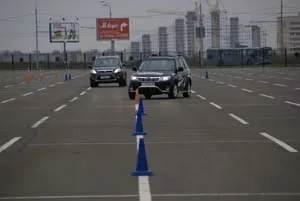
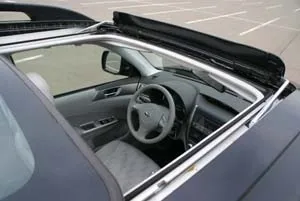
True, the car turned out to be a bit noisy: with the open shade of the huge sunroof, which takes up almost half the roof, aerodynamic noise penetrates the cabin. And its source is the huge rear-view mirrors, real burdocks. Despite the four-speed automatic, the car drives very well. Later on the highway, I tried the sport mode — the dynamics become noticeably better. By the end of the event, the onboard computer showed a fuel consumption of only 12 liters per 100 km. And this is with the all-wheel drive constantly engaged, and we also drove off-road and on the highway to our heart's content. Again, Subaru's unique technologies come to mind. The steering wheel is very light and, like almost all electric ones, somewhat empty. There is a lack of pleasant heaviness, but it remains informative. The long rear end occasionally thuds on some bump — not exactly uncomfortable, but a residue remains. On the slalom, the Subaru yielded a bit: I seemed to have caught the rhythm and understood how to dive into turns, I added gas and lifted the rear wheel off the asphalt. The main thing here is to cope with the relatively soft suspension. Due to the low center of gravity, the rolls are not so scary, but you need to carefully, as if in a boat, turn the steering wheel and work the gas. But the Kuga simply breaks into a slide and knocks down cones sideways. Nevertheless, it completed the slalom 5 km/h faster than the Forester.
I also really liked the diesel. It pulls confidently from the very bottom, as it should, but shifting gears manually was frankly lazy. So the automatic is preferable in this regard. Before making final conclusions, I will note the ease and composure with which the Subaru stormed the muddy rut. It gave no reason to doubt its off-road capability. Here it behaves much more confidently than the Kuga. The Forester destroyed my stereotype that real off-roading requires a manual transmission — nothing of the sort. The automatic even distributes torque better, and you just work the gas pedal and steering wheel, without fear of over-revving and digging in. At first, I forcibly engaged second gear, and then I just drove in "D" mode — I felt no difference. The Forester felt equally confident on our test site. So, the Forester is a family car, a thing in itself, which does not chase fashion and stands apart. It is ready to leave the asphalt without hesitation, knowing that it will return without outside help. It is more spacious, more comfortable, and softer. The Kuga is designed for the city dweller: hence the stiffer settings, dense build, hidden ESP off button, and a clear claim to fashionability in design.