Subaru Forester
Engine:
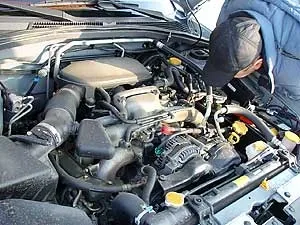
type: horizontally opposed 4-cylinder, 16-valve, petrol,
displacement: 1,994 L
power: 158 hp
max torque: 186 Nm/3200 rpm
fuel consumption:
city: 12.3 L/100 km
highway: 7.5 L/100 km
combined: 9.3 L/100 km
dimensions:
length: 4485 mm
width: 1735 mm
height: 1590 mm
ground clearance: 205 mm
curb weight: 1405 kg
tires: 215/60 R16
 Alfred, driving experience 10 years.
 Personal car: Toyota Corolla.
Just say “Subaru” — and an image of speed and full control over the road immediately comes to mind. It’s for these sensations that I love this brand. No matter which model falls into my hands, the dynamics and all-wheel drive are always at their best.
Now, when it’s 23°C below zero outside and everything is covered with snow, the Forester is the most relevant topic. Last year I already dealt with the predecessor of this model, and the impressions remained vivid. I especially remember how, literally from the first seconds behind the wheel, a feeling of unity with the car arises. Light, fast, obedient — that’s just a small part of what can be said about the “forester.”
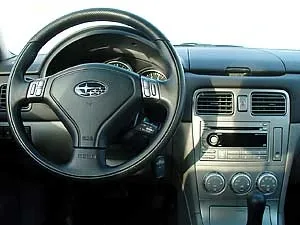
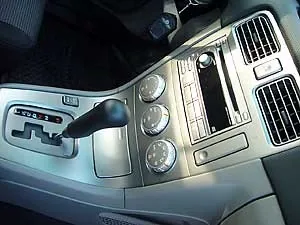
The new Forester has noticeably transformed: it has become more modern and lower. The interior now resembles not a modest shack, but a cozy hunting lodge with solid finishing. The materials are pleasant, the console shines with “metal,” and carbon-look inserts decorate the dashboard and door cards. The emblem on the steering wheel (by the way, the wheel is from MOMO) is mesmerizing: you look at it, and it seems as if you’re diving into the sea depths, where star-like glints dance on the surface. The instruments are perfectly readable — large numbers and bright red needles are visible at a glance. The climate control unit is interestingly arranged: three round knobs, but two of them work on a sequential principle — turn the ring slightly, and the first fan speed engages, a bit more — the second. You don’t often see that, but it’s very convenient.
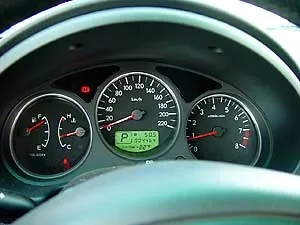
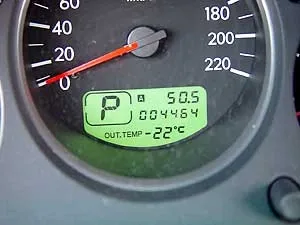
The “automatic” selector now moves along a zigzag slot; previously it was straight. It takes a couple of attempts to get used to the new algorithm, and then everything becomes clear. There’s no manual mode here, and I consider that a plus: most drivers will play with the “tiptronic” in the first weeks, then forget about it and drive as if on a regular automatic.
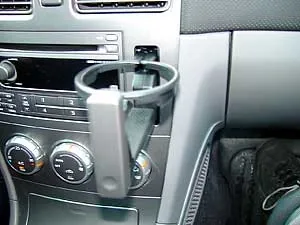
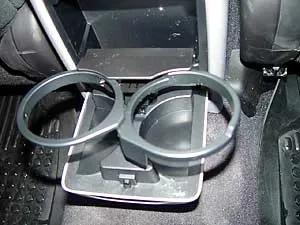
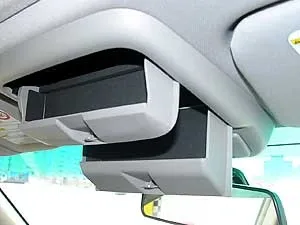
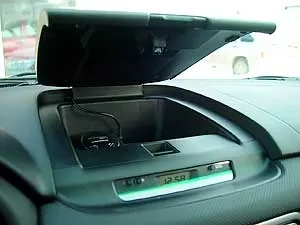
There aren’t many pockets and compartments, but they exist. The glovebox, unlike many Japanese cars, is spacious, while the other little boxes are only suitable for small items. But I was pleased with two glasses holders on the ceiling — both with a micro-lift, so glasses wearers will be comfortable here.
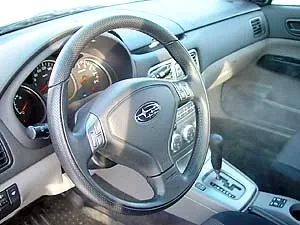
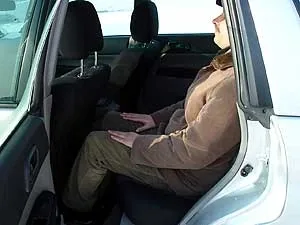
The interior turned out not as spacious as expected: from the outside, the car seems larger than inside. Rear passengers are a bit cramped — if a tall person of 185 cm sits behind the driver, their knees will press against the front seats. But the trunk is good, even with a reserve. Personally, I don’t need that much — I don’t carry bags of potatoes; space for a sports bag and a subwoofer would be enough. I’d rather have reduced the trunk in favor of the rear seats. But, after all, this car is made for driving pleasure, and you feel it literally with your fingertips when you touch the steering wheel and pedals.
From a standstill, the Forester takes off briskly — the permanent all-wheel drive makes itself known, so you need to be careful with the gas pedal. And here you involuntarily think: what goes on in the version with a 2.5-liter turbo engine?
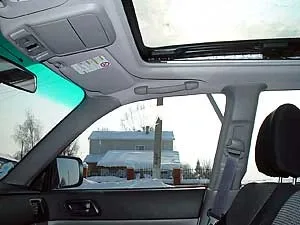
The all-wheel drive concept, honed in rally battles, works flawlessly here. The driver never loses connection with the car: the steering wheel has excellent reactive effort, the brakes please — even despite the drums at the rear, and the ride smoothness is superb. On a broken road, you can go at high speed; the suspension confidently holds the body on both large bumps and waves. The only thing that causes slight bewilderment is the reaction to small hard joints like tram tracks: here the Forester responds a bit more nervously than I’d like.
Sound insulation is fine. The engine is audible, but the sound isn’t annoying, and during active driving it even adds excitement. However, at speeds above 120 km/h, the angular body begins to whistle noticeably due to not the best aerodynamics. Though, there’s a certain charm in that too. As for off-road capability, we didn’t harbor illusions, but the Forester clearly goes beyond the usual raised station wagon. It gives a feeling of confidence and permissiveness — you just want to bury it in snow up to the roof and see how it gets out. A colleague tried to confuse it with various tricks — for example, braking on the roadside when one half-shaft is on asphalt and the other on snow, or vice versa, sharply accelerating in such a position. But the Forester remained unperturbed.
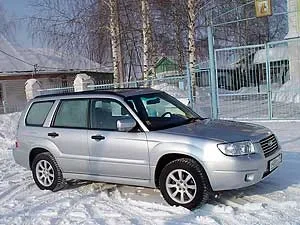
The bottom line is this: the new Forester didn’t disappoint. It’s as easy to get going as a regular passenger car, not a station wagon. Confident on the road, recognizable, prestigious, and it’s a Subaru.
 Vadim, driving experience 9 years.
 Personal car: Toyota Avensis
Subaru is more of a cult brand than a mass product: all models are all-wheel drive, and prices are steep. The Forester stands apart in this lineup, as its price of $32740 (with a manual) is almost no different from the cost of any compact “crossover.”
I admit, I have no experience with SUVs — brief encounters with the CR-V and Grand Vitara don’t count. So it was all the more interesting to test the Forester in winter conditions. First, I headed to a packed snowy village road with a single track. Several times I drove into it and out — and the feeling was as if I were driving on perfectly smooth asphalt! No front-wheel-drive car, even with an independent rear suspension and stabilization, would pass this section so smoothly. The next test — driving the right wheel off the road into soft snow. You might not believe it, but the Forester drives as if nothing happened! No wheel spin, no strain. I’m all for a healthy lifestyle, but such behavior of the car is addictive like a drug: I drove off the road into the snow almost every 200 meters to feel that sense of “permissiveness” again. In one place, I even got out of the car to assess the depth of the rut — impressive. Another test — starting from an icy road. Here, for the first time, I felt that there’s an “automatic” under the hood. If you sharply press the pedal to the floor, you get a slight pause, and only then acceleration. But with a smooth press, the Forester starts very briskly — an excellent quality for pulling out from a secondary road. The behavior on the highway also pleased. We, of course, didn’t race along the dividing line at 200 km/h, flashing high beams at everyone, like some Kazan journalists. After all, most buyers are ordinary people, and they care how the car behaves in standard situations. Here, the outdated 4-speed “automatic” again made itself known: there are delays in acceleration, but only with a sharp press. With a smooth one — everything is fine: sufficient acceleration without pauses. Moreover, the red zone on the tachometer starts at 7400 rpm, so acceleration can be quite lively. In the city, you can see that the latest engine is installed here: revs rarely rise above 2500.
After getting acquainted with the Forester, I decided to look into its technical specifications, and they only strengthened my respect for this car. The two-liter engine produces 158 horsepower at 6400 rpm — an excellent figure, because most modern engines of similar displacement deliver about 150 hp at 6000 rpm. And in terms of torque, Subaru is even ahead: 186 Nm already at 3200 rpm! This promises a brisk response to the gas pedal even at low revs, as well as confident behavior on muddy dirt roads or snowy surfaces. For comparison: the Ford Mondeo has a torque of 185 Nm at 4500 rpm, the Toyota Avensis — 196 Nm at 4000 rpm. Subaru engines have always stood out for their modernity and solidity.
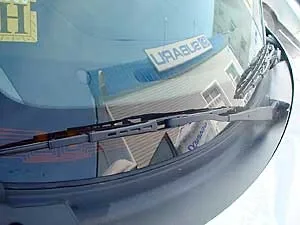
The base Forester trim also pleased: ABS with EBD, climate control, cruise control, CD changer, heated seats, mirrors, and even wipers. True, heating the wipers is not the same as heating the windshield. There's a nuance here: you first need to warm up the non-working wipers, and only then will they not ice over or get covered with snow. And again, a reason for surprise: an SUV, automatic transmission, rich equipment — and all this for $34,240!
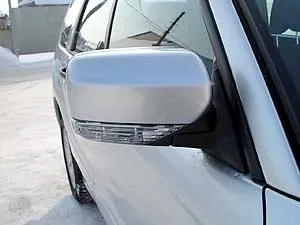
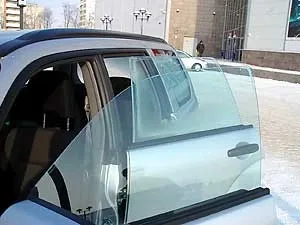
But there was a fly in the ointment. The first thing that puzzled me was the rear drum brakes. Nowadays, almost all cars (except, of course, VAZ) with engines from 1.6 16V are equipped with rear disc mechanisms, and with two-liter engines — even ventilated ones. To be fair, the Forester's brakes work quite decently. The second point is the seating in the back row. Even with the front seatback set vertically, it's not very comfortable to sit in the back: either two adults or three children, and even then, it's tight. And another nuance. The car's external width is 1735 mm, typical for golf-class cars, but inside the Forester turns out to be more cramped than those same hatchbacks. My acquaintance Oleg once dreamed of this car. He approached the choice with all seriousness: he studied the internet, including forums. The conclusions he drew: the car handles remarkably well, forgives almost any mistake; after the Forester, other cars seem worse, so owners buy another Subaru next. But Oleg eventually refused to buy it: at his height of 180 cm and a stout build, he was frankly cramped. However, for a person of average build and height, this drawback fades away.
There are drawbacks, of course, as with any car. But the main conclusion: I truly took a liking to the Forester. I realized this especially acutely when, after the test, I returned to my front-wheel-drive car.
 Ilya Lysenkov. Head of the car audio studio «Bluzmobil».
Driving experience — 20 years. Personal car — Honda CR-V.
I would break down my impressions of the Forester into positive and negative as follows.
Advantages:
1) Excellent acceleration dynamics
2) Reliable road grip on any surface
3) Confident behavior in corners (within reasonable limits, the car does not go into a skid, no matter how hard we tried)
4) Low noise level at high speeds
5) Instant response to the gas pedal
6) Smooth and predictable force on the brake pedal
7) Huge rearview mirrors (all three)
8) Solid interior finish
9) Spacious trunk
10) Despite the station wagon body, the car does not feel like a long vehicle
Disadvantages:
1) Somewhat cramped interior
2) Thoughtful automatic transmission (though, like most) — does not allow sharp maneuvering in city traffic
3) Too «family» appearance
4) Unpleasant engine sound at 5000–7000 rpm — reminiscent of an electric motor whine
Overall result: this is an ideal car for our climate, for those who need reliable, passable, and trouble-free transport in any conditions.
Oh, if only the appearance were livelier! Then I would definitely fall in love.