
SsangYong Rexton II. Korean flagship
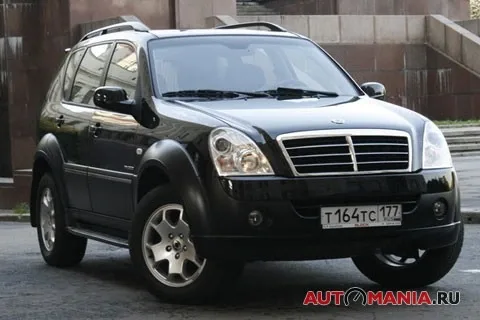
The SsangYong brand has long been established on the Russian market, and recently has further strengthened its position thanks to cooperation with Severstal. This company now not only officially distributes the brand's cars, but also assembles them in our country. Some time ago, the flagship SUV Rexton began production on the assembly line in Naberezhnye Chelny, which quietly and, notably, completely unnoticed by customers, turned into the Rexton II.
We have become accustomed to treating SsangYong's creations as a kind of homage to Mercedes, recalling the words from an old film: "ugly on the outside, kind on the inside." With time-tested technical content, these cars have always stood out for their very distinctive appearance — be it the Musso pickup, the bulky Rodius minivan, the sturdy Kyron mid-size, or the fresh Actyon model. But against their background, the Rexton looks like a true conservative in terms of design. It is, of course, far from classic European canons, but the exterior is much more restrained: familiar off-road proportions, soft body contours, and in places the features of the first-generation Mercedes ML are discernible, albeit carefully disguised by ItalDesign designers.
It is telling that in its second iteration, the car has practically not changed. In essence, the Rexton II can confidently be called not a new generation, but simply an updated version. Almost the only noticeable difference is the typically Mercedes-style radiator grille, which should bring it even closer to its renowned German ancestor and give marketers a reason to formally classify the flagship as premium, at least for advertising purposes.
Inside, the Rexton also remained true to tradition. The changes are minimal: the instrument panel and center console have changed slightly, where a round block framed in metal has appeared, which became the brand's signature after the Kyron's release. Otherwise, it is the same familiar Rexton with a massive front panel in the "American" style, generously decorated with palisander inserts, quality trim materials, and rich equipment. The owner of the top version, in addition to standard ABS and front airbags, will receive a stability control system, side airbags, and a leather interior. A nearly complete set of electric drives will also come in handy: windows, seats, optional sunroof, as well as mirrors that automatically fold when the ignition is turned off. The Koreans also did not stint on a decent double-DIN stereo that can, among other things, play MP3.
The clear overseas orientation in the interior design guarantees passengers a very comfortable stay in advance — both while moving and when parked. There are enough adjustments for the driver's seat and steering wheel to comfortably accommodate a person of almost any build. At the same time, the comfortable leather seats are well profiled and have pronounced lateral support, which is not typical for "Americans." So the seating position — high, as befits an SUV, or relaxed, like in a passenger car — is chosen by the driver according to their taste, and this will hardly affect either driving comfort or visibility. As for passenger capacity, nothing has changed here either, and there are no surprises. The rear sofa easily accommodates three adults, with enough space in the shoulders and above the head. There is also plenty of legroom, and given the adjustable backrest angle, the trip promises to be very pleasant.
True, there are a couple of drawbacks, which, however, with regular use, can probably be gotten used to. Since this is not a crossover but a real SUV, all passengers will have to step over a fairly high threshold when getting in. The standard side step proved inconvenient in practice, so getting into the cabin and out of it usually has to be done without its help. The trunk is also located quite high. But this is compensated by the capacity and useful options: small items can be placed on the tension shelf by opening only the rear window, and the cargo area platform itself is absolutely flat, without a lip, so loading bulky items is not too difficult despite the height. If you fold down the rear seats, you get a quite voluminous compartment — more than one and a half cubic meters.
Now about how the car drives. The top 3.2-liter 220-horsepower V6 engine, together with the five-speed T-tronic automatic transmission, the Rexton inherited from the Mercedes-Benz ML, so the car's dynamics are decent. For example, it accelerates to 100 km/h in about 10 seconds. True, you will have to endure the loud and unpleasant sound of the engine, similar to a strained howl. Moreover, do not forget that this is a body-on-frame SUV with spring solid axles, which means considerable mass and inertia. In practice, this is felt in noticeable nose dives during hard braking (the deceleration is quite adequate) and in longitudinal pitching on a straight road, which can only be dampened by lifting off the throttle. In corners, you also have to slow down due to noticeable body roll. There are also complaints about the steering — there is not enough reactive effort, especially on long, gentle arcs. However, at high speed, the Rexton confidently holds a straight line, and thanks to the energy-intensive suspension, it very smoothly handles even large bumps — you hardly notice them.
Now about off-road capabilities. There are no inter-wheel locks here, so serious off-roading is not for this "Korean." However, on light off-road, it will definitely outperform any modern crossover. Leaving the asphalt is not a problem for the Rexton II: its arsenal includes permanent all-wheel drive, a low-range gear, and long-travel suspensions (which, by the way, interfere on the highway). As for the price, compared to competitors, the Korean model still looks quite democratic. True, the previous price difference, which before the restyling was up to $15,000, has now almost disappeared. The base Rexton can be found for at least 1.025 million rubles, and the most expensive version will cost 1.28 million rubles — this is quite comparable to the price of, for example, the Nissan Pathfinder. But the choice, as always, is yours.
Specifications:
| Dimensions: | SsangYong Rexton II |
| Length (mm) | 4785 |
| Width (mm) | 1870 |
| Height (mm) | 1830 |
| Wheelbase (mm) | 2820 |
| Weight (kg) | 1860 |
| Ground clearance | 195 |
| Engine displacement (cm3) | 3199 |
| Max power (hp) | 220 at 6100 rpm |
| Max torque (Nm) | 318 at 4600 rpm |
| Max speed | 182 |
| Acceleration 0-100 km/h (s) | 9.9 |
| Average fuel consumption (l) | 14.2 |
| Price (rub.) | 1,025,000—1,280,000 |
Magazine "Autogid" January 4, 2008 No. 47
Source – AUTOMANIA.RU