
The Korean brand SsangYong was born as the Asian division of the German Daimler-Benz (at that time Chrysler was not yet part of the concern). The exact share of German capital is not officially disclosed, but it is obvious that it is insignificant, and the main German influence was felt in the technological sphere. Initially, power units—both gasoline and diesel—were imported from Germany, and then began to be assembled under license, along with some other technical solutions. To be fair, it should be noted that the Germans shared far from the latest developments, but rather those that were already nearing the end of their life cycle at home; nevertheless, even such a gift was welcomed in Korea. It was the alliance with Mercedes that always placed SsangYong half a step above other Korean manufacturers.
And the model lineup of the Korean company matched its status—only SUVs and large sedans, no small cars. The only thing that could tarnish the brand's reputation was pickups, but they were always called with the Sport prefix, and they looked anything but workhorses.
When Korea experienced its first economic boom and then the Asian crisis, SsangYong briefly came under the wing of Daewoo. The mass-market brand also wanted to tap into German technology, but ultimately went bankrupt, merged into General Motors, and left the global market. SsangYong, on the other hand, became independent again and did not change its principles—SUVs and large sedans remained at the core. The latter were rarely supplied to Russia, although the latest generation of the flagship Chairman debuted at the Frankfurt Motor Show, and the issue of its supply to us is currently being worked out.
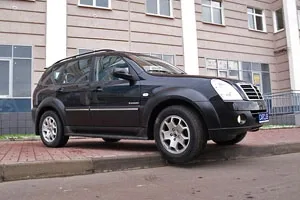
But let's return to the hero of today's material—SsangYong Rexton II. The first generation debuted in 2002 and immediately attracted attention with its unusual appearance. Some noticed the "Mercedes-like" radiator grille, others remembered the rear pillar leaning in the opposite direction. At its core—a ladder frame and a solid rear axle on springs. Drive is either part-time or full-time, depending on the engine and its power. Transmissions—a choice of "manual" or "automatic". In this form, the Rexton survived until 2007, and then underwent a serious facelift: not only the front end was changed, but also the rear suspension—it became independent, which was supposed to add both comfort and off-road capability. For the test, we got the top version with the previous gasoline engine producing 224 horsepower, automatic transmission, leather interior, and fully loaded.
The updated Rexton is recognized primarily by its front end—and, frankly, it started to resemble a... "Chinese car". Not any specific model, since most of them are clones of famous brands, but a certain collective faceless image. The oval "eye" headlights would look cute on a small Daewoo Matiz, but not on a huge SUV for $50,000. Behind the wheel of the Rexton, it's hard to imagine a woman, and men are unlikely to like such headlights either. The previous headlights, with their edges, looked much more interesting and appropriate! Maybe the Rexton isn't chosen for its looks?
The interior changed more successfully. Those familiar with the old Rexton will have something to discover. The center console is now completely different—with stylish chrome and glossy plastic. The steering wheel, covered in buttons, resembles an accordion, and the buttons themselves seem designed for pressing with fur gloves. But the optitronic instrument cluster is simple, clear, and even elegant. In a prominent place on the console—a convenient pocket for a mobile phone. But the rear row of the Rexton turned out to be unexpectedly cramped: there's enough space above, but legroom is tight, and three adults won't be too comfortable here. However, the trunk is simply huge.
You can't expect ideal handling from a large body-on-frame SUV, and the Rexton II doesn't provide it. The SsangYong simply drives—exactly as you'd expect from it. Noticeable body roll, a vague steering wheel—that's normal for such a design, but at least the shaking from bumps isn't transmitted to the wheel, and on the highway the Rexton holds its course confidently and doesn't react to ruts. Speed bumps and other asphalt defects can simply be ignored—they are absorbed by the long-travel, energy-intensive suspension.
The 3.2-liter engine of Mercedes origin works in tandem with a 5-speed "automatic" and fully corresponds to the philosophy of the "three-pointed" star. Gears shift smoothly but are heavily stretched. On the highest gear, acceleration is practically impossible—acceleration appears only a second after pressing the gas, when the gearbox deigns to downshift. Fuel consumption of nearly 20 liters is also not surprising: the previous-generation Mercedes ML320 with the same unit consumed the same amount. I'd also like to improve sound insulation—when the tachometer needle goes past 3,000, the cabin fills with a beastly engine roar. It's certainly justified by confident acceleration, but competitors are probably quieter.
We decided to test off-road capability not in mud, but in an urban landscape—on a staircase. Can the SUV climb the steps? There are two challenges here. The first is ground clearance under the front bumper, and the Rexton is fine with that. We easily drive onto the first step and overcome two more. Almost any crossover can handle such a task, but further climbing will show who we're dealing with—a "jeep" imitation or a real off-roader. The thing is, on the second or third step, most cars experience diagonal wheel hanging. The rear wheel lifts off the ground, which also unloads the front wheel diagonally—and the car stops. A central differential lock is no longer a panacea here; you need a cross-axle lock, which not everyone has. Another way to combat wheel hanging is long suspension travel: then the wheels simply don't lift off the surface, and the vehicle continues moving.
The engineers of the SsangYong Rexton chose the second path, and the huge SUV, like a rubber hippopotamus, spread its wheels across the steps so that all of them maintained traction with the surface—had the staircase been longer, it could have climbed endlessly. 15–20 years ago, almost any four-wheel-drive vehicle could do this. Now, in favor of the fashion for light crossovers, real "off-roaders" have become a rarity, and it's all the more pleasant that one of them recently began to be assembled in Russia—at the facilities of the "Severstal-Auto" plant in Naberezhnye Chelny.
Is the SsangYong Rexton II worth considering for purchase? It all depends on how you plan to use it. If your soul lies in hunting, fishing, or you simply can't imagine life without off-road trips—this Korean, assembled in Russia, will show its best side. You'll get to the desired point in a cozy and attractive cabin, and the trunk with trophies will fit without any problems. But in the hustle and bustle of everyday city life, the Rexton gets bored, like a spaniel left without a walk. It becomes melancholic and keeps trying to jump onto curbs, just to entertain itself somehow. If your lot is the asphalt of a metropolis, then for 1,160,000 rubles (the price of the tested example), it's more logical to look at a more suitable powerful crossover, for example, the Mazda CX-7. But the base versions of the Rexton, starting from 970,000 rubles, look quite justified—for that money, you get a true full-size SUV.
Text: Leonid Pavlov