
Today in the automotive industry, no one is surprised by borrowings — someone honestly borrowed a platform from someone else, someone borrowed a design idea, and someone even borrowed an entire powertrain. But in the case of the SsangYong Rexton II, you won't have to work hard to find similarities: the licensed engine and automatic transmission from Mercedes moved to the second generation of the SUV unchanged. However, the Koreans wouldn't be themselves if they hadn't put their hand to the internals. Under the hood, a turbocharger with variable geometry appeared, which the company proudly calls its own development. It is this innovation that has become the main technical news of the model.
Thanks to the turbocharger, the engine's characteristics have noticeably grown. The 2.7-liter diesel now produces 186 hp instead of the previous 165, and torque has jumped from 340 to 402 Nm. You'll agree, the numbers are impressive. However, the engine sound is not very good: up to 3500 rpm it sounds quite decent, but after that mark it starts to get on your nerves with its annoying tone. Fortunately, the five-speed automatic acts as an ally in this situation — it is at this moment that it smoothly shifts to a higher gear. The manual mode of the automatic transmission, by and large, can be ignored: during active acceleration, the gearbox copes perfectly on its own, providing confident acceleration with almost no dips at the bottom. When overtaking, forced downshifting also doesn't give a noticeable advantage — the automatic perceives such initiative with hostility and immediately returns to a higher gear. And the process of "manual" shifting itself is implemented unusually: a tiny lever is hidden on the left side of the selector, and you need to operate it with the thumb of your right hand, moving it back and forth. However, you can get used to it.
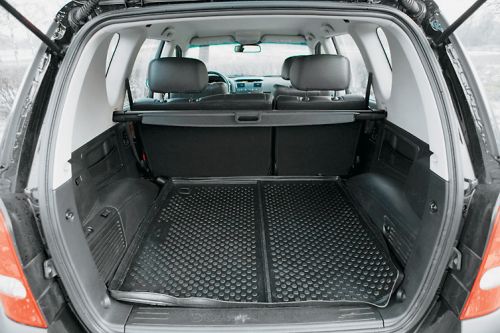
2007 SsangYong Rexton
© Photo: Sergey Krestov, 5 Koleso
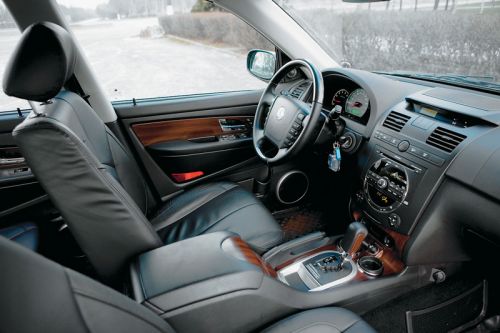
2007 SsangYong Rexton
© Photo: Sergey Krestov, 5 Koleso
You'll also have to get used to the steering wheel, which is so light that you can turn it literally with your little finger. In a supermarket parking lot or in a leisurely city traffic, such effort is an undoubted plus. But as speed increases, the steering wheel doesn't fill with heaviness, and this affects informativeness. So it's better to forget about fast cornering — perhaps in the next version, the steering will become more precise. After all, the Koreans did make serious changes: instead of the solid rear axle of the previous Rexton, the new version has an independent eight-link suspension — however, only in top trim levels. The effect was felt immediately: body roll decreased, and road irregularities stopped bothering passengers so much. But the brake pedal clearly needs refinement: it's hard to calculate the force on it — you press lightly, and there's almost no deceleration, and if you overdo it a bit, passengers are already hanging on their seat belts.
Another important detail of the top test version is permanent all-wheel drive, but without a low-range gear. In normal mode, torque is distributed in a 60/40 ratio, and when slipping, the electronics decide on its own how to redistribute traction. If serious off-roading doesn't interest you, and the maximum the car will face is a snowy road to the dacha, the Rexton 2.7 XVT can be considered an optimal choice.
The change of generations did not come without design changes, although they are not too radical. On the outside, the Rexton II is distinguished by a new radiator grille and a different shape of the headlights, and inside — a front panel of a different configuration. But the most noticeable change happened with the price: the flagship became cheaper by as much as 70,000 rubles. True, the remaining 1,210,000 rubles can hardly be called a trifle — there are plenty of worthy alternatives in this segment.
Such different drive...
The SUV has three all-wheel drive options. Expensive versions get permanent AWD. Cheaper modifications are equipped with the TOD (torque-on-demand) system, which in normal conditions drives on the rear wheels, and connects the front wheels automatically when necessary. In the most affordable trim, Part-Time 4WD is used — here the driver connects the front axle himself.
Driving
This SUV clearly lacks a more informative steering wheel and clear brakes.
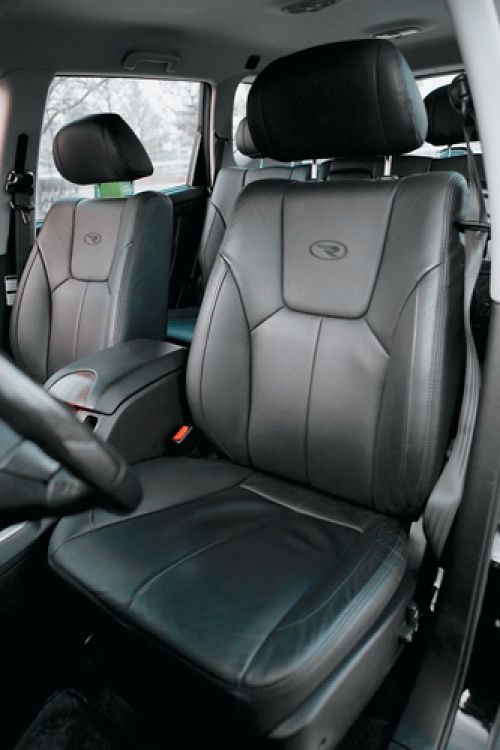
2007 SsangYong Rexton
© Photo: Sergey Krestov, 5 Koleso
Interior
There's simply nothing to nitpick here: plenty of space, comfortable seats, and all controls are clear and logical.
Comfort
Top versions have everything for the convenience of the driver and passengers, and even a bit more. The independent rear suspension noticeably reduced body roll and increased passenger comfort.
Safety
Even in the base version, there are ABS, ESP, and front airbags.
Price
Somewhat overpriced.
Advantages and disadvantages
+ Attractive appearance, torquey engine, comfortable interior.
- Uninformative brakes, too light steering wheel, overpriced.
Specifications
Make and model — SsangYong Rexton II 2.7 XVT A/T
Dimensions — 4720x1870x1830 mm
Engine — diesel, 2696 cm3, 186 hp/4000 rpm
Transmission — automatic, 5-speed
Dynamics — 181 km/h; 13 s to 100 km/h
Competitors — Kia Sorento, Nissan Pathfinder
Our opinion
This car is perhaps the best that the Korean brand currently offers on the Russian market. Unlike its design-controversial siblings, the Rexton II looks quite harmonious. In addition, the SUV has decent driving qualities. But the price still seems overpriced.