
The updated SsangYong Kyron SUV with a 2.3-liter gasoline engine was presented in the Moscow region. We drove the diesel Kyron of the previous generation a year and a half ago (see AR No. 9, 2006). What has changed after the restyling? And how will the car behave with a gasoline engine?
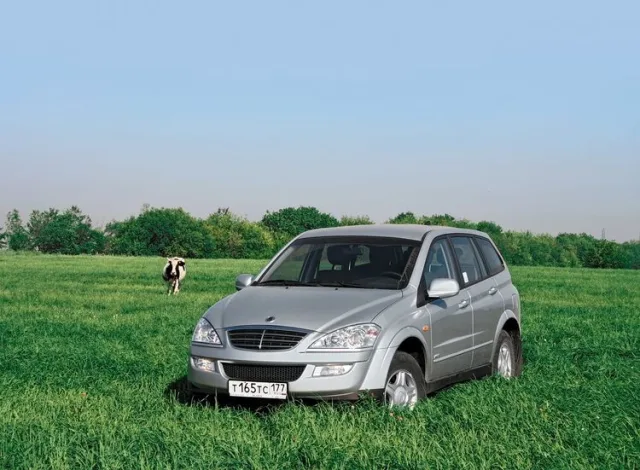
Restyling just a year and a half after the debut? Apparently, the exterior designed by Briton Kenneth Greenley, who has long been responsible for SsangYong's style, turned out to be too provocative. The designer clearly overdid it, trying to give the Kyron the image of an indestructible knight...
Now the "visor" of the front part has been slightly raised: the three elongated slots under the headlights have disappeared, the radiator grille now references the "Mercedes" platform, the air intake in the bumper has become larger, and the round fog lights have been replaced with elongated ones. The rear lights are now ordinary oval optics instead of shields. Added a new spoiler, molding, and more assembled bumper plastic. And now the Kyron no longer looks like an impregnable citadel: it's quite a modern car, albeit still with quirks.
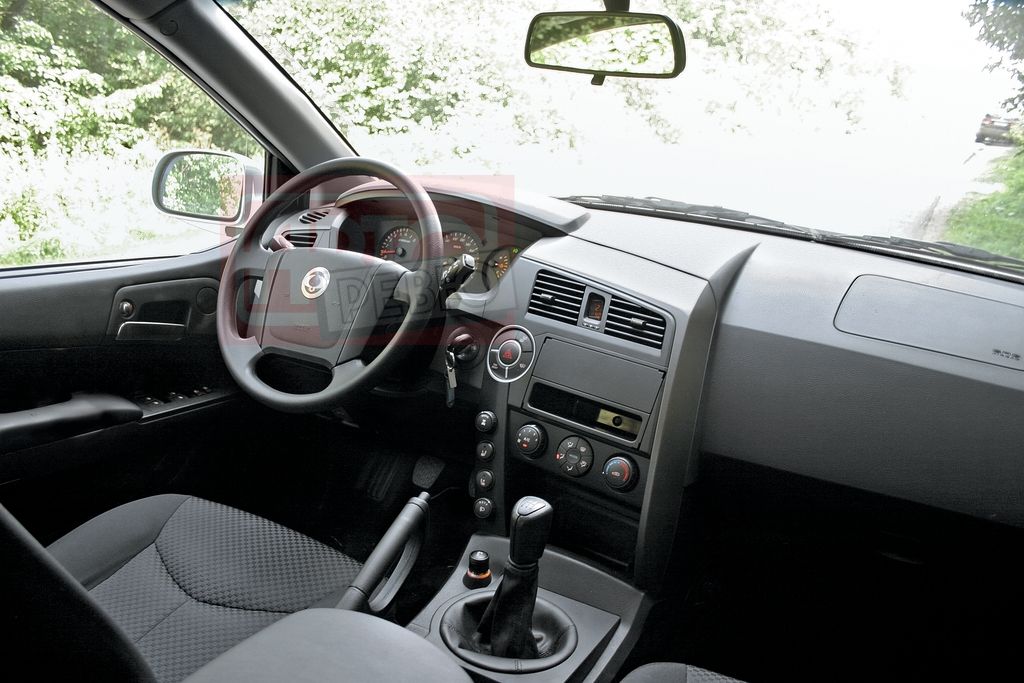 | 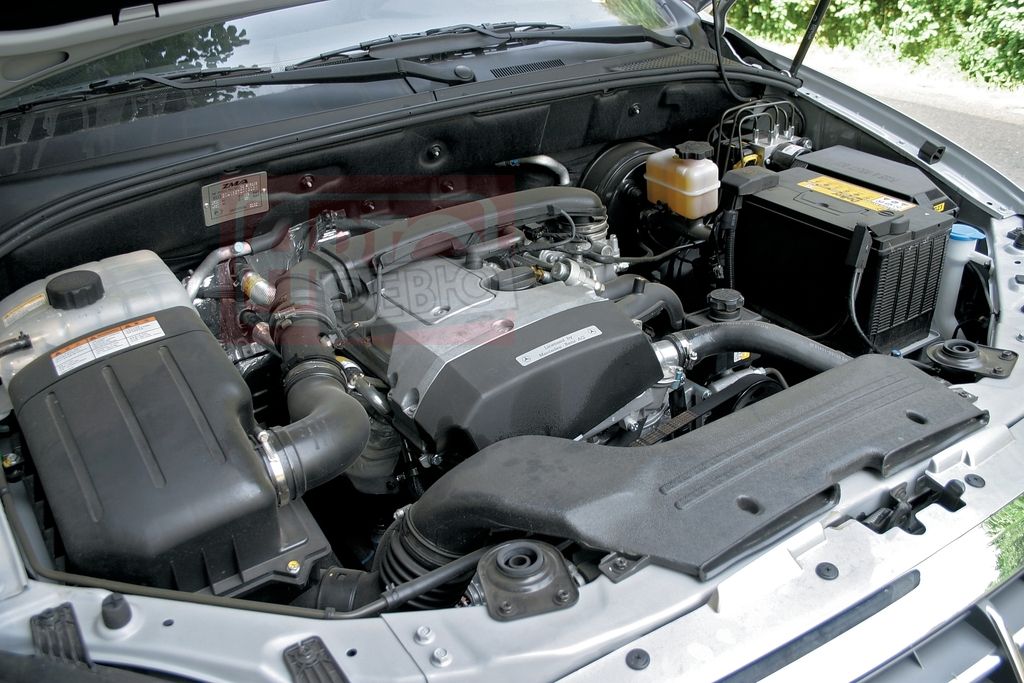 | |
| The main change in the interior is the console with carbon imitation | The 2.3-liter gasoline engine (150 hp) came to the Kyron from the first SsangYong Rexton SUV | The grab handle for the passenger is a change you feel with your head |
In the spacious, cozy, and balanced cabin, there are noticeably fewer changes. The central console is now decorated with a "carbon" overlay, and a rigid grab handle for the front passenger has appeared on the ceiling. So rigid that I bumped my head on it twice. It would have been better to place the handle on the inclined A-pillar...
Under the hood is a proven inline "four" from Mercedes with a displacement of 2.3 liters, producing 150 hp. Seems decent, but the body-on-frame Kyron weighs almost two tons. Therefore, the engine, like a tired barge hauler, lazily turns the tachometer needle across the entire range from 2000 to 6000 rpm. And at low revs, up to 2000 rpm, it's almost impossible to start uphill on a manual without burning the clutch. Moreover, the long-throw gear lever often makes you miss the desired gear, and the synchronizers resist sharp shifts.
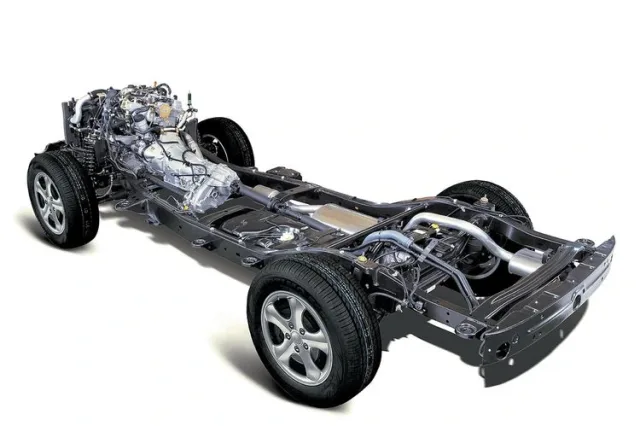
The base of the Kyron is a classic frame, independent suspension at the front, and a solid axle at the rear
So the preferable option is the four-speed "automatic" from Australian BTRA, made under Borg Warner license. It shifts without haste, but smoothly and predictably. And the lack of traction at low revs is compensated by the torque converter.
But with both the "manual" and the "automatic," the Kyron 2.3 is a car for calm driving. The "empty," uninformative steering wheel that also trembles on bumps, noticeable body rolls... However, at high speeds, you feel confident behind the wheel: reactions to steering inputs are smooth and unhurried. And if you overdo the speed in a corner, the Kyron slides outward with the front end evenly and predictably.
I'd also like better ride comfort! The suspension decently "swallows" only medium bumps. On large potholes and on small irregularities, the body shudders from vibrations of large unsprung masses, and on waves, the Kyron rocks. But it's quieter in the cabin than in the diesel Kyron.
So which Kyron should you take? The price difference is small — the gasoline version in base is only 8,000 rubles cheaper than the old diesel (from 802,000 rubles, or $31,110). The diesel Kyron with the updated appearance will appear only by November, and prices for it are not yet known.
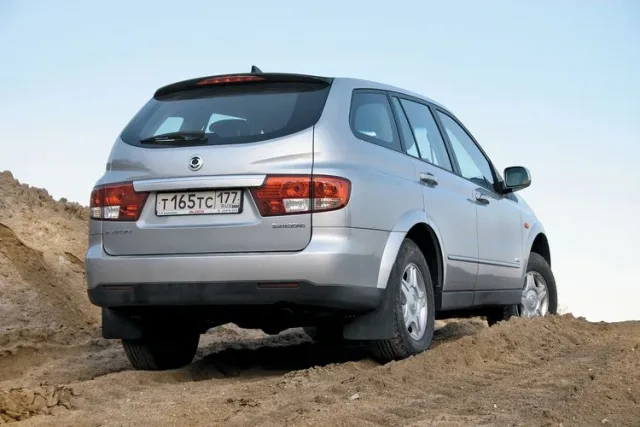
Currently, the Kyron sells well — 2,352 cars in seven months. For comparison, during the same time, 2,283 body-on-frame Mitsubishi Pajero Sport SUVs and 2,130 Chevrolet Captiva crossovers were sold. Now the Kyron will become even more attractive, especially for buyers from the regions: owners of gasoline cars won't have to fear low-quality diesel fuel. And most importantly — excellent off-road capability. You engage the front axle, low range — and go!
| Specifications | ||
| Parameters | Vehicle | |
| SsangYong Kyron | ||
| Body type | 5-door wagon | |
| Number of seats | 5 | |
| Dimensions, mm | length | 4660 |
| width | 1880 | |
| height | 1755 | |
| wheelbase | 2740 | |
| track front/rear | 1570/1570 | |
| ground clearance | 199 | |
| Departure/approach angle, deg. | 26/23 | |
| Curb weight, kg | 1862—1971 | |
| Gross weight, kg | 2530 | |
| Engine | gasoline, with distributed fuel injection | |
| Location | front, longitudinal | |
| Number and arrangement of cylinders | 4, in-line | |
| Displacement, cm³ | 2295 | |
| Cylinder bore/piston stroke, mm | 90.9/88.4 | |
| Compression ratio | 10.4:1 | |
| Number of valves | 16 | |
| Max power, hp/kW/rpm | 150/110/5500 | |
| Max torque, Nm/rpm | 214/4500 | |
| Transmission | manual, 5-speed (automatic, 4-speed)* | |
| Drive | all-wheel drive, with pluggable front-wheel drive | |
| Front suspension | independent, spring, on double wishbones | |
| Rear suspension | dependent, spring | |
| Front brakes | disc, ventilated | |
| Rear brakes | disc | |
| Tires | 225/75 R16 | |
| Maximum speed, km/h | 167 (164) | |
| Acceleration time 0—100 km/h, s | 13.6 (14.5) | |
| Fuel consumption, l/100 km | urban cycle | 14.9 (14.8) |
| extra-urban cycle | 8.7 (9.7) | |
| combined cycle | 11.0 (11.6) | |
| Fuel tank capacity, l | 80 | |
| Fuel | AI-95 | |
| * In parentheses — data for vehicles with automatic transmission | ||