Ssang Yong Actyon Sports. Sporty activist
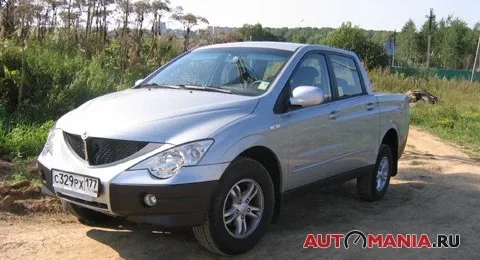
Mass "pickupization" of our country is definitely not going to happen anytime soon. The tribe of farmers and hunters for whom such a car would be a necessity hasn't grown up here yet. And not everyone who needs such a vehicle is ready to shell out $800,000–900,000 for it.
In the States, pickups (they call them trucks there) make up almost half of all vehicles on the roads. Here, dealers started actively offering such cars only three years ago. It all began with the Thai Mitsubishi L 200 (also known as the Mazda B 2500), then the Ford Ranger, also from Thailand, joined in. About a year and a half ago, the luxurious Nissan Navara appeared.
"Gray" dealers bring in outright super-luxury models: Chevrolet Avalanche, Cadillac Escalade truck, Dodge RAM, Ford F 350, Honda Ridgeline. And of course, the widest selection is from the Chinese: besides the Great Wall Deer, there are about a dozen more models with cargo beds. Most of them are shabby, excessively long, with low payload capacity, weak gasoline or noisy diesel engines developed back in the last century.
Workhorse
If we set aside the Chinese stuff and luxury pickups, until recently we had only three "workhorses": the updated Mitsubishi L 200, the new Mazda BT 50, and the Ford Ranger. But a newcomer has entered the market, capable of seriously competing with the veterans. Perhaps not in price or off-road capability, but in design, diesel efficiency, and payload.
The newcomer is called the Ssang Yong Actyon Sports. This pickup replaced the Musso Sports model, which was sold two or three years ago. We took the new model for a week-long test and decided to use it for its intended purpose—to transport as much cargo as possible from Moscow to the Ryazan region.
Getting to know the Actyon
But first—getting acquainted with the car. The pickup is built on the basis of the Korean Ssang Yong Actyon, which is called the world's first jeep with a hatchback body. However, our hero is noticeably longer: the wheelbase is increased by 220 mm, and the overall length by 515 mm. In addition, unlike its predecessor, the Sports can boast not only 16-inch wheels but also optional 18-inch ones, making it even more rugged and aggressive.
Ssang Yong engineers always play on the edge, inviting famous designers to create a memorable and unusual look. This time was no exception. The exterior was worked on by Englishman Ken Greenley—the author of the Kyron, Korando, Actyon, and Actyon Sports—and his portfolio includes Aston Martin and Bentley.
The front pillars harmonize perfectly with the expressive stampings on the sides, which favorably distinguishes the car from the "boxes" of competitors. The front end evokes associations with some bizarre deep-sea creature. The car either makes you fall in love at first sight or causes rejection. But no one will remain indifferent. This is exactly the kind of car that people turn to look at and even photograph for memory. I've only seen such photo-magnetism once before—with the world's only passenger pickup, the Chevrolet SSR.
Why do you need a pickup?
Visually, the cargo compartment seems longer and more spacious than the L 200's, but that's an optical illusion. In reality, it's 50 mm shorter than the Mitsubishi's and 250 mm shorter than the Mazda's. However, it's noticeably taller and wider—by 200 and 100 mm, respectively. In terms of payload, the Actyon Sports loses to the L 200 by 150 kg and to the Mazda BT 50 by 210 kg. True, it's worth remembering that competitors have leaf springs at the rear, while the Sports has a solid axle on coil springs.
When I first parked near my building, local car enthusiasts, after discussing the design, asked: "Why do you even need a pickup?"
The next morning, the question resolved itself: I loaded the car to the brim with boxes and seated three passengers in the cabin. That much stuff would only fit in a Nissan Pathfinder, but then I'd have to fold down the rear seats and go alone.
300 km with cargo there and 300 km empty back—the car behaves completely differently. You realize that the vehicle is built for work. With a full load, there's no hint of lateral sway, and the broken Astrakhan concrete road feels like a freshly laid Rublyovka. Fuel consumption with cargo increases slightly, and the pickup confidently holds 120–130 km/h (maybe more, but the loaded single-lane road didn't allow testing). The car handles large obstacles almost perfectly, demonstrating excellent suspension energy capacity.
"We'd like one like that..."
In short, the Actyon Sports handled the assigned tasks with flying colors. In a provincial town, a crowd of onlookers gathered around it. The question of whether such a car was needed didn't arise there. They discussed something else—how convenient it would be to carry potatoes, hay, bricks, and anything else. Especially since the Sports has a huge advantage over competitors: the cargo compartment is lined with plastic inside. Most pickups have bare metal, and lining is only available for an extra charge. But here, you could even haul manure—just rinse it off with a hose, and that's it. The discussion concluded unanimously: "We'd like one like that!" Both for hunting (throwing a boar or elk into the bed—no problem) and for visiting the mother-in-law for potatoes and apples. Bicycles will fit, and even a motorcycle.
Differs from competitors
Inside, the Sports also stands out noticeably against its rivals. It's not a "vegetable van" cabin: soft and hard plastics don't hurt the eyes, and climate control is a useful thing. Seat adjustments are convenient. Even without longitudinal steering wheel adjustment, you sit quite comfortably behind it. Rear passengers aren't short on space either. The only downside is that your right foot tends to hit the seat heating buttons or the transmission switch (are they near the pedal? Unclear!). But you get used to it in a day, and your foot stops going where it shouldn't.
Managing the Borg Warner transmission is simple. On asphalt, it's better to disconnect the front axle and drive in 2H mode. Up to 70 km/h, you can turn the dial to 4H on the go. But for 4L, you'll have to stop and press the clutch. The shift happens slowly, and the pictogram on the panel lights up only after 30 seconds. The diesel's torque is enough to overcome serious off-road conditions, although the Actyon Sports clearly doesn't reach the laurels of the L 200, Mazda BT 50, or Ford Ranger.
The Sports also doesn't shine with ground clearance: 190 mm versus 210 mm for the Mitsubishi L 200. True, under the front axle it's 216 mm, but the rear axle housing hangs just 190 mm from the ground. The coil suspension and engine came to the Sports from the Actyon crossover. The engine is a licensed Daimler Chrysler two-liter turbodiesel with 141 hp. The same one is in the diesel Jeep Compass. The engine's voice is low, pleasant, and, most importantly, quiet. But overall, sound insulation seemed slightly worse than in the Actyon hatchback.
Time will tell whether the Actyon Sports becomes in demand. Over the week, I encountered only 3–4 such cars on the streets. I think in the provinces and villages, they would be in huge demand if not for the price. The tested model cost 770,000 rubles, and the base version starts at 745,000 rubles. That's almost 100,000 more than the L 200 and 150,000 more than the Mazda BT 50. Only the new Ford Ranger will be more expensive than the Actyon Sports.
Technical specifications.
| Dimensions (mm) |
4965x1755x1900 |
| Wheelbase (mm) |
3080 |
| Drive type |
all-wheel, switchable |
| Cargo platform dimensions (mm) |
1275x1610x540 |
| Ground clearance (mm) |
190 |
| Curb weight (kg) |
1912 |
| Payload capacity (kg) |
830 |
| Engine displacement (cc) |
1998 |
| Power (hp/rpm) |
141/4000 |
| Max torque (Nm/rpm) |
310/2700 |
| Maximum speed (km/h) |
161 |
| Fuel consumption (l/100 km) |
11.1/6.2/8.0 |
| Price of tested car (rubles) |
770,000 |
Dmitry Shavyrin
Source – www.automania.ru
