
Czech Intervener
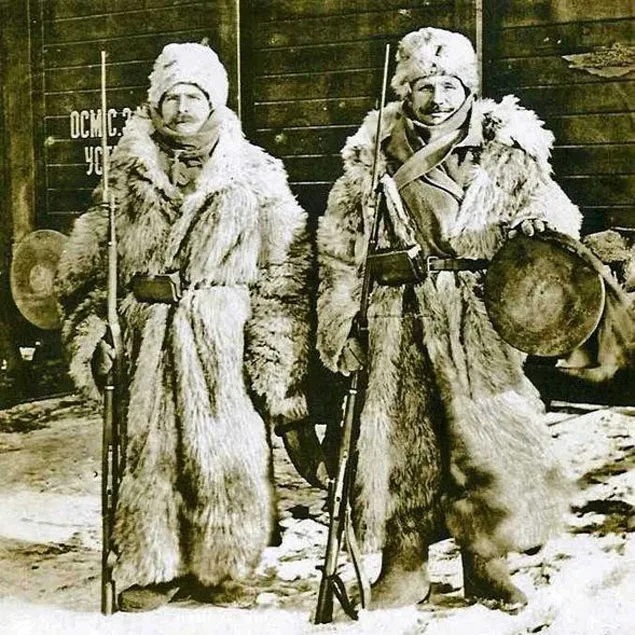
At the very end of 1918, Irkutsk served as a transit point for the rebellious Czechoslovak Legion — soldiers passed through it on their way to Vladivostok, from where they sailed home on ships. According to Wikipedia, it was then that Baikal first saw such a concentration of Czechs on its shores: about 72 thousand military personnel traversed the route from the Urals and Western Siberia across the ocean to Europe.
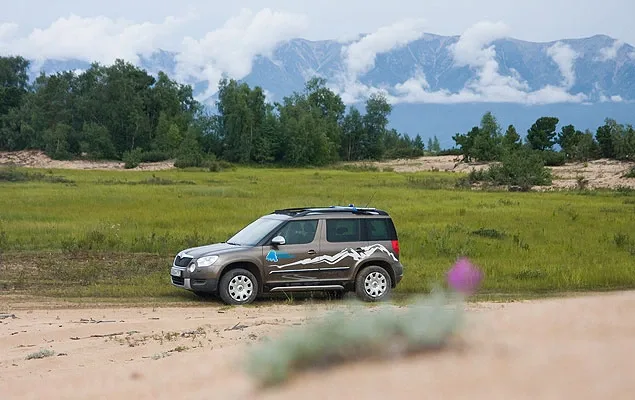
But here we will talk about something else — about the peaceful invasion of Czechs on the shores of the deepest lake on the planet, which happened in the summer of 2010. The landing party arrived in Zabaikalsky National Park, not far from the mouth of the Barguzin River. It was there, on the Chivyrkuisky Isthmus and the Svyatoy Nos Peninsula, that the Russian office of Skoda organized an off-site event for the press dedicated to the Skoda Yeti crossover, to demonstrate its off-road potential.
It must be said that by that time the "Yeti" had already traveled around the world — we reported on its international premiere on Slovenian roads, then drove it through the winter Alps, and later took a front-wheel-drive version with a 1.2-liter turbocharged gasoline engine producing 105 horsepower for long-term testing for the "Our Garage" project. Now the Czechs decided to test on the shores of Baikal the all-wheel-drive modification with a Haldex coupling, which is installed on cars with a 152-horsepower turbo engine and a six-speed manual gearbox.
The meeting point is unchanged
Both the place and the time for the test were chosen perfectly. First, early August is the peak season on Baikal. So much so that the most daring journalists even ventured to swim in Barguzin Bay, although the water temperature there hardly reached 15 degrees Celsius.
Second, besides swimming, Zabaikalsky National Park is famous for its nature. It is full of animals and birds that are more often found on the pages of the Red Book than in their natural habitat. A striking but not the most harmless example of local fauna is bears, which regularly patrol the shores in search of leftovers left by tourists. The organizers even strongly recommended that we not wander away from the camp alone — who knows who you might meet in the Siberian taiga.
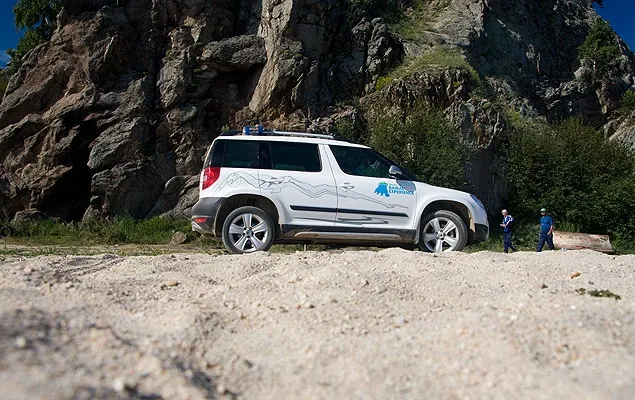
True, we came to Baikal not to count whooper swans or white-tailed eagles, so the feathered inhabitants of the park could calmly soar in the sky or fuss in the bushes without fearing curious binoculars. Meanwhile, we were testing the Czech crossover on local roads and full off-road terrain.
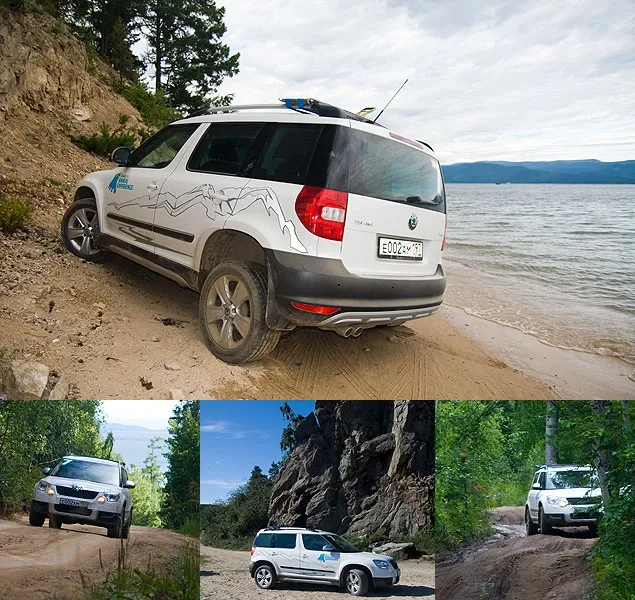
The coast of the Chivyrkuisky Isthmus, composed of alluvial rocks, strongly resembles the Baltics — the same pines and dunes. It was on this sand that the first route for the "Yeti" was laid. At a short briefing, we were told to disable the stability control system and the off-road mode, since the electronics prevent the wheels from spinning, and also advised us to stop less and not leave the ruts. After that, the column of crossovers set off to storm the dunes.
Walker on sand
It turned out that as long as the "Yeti" has 180 millimeters of ground clearance, deep sand is not a problem for it. Bouncing over hummocks, the crossover persistently digs through sand waves with its wheels. The "Czech" also fords deep puddles without difficulty. True, before climbing into an unfamiliar body of water, it is better to check the depth with a stick or on foot to avoid hitting holes. And there is no need to rush. The organizers warned: if the car raises a wave that floods the hood, you need to ease off the gas.
Stopping and starting again on loose ground is also possible, but you need to choose shallower places: if the wheels dig deep into the sand, the engine may simply not have enough low-end torque to get out. And although according to the specs, the 152-horsepower turbo engine delivers maximum 250 Newton-meters already at 1500 rpm, in reality, to overcome serious obstacles, it is better to keep the engine in the 2500–3000 rpm range.
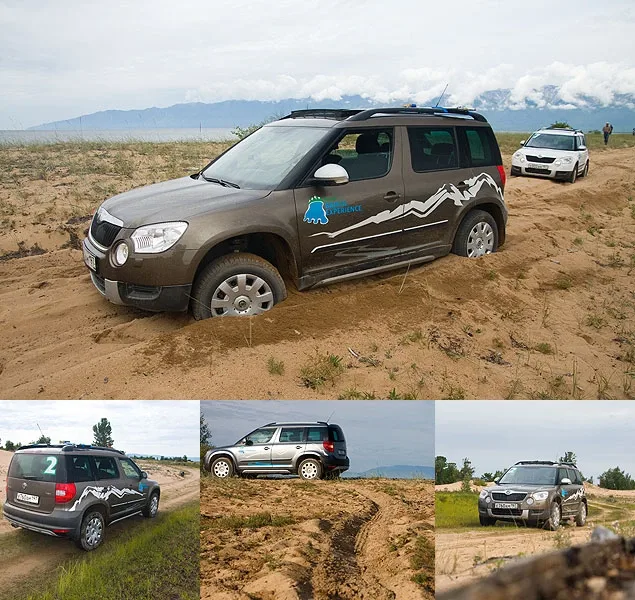
It was not without adventures. Deciding to go through the sandy track again, we, through our own stupidity — reversing in a puddle — broke off the steel engine protection on the test Yeti. That ended our off-road exercises. Even after unscrewing the damaged shield, we could not get to the camp under our own power: the torn steel damaged the intercooler, and the "Yeti" engine consistently stalled after 10–15 seconds of operation.
By the way, without thick steel protection, it is better not to venture onto the dunes not only in the Czech crossover but also in any other car. In the sand, there are often stones and pieces of wood, meeting which can be fatal, say, for the engine oil pan.
Acrobatics exam
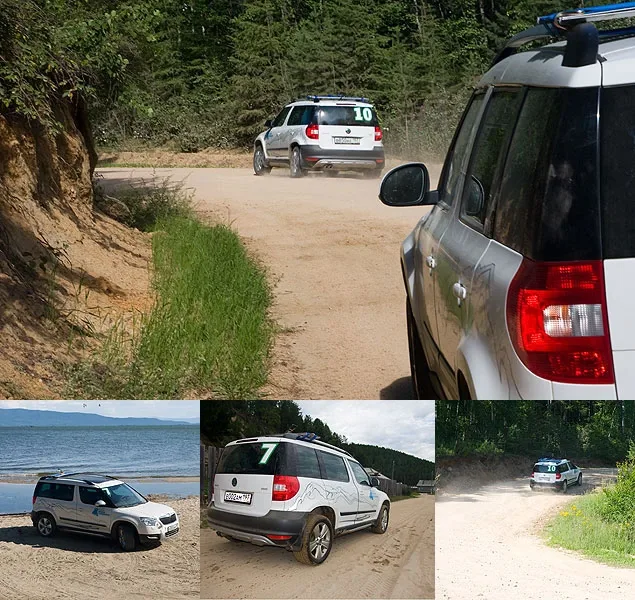
After replacing the damaged car with a working one, we set off to conquer the mountain roads of the Svyatoy Nos Peninsula. There, the "Yeti" faced taiga thickets, ruts broken by trucks, slippery stones, as well as steep ascents and descents. And it was here that the previously disabled off-road system came in very handy.
On the approach to one of the villages on the peninsula, the road for several dozen meters turned into almost a jeep trial track. Apparently, in spring and during heavy rains, this place becomes a stream bed, along which water flows from the ridge straight into Baikal. Our crossover had to descend a slope over wet stones, sand, and clay, now and then hanging one wheel or another, and the "off-road" mode did not let us down.
During a slow descent on slippery surfaces, the Yeti with all-wheel drive and the off-road button engaged fully takes over throttle and brake control, preventing the wheels from locking on the slope. In such a situation, the driver only needs to take their feet off the pedals and turn the steering wheel, avoiding obstacles. The traction control system also fights diagonal wheel hanging: the electronics brakes the wheel suspended in the air to transfer torque to the other three that still have contact with the ground.
On Baikal, this electronics worked no worse than in the Slovenian test when we first trusted it. Although it was still a bit scary — it seemed that we would soon catch the body kit on the ground or rub against a rock. After all, unlike "home" tests on prepared grounds, Baikal conditions are reality, where any surprises are possible. As we already saw in the morning on the sand.
But this time everything went smoothly. We reached a fishing village on Cape Zmeiny, admired the sunset over Baikal, and returned to camp without incident to sum up the results of a whole day of testing the Czech crossover.
Inventory
No miracle happened: the "Yeti", even after breathing the taiga air, did not turn into a real off-roader. On sand, the main advantage of the Skoda Yeti crossover over all-wheel-drive passenger cars is a few extra centimeters of ground clearance. Whether that is a lot or a little depends on the driver's ambitions. But now we are ready to boldly embark on sandy adventures in the Yeti.
The main thing is that in the trunk, as in our test cars, there is an entrenching shovel, and on the roof, sand tracks are tied to the roof rails. The light "Yeti" is easy to dig out and return to the beaten path, because it simply cannot go far from it. Here the saying works: "If the jeep is small, then maybe you won't have to go for a tractor."
However, on rocky sections and deep ruts, the "Czech" can quickly lead the driver into a dangerous situation. Therefore, when storming such obstacles, it is worth soberly assessing the situation and, without hesitation, turning around if the idea seems risky.
The main thing we took away from this journey is that residents of Russia should definitely get to know their homeland. A seaside vacation is certainly good, and for it, you can go abroad. But not noticing such places as Baikal would be a real omission.
Getting carried away by off-roading, we almost missed the obvious: the smooth suspension of the Czech crossover behaves excellently on broken and bumpy unpaved roads, along which we moved between test zones. Therefore, the "Yeti" is an excellent companion for long hauls on gravel or broken asphalt at decent speed. At the same time, comfortable ride smoothness and increased ground clearance are combined with a low center of gravity for an SUV, which noticeably improves handling, especially in difficult conditions.
Moreover, the turbocharged engine not only pulls confidently but also pleases with its appetite. On the highway, the Skoda Yeti with a 1.8-liter engine producing 152 horsepower consumes about seven liters per hundred kilometers. Comfortable and economical — that's exactly the companion needed for exploring Russian roads.
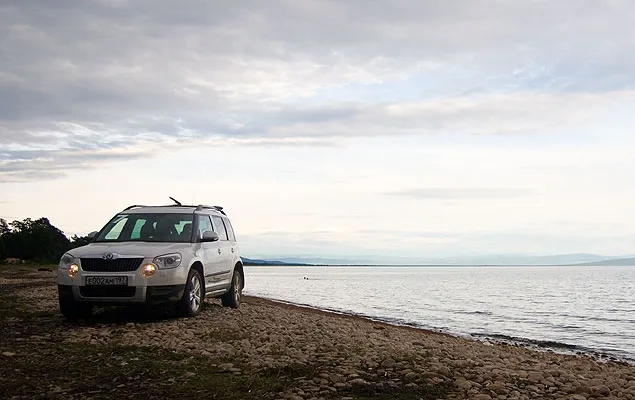
In the end, our country desperately needs a tourist "inspection", and you can do this on anything — train, plane, regular car, or bicycle. But we would gladly roam the expanses in cars like the "Yeti", which, in essence, is not some invader, but rather an explorer. Auto.Lenta
Technical characteristics of Skoda Yeti 1.8 TSI MT
| Length, mm | 4223 |
| Width, mm | 1793 |
| Height, mm | 1691 |
| Wheelbase, mm | 2578 |
| Curb weight, kg | 1520 |
| Engine displacement, cm3 | 1798 |
| Power, hp/rpm | 152/4500-6200 |
| Torque, Nm/rpm | 250/1500-4500 |
| Acceleration time from 0 to 100 km/h, s | 8.4 |
| Maximum speed, km/h | 200 |
| Fuel consumption in combined cycle, l/100 km | 8.0 |