
In Search of Winter
Ecologists have long warned about global warming, and now it is no longer just a scare story but a harsh reality. In Moscow, in the middle of December or at the end of January, rain is increasingly falling instead of snow, and the thermometer does not drop below zero.
Due to such climate changes, not only animals are forced to migrate in search of their usual habitat. Automakers also have to look for new places to test their cars. No one can guarantee that winter will actually be outside during the planned dates of a winter test.
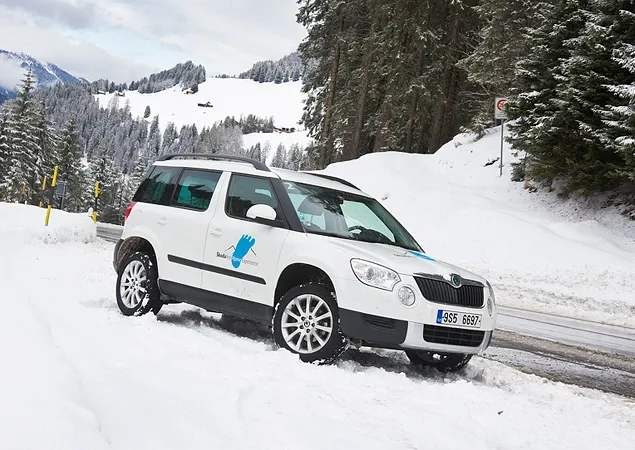
There is only one way out — go where snow lies almost all year round — to the mountains. We headed to the Alps! And what company could be better chosen for the search for real winter than the new Skoda crossover with the telling name Yeti?
does not get lost even against the backdrop of the snowy peaks of the Alps
Up!
However, on the first day of our December trip in search of snow, no one would have thought about winter. In Milan, where the route started, it was not winter-like warm at all — plus twelve degrees, and it was drizzling. The landscapes outside the window more resembled deep autumn: gray-brown fields and low heavy clouds over the road. But in the distance, the snow-capped peaks of the Alps were already looming, beckoning us.
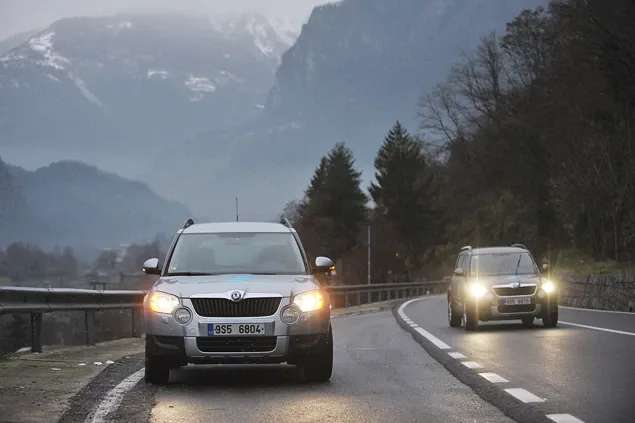
On the high-speed European highway, the Skoda Yeti does not let the driver feel that he is driving a tall and slightly angular crossover. Dense, collected chassis, precise steering with good feedback, and a torquey diesel paired with a manual gearbox give the Yeti an almost car-like character. On the first leg of the journey, we got the most modest in power — 110-horsepower — turbodiesel, but calling it deprived is hard. Thanks to 280 Nm of torque, available from 1500 rpm, the engine confidently pulls in high gears, and overtaking does not require downshifting.
But in Russia, it should not disappoint either - the suspension is very energy-intensive.
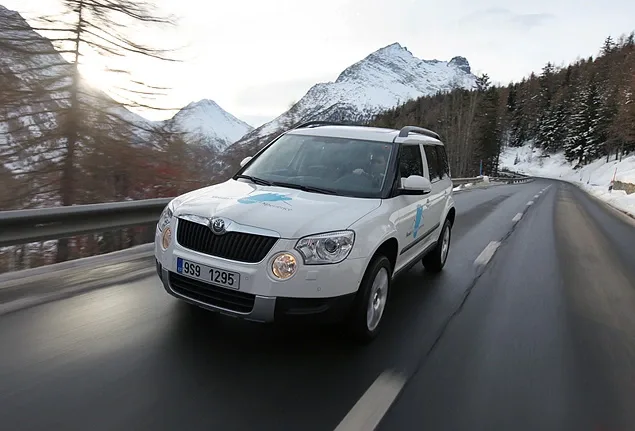
Up to the border of Italy and Switzerland, where customs posts with stern policemen still stand, winter was almost not felt. Only occasionally did half-melted snowdrifts come across. Our goal for the day is the Swiss town of St. Moritz, located at an altitude of 1822 meters above sea level. It was here that the Winter Olympic Games were held in 1928 and 1948.
With the gain in altitude, the roadsides became whiter, and soon snow covered everything around in a dense carpet. True, it was still plus outside and slush, but the roads were surprisingly clean. In Switzerland, as almost everywhere in Europe, ordinary salt is used to combat ice. Therefore, the car does not get dirty even in bad weather, and the roadsides do not turn into black mush, as happens in Moscow.
This “non-winter” weather is explained simply — Lake Como, along which most of the route passed. This is the third largest lake in Italy and one of the deepest in Europe, with an average depth of 154 meters and an area of about 146 square kilometers. It creates a special microclimate around itself: real frosts are rare here, and in summer the air warms up to resort-like thirty degrees.
the Yeti is not afraid of rain or snow...
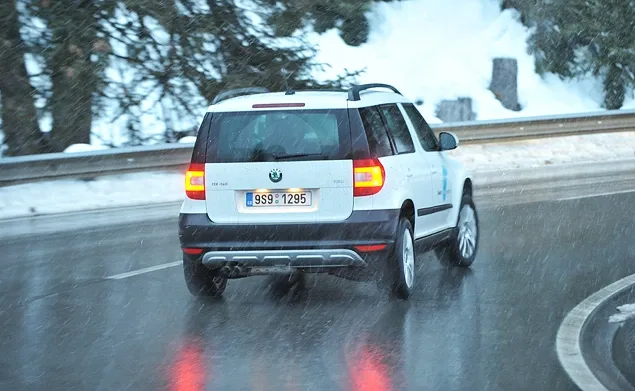
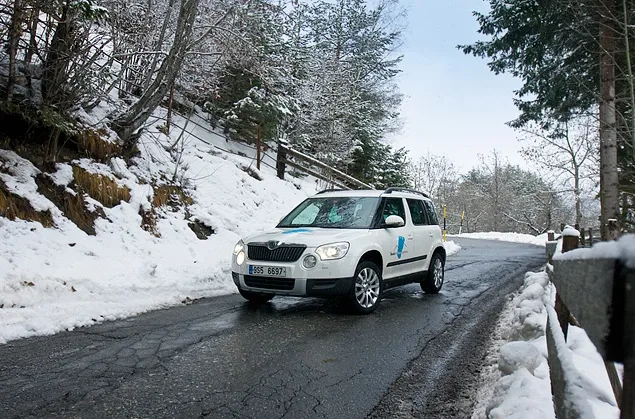
The last stretch of the first day is the most beautiful gorge, along which we gradually climbed into the mountains, covering about 50 kilometers. The drizzling rain suddenly turned into wet snow, and then into a real snowfall. Snowplows appeared more and more often on the road, but even they could not cope with the elements: the last five kilometers we drove on wet snow slush, and the stability system cheerfully blinked its indicator.
It seems that such weather in the Alps is a common thing. On the approaches to St. Moritz, we repeatedly noticed Porsche 911s, large Mercedes and BMWs parked near hotels — mostly all-wheel drive. The owners clearly knew what they were getting into.
Rewind
The second day brought us the Julier Pass, which is at an altitude of 2284 meters. In summer, there are the most beautiful winding roads meandering among the mountains. But we were looking for winter — and we got it!
Just a few kilometers from St. Moritz, our Yeti plunged into a real blizzard. Visibility dropped to almost zero. Outside the window, not only the mountains were invisible — even the two-meter orange-black posts along the road were hidden behind a wall of snow.
but braking and turning on “Euro tires” was worse for it
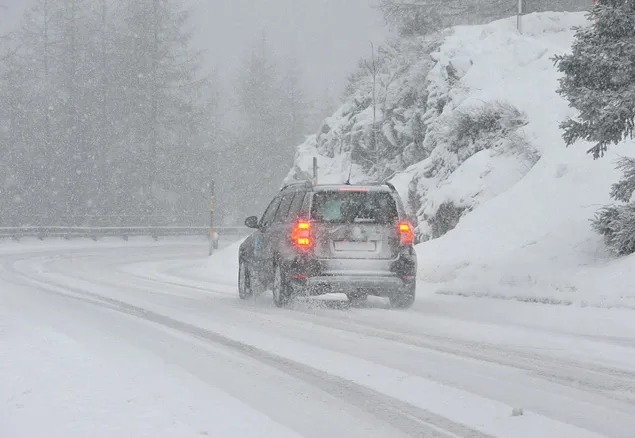
At the top of the pass, it was raging so much that we had to stop several times and wait for the road to appear through the snow wall. The standard navigation of the Skoda Yeti also turned out to be powerless: the signal, apparently, did not penetrate the dense snow clouds, and the navigator constantly lost satellites.
Having descended from the pass, we met stuck cars and a tourist bus. In Switzerland and Italy, driving on mountain roads without winter tires is prohibited by the rules, but even with them, it is impossible to save yourself in such conditions: European studless tires, designed for a mild winter, cannot cope with packed wet snow. Therefore, everyone who goes to the mountains is obliged to carry chains with them. It was while putting them on the drive wheels that we caught the stuck cars.
willingly goes sideways
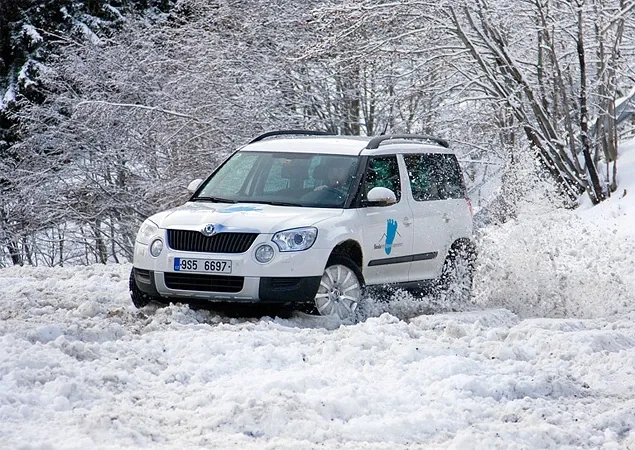
Chains were also in our trunk, but the all-wheel-drive Skoda Yeti with the latest, fourth-generation “Haldex” coupling easily started on snowy climbs even without them. The main thing is that there is enough tire grip. The test crossover stood on Continental Winter Contact TS830, which hold wet asphalt and slightly powdered snow well, but struggle with slush and a thick layer of snow. Longitudinal “traction” is still there — you can start and brake, but in corners, grip on a slippery surface is almost absent.
Therefore, on uncleaned roads, we had to move extremely carefully, literally feeling with the front wheels for sections that could be hooked in a turn. Fortunately, the steering wheel of the Yeti is almost exemplary in terms of feedback and honestly informs the driver even about the slightest slips.
But when the front tires find something to grip, you can also hooligan a bit by adding gas. On a slippery surface, the electronics will pre-lock the multi-disc clutch, engaging the rear axle almost instantly. The rear goes into a slide so predictably and understandably that making the Yeti effectively “steer with the throttle” on the exit of a corner can be done without fear: the cautious stability system will not allow the drift to develop in any case.
even for European motorists
As we descended towards Zurich — the end point of the second day — the weather changed like in a fast-forward movie. In a couple of hours, winter with a blizzard and heavy clouds gave way to real spring: around green hills with lush grass, above — a bright blue sky.
But the search for winter did not end there. On the third day, the final point awaited us — the ski resort Saas Fee, located at an altitude of 1800 meters.
Door to Winter
For the final trip, we chose a petrol Yeti with a 1.8-liter turbo engine producing 150 horsepower. Despite the impressive 250 Nm at the same 1500 rpm as the 110-horsepower diesel, the petrol version initially seems a bit lazier — the engine truly wakes up by 2500-3000 rpm. But then the juicy traction does not dry up until the red zone. In addition, the petrol crossover has a differently tuned chassis: the steering is heavier and more precise than the diesel, and the suspension is softer and slightly more relaxed.
Surprisingly, the petrol Yeti is perceived as a more solid car than the slightly shaky and noisy diesel version. Soft but precise responses to the steering, an elastic engine, well-calibrated brake pedal settings, and a “rounded” suspension — all this creates the feeling of favorite sneakers that fit so comfortably on the foot that you forget about their existence.
Especially in the version with a petrol engine
We cover the 140-kilometer route from Zurich to the foot of the mountains virtually without stops: only the ridge that separates the cantons of Bern and Valais forces us to slow down. There is no road through the pass here — to bypass the obstacle, you will have to make a considerable detour, or... use the 17-kilometer tunnel through the mountain, along which special trains run.
A short wait — and we drive up the ramp into open carriages that are only slightly wider than the car. The train starts moving, and within a couple of minutes, the absolute darkness of the tunnel closes around us. It is forbidden to leave the car while moving, the engine must be turned off, and the radio receiver switched to the “emergency” station wave. The whole trip takes about twenty minutes. Those who are panicky afraid of enclosed spaces are unlikely to like such a crossing, but for other travelers, the tunnel saves one and a half to two hours that would have to be spent on independently overcoming the pass.
of loading the "Yeti" onto the train <\/div>
 <\/div>
 The final dash to the hotel hidden in the mountains, along the serpentine road going up, the petrol "Yeti" completes in less than an hour. The Continental tires, which did not impress us in the snowfall, on frosty dry asphalt work to perfection: they grip the rough surface tenaciously and allow you to truly enjoy fast driving. Most of the turns are taken in second or third gear, and only in the steepest hairpins do you have to engage first.<\/p>
At the entrance to Saas-Fee, a surprise awaits us: this tiny town with a population of just over 1,600 people is completely closed to cars. Both tourists and locals have to leave their vehicles in a multi-storey parking lot and then move on foot or in small electric vehicles.<\/p>
<\/p>
used in the Alps differ for the worse
from the beautiful concepts
that we see at auto shows <\/div>
 <\/div>
 Electric vehicles have displaced other modes of transport not only in Saas-Fee. These angular, almost homemade-looking and nearly silent machines are found in most Alpine villages. Open electric carts deliver goods to shops and food to hotels and restaurants, closed "electric cars" carry passengers, accommodating at most 4-6 people; there are even "electric fuel trucks".<\/p>
On the narrow streets of Saas-Fee, where snow creaks underfoot and blindingly white mountain peaks rise around, quiet and eco-friendly electric vehicles look surprisingly organic — much more appropriate than the large sedans and SUVs that fill the parking lot at the entrance. At some point, you catch yourself thinking that this is where you would want to live out your days...<\/p>
And yet, an intrusive thought does not leave your head: you have entered a reserve — a carefully protected territory of winter. A winter that you can admire but cannot touch.<\/p>
But we and the "Yeti" have nothing to do in the reserve. We need real winter — the kind you can live in and feel at home. What kind of "snowman" is it if they don't even let him touch the snow?<\/p>
<\/p>
We'll find out in a month! <\/div>
 <\/div>
 <\/p>
| <\/td> | DISCUSS<\/td> | [ comments: NONE ]<\/td> <\/tr> <\/tbody><\/table> <\/div> Mikhail Tsymbal<\/div> |