"Blood" Enmity
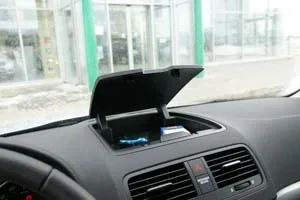
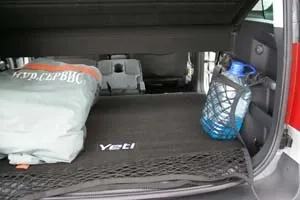
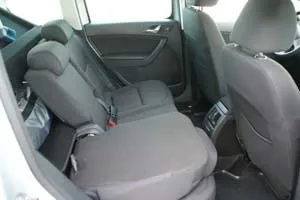
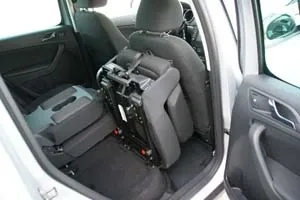
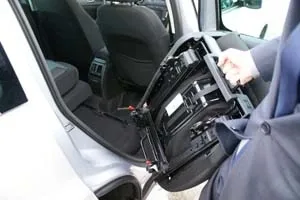
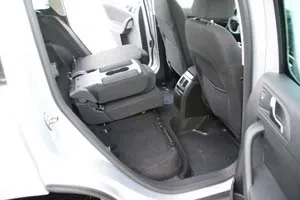
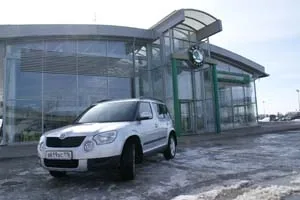
It is curious what nickname people will give this car. It is impossible to guess in advance — the imagination of our people is boundless! And I am not saying this just for the sake of it. Nowadays quite unusual names are appearing: "Tiguan", "Qashqai", and now "Yeti". For those who do not remember, that is the name of the snowman — a creature that hides from people and lives somewhere high in the mountains. Apparently, the manufacturer wanted to emphasize the unconventional character of the car, and a sonorous name is also important. Marketing! Looking ahead, I will say: it was with snow that I had problems during my test. In the meantime, taking advantage of the fact that the dealer center has a decent and almost empty lot (there is plenty of parking space for customer cars), I decided to have a photo session, as they say, without leaving the checkout — otherwise, due to the dirt on the streets, the car simply would not turn out photogenic. Outside, the huge headlight-eyes and the massive rounded middle pillar, very similar to the Rumster's pillar, immediately catch the eye. Its motifs are also guessed in the general contours of the body. But inside — it is pure water from VW. Here no one started to be clever: they took the interior as is, naturally, along with the instruments and the quality of materials. Although the ability to transform the interior is closer again to the Rumster. In general, the impression is that the Yeti is a cross between the Tiguan and the Rumster. After all, it was the VW Tiguan that became the blood brother (and at the same time, probably, the "enemy" as a competitor) for the Yeti, acting as the donor of the "cart". Visually, the interior seemed to me somehow more cramped than in the VW, but according to the showroom manager, it repeats the dimensions of the Tiguan centimeter by centimeter. The multifunctional display in the center understands commands from the touch of a finger — Touch Screen technology. Data from the parking sensors is also displayed on it, and very correctly and clearly. The four-spoke steering wheel fits comfortably in the palms and is well loaded with functions. Clear informativeness and sharpness (only 3.5 turns from lock to lock) again refer to Volkswagen settings. As for transformation: the rear seats, consisting of three independent parts with separate longitudinal adjustment, not only fold down but can be removed entirely. True, in this case, a flat floor will not work — there will be a step.
I get behind the wheel first. We go to the standard hippodrome, where a specially equipped area for cadets of the Kazan School of Higher Driving Skills awaits us. Literally from the first meters, it is impossible not to notice the liveliness of the engine. Moreover, as if obeying some unknown instinct, I forget that test cars do not always have an automatic transmission, and I simply do not shift gears. The other two participants are strangely silent, not understanding what I am doing. Oops! I quickly corrected myself and shift to a higher gear, and the display lights up with the number of the selected gear and a clever arrow hints that it is worth shifting even higher. This is how the car hints at an economical driving mode. The six-speed gearbox has a sporty short lever and an equally short throw; informativeness suffers a bit due to the unusual number of gears, but then that same screen comes to the rescue. I mixed up the gears: instead of third, I hit fifth and... did not notice — the engine stubbornly pulls and does not think of giving up. It is super elastic. The suspension operation also pleasantly surprised me, and only at the end of the test did I realize that it is "aluminum". By reducing the weight of unsprung masses, the manufacturer achieved a comfortable ride and good handling. The sharp, not at all "SUV-like" steering also contributes to this. And this is on low-profile R17 tires. And if you install standard ones, the ride will become even softer. Yes! In this regard, the Yeti is a typical VW. I repeat, I have already said this. The area met us with smooth ice with patches of wet asphalt.
All-wheel drive is implemented through the connection of the Haldex electronic clutch when the front wheels slip. Under normal conditions, a measly 4% of the torque goes to the rear axle, but if necessary, this figure can rapidly grow to 90%. And this, by the way, is very noticeable on ice. With the stability control system turned off, the car behaves quite adequately. It slides sideways, and by working with the gas and steering wheel, it can be easily placed on the desired trajectory — easier than you would expect. Whether due to the competent distribution of torque across the axles or the weight distribution of the car itself — I do not know, but it is a fact. Rather the former, because you can feel how either the front or rear axle grips harder, helping the driver. After that, we drove on the snow to the off-road discipline, and here I became the "snowman", stupidly burying the car up to its ears. I over-revved and dug in — the most common mistake of a "newbie". If on the Prado we stupidly gassed our way out of the snow trap, using all sorts of lockers (the car is not a "crossover"), then here I dug in. But not for long. Realizing that we were hanging on the belly, we found a digging stick, jacked it up, and I tried to remove the snow from underneath. The bottom is almost flat, nothing sticks out, and you can safely scrape without fear of tearing something off. Having gotten dirty in the wet snow, we still jumped out from the placed bricks amid general hooting and joy. That is what the Yeti is like.
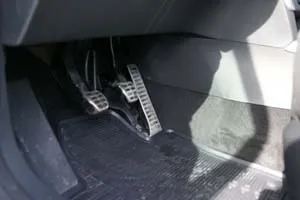
It dug into wet, dense snow all the way to the ground and got out after brief manipulations and with the help of the Off Road function. Graphically, it also combines the hill descent and ascent assist system, which corresponds to reality! But, unfortunately, we could not test them; they say that during descent it works even with the gear disengaged and, moreover, can slightly increase the speed from the set 4 km/h with a light press on the gas. The track showed how good the engine is, and I was glad for Skoda once again. Still, it is an interesting brand. It not only took the best from VW but is also assembled at VW plants in Kaluga. Confident traction from 60 km/h in fifth gear without much effort, but sixth is usually economical, and it makes sense to use it on long straights, as well as cruise control, which, by the way, is already ready to work from 40 km/h. The middle box, which easily turns into an armrest with five fixed positions, will help reduce fatigue on a long journey — you can comfortably lean on it, while your left hand rests freely on the door armrest. Sound insulation is good; the rear passenger begins to hear the noise of the wheels at speeds above 70 km/h, but it is not annoying, and we talked the whole way without raising our voices. Anton (the showroom manager) asked a reasonable question about the car's shortcomings. It stumped me, honestly. I had to find fault with the rear seats, and I would probably slightly increase the load on the brake pedal. They do their job well, but the pedal is light to press. Every time I ask myself the question of who this car will displace, and it turns out that first of all it will be a competitor to the same Tiguan. So it turns out that their blood brotherhood breeds enmity.