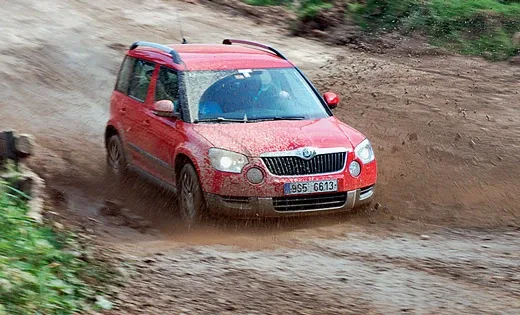
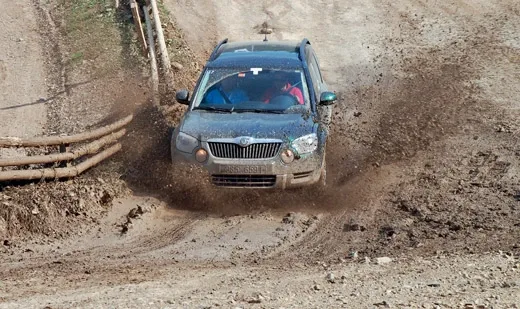
The creaking of springs as wide as a hunting ski, the splashing of huge toothed tires through mud. How else? One of the nicknames for the yeti is Bigfoot, 'big foot.' And here we have such a politically correct European crossover on 225/55 R17 wheels. At first glance, it's just a passenger car for asphalt, lawns, and gravel near a cottage...
FRIENDLINESS IS NOT A GOOD THING
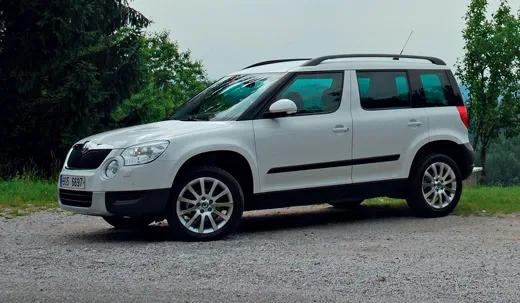
It's clear that the Skoda Yeti took a lot from the VW Tiguan. For example, diesel engines and an electronic off-road settings system. At the same time, its interior is from the Skoda Roomster, transformable, and the design is its own, original. At Skoda, they believe the Yeti's face turned out friendly. I don't know if that's good: usually, before cutting in line, a rude person picks someone more intelligent-looking. And in general, in my opinion, the Yeti is good not so much from the front as in profile — from that angle, it has something 'Saab-like,' aviation-like and dynamic. And this, by the way, is not without reason — the crossover is light, powerful, and quite suitable for flying.
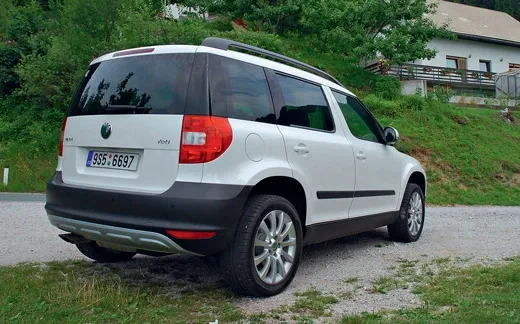
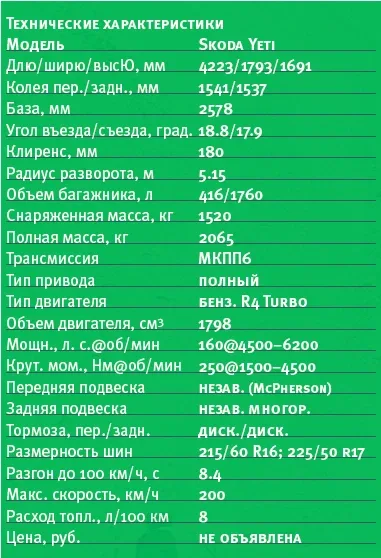
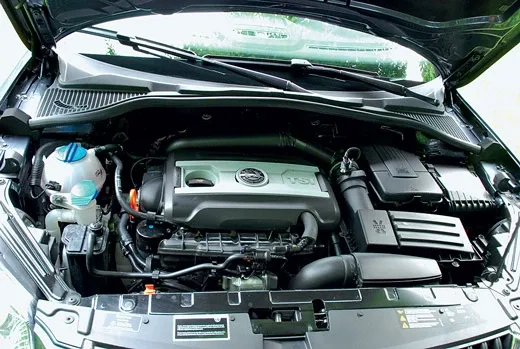
At the model's presentation in Slovenia, I got to try two engines: a 2-liter turbodiesel and a 1.8-liter turbocharged gasoline engine. Both come exclusively with a 6-speed manual transmission. A bit strange for a compact crossover, isn't it? But the Slovenians we met on the road, who were keenly interested in the Yeti, think everything is fine, even great — pure savings. And a car with a 'stick' is cheaper, and fuel consumption is lower. Savages. They should come to Moscow, into our traffic jams — they'd understand why a civilized person needs an 'automatic.'
At the start of the tests, I first, out of habit, took the keys to the diesel version. As it turned out, the weakest of those that will be offered — only 110 hp. I didn't expect anything from it, I just needed to get acquainted. So, speed limits in Slovenia are not strictly observed, and our 150–160 kilometers per hour on the highway didn't look like a gross violation. But the main thing is that the Yeti didn't object — it ran easily, without roaring or straining, only the tires rustling on the asphalt. And it clearly wouldn't have minded accelerating even more... Why not, when peak torque of 250 Nm is available from 1500 to 2500 rpm.
THE MAIN THING IS TO STOP
Later, with the gasoline car, an even funnier picture emerged: maximum traction is the same, 250 Nm, and available from 1500, but up to 4500 rpm. That is, the engine is even more elastic than the diesel. If you make a mistake during acceleration and hit sixth gear instead of fourth — no problem, it will pull through. And into fifth instead of third — also possible. However, the gearbox works correctly, though without rifle-like precision. Handling is also 'Volkswagen-like': very adequate responses, minimal body roll, three turns of the steering wheel from lock to lock (less is only found on 'angry' passenger cars), and yet no sharpness. If you once take the Yeti from your wife to tear through the night city, you'll lack driving excitement. But if you start driving it every day, and a lot, you'll quickly appreciate it: it's equally suited for calm driving and fast maneuvers. Not soft, not hard, not bland, and not oversalted. The golden mean. Except that I'd like a bit more feedback from the brakes, because when you're racing along a logging gravel road the width of one and a half Yetis, and an orange MAN crawls out from a blind turn, rumbling with logs... However, it's unlikely that owners of the new Czech crossover will drive their own car as recklessly as a journalist on a test car. And for normal driving, without pretensions to rally laurels, the brakes are quite sufficient. By the way, about the mountain logging gravel road — it really was part of our program and gave an interesting observation. On gravel corners, the Skoda Yeti behaves like a typical front-wheel-drive car. You lift off the gas — and the rear starts to slide slightly. You press the accelerator — the Yeti stabilizes, screwing into the turn. Both sensations are extremely distinct. But what about all-wheel drive, you ask? In this case, it engages automatically, through an electronically controlled Haldex coupling. The coupling is connected to the rear differential and, in ideal road conditions, sends only 4% of the power flow to the rear wheels. When the front wheels slip, of course, the coupling reacts incredibly quickly and loads the rear axle more. It can send up to 90% of the 'horses' there. But when you lift off the gas before a turn, as well as when braking, the front wheels get loaded. The rear wheels, on the contrary, lose traction, especially on a descent. And it seems the electronics don't give them anything beyond the prescribed 4%. Despite the presence of a sensor monitoring the steering angle. However, there's nothing scary about this front-wheel-drive behavior — you just need to maneuver with steady throttle. 'Then why pay for all-wheel drive?' you'll ask. Because off-road, the Yeti's transmission honestly does its job.
SERVICE OF A SINGLE BUTTON
I specifically watched from the side how this crossover starts in mud — the front and rear wheels begin to rotate together and at the same speed. At least, the eye doesn't notice a difference. Is that possible? Of course. Especially with the coupling locked. All all-wheel-drive Yetis have an 'off-road' button. When used, the responses to accelerator pedal input change, the ABS and traction control algorithms change, and an electronic differential lock (i.e., in this case, the coupling) engages. Hill descent and hill start assist systems activate. The latter, frankly, I didn't like. When I'm driving a car, I'm not scared. But when it starts working on its own... Judge for yourself: I stopped on an incline. Took my feet off the pedals. The brakes hold automatically. OK. I start moving and... stall. Again — same effect. Ah, we've been through this with the VW Tiguan, it has the same system. 'More gas,' the company representative reminds me. 'Floor the pedal, be braver!' My brain protests, you can't start like that on a slippery slope. But I obediently press the gas, release the clutch, and the electronics release the Yeti from the brakes, smoothly letting it climb up. Phew, I'd rather do it myself... The descent is even more interesting. You can go down in first gear without touching the pedals: then the electronics will keep the speed within 9 km/h and fight wheel spin. You can speed up more by pressing the gas: the speed will rise to the limit you set, then remain constant. But the funniest thing is that the system allows descending in neutral — then the maximum speed won't exceed 4 km/h. And again, you can increase it to the desired limit by lightly pressing the gas. Yes, yes, right with the gear disengaged... I don't know about you, but I found it hard to accept. I've trained for years to feel the slightest trick on descents and, if anything, press the gas no matter how scary it is, and here some computer algorithms mean I don't need to understand anything... On the other hand, a driver with minimal experience also needs to be taught such electronic off-road tricks first. So, special off-road courses will appear — like Volkswagen Off-road Experience. Can you imagine what their name will sound like? For example: 'And why aren't you with your wife? Oh, unfortunately, she's busy, she has Yeti Experience school today.'
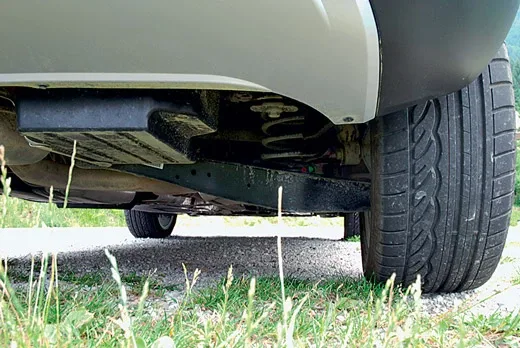
But overall, if we return to the sensations of driving the Yeti off-road, it's a great little machine, light and with an effective traction control system. The ground clearance is normal for a crossover — 180 mm, the underbody is flat, and the overhangs are small. Plus, there's a limited-slip differential on the rear axle. Honestly, for real-world operating conditions of such cars, the listed features are more than enough.
THRONE ROOM
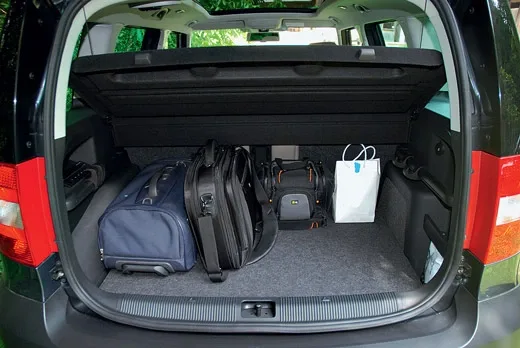
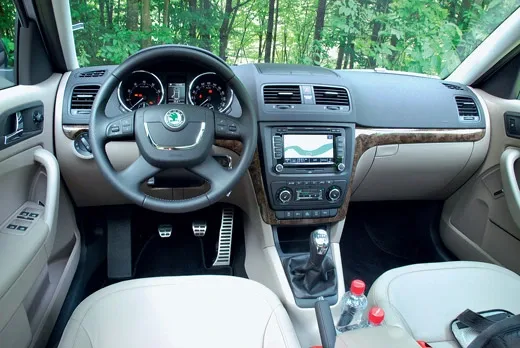
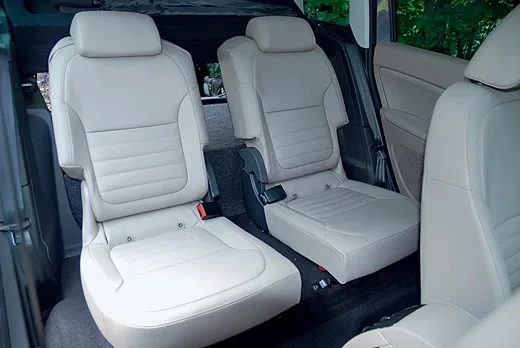
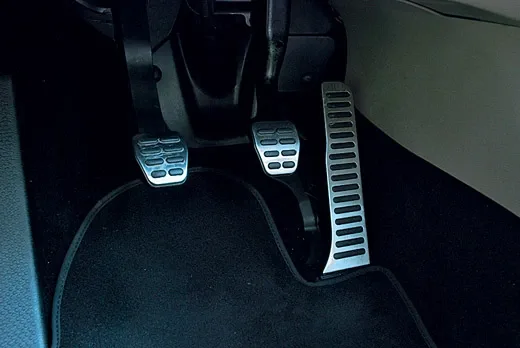
I saved the story about the Yeti for dessert and will start with what is usually mentioned first — the interior. The steering wheel here is a separate pleasure: dense, fits comfortably in the palms. And the rest? The rest is without surprises. Solid, well-thought-out. Perhaps even too calm. But in my opinion, the cabin should be exactly like this: practical, reliable, and without excessive pretentiousness. So that the plastic is soft, the panel joints are neat. And the ergonomics are precise. Recently we drove large seven-seat crossovers, and in none of them could I sit behind the wheel the way I wanted. But here, in this little one, it's easy. I could have moved the seat even further back, but then I wouldn't reach the pedals. And that's despite the fact that in childhood I didn't skip porridge and grew to 186 cm. Everything else is also to the point. The steering column adjusts in two directions, there is seat height adjustment and cushion tilt. But what disappointed: it's a bit cramped in the shoulders. If two sturdy men sit in front, the second one better not reach for the armrest. And another point: if you slide the driver's seat all the way back, the rear passenger seat can be safely crossed out — legs won't fit there anymore. By the way, about the rear row. It is divided into three sections, each moves forward and backward and is easily removed. Moreover, if you remove the middle part, the outer seats can be moved toward the doors by 8 cm. You get two full-fledged "thrones" for passengers. It's only a pity that with the seats removed, you don't get a flat floor: in the trunk niche hides a spare tire, which creates a step.