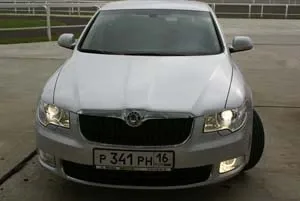
Škoda Superb
SUPER BIG
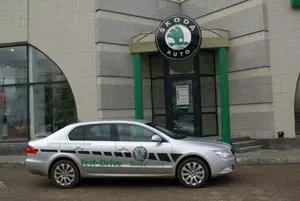
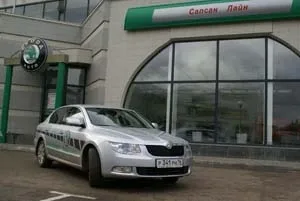
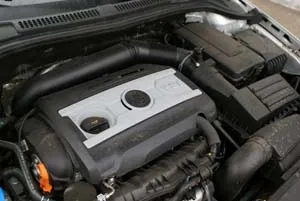
Power unit — 1.8 L TSI
Peak power —
160 hp/5000-6200 rpm
Max torque — 250 Nm/1500-4200 rpm
Top speed (km/h) — 220
Sprint 0-100 km/h — 8.5
Fuel consumption (L/100 km):
urban cycle — 10.4
extra-urban cycle — 6.0
combined cycle — 7.6
Front-wheel drive
6-speed manual
Length — 4838 mm
Width — 1817 mm
Height — 1462 mm
Curb weight — 2074 kg
Tires 205/55R16
Ground clearance — 168 mm
Price $ 35,233 (281,862 UAH), base version price $ 26,663 (213,300 UAH)
Equipment:
Elegance+, curtain airbags, seatbelt pretensioners, ESP (MSR, ABS, ASR, EDS, HBA), auto-folding mirrors, textile mats, SunSet tinted glass, Alcantara leather interior, metallic color
Maintenance costs:
Service intervals:
15,000 km
Service 1 at 15,000 km — $186 (1,485 UAH)
Service 2 at 30,000 km — $220 (1,756 UAH)
Service 3 at 45,000 km — $321 (2,565 UAH)
Service 4 at 60,000 km — $186 (1,485 UAH)
Service 5 at 75,000 km — $220 (1,756 UAH)
Service 6 at 90,000 km — $406 (3,240 UAH)
Warranty 2 years without mileage limit
Rivals:
Nissan Teana
Toyota Camry
Ford Mondeo
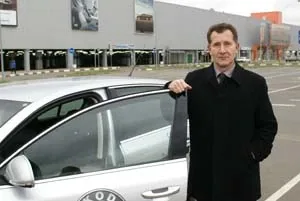
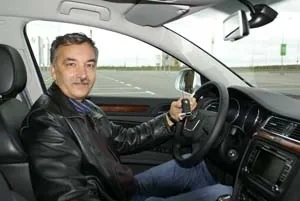
Marat Makhmutov, deputy director of the Kazan School of Higher Driving Skills
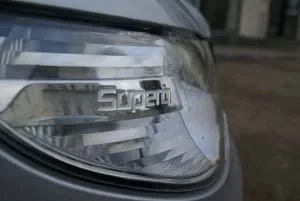
“Skoda Superb”. For me, this name always sounds like “Škoda Super B” — in my perception it is associated with the word “Super”, and I deliberately stress it differently than those who pronounce “Superb” with the stress on “e”. But the point, of course, is not how to pronounce the name, but whether the Czech brand deserves such a loud name. I remember back in the early eighties, when I, a young soldier, found myself in Czechoslovakia as part of the Central Group of Forces, I was assigned to a factory in Mladá Boleslav. Those who served don’t need an explanation of what that meant. Back then, I not only got to watch how the Škoda Favorit was assembled, but also participated in the process myself — I stamped fenders, hood, and roof for future cars.
Even in those days, the factory produced cars for export — I saw with my own eyes a batch of right-hand-drive Favorits ready for shipment to England. In our market, Škoda became known in the nineties when the Felicia appeared — a station wagon with a huge trunk, and then the Octavia came along, of which the Superb is the extended version. It’s interesting to trace how Czech cars and their quality have changed over this time, especially considering that the brand now works under the wing of the Volkswagen Group. There is something to look at, especially since the Super B is the flagship. Externally, it doesn’t differ much from the Octavia, except that in profile it looks more massive. The test car was equipped to the maximum: xenon headlights, electric adjustments for both front seats, cornering lights in the front bumper, wooden interior trim, dual-zone climate control, and much more. Moreover, the driver’s seat and both mirrors remember settings for three people. The large touchscreen of the stereo also caught my attention — the sound, by the way, is quite decent, and all settings are changed by simply pressing the desired menu item.
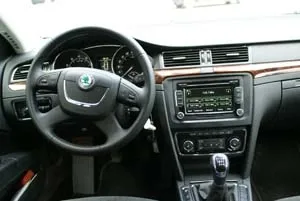
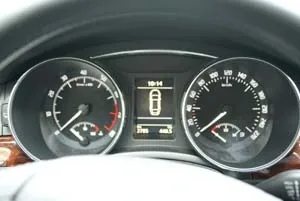
The trim materials are of a high level, assembly is done with German pedantry, sound insulation is top-notch, so there is nothing to fault: complete order! The equipment, of course, also includes an onboard computer and cruise control — and that’s on a car with a manual gearbox! What a surprise: I always thought that such a function is appropriate in pair with an “automatic”, where shifts are controlled by electronics, but here who will press the clutch if you need to change gear on a descent or ascent? To be fair, I note that on a flat road the car steadily maintains the set speed, but Alfred can tell you more about that — he was just playing with this “toy” on the highway.
And I’d rather describe how the car behaves on the road. By tradition, we start with acceleration and handling at the autodrome. The 1.8 TFSI engine with 160 hp pulls the heavy car quite briskly and confidently, revving to the limit without strain, but first gear is too short for a smooth shift up — shifting to second in the mid-rev range without a “dip” is not easy. If you rev the engine to the cutoff, everything is fine, but in everyday life nobody drives like that.
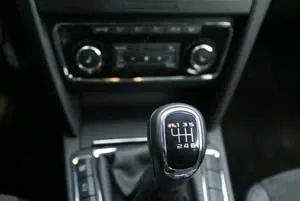
Such a car shouldn’t do that by status — after all, it’s not a sports car. Especially since there is so much legroom in the back that you can sit cross-legged and still have room to spare. So, this car is made for transporting important persons who value comfort, not racing mode. And yet, we didn’t cancel the handling test — it’s an element of safety, so we set up cones and get started. Each of us mastered the “slalom” at 80 km/h — an excellent result, given the long wheelbase. There are no complaints about the car’s behavior. If you miss the trajectory in a corner, ESP brakes the right wheel in time and returns the car to course. The engine’s elasticity allowed us to complete the “slalom” in second gear without extra shifts. But still, this car is more suited to an automatic gearbox — the trip to the highway was further confirmation.
Settling in the back, I imagined myself as an important “boss” being driven by a chauffeur. There were grounds for this role: not only is there a lot of space in length in the back, but there were also special footrests from the kit on the floor. You can settle in like in a home armchair and think about something important without being distracted by what’s happening outside. By the way, getting in and out through the rear doors is also convenient — nothing hinders entering the cabin or leaving it at a stop. And between the front seats, at the end of the cooled armrest, there is an information display with an outside temperature indicator, and under it — two buttons for separate rear seat heating. Everything for passenger comfort.
So, the ride on the rear sofa revealed two unpleasant features. The first is the already mentioned step when shifting from first to second gear, which causes a “dip” for the person sitting behind (the “boss” didn’t like it!). The second is that the back gets motion sickness, which is provoked, among other things, by the uneven change in longitudinal acceleration during gear changes and braking. The brake pedal is so sensitive that it requires not pressing, but rather stroking. Therefore, to transport the “boss”, you need an automatic… or a specially trained driver!
In conclusion, I return to the question of the quality of Czech cars and, in particular, the Superb. It seems to me that “Super B” more accurately than “Superb” reflects the essence of this car: a super Big Škoda, whose quality compared to the Forman, Favorit, and even Felicia is simply super, and is in no way inferior to German classmates within the concern. True, the price of the new car has also become super, competing with decent Japanese E-class representatives like the Teana and Camry. And in the D-class, this Škoda has even more rivals, including a famous relative — the Passat.
Vadim Sadykov, “Autoclub-Kazan”
Don’t rush to throw stones at me, but I consider the Superb the most worthy new model in the D-class. At least, among the cars we’ve managed to test. Let’s approach the choice of a D-class car somewhat detachedly, without focusing on exterior design (here two people will always have three opinions) and on the manufacturer’s name. What does a buyer of such a car need? First of all, the car should be spacious enough, both in length and width. The second important aspect is the quality of interior trim materials.
Status demands: there is no place for cheap and rattling plastic here. Naturally, even the base version cannot be poorly equipped. Chassis settings are a matter of preference, but the presence of torquey and economical engines is a must. And, of course, the price. After all, it’s what people look at first. If the cost of a D-class car is overpriced, then a potential buyer with such an amount might well look at something more prestigious in the E-class. Let’s return to the Superb. The starting price is 840 thousand rubles (not counting the exotic version with 1.4 turbo for 790 thousand). The maximum configuration (2.0 turbodiesel with 170 hp and all-wheel drive) is 1 million 70 thousand. True, later a version with V6 3.5 will appear, but its price has not yet been announced. The prices are quite adequate: Citroen C5 or Audi A4 will cost more. In terms of trim quality and thoughtfulness of mechanisms — a solid five. Especially pleasing was the combination of sedan and liftback. Configurations are formed according to the European principle: there is a basic set (Ambition or Elegance), and you can add many options to it.
This is convenient and practical. You can build the car to suit yourself: save on what you don't need or get everything you need. The 1.8 turbo engine (the same as in the A4) is quite economical, yet it easily accelerates the car (factory 8.5 seconds to 100 km/h). This engine can be paired with a 7-speed DSG robot, while the 2.0 turbodiesel comes with a 6-speed. DSG compares favorably with conventional automatics: the efficiency of a manual and the convenience of an automatic in one. Thanks to the low-profile tires 225/45/17, the car handled the slalom test excellently. But in everyday city driving on our roads, everyone felt excessive stiffness. For me, this was the biggest and most unexpected drawback. With R16 wheels, it would be more comfortable.
The car, I repeat, is almost ideal in terms of overall characteristics. Perhaps except for the name — Skoda. We are used to this brand making inexpensive and good cars. But having such a solid representative in its lineup is still new to me personally.
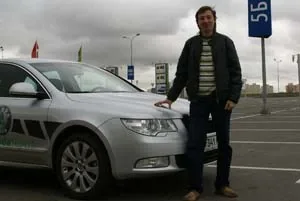
Alfred Mardanov, "Autoclub-Kazan"
The first Superb from Skoda appeared back in the late 30s. They were created to meet the growing demand for expensive and refined cars, but the war hindered these plans. The current Superb is essentially made for the same purposes. The first thing you think of when looking at this car is: where is the German trace here? You involuntarily look for common features with VW, because the car is built on an extended platform from the Passat. There is something common with VW, something barely perceptible and airy. Whether it's interior elements, or body lines and headlights... Stop! I get it! It's the feeling of ergonomics, comfort, and prosperity inherent to VW! The interior is styled very similarly — strict, without excess. This applies to both materials and design. When I got behind the wheel to move the car for shooting, I turned the key — and the car immediately jerked. The gearbox is manual, and first gear was engaged. Hmm... such a car should be driven by experienced drivers, not "newbies" like me. There's no foolproofing here, while in many modern cars it's already the norm: the engine won't start until you press the clutch. But okay, why am I nitpicking, it's my own fault.
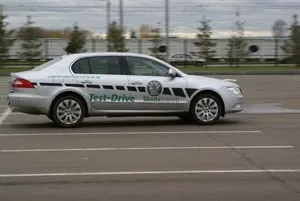
I press the clutch, turn the key, and realize the engine has started only by the instruments. I try to give it gas — the tachometer needle makes its usual movements, and silence. Sound insulation is excellent. I try to pull away and almost stall. First gear requires revving, and the long clutch pedal travel doesn't help. After a short photo session, we go with the dealership manager to the test track. Traffic light, first, second, third — and then a slight ding-ding. What's that? Seatbelts are fastened, I look at the speedometer — ah, probably it's the buzzer that goes off at 100 km/h. And I didn't even notice how I accelerated. Now I'll be more careful. The slalom on the track is clearly passed at 80 km/h, and both Marat and I did it the same. Slightly exceed this speed — and the last two turns are already in a drift. Conclusion: for its length, the car holds unexpectedly well and performed admirably. Moreover, I drove the slalom in second gear — it's somehow endless, the engine revs easily and accelerates the car to 80, you can feel there's a reserve up to a hundred.
Now we head out onto the highway — there, such an engine has room to stretch its legs and breathe freely. While driving, the "ding-ding" sounded more than once: the car takes a hundred too easily, and this tinkling in the quiet cabin even started to get annoying. Vadim, finding himself behind the wheel on the highway and performing his signature test — overtaking without shifting from fifth gear, couldn't hold back an exclamation of approval. And what was his disappointment when I got behind the wheel and "found" sixth gear. Ha! He simply forgot about it. By the way, sixth gear here is functional, unlike many other manual cars where it's just for show. It was interesting to test the cruise control: how would it behave, since it can't shift gears itself. In fifth gear, the speed range at which it maintains the set mode is quite wide. Conclusion: it's a useful thing, especially since we already have roads where it can be used. You can take a break from the long-travel clutch that tired me out. The suspension's work on the "washboard" road on the way to the bypass also tired me — it's a bit stiff, doesn't let you relax. And you so want to stretch your legs, lounge in the seat and... Well, who knows what else might come to mind if you pretend to be the boss in the back seat. And there's just the place for him: very spacious in length and decent in width. If we return to highway behavior, one cannot help but note the engine's tractive effort, which doesn't need to downshift when overtaking. Speaking of the car as a whole, it's appealing, wins you over with quality and a certain chic. And the most pleasant thing — it's worth its money. It's honest with the buyer, doesn't make you overpay for a badge, and that already deserves respect.
(C) "Autoclub-Kazan".