The previous Superb essentially came to the Czechs for free — no one looks into the radiator grille of such a car. It was built on the basis of the "stretched" Passat intended for China: the exterior got a slight makeup touch-up, while the interior was left authentic. And lo and behold — the car was a hit! Every year, 30,000 buyers were found. The Czechs profited from "corporate sales": the spacious, reliable, and roomy model appealed to fleet operators. So what has changed now?
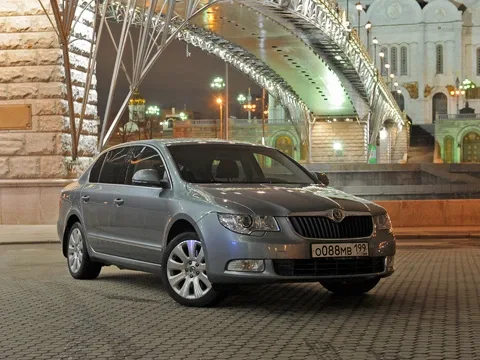
There was talk that Skoda intended to make the Superb different — more elegant and avant-garde. So that it would not only collect awards in categories like "Ideal Taxi" or "Best Budget Official Hauler," but also become an attractive family car. However, they got scared: what if previous customers wouldn't understand?! In the automotive industry, only things that sell terribly are radically changed. What sells well is preferably left untouched.
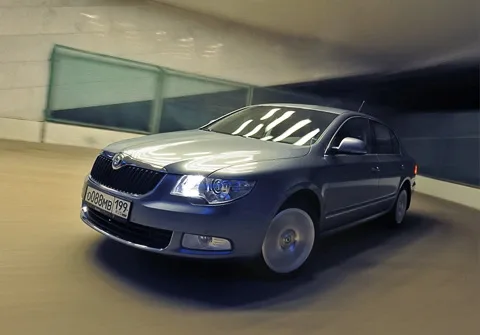
Adaptive bi-xenon headlights not only turn with the steering wheel but also change the shape of the light beam depending on speed.
And yet this restraint leaves a feeling of understatement — it seems as if the Czechs were allocated a budget for "transforming" the Passat into a Superb, but there wasn't enough money left for a full-fledged design effort. Or desire. After all, it would have been enough to slightly fix the humpbacked profile, "treat" the dreary front end — and you'd get a completely different car. Or else make it majestic and imperial, like the pre-war Superb limousines.
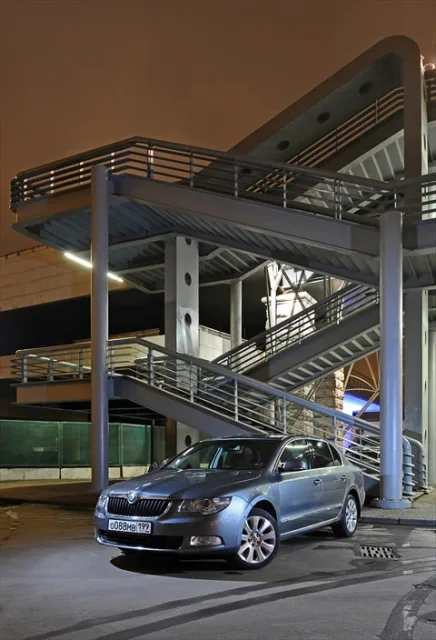
Rather, you want to get inside, take a ride — to confirm that the car is lousy, and then calm down. I sat down. Okay, I'll admit honestly. In the first paragraph, I was being disingenuous — I don't want to get out not only because of the exterior. Inside — it's just great! The Passat could envy the trim materials, not to mention various Teanas and Camrys — the latter's plastic on the center console probably turned green from envy. After the Superb, the feeling in them is as if you were moved from a decent "Hilton" to some "Ukraine" — expensive but still Soviet-style.
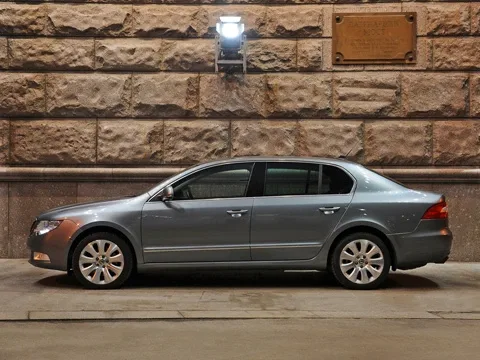
The Superb's wheelbase is 2761 mm: 44 less than the previous generation. However, due to the switch to a transverse engine layout, there's more space in the back.
No matter how much I searched, I found no flashy elements or overuse of wooden inserts in the cabin. Instead, I found solid plastic, luxurious combined leather and Alcantara upholstery, perfectly tuned climate control, and a sensible navigation system with a clear interface. Attention to detail: the ventilation ducts look solid and are trimmed with chrome, all door handles are rubberized inside and illuminated with LEDs; even the glove box lid is made of soft plastic.
In the back — there's plenty of room, even for Uncle Styopa in his cap. Additionally, passengers get pleasant little touches: footrests, sunshades, a clock, and an outside thermometer. It's a pity that the sofa itself is flat, and the backrest doesn't recline: with such a space reserve, you could have lounged.
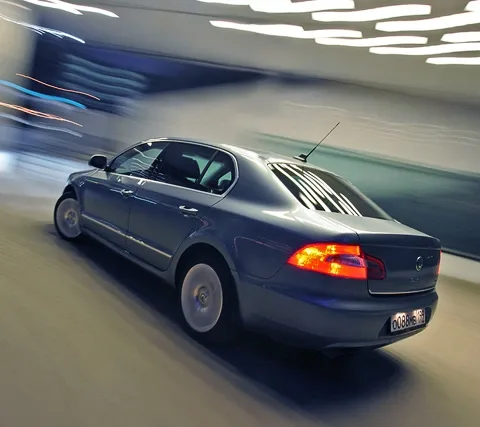
However, the Superb is not just about rear passengers. Getting behind the wheel, I notice that Uncle Styopa would have no trouble settling in here either: the adjustment ranges are huge. I take the familiar Golf seating position, start the engine with the familiar flip key, and pull away. Everything is familiar. Golf, Passat, Polo — on the move, the Superb reminds me of all of them at once. Convenient pedal box, light but informative steering, a resilient suspension that thumps slightly on large bumps, and excellent directional stability. The 1.8 TSI engine pulls beautifully from two and a half thousand rpm, and while the gearshift lever travel is a bit long, the precision is still unmatched.
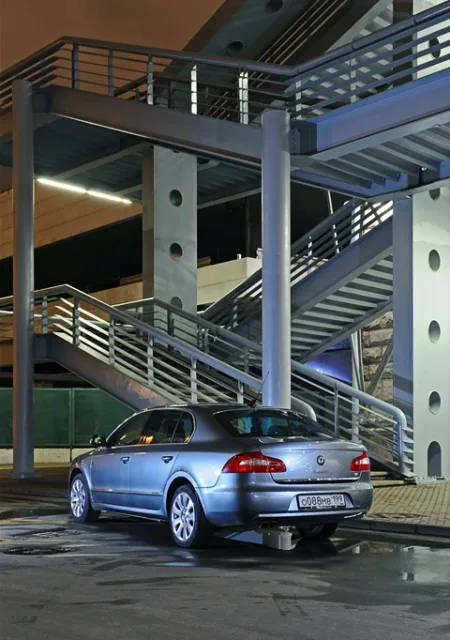
And already in the first corner, I start to hooligan. A finger to the ESP off button, foot off the gas: and the Superb wags its tail as if it weren't a heavy business-class sedan-liftback but a frivolous hot hatch! But as soon as you turn the system back on, in a tight corner it merely delicately brings the car back on course. By the way, much more delicately than Volkswagens do. The question is — why pamper a hired driver with such handling?
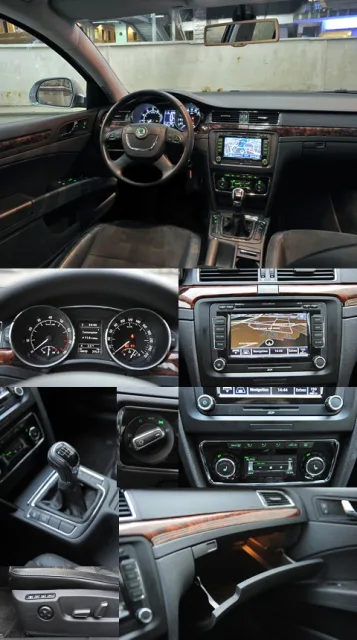
The cabin is assembled from Volkswagen components: the navigation, climate control unit, and onboard computer screen only changed the backlight color. The instruments are like on the latest Golf. But attention to detail is at an unthinkable level for Skoda.
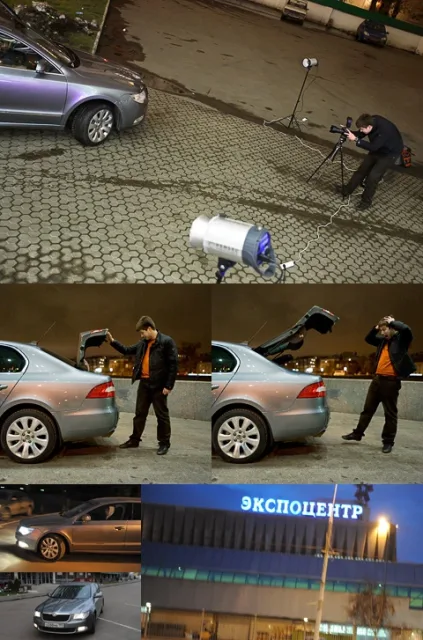
A status car also doesn't need the gimmick of a double door. A sedan body would suffice. And for a family... I have nothing against sedans — until I have to drive one every day. You can't fit a bicycle. A snowboard and skis will fit, but with cursing. In the Superb, you can stuff almost anything — the trunk is huge and has a large opening. When there are no bulky loads, you can open only the "sedan" lid and not blast the rear passengers' ears. True, they didn't manage to make the Superb a proper hatchback — the backrest doesn't fold flush with the floor. The idea is good, but the implementation fell a bit short.
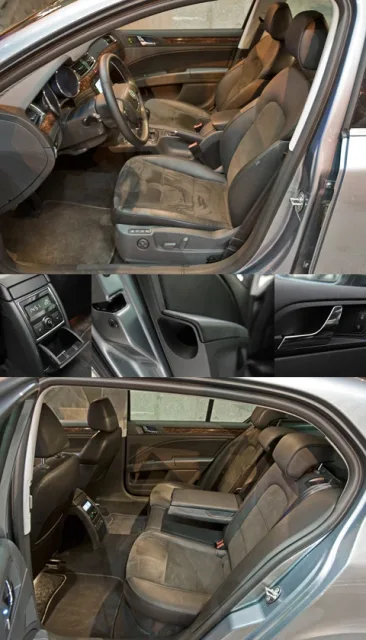
The front seats are comfortable and have power adjustments with memory, but the shape of the rear sofa is suboptimal.
So, has Skoda really built the perfect car for all occasions? No. First, it's ugly. Second, it's made by Skoda — a company that in Soviet times produced cars no better than the Zhiguli. And although the new Superb is truly excellent, it won't take many customers from Volvo, but it will nip at the heels of Japanese business class. And also the Insignia and its ilk. Though here it's still a question of who gets whom.

The rear door is not only double but also equipped with a soft-close mechanism.
However, why encroach on the very top? And the pre-war Superb, not counting licensed Hispano-Suiza cars, was the company's most luxurious model — but it wasn't fit to lick the boots of the then automotive elite. Yet it always cost reasonable money. And it still does: the test car in very rich trim — with hard-drive navigation, self-parking, leather and Alcantara interior, adaptive bi-xenon, power seats with memory, and other delights — costs just over a million.
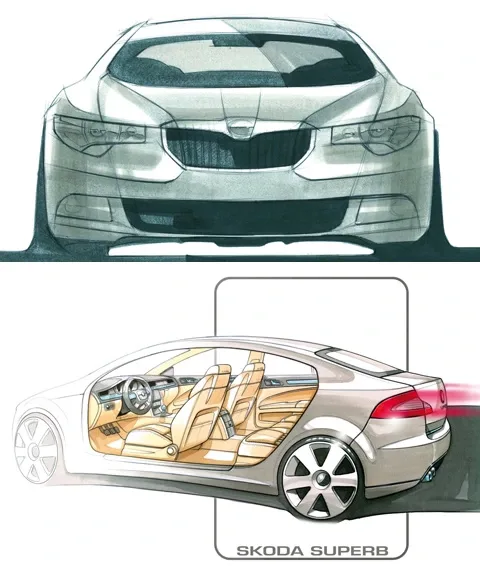
It would have been better if the company hadn't shown these sketches of the Superb — in them, it looked far more attractive.
But the main problem of the Superb is in itself. To hell with the design and prestige. Beauty is subjective, and the lack of pomp is even a plus for me. If I had such a car, I'd be torn — whether to sit behind the wheel or in the back. But definitely not outside.
| Specifications | Skoda Superb 1.8 TSI |
|---|---|
| Body | |
| Number of doors/seats | 4/5 |
| Length, mm | 4838 |
| Width, mm | 1817 |
| Height, mm | 1462 |
| Wheelbase, mm | 2761 |
| Front/rear track, mm | 1545/1518 |
| Curb weight, kg | 1454 |
| Gross weight, kg | 2074 |
| Trunk volume, l | 565–1670 |
| Engine | |
| Type | petrol, with direct injection and turbocharging |
| Location | front, transverse |
| Number and arrangement of cylinders | 4, in-line |
| Number of valves | 16 |
| Displacement, cm3 | 1798 |
| Max power, hp/rpm | 160/5000–6200 |
| Max torque, N•m/rpm | 250/1500–4200 |
| Transmission | |
| Gearbox | manual, six-speed |
| Drive | front |
| Chassis | |
| Front suspension | independent, spring, McPherson |
| Rear suspension | independent, spring, multi-link |
| Front brakes | disc, ventilated |
| Rear brakes | disc |
| Ground clearance, mm | 139 |
| Performance characteristics | |
| Maximum speed, km/h | 220 |
| Acceleration time 0–100 km/h, s | 8.6 |
| Fuel consumption, l/100 km | |
| – urban cycle | 10.4 |
| – extra-urban cycle | 6 |
| – combined cycle | 7.6 |
| Toxicity standard | Euro 4 |
| Fuel tank capacity, l | 60 |
| Fuel | AI-92 |
Trim level Base equipment
Price of tested car — 1,112,620 rubles
- Front airbags
- Side airbags
- Fog lights
- ABS
- Tire pressure monitoring system
- Light and rain sensors
- Bi-xenon adaptive headlights
- Front and rear power windows
- Power-adjustable and heated exterior mirrors
- Cruise control
- Dual-zone climate control
- Heated front and rear seats
- Front seats with power adjustment and memory function
- CD/MP3 audio system with 8 speakers
- Multifunction steering wheel
- Rear parking sensors
- 17-inch alloy wheels
- Central locking
- Front and rear power windows
- On-board computer
- Steering column with tilt and reach adjustment
- Power steering
- Full-size spare wheel
- Leather-wrapped steering wheel and gear shift knob
- Metallic paint
- Electronic stability control
- Curtain airbags
- Driver's knee airbag
- Rear side airbags
- Combined leather and Alcantara seat upholstery
- Automatic parking system
- Auto-dimming interior rearview mirror
- Preparation for mobile phone connection
- Navigation system with 30-gigabyte hard drive
Price of tested car — 1,112,620 rubles
Behind the scenes