
Skoda Roomster. Children's Room
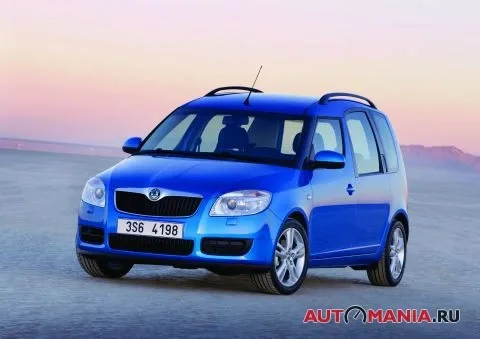
It's interesting what Skoda's chief designer Thomas Ingenlath had in mind when he drew the profile of the eponymous concept. Was it a multicolored Rubik's cube that bends in all directions? Such audacity has never been seen! Although, perhaps this deliberately divided into front and rear parts car will become the beginning of something new — at least, the Czechs are confident in this.
Room-ster… "Room" — "room", "-ster" — the ending of the word "roadster", hinting at speed. The front part, dynamic and somewhat resembling an airplane cockpit, is the driving room, while the rear, "residential" part is the living room. The whole point lies precisely in their clear separation.
The interior of the driving room is clearly inspired by the new generation of the Skoda Fabia, which was shown to journalists quite recently. True, it didn't come to full copying — here there is its own front panel with two "glove boxes". It must be said that the Czechs quickly and efficiently absorbed everything that VW gave them. Ergonomics and comfort in the front seats of the Roomster are at the maximum level for this class. And given that this is a completely independent development, one can only applaud.
Everything needed is at hand for the driver. The range of adjustments and space reserve allow both a fragile girl and a person of basketball height to sit comfortably behind the wheel. Whatever the driver's height, there will be enough space in the cabin: both above the head and at elbow level. As for details, the Czechs have not abandoned unification with the products of the "big brother". But this in no way diminishes the merits of the new product, but on the contrary: for ergonomics and reliability of VW components, the latter has long received an "automatic pass".
If the driving room is part of a passenger car, then the living room environment is borrowed from compact vans. Passengers will have to sit more upright, even despite the backrest tilt adjustment. But there are also tangible advantages — the configuration of the rear sofa changes endlessly. Each of its three sections can be moved along, folded, or completely removed. If the middle part is dismantled, the Roomster turns from a five-seater into a four-seater, and the outer seats shift toward the center. Large glazing area, panoramic roof — the younger generation, which usually "lives" on the rear sofa, should like such a car. Children will definitely have something to do and look at…
Buyers are offered a traditionally wide choice of engines: three gasoline and, more interestingly, a couple of turbodiesels. The base engine, as on the old Fabia, is a three-cylinder unit with a displacement of 1.2 liters, producing just over 60 horsepower. And it is truly base — given the mass it is entrusted with, its role in the lineup is purely nominal: it's a bit weak, you know. But the 1.4-liter 86-horsepower engine is its complete opposite. With it, the Roomster is confident and quite dynamic, the main thing is not to be afraid to rev it to high speeds. However, since it is only paired with a 5-speed manual, there will be no problems with that. The "automatic" is installed on the compact van exclusively in combination with the 1.6-liter 104-horsepower unit from VW. Both of these engines are quite decent in characteristics and will undoubtedly find their admirers.
However, the main "highlight" is the 1.9-liter turbodiesel with 101 hp. It is simply magnificent, and there is nothing to add here. Half of Europe drives this engine; it is installed on both "Golfs" and more democratic Audi models. It is thanks to it that the old Fabia RS turned from a modest average hatchback into an aggressive fury — fast, sharp, and lively. Exactly the same can be said about the similar version of the Roomster, which, oddly enough, seemed to the author of these lines even more driver-oriented than its gasoline counterparts. But its "appetite" is quite moderate — from 6 to 8 liters per 100 km, depending on driving style.
Well, since we've touched on driving, it's worth noting that the new product will give a head start to many classmates, and the reason for this is a mixed chassis. The front of the compact van is from the new Fabia, but the rear is from the Octavia, due to which the rear track is 70 mm wider than the front. This adds dynamic stability and, partly, controllability to the car. The suspension of the "Czech" provides quite comfortable driving, which is also important for a family car.
On our market, the Skoda Roomster is sold in four trim levels — in addition to the base one, the buyer will be offered Style, Sport, and Comfort versions. The minimum price of the model with a 1.2-liter engine and driver's airbag is just under $15,500. Further, the number and quality of options grows proportionally to the price, as does the same for engines and transmissions. So, a car with an automatic transmission becomes available only when reaching the threshold of $20,000. The most expensive will be the Sport and Comfort versions (with that very 1.9-liter turbodiesel and manual transmission) — for them you will have to pay $24,890 each. Anticipating skeptical remarks, I want to note that over the past few years Skoda has gradually moved away from the role of a dependent brand and proved that it can produce quite high-quality products. And for quality, as always, you have to pay.
Technical specifications. Skoda Roomster
Length (mm) 4205 Width (mm) 1867 Height (mm) 1607 Wheelbase (mm) 2617 Weight (kg) 1155 Trunk volume (l) Engine displacement (cm3) 1390 Max power (hp) 86 at 5000 rpm Max torque (Nm) 132 at 3800 rpm Max speed (km/h) 171 Acceleration 0-100 km/h (s) 13 Average fuel consumption (l) 5.6
Price ($) 15,490-24,890
Alexey Vorontsov
Source – www.automania.ru