
Skoda Fabia. Recipe for Success
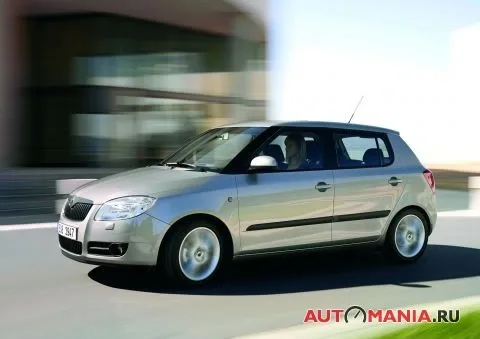
The changes that have happened to the Skoda Fabia cannot be called a simple update — it is a full-fledged transformation. The Czechs have clearly made it known that they are determined to radically rethink their image. Not a trace remains of that strict, almost "Volkswagen-like" restraint. The car now has "cat-like" headlights at the front with outer corners that seem to flow onto the fenders, a completely different character of the radiator grille (with the brand badge at the top), and new bumpers. The rear lights have also changed, gaining signature C-shaped sections. Add to this the modern shapes, bold design solutions, dynamic silhouette — and you have a ready candidate for a bestseller.
The front part, as the manufacturers announced in advance, is an exact copy of the previously released Roomster microvan. But in spirit and mood, the Fabia body with its "two-box" design has nothing in common with its "relative." Personally, it reminded me somewhat of the charming MINI Cooper. Perhaps it's the black roof pillars or the "raised" tail above the rear door. Of course, this is a subjective opinion, and everyone will find something of their own in the Fabia's appearance, but a comparison with the holder of the "European Car of the Year" title certainly won't hurt the model.
The Czechs have not changed their established rule and have again slightly increased the body, not neglecting the wheelbase either. The result of this enlargement immediately affected the interior. It wasn't cramped before, but in the new version it has become noticeably more spacious, especially in terms of the always scarce legroom for rear passengers and headroom in such cars. In general, the amount of free space and range of adjustments will be enough for both a fragile girl and a person of considerable height and build to sit comfortably behind the wheel. It's nice that there is also room for the trunk, which now holds 300 liters instead of the previous 280.
As for the design, here the Fabia has also risen a notch: everything is neat, tidy, and quite modern. Cheap plastic is a thing of the past; the quality of materials and assembly should now satisfy even the most demanding. True, the interior atmosphere remains the same: the cabin of the new model is still completely unemotional. The Skoda folks, without overthinking, chose good over better. Having substantially reworked the appearance of the main interior parts, they only followed tradition. As before, the main role here is given to ergonomics. All controls that the driver might need while driving are exactly where you expect to find them. Around the perimeter are various boxes, cup holders, niches, holders... And at the same time, no design liberties. The only thing the authors allowed themselves is the contrasting execution of the front panel, which, of course, added solidity to the interior.
As before, a wide range of powertrains will be offered for the Fabia, and no territorial division is provided, so our buyers, in addition to petrol engines, will also have access to turbodiesels. In the petrol lineup, the base remains the three-cylinder 1.2-liter engine. Depending on the settings, it produces 60 or 70 hp. It won't satisfy driver ambitions, of course, but practice shows that demand for such versions justifies their existence. The most popular here promises to be the 86-hp 1.4-liter petrol engine, which we are already familiar with from the Skoda Roomster. With comparable fuel consumption to the "younger" ones, it boasts enviable elasticity and decent torque (maximum 132 Nm is available already at 3800 rpm), making it quite dynamic. The top petrol unit will be a new 1.6-liter engine with 105 hp, which accelerates the Fabia to 100 km/h in just over 10 seconds. By the way, in addition to the usual 5-speed manual, it can be paired with a new-for-the-model 6-speed Tiptronic automatic.
Given how petrol prices are rising, the trio of turbodiesel modifications will come in handy. Essentially, there are two engines here: 1.4 and 1.9 liters. In the first case, the three-cylinder 1.4-liter unit, depending on the version, produces 70 or 80 hp. The figures seem modest, but decent torque, available across almost the entire rev range, provides the car with respectable dynamics and speed. But the most interesting thing is not that: the range of a car with such an engine at rational fuel consumption can reach 900 (!) kilometers. The most powerful turbodiesel with a volume of 1.9 liters develops 101 hp, with a peak torque of 240 Nm at 1800 rpm, allowing the hatchback to reach 100 km/h in 10.8 seconds. The top speed is 190 km/h, and consumption is less than 6 liters. With such characteristics, it is safe to say that this engine will be in demand. True, this statement is probably only valid for Europe: firstly, our compatriots still distrust diesels, and secondly, the price of such a Skoda will likely be comparable not only to the cost of the Octavia but also to the base VW Passat.
By the way, prices for the new Fabia have not yet been announced. This applies not only to Russia but also to the Old World. One can only guess, relying on indirect factors, for example, the starting price of the same Roomster — just over $15,500. But this does not give an objective picture either, since the Czechs, like their "big brother" VW, prefer maximum variability in this matter. For the Fabia, 4 trim levels are provided: Classic, Ambiente, Sport, and Elegance, each with its own set of mandatory options. For example, the Classic includes only 4 airbags, ABS with brake force distribution, seatbelt pretensioners, power steering, and an immobilizer. The Ambiente adds a radio, front power windows, folding rear seat back, the Sport adds fog lights... Air conditioning in most cases is available only as an additional, i.e., paid, option. The same applies to a lot of other equipment.
The conclusion for today is this: people accustomed to considering Skoda a secondary brand making affordable cars are unlikely to be pleased with the prices of the new Fabia. However, given the pace of development of our market, it is quite possible that this will not affect the popularity of the new model at all.
Technical specifications: Skoda Fabia
Dimensions: Length (mm) 3992 Width (mm) 1642 Height (mm) 1498 Wheelbase (mm) 2462 Weight (kg) 1070 Trunk volume (l) 300/1163 Engine displacement (cm3) 1598 Max power (hp) 105 at 5600 rpm Max torque (Nm) 153 at 3800 rpm Max speed (km/h) 190 Acceleration 0-100 km/h (s) 10.1 Average fuel consumption (l) 6.9
Alexey Vorontsov.
Source – www.automania.ru