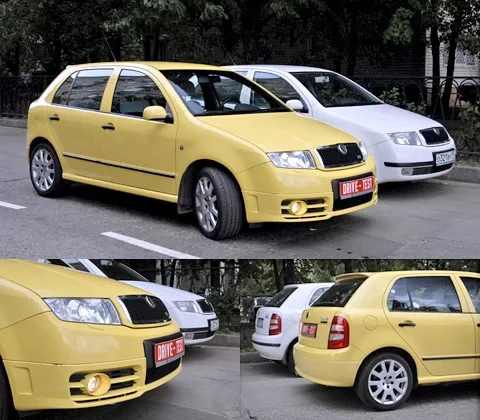
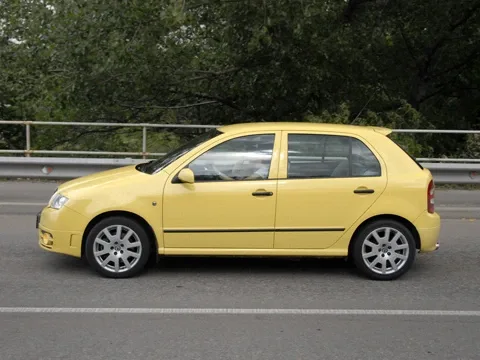
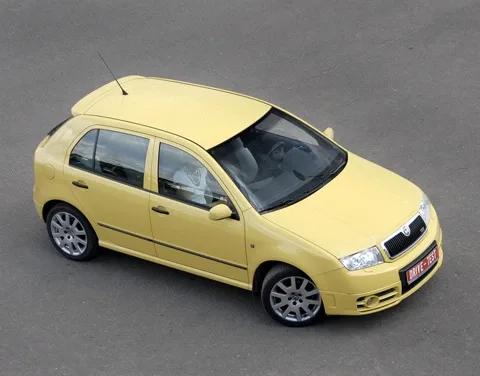
The Skoda Fabia RS opened a new chapter in the history of "hot" versions. The car's exterior immediately reveals its belonging to the sports family: a massive front bumper with an aggressive "chin," neat sill covers, and 16-inch wheels in the signature RS style. Recognizable badges on the grille and the fifth door complete the look. And crowning it all is a fairly large chrome exhaust pipe from which a puff of black smoke bursts out during a sharp start. And let no one be confused: under the hood here is a diesel, not a broken gasoline engine. It's easy to imagine how fans of hot hatches grimaced at such news.
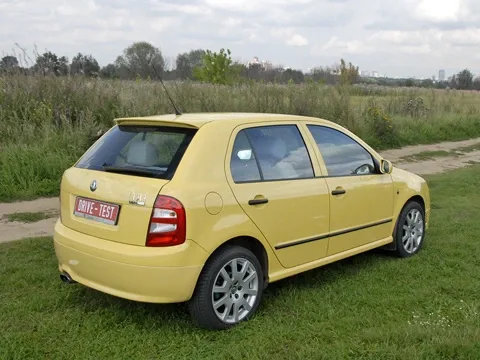
Even in a bright color, the Fabia RS looks so ordinary that others don't take it seriously. And that's only a plus: the less noticeable the car, the more surprise there will be on drivers' faces at the next intersection.
But don't jump to conclusions. Yes, the 1.9-liter turbodiesel doesn't impress with its 130 horsepower. However, the torque of 310 Nm, available from 1900 rpm, is one and a half times more than that of recognized class leaders like the Honda Civic Type-R or Renault Clio Sport, and comparable to the new turbocharged "hot" Golfs. For the first time, a diesel hatchback is not associated with agricultural machinery, but is ready to compete on equal terms with gasoline opponents. The claimed 9.6 seconds to 100 km/h, of course, brings a smirk, but in the case of the Fabia RS, these figures don't convey the real picture of what's happening.
The bright yellow car, having received a signal from the key fob, greeted me with a friendly blink of its turn signals and opened the doors. Inside, a familiar picture: a standard front panel made of black plastic, which looks somewhat dull, although the build quality and fit of parts are top-notch. The ceiling is also dark, but on a sunny day it doesn't weigh on the psyche. The main thing here is something else: an excellent three-spoke steering wheel with leather trim, metal pedal covers, a comfortable six-speed manual gear lever, and sports seats with the RS emblem on the backrests.
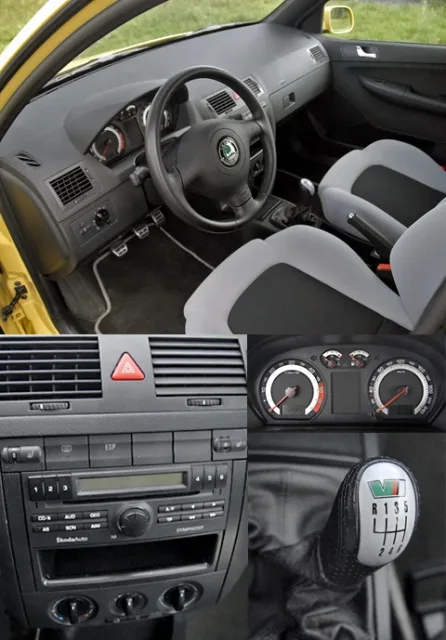
Inside is simple but comfortable. No complaints about ergonomics.
The driver's seat is well organized. The only remark is that the side bolsters of the seats could use more firmness. After quickly adjusting the mirrors (by the way, when will Volkswagen Group stop tormenting drivers with the small right mirror?) and controls, I start the engine. At idle, the diesel makes itself quite noticeable, as if urging: "Enough idling, time to hit the road!".
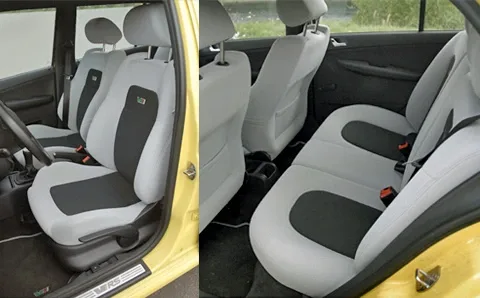
The front seats hold you well in corners, but rear passengers, as usual in this class, will find it a bit cramped. However, no one asked their opinion.
Let's go. As soon as I leave the alley, I immediately get into a traffic jam on the Boulevard Ring. In such a mode, driving the Fabia RS can get boring: there's nothing to catch the eye, and you involuntarily start to nitpick at little things, the first of which is the lack of climate control. Only a regular air conditioner saves you from suffocating in the scorching city. Slow movement in traffic reveals another nuance: the clutch feels somewhat vague, and the diesel doesn't please with traction at the very bottom. If you drive as you're used to in a gasoline car, then up to two thousand rpm the car barely crawls, and then the turbo wakes up, and the Fabia sharply picks up.
But now the traffic jam is behind, and I stop first at a traffic light. Let's try a different approach: before starting, I raise the revs to two thousand and drop the clutch. Wow! With a squeal of tires, the yellow beast lunges forward. The tachometer needle instantly flies to four thousand, and the main thing is to shift to the next gear in time, fortunately the gearbox works clearly. The yellow ESP icon desperately flashes on the panel up to third gear. At the next traffic light, I noticed bewildered looks from drivers who clearly didn't expect such agility from a "budget compact." After several such starts, accompanied by the loud and gruff voice of the engine, you forget about the dull interior, the air conditioner, and everything else in the world. Only the drive remains. A smile naturally blooms on your face, perfectly matching the sunny yellow body color.
The only thing you need to get used to is the relatively narrow operating range of the engine. But it's easy to adapt: the six-speed manual with tight ratios allows you to easily keep the tachometer needle between the "2" and "4" marks. If on the first two gears someone still tries to keep up with the Fabia RS, then on third the car already exceeds a hundred (hence the modest claimed figures), and the huge torque takes over, while rivals simply disappear in the mirrors. A friend I was giving a ride surprised me after a couple of minutes with the question: "Why is this Fabia so nimble?" There you go, stereotypes.
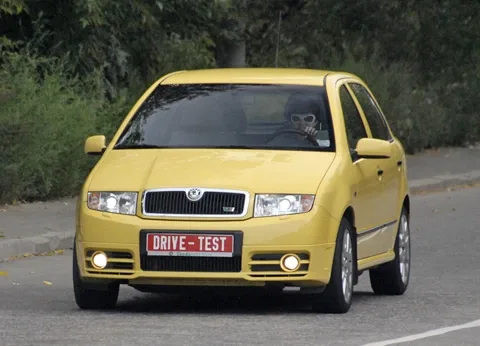
Remember: the friendly appearance of the Fabia RS is deceptive. In fact, it's a very angry car. Angry not for the driver, but for everyone else.
Handling raises no complaints. My fears about the heavy engine hanging over the front axle were only partially justified: there is understeer, but it's perfectly compensated by grippy tires — our car had sporty Michelin Pilot Exalto 2 up front. The stability control system works delicately and doesn't interfere with active driving. The brakes initially disappointed: the pedal with a long travel is inconvenient in city traffic. But at speed, everything falls into place — the mechanisms with green calipers confidently hold the load. On the highway, the Fabia RS practically ignores ruts: having accelerated on a free road, I was surprised to see 200 km/h on the speedometer, while my hands weren't tense, and I didn't have to grip the steering wheel convulsively. In the evening, the xenon headlights easily "pierce" the darkness of the left lane. Some drivers overtaken by "some Fabia" tried to come back and restore justice, but to no avail.
It's at high speeds that the Fabia RS fully reveals itself: the turbodiesel delivers excellent traction in any gear, thoughtful aerodynamics keep the car on course, and sound insulation allows you to talk to passengers without raising your voice. The car also pleased at the gas station: the onboard computer showed an average consumption of 10 liters per hundred even with extreme driving! And in a calm city rhythm, without racing from traffic lights and highway speeds, the appetite drops below 8 liters. A small thing, but nice.
Honestly, the car is so endearing with its driving qualities and endless traction that you stop paying attention to things like modest equipment (rear passengers have to crank manual windows) and a nondescript image (although there's a certain charm in that!). The mind is only not ready to accept the price. For the Fabia RS in this configuration, they ask $24,920. And that's already almost the territory where predators with much more powerful engines live. It's a pity that an excellent car that deserved the right to wear the RS badge was let down by marketing policy.
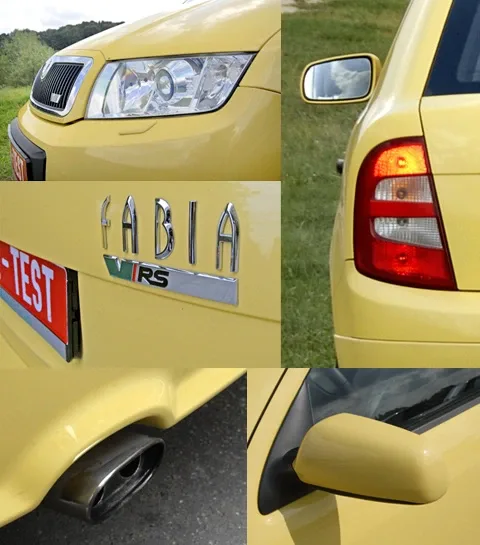
In the parking lot, the car rattles amusingly. But those who looked down on the diesel Fabia at the traffic light will be carefully examining the RS badge on the tailgate at the next one.
What's next? The experiment with installing a diesel in a "hot" hatchback turned out to be successful, and in Volkswagen's laboratories they are already preparing new representatives of the diesel family — this time with a more serious argument: a new 2-liter 170-horsepower turbodiesel that will also appear on the Skoda Octavia RS. The task of these predators is to challenge gasoline competitors. But that's a completely different story…
First Impressions
For the test, I got a Skoda Fabia RS in a bright trim. This is the version that received an aggressive body kit, sports seats, and special alloy wheels from the factory. It's immediately clear that this is not just a city hatchback, but an attempt to make something more driver-oriented out of a compact car.
Under the hood of this Fabia is a 1.9-liter turbodiesel engine. It produces 130 horsepower at 4000 rpm, and torque of 310 Nm is available from 1900 rpm. This unit works in conjunction with a six-speed manual that transmits traction to the front wheels. Acceleration to 100 km/h takes 9.6 seconds, and the top speed is 204 km/h. The claimed fuel consumption in the city is 7.4 liters, and on the highway — only 4.5.
The price of such a car is $24,920. For this money, you get quite rich equipment: xenon headlights with washers, air conditioning, an onboard computer, heated washer nozzles, a sports steering wheel in black perforated leather, electro-hydraulic power steering, and disc brakes with green calipers that immediately catch the eye.
Driving Impressions
The interior greets you with sporty seats with bright upholstery and the signature RS lettering on the floor mats. The driver's seat can be height-adjusted using a micro-lift, and the steering column is adjustable for both height and reach. The rear row folds in a 60/40 ratio, and under the passenger seat there is a convenient box for small items. The trunk in standard condition is 260 liters, but if you fold down the seatbacks, it expands to 1015 liters.
You start the engine, and the diesel immediately makes itself known with a slight vibration at idle, but it is quite quiet while driving. Turbo lag is almost imperceptible; torque picks up confidently from low revs. The six-speed gearbox works precisely, the gear lever is sporty with a short throw, which adds to the driving excitement. The Fabia handles nicely: the steering builds up effort, the suspension with coil springs on both axles is taut, but it makes itself known on uneven surfaces.
The ground clearance is 140 mm, which is quite acceptable for a sporty version. Front and rear brakes are disc, with ABS and Brake Assist, so deceleration is confident. The turning circle is 9.9 meters, allowing easy maneuvering in the city. The curb weight is 1245 kg, and the gross weight is 1720 kg.
Among the little things that please: light-absorbing coating on the windshield, a gray stripe on it as well, two reading lights in the front, a vanity mirror in the right sun visor, and a two-tone horn. There is also preparation for installing a radio with eight speakers, as well as a smoker's package. The rear wiper with washer and heated rear window are standard for such a car.
Overall, the Fabia RS is a compromise between practicality and character. It remains a compact and economical diesel car, but at the same time it delivers emotions you wouldn't expect from the regular version. If you don't chase the gasoline sound and aren't afraid of diesel clatter in the parking lot, this car can surprise you.