
Seat Leon. Golden Copies
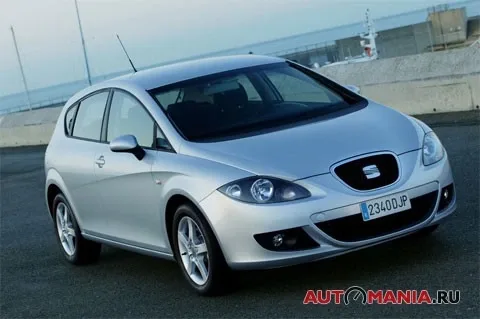
In fact, today's Spaniard is a novelty only formally. Firstly, the Leon saw the light of day back in 2005, and secondly, it differs from the well-known VW Golf V mainly only in its exterior and interior design. However, this is not a reason to consider it uninteresting. Quite the opposite: the Seat brand has been somewhat forgotten here, so any of its models is perceived as a curiosity. Moreover, history has many cases where an analogue became no less popular than the original. It is unlikely that the Leon will be able to seriously displace its famous relative in the near future, but in the long run, as they say, anything is possible. The only thing that, in my opinion, hinders the Spaniards today is the difference in status and class.
Here, Seat cars are traditionally treated with caution: they say the brand is little-known, unpublicized, a kind of Skoda from the Iberian Peninsula. Yet the Spaniards have been producing cars for almost 60 years and, unlike the Czechs, have not experienced the delights of the Soviet planned economy. Just think: Seat's portfolio includes 25 original models, and the total circulation of sold cars has reached 14 million. However, the brand's heyday came with cooperation with Volkswagen, which now owns the brand. The first partnership agreements were signed back in the early 80s, and it was thanks to this alliance that the best-selling Spaniard, the Ibiza, was born. And when Seat fully came under the Germans' wing, other quite successful models also rolled off the assembly line.
But one should not consider the Spaniards as disenfranchised vassals. Firstly, Seat is only the second acquisition of VW after Audi. Secondly, it was initially a partner and only then came under subordination, so it can be placed on the same level as the titular brand. The only thing the southerners had to sacrifice was constructive originality. But they are unlikely to regret it: the technical potential of such a structure is always higher than their own developments.
This, in fact, explains the current situation in the Volkswagen group. The boundaries between brands are blurred, and the satellites shamelessly use all the latest developments of the suzerain. They only have to deal with styling—but even over this, the "big brother" keeps a close watch. Previously, Seat made solid and reliable cars, but completely inexpressive in terms of design. Everything changed when the famous designer Walter de Silva took charge of the Spanish brand's style. It was he who created the modern image: flashy, dynamic, temperamental. The Salsa concept presented in 2000 was received with enthusiasm by the public. It became the basis for the Leon. A squat, almost sporty body, widely spaced wheels, an absolutely non-Teutonic face with large teardrop headlights... This is not a prim VW, but a real Alfa Romeo—light, plastic, and... Spanish. The maestro even allowed himself some small liberties, for example, hiding the rear door handles in the pillars. So the comparison with the 147 model is quite appropriate here.
The hatchback's interior is styled in tune with the exterior. The quality of materials, of course, is slightly lower than in the Golf V or Audi A3, but it is at a quite decent European level. As for design, the hot Spanish guys, trampling stylistic traditions, presented their vision of a modern compact car. There is no hint of monumentality or brutal linearity in the architecture: all corners are rounded, surfaces are open... Even the instrument panel has become a kind of work of art. If the needles hanging at right angles can no longer be called original, then the LCD display built into the left "well" is a clear know-how, at least for this class. The only drawback is the glass, which glares in the sun.
However, some things the Seat engineers decided not to change. For example, capacity and ergonomics. As in the Golf V, the Leon will accommodate with equal comfort both a fragile girl and a hefty guy of basketball height. The latter will have enough space both above the head and for the legs. The driver will not only sit comfortably behind the wheel but also easily reach all the buttons on the central console. The only thing you'll have to stretch for is the glove box, so it's better not to risk it while driving. The rear sofa also deserves favorable reviews, especially considering that usually the space between it and the front seats directly depends on the dimensions of the driver and his neighbor. It's comfortable to sit, there's enough legroom... In short, two people can travel in the second row without any restrictions. But the cargo compartment's capacity is lacking, not so much because of the lack of useful volume (341 l versus 350 l for the Golf V), but because of... the design. The opening is narrow and high, so loading bulky luggage here is extremely inconvenient.
The engine lineup for the Russified Leon, naturally, is completely borrowed from VW: three gasoline engines and two turbodiesels. The latter, alas, are not yet brought to us, so you have to choose between the old 102-horsepower 1.6-liter engine and the naturally aspirated and turbocharged versions of the two-liter FSI. True, cars with "direct injection" engines differ from the base ones not only in more decent dynamics but also in a corresponding price. However, what will be under the hood of the purchased Leon is up to the client to decide. At my disposal was a 1.6-liter version with a standard manual transmission. This tandem, in principle, is not bad, but hardly anyone will be delighted with it. Everything is madly average: reasonable dynamics, acceptable fuel consumption, decent elasticity, good sound insulation. The gearbox ratios seem to be cut into even slices, so the car is easy to drive both in the city and on the highway. At the same time, in its manners, the model resembles not a VW but a more dynamic Audi A3. A stiff, almost sporty chassis, a fairly sharp steering wheel, excellent brakes with deliberately rough ABS tuning... The car is tuned for fast and uncompromising driving—102 hp is clearly not enough for it. This is quite understandable if we recall the brand's rallying traditions and that the Spaniards are trying with all their might to put their products on the same level as Audi and Alfa Romeo.
Therefore, the price tag is not surprising: for the base Leon they ask at least 572,500 rubles. For "loaded" versions you will have to pay much more. The "hot" version will cost as much as 1.065 million rubles. So there is something to think about here.
Technical specifications:
| Dimensions: | Seat Leon |
| Length (mm) | 4315 |
| Width (mm) | 1768 |
| Height (mm) | 1438 |
| Wheelbase (mm) | 2578 |
| Weight (kg) | 1205 |
| Trunk volume (l) | 341 |
| Engine displacement (cm3) | 1595 |
| Max. power (hp) | 102 at 5600 rpm |
| Max. torque (Nm) | 148 at 3800 rpm |
| Max. speed | 184 |
| Acceleration 0-100 km/h (s) | 11.7 |
| Average fuel consumption (l) | 7.4 |
| Price (rub.) | 572,500—1,065,000 |
Magazine "Autogid" February 01, 2008 No. 51
Source – AUTOMANIA.RU