
First, the public was shown the Altea and Toledo — unusual one-box cars in Seat's fresh styling. However, these cars were aimed at a narrow audience, while everyone was waiting for a traditional five-door hatchback. And now it has finally appeared... True, three years have already passed since its debut.
The new model reached the Russian market only at the end of 2007, when the local SEAT representative office opened. Along with the second-generation Leon, the rest of the brand's models also arrived.
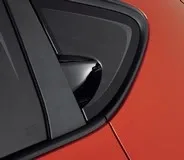
It's hard to call this hatchback "ordinary." Visually, the Leon, which is a cousin to the Golf, looks more like a compact coupe. Take, for example, the aggressive front end and the sides cut with wavy lines... And the rear door handles are completely confusing — this is Walter de Silva's signature move. The Milanese designer hid them just like he once did on the Alfa Romeo 156. In the triangular rear window, there is a small recess made of transparent plastic, and the handle itself is hidden under the edge of the window.
The Leon's interior is also clearly designed with the goal of distancing itself from its "bourgeois" relative and attracting young drivers who like to drive fast. Just look at the anatomical seats with developed lateral support. Both the seats and the steering column have wide adjustment ranges, so a driver of any build can get comfortable. Red dominates the instrument panel: it's in the display backlight, the needles, and the seat upholstery. The center console is trimmed in satin aluminum, emphasizing the sporty character. At the base of the car is the excellent Golf V platform with reliable and time-tested mechanics.
For our test, we got the version with the two-liter FSI engine — a naturally aspirated gasoline unit with direct injection, producing 150 hp. If that's not enough, you can look at the Leon FR 2.0 TFSI, which has 200 "horses." In Europe, this version is also offered with a 185-horsepower engine.
For us, though, a hundred and fifty horsepower was enough. The car is compact and not too heavy — the test sample weighed 1420 kg, so even on the track the Leon performed admirably. Acceleration to 100 km/h took 9.1 seconds, and on sixth gear from 70 to 120 km/h the car accelerated in 15.7 seconds — a very good result (on fifth gear it took 12.6 seconds).
If you compare these figures with competitors, it turns out that the "Spaniard" has no particular advantage. But the Leon has other trump cards that it reveals right on the road. When you lift off the throttle in a corner, the car understeers smoothly and predictably, so correcting the trajectory is easy. The same goes for oversteer: even a driver without much experience can catch the rear axle. The steering is responsive and informative, with excellent feedback, and the six-speed manual is simply magnificent — gears engage quickly and precisely.
The Leon's suspension is short-travel, so there's no surprise when going over speed bumps. The car doesn't pamper with ride smoothness, and our measurements clearly confirmed this: the Leon handles bumps quite harshly. True, one should make allowance for the fact that the test car sat on 17-inch wheels.
COMFORT? AND WHY?
The Leon can be considered as a family car, but with reservations: the bright, image-driven design often conflicts with practicality.
For example, a passenger getting into the car for the first time is unlikely to immediately find the rear door handle. And even getting into the front seat requires some skill — just look at the rake of the front pillars.
Realizing how hard the Leon tries to pass as a coupe rather than a hatchback, you understand that some inconveniences are a deliberate price for the "sporty" image. But some flaws can no longer be justified. Take, for instance, the small side mirrors — they're not very convenient to use.
A separate topic is the trunk. For a "two-box" car 4320 mm long, it's clearly too small — only 344 liters. The Spaniards, however, object that the previous generation had even a liter less. But that's not the most compelling argument: the buyer will compare the car with current rivals.
If you seat passengers in the back, another shortcoming emerges — the seat cushion doesn't fold up, so with the backrests folded down you get not a flat floor but an awkward step. The glove box is no less disappointing — couldn't they have made it more spacious?
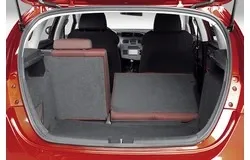
DEEP, BUT UNEVEN
In terms of trunk volume, the Leon is not among the leaders, but if you fold the rear backrests, the compartment becomes quite deep (more than 1.5 m), but you don't get a flat surface: a noticeable step forms.
Technical data
1984 cm3
150 hp
4 cylinders, gasoline
from $24,132 (193,050 UAH)
Max speed — 207 km/h
0–100 km/h — 9.1 s
70–120 km/h on 6th — 15.7 s
Average consumption — 9.5 l/100 km
A HUNDRED AND A HALF UNDER THE HOOD
The two-liter four-cylinder FSI is a naturally aspirated gasoline engine producing 150 hp.
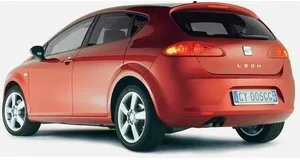
AGGRESSION OUTSIDE AND INSIDE
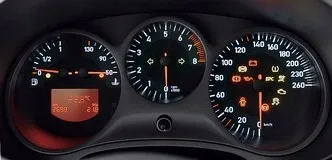
The Leon looks very much like a coupe — note the "wave" running along the side. Inside, the sporty theme continues with the instrument cluster design. The steering wheel is three-spoke, and the center console is trimmed in satin aluminum.
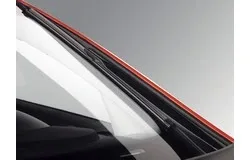
WIPERS REST STANDING
The wiper blades stop in a vertical position and don't hide behind the front pillar trims. The pillars themselves are quite elegant, which keeps visibility good.
LIKES
The door handle is hidden, and only a recess in the transparent plastic of the triangular rear window gives it away. It's as if we're "invited" to slide our hand under the door frame.
DISLIKES
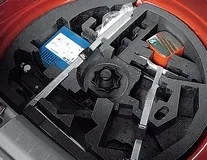
The trunk volume is nothing to brag about. Space for a spare wheel is provided, but in our case there was a tire repair kit and a compressor. A "space-saver" spare will have to be ordered separately.
STABILITY TESTS
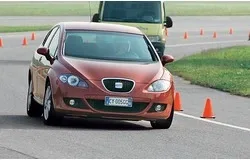
THE STABILITY CONTROL SYSTEM IS NOT ASLEEP
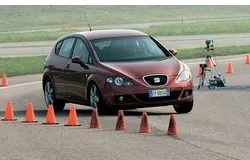
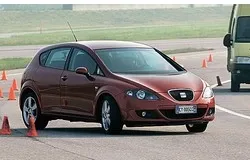
We already praised the Altea one-box for how it holds the road despite its tall body. So it was obvious that the Leon, built on the same platform but looking more like a compact coupe, would also perform well. Especially since the tested car sat on 17-inch wheels and had a sporty setup. In the cornering stability exercise, the Leon reached 103 km/h. The car holds its line confidently, body roll remains within acceptable limits, and the wheels grip the asphalt tenaciously. On the arc, the car behaves predictably. If you brake right in the corner, the front axle starts to slide outward smoothly, but it does so so gradually that the driver has time to react without panic. In a critical situation, the dynamic stability control system kicks in, although it does so perhaps too intrusively. At speeds above 180 km/h, a sharp lane change doesn't cause the car to yaw. The outer wheels maintain good grip, and the suspension's lateral rocking doesn't interfere. Lifting off the throttle also doesn't provoke problems — control remains simple. The stability system works clearly and decisively, even overly decisively.
Below are the technical specifications of the Seat Leon 2.0 FSI as stated by the manufacturer.
• Engine: four-cylinder inline unit, transversely mounted at the front, with a displacement of 1984 cc. Power reaches 150 hp at 6000 rpm, peak torque of 200 Nm is available at 3500 rpm. The cylinder head has two camshafts and four valves per cylinder, with hydraulic lifters and a timing belt drive. Fuel is supplied by direct electronic injection.
• Transmission: manual six-speed with front-wheel drive. Gear ratios: I – 3.778:1, II – 2.267:1, III – 1.650:1, IV – 1.269:1, V – 1.034:1, VI – 0.865:1, reverse – 3.600:1. The final drive (bevel) has a ratio of 3.938:1.
• Wheels: tires 205/55 R16 on rims sized 6.5Jx16.
• Body: five-door, seats five people.
• Suspension: front independent MacPherson type with transverse arms, telescopic strut, coil springs, and anti-roll bar. Rear also independent design on longitudinal and transverse arms with springs and hydraulic telescopic shock absorbers.
• Brake system: ventilated disc mechanisms at the front and regular discs at the rear. Equipment includes ABS, stability control, and dynamic stabilization system.
• Steering: rack-and-pinion mechanism with hydraulic power assist.
• Dimensions and weight: wheelbase is 2578 mm, body length – 4315 mm, width – 1768 mm, height – 1458 mm. Curb weight is 1260 kg, gross weight – 1830 kg. Permissible trailer weight is 1400 kg. Trunk volume varies from 341 to 1100 liters, fuel tank holds 55 liters.
• Production: plant in Martorell, Spain.
SEAT LEON COMPETITORS: HOW CAN THEY SURPRISE THE "SPANIARD"?
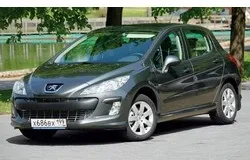 |
Peugeot 308 1598 cm3 – 150 hp – 240 Nm – from $21,577 (172,611 UAH) ■ The French hatchback stands out with its emotional design, spacious interior and decent driving characteristics. For a long time, only petrol modifications were brought to Russia, but now this restriction has been lifted. |
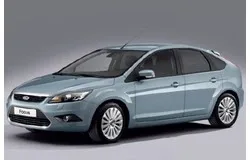 |
Ford Focus 1999 cm3 – 145 hp – 185 Nm – from $16,302 (130,411 UAH) ■ Local assembly has made the Focus one of the most attractive offers in the compact class. Among its other advantages are excellent handling, high comfort and a wide choice of engines. |
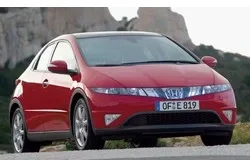 |
Honda Civic 1799 cm3 – 140 hp – 174 Nm – from $22,748 (181,980 UAH) ■ Catchy futuristic appearance and no less bold interior are the main trump cards of the Japanese model. For such an original look, it is forgiven for not the most impressive dynamic performance and weak sound insulation. |