
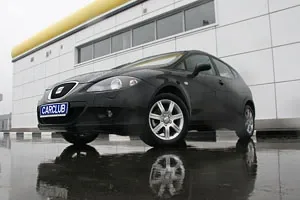
The second-generation Seat Leon debuted in Europe back in 2005, but only now has it reached Russia. For the appearance of the Spanish brand on our market, we should thank the exclusive importer — the company «Iberia Motor Rus».
The Leon's appearance is a unique thing. Arguing that this hatchback can't be confused with anything else is pointless. Examining the body, you catch yourself thinking that the Spaniards have always dreamed of ending up in Italy and becoming as stylish as Alfa Romeo. But the German blood flowing in their veins didn't let them go beyond the Pyrenees. Although a fleeting romance with the Italians did happen for Seat: at one time, the company was a Fiat subsidiary and assembled its models under license. And Walter de Silva, who gave the Leon this look, had previously worked at Alfa Romeo.
The Spaniards approached the creation of the Leon like true couturiers: in 2003, they showed the Salsa concept — a kind of haute-couture from which the production pret-a-porter later grew. The creases on the hood and sides, almond-shaped headlights, and oval-trapezoidal grille give the car a feline plasticity. From the three-door prototype, the hatchback inherited coupe-like features — for example, hidden rear door handles, like on the Alfa 147 or Honda Civic. My acquaintance couldn't find the rear handle at all until I showed her the trick with opening. She would never have guessed on her own.
The Leon also has another secret — the wipers. They are hidden not under the windshield, but in the side niches of the front pillars. In winter, they are definitely not destined to freeze. For Russia, this is a prudent solution, although it's unlikely that engineers from sunny Spain thought about our frosts.
The trunk is 341 liters, which is so-so by class standards. Fold the seats and you get 1166 liters, and again this is less than competitors. In the related Volkswagen Golf, for example, in the same position the volume grows to 1305 liters.
Up front, there are seats with pronounced but not excessive lateral support. The adjustments are simple and clear. The three-spoke leather steering wheel with buttons sits comfortably in your hands and adjusts for both reach and height.
The dashboard is trimmed with soft-touch plastic. In the center are dual-zone climate control and an audio system with MP3. The readings of the «climate» and music are displayed on two monochrome screens that light up red when the lights are turned on — it looks stylish.
The instrument panel is a separate story. The needles hang vertically, and the gauges are recessed into wells. On the left are fuel and temperature indicators, as well as the onboard computer screen. In short, Barcelona here smoothly flows into Milan.
We got a version with a 1.6-liter engine producing 102 hp. Acceleration is smooth and unhurried. In city traffic, under the even hum of the engine, you forget about the predatory essence of the hatch and simply enjoy the feline grace. A 5-speed manual helps to invigorate the beast — the lever moves precisely and unquestioningly. The steering wheel and wheels seem to have been friends since birth: they understand each other without words.
However, this little 8-valve engine, which was also installed on the previous-generation Golf in 2000, gives itself to the driver completely, but it won't make a macho out of you. If you want to growl, you'll have to rev it almost to the red zone, almost to a squeal. But there's little joy in that: at high revs, aerodynamic noises, tire rustle, and the strained howl of the old but reliable engine creep into the cabin. Only quality music saves the day, drowning out these sounds. If you want real emotions, the Leon lineup includes turbo versions: FR with 200 hp and Cupra with 240. But that's already a matter of budget and preferences.
The Leon's main trump card is its design. It either grabs you or it doesn't, but it doesn't leave you indifferent. The price, however, bites: our test car in the Stylance trim with a 1.6-liter engine, manual, ABS, traction control, six airbags, dual-zone climate, cruise control, and other little things was priced at almost $26,390. For that money, you could get a Mazda 3 with a 150-hp engine in similar equipment. But the Leon is a European car with Spanish character, Italian glamour, and German quality. A choice for those who don't want to be like everyone else but aren't ready to overpay for a capricious Alfa or a conservative Golf.
Text: Daniil Sonin. Photo by the author.