
Seat Leon Cupra. Price: from $44,990. On sale: since January 2008.
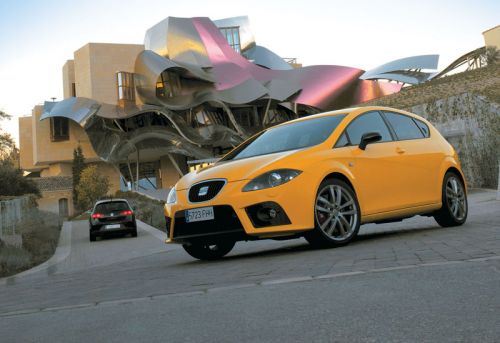
2008 Seat Leon Cupra
© Photo: Seat
Although Seat lost to BMW in the 2007 World Touring Car Championship, the hot hatch Leon Cupra still deserves to be called one of the best sports cars in the Touring class.
In January 2008, the civilian version of the famous Leon Cupra goes on sale in the Russian market. The sporty progenitor remains almost the only car capable of giving battle on WTCC tracks to the recognized favorite of the touring championship - the BMW 320si. In both the past and current seasons, Seat only failed to dethrone the Bavarian from the world throne due to mistakes in the final races in Macau. Although the title slips away from the Spanish Lion every time, it is already clear: sooner or later BMW's hegemony will end.
Spanish fans dreaming of a compatriot's victory can prove their loyalty to the brand by buying a Leon Cupra with a 240-horsepower engine. Before the Russian debut of the second-generation Cupra, we went to Seat's homeland to test the Spanish Lion on the Catalan roads of the Costa Dorada coast.
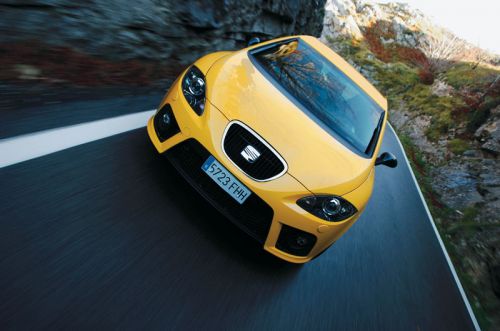
2008 Seat Leon Cupra
© Photo: Seat
Catalans, who have long strived for independence, take offense when they are called Spaniards. And it's not just about language and politics. The character of Catalans is more refined, calculating, and pragmatic than that of Spaniards. The mentality here is completely different - bullfighting, for example, is not tolerated in Catalonia. But Catalans are excellent businessmen and artists. Dali, Miro, Gaudi - all of them are from Catalonia.
The company Seat (La Sociedad Espanola de Automobiles de Turismo) was founded in 1950 as a popular Spanish brand. However, the factory and design bureau are located near Barcelona, at the foot of the sacred Catalan mountain Montserrat. This leaves an imprint on the character of the cars. The Spanish Lion is imbued with Catalan pragmatism - just look inside.
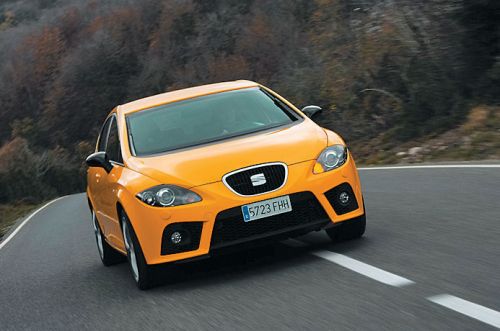
2008 Seat Leon Cupra
© Photo: Seat
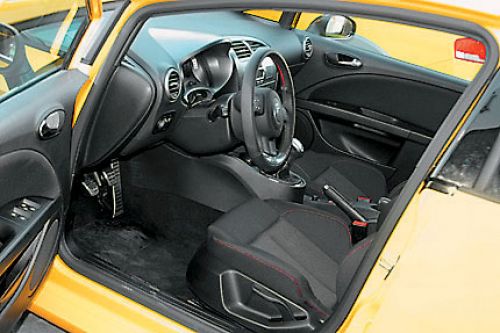
The interior of the Leon Cupra, to put it mildly, does not impress. The simple trim and sports seats without power adjustment smack of Spartan minimalism. In a cheaper car, one could turn a blind eye to this, but turning the plastic backrest adjuster in a car worth $50,000 is dubious pleasure. However, functionality is at its best, as befits Catalans. You can get used to the Leon Cupra's cabin in a few seconds. There are a minimum of buttons and switches, except for the keyboard built into the central console for controlling navigation and audio system. The instrument panel is perfectly readable. The leather steering wheel with sporty thickenings provides an excellent grip...
The Leon Cupra leaves the parking lot with difficulty. Even considering the sporty nature, the suspension is too stiff for the city. It still absorbs small waves and cracks in the asphalt, but speed bumps resonate through the iron body of the Leon with wild pain.
The test on a deserted mountain road near Sitges leaves a much better impression. The ultra-stiff suspension allows the Leon to hold the track perfectly. By replacing the steel fork and steering knuckle with aluminum ones, Seat's engineers changed the suspension kinematics towards slight understeer. This had a positive effect on handling. The switchable ESP is tuned so that it does not annoy with its intervention and only kicks in in critical situations. The only drawback is that at low speeds the steering feels too vague for such a charged car. Therefore, a slow winding serpentine, where you can't get above third gear, like city streets, is not for the Lion. The Cupra is not a rally car but a circuit car, created for wide tracks and high-speed corners. At speeds around 100 km/h, the steering becomes sharper, and the hot breath of the two-liter turbo engine is felt much brighter.
2008 Seat Leon Cupra
© Photo: Seat
The 240-horsepower engine is admirable! However, it's not surprising: the heart of the Catalan lion is Aryan. The Seat factory in Martorell, where the Cupra is assembled, is essentially just a body and assembly plant. Seat orders almost all components and units from more than seven hundred suppliers. And engines are assembled at Volkswagen factories in Germany, Hungary, and Mexico.
At 2200 rpm (maximum torque is achieved in a wide range from 2200 to 5500 rpm), the turbine kicks in, and the Cupra gets a second wind. With proper use of the 6-speed gearbox selector, you can accelerate to 100 km/h in 6.4 seconds. The Leon covers the kilometer sprint from a standstill in 26.4 seconds. The racing dynamics of the Cupra are impressive! And the brakes are up to par: 17-inch (345x30 mm) discs at the front and 16-inch (286x12 mm) at the rear allow braking literally a few meters before a corner. However, it's better to look in the rearview mirror more often before traffic lights - not all cars have such powerful braking potential.
Long-term strategy
2008 Seat Leon Cupra
© Photo: Seat
At the end of autumn, a state-of-the-art design studio opened on the territory of the Seat Technical Center in Martorell, where specialists from ten countries work on future cars under the leadership of Seat's chief designer, Belgian Luc Donckerwolke. Their first creation - the Seat Tribu concept car - was shown this year in Frankfurt. In spring, the second-generation Ibiza will be presented at the Madrid auto show. But this is only part of the long-term development program of the Spanish brand, which by 2018 should increase Seat's annual sales to 800,000 cars. This means that over the next 11 years, the company will have to double production. Last season, Seat sold 408,318 cars. A third of sales came from Spain, the rest went to export. Cars sell best in Western Europe (86%). Six percent each go to Central Europe and Latin America, another two percent to the rest of the world. As for the model range, the most popular, as in the previous year, remains the Ibiza - 41% of production and sales. Next come Leon - 28%, Altea XL - 9.5%, Altea - 8.5%, Cordoba - 7%, Alhambra - 3.5%, Toledo - 1.5%, and Altea Freetrack - 1%.
2008 Seat Leon Cupra
© Photo: Seat
Driving
At low speeds, the steering seems not sharp enough for such a charged car. But this is the only thing to complain about.
Interior
There are almost no complaints about functionality, but the interior trim looks too simple.
Comfort
Sports seats with lateral support are comfortable, but the stiffness of the suspension negatively affects comfort.
Safety
8 airbags, good ESP, and very reliable brakes.
Price
Given the low popularity of the brand in Russia, the price seems inflated.
| Dimensions, mm | 4323x1768x1458 |
| Engine | petrol, 1984 cm3, 240 hp/5700–6300 rpm |
| Transmission | manual, 6-speed |
| Dynamics 0-100 km/h, s | 6.4 |
| Maximum speed, km/h | 247 |
| Competitors | Ford Focus ST, Volkswagen Golf GTI, Opel Astra OPC |
Advantages and disadvantages
+ Excellent acceleration dynamics and huge braking potential.
- Lack of a suspension stiffness adjuster, which could significantly simplify city driving.
Our opinion
The Cupra accelerates to 100 km/h 0.3-0.4 seconds faster than its closest competitors - the hot hatches Ford Focus ST, VW Golf GTI, and Opel Astra OPC. Excellent dynamics and handling make the Seat a real find for speed fans. But the simple interior does not match the high cost of the car.
© 5 Koleso