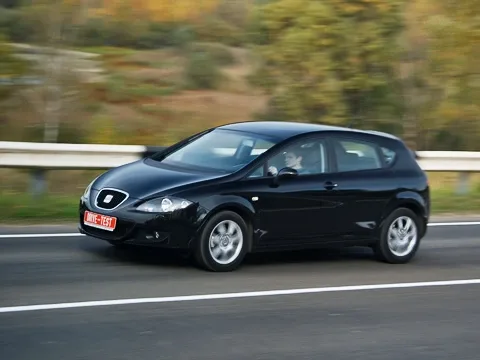
At first, when you pick up the familiar folding key from the SEAT Leon, which differs from the Golf or Octavia only by the emblem, a reasonable question comes to mind: what has changed since then, and has anything changed at all? Or is this just another variation on the Volkswagen theme for our market? However, the very first glance at the car puts everything in its place. Yes, SEAT has been under the wing of the VW Group for three decades and, let's say, actively borrows technical solutions from the Germans. But the exterior has nothing in common with its Wolfsburg siblings. Moreover, the Spaniards position their cars as driver-oriented, temperamental, and even passionate — fully in line with the national character. This is not Skoda, which is essentially "the same Volkswagen, only cheaper." The Leon is different, and that cannot but please. But under the attractive bodywork hide our old acquaintances — VW units. Impatiently pawing the ground are 102 "horses" hidden in the well-known 1.6-liter eight-valve engine. The suspension, the five-speed manual — we've seen all this before. Perhaps this is just another Volkswagen in different wrapping? And is it worth spending time on it at all? When opening the hood, the thought arises: "You could fit a lot more interesting stuff in here." The engine is very compact. But it cannot boast of a modest appetite — the average fuel consumption during the test was 12.2 l/100 km. Our Leon came in the Stylance trim, which means it has everything needed for a comfortable life: six airbags, power windows and mirrors, an onboard computer, alloy wheels, and dual-zone climate control. Quite good. Inside, the mood continues to improve. The central panel with "clustered" small buttons and indistinct backlighting doesn't appeal to me, but here almost nothing reminds of Volkswagen. This favorably distinguishes the Leon's interior from, say, the Skoda. Everything here is different. Although, if you look closely, you can find many common parts — window lift buttons, central locking, some levers and elements. But still, the feeling persists that this is not a "variation on the theme." The Leon is a cat that walks by itself. The Leon's interior is designed on the principle of "so it's not like everyone else's." This principle was achieved, and it turned out quite comfortable, but there will surely be debates about the aesthetics of the interior. Even the driving position is not as German-perfect as in the Golf or Octavia, although only the most spiteful buyer could find fault with it. But the instrument binnacles with Mazda-style, that is, excuse me, Alfa-style needles pointing strictly down in the "zero" position — they're great! They look good, and the readability is top-notch. By the way, another interesting move — the wipers hidden in the pillars: they remove that "strip" of dirt that so obstructs visibility in winter slush. That's great, you'll agree. The only problem is that the pillars themselves are indecently thick. Sitting in the front seats is a pleasure. The rear is also fine, with enough legroom, but the roof presses heavily on the head. The steering wheel left a mixed impression. It's small and plump, but for me personally — perhaps too much. Although, for example, Klepach found such a size just right. So the wheel is more suitable for people with large hands and large thumbs. Which, by the way, fit in the Leon without much trouble, but only in the front. In the back, the sloping roof does its dirty work and literally presses on the head. The Germans would never do that just for the sake of appearance, right? Notice the clever "glass" handle of the rear door. The solution is original and quite convenient. But there are no complaints about the gearbox. On the contrary, I really want to praise it for its excellent shift precision and very well-chosen, slightly closer gear ratios. However, there's nothing surprising here: this unit was also developed by the Germans, and what complaints could there be about a Volkswagen development? I'm sure it was they who foresaw that the driver might accidentally engage reverse instead of first (this confusion happened to me once). Therefore, "full reverse" is accompanied by a warning beep. A very useful thing. But, of course, like any decent car, the Leon is more suited to rushing forward than backing up. And it does that well. A cheerful, responsive, fiery machine! The "closer" gears allow you to feel confident in traffic. Working the lever is a pleasure. The engine pulls well, and you start to doubt the 102 in the "power" column — didn't the Spaniards undersell it? Maybe there's another ten hiding there? And the sound! Very good indeed! And I'm not talking about the audio system, but the exhaust. You just want to rev the engine again and again, enjoying the dance of the tachometer needle, which without any embarrassment sits right in the center of the instrument panel, like in proper sports cars. And even if the dynamics aren't much, what emotions! The Spaniards... Every corner the Leon "writes" damn correctly, the steering wheel fills with juicy effort, and it seems that no speed will knock the car off its trajectory. At the same time, it hasn't turned into a nervous psychopath, and the suspension doesn't bother with excessive stiffness. However, all this is very familiar. Volkswagen? Not quite. In places, SEAT engineers allowed the Leon to behave a bit sloppily. But it's more interesting and fun. At such moments, the driver is very glad that there are no whining passengers with weak vestibular systems nearby. An empty road, you, and the SEAT Leon. Pleasure guaranteed. In general, the Spaniards have made a good car. Stylish, compact, nimble, of excellent quality, with thoughtful ergonomics, a practical hatchback. And despite all that — it's not a Golf! Yes, the Catalans (after all, the SEAT factory and headquarters are near Barcelona) managed to cook up something completely different from the same ingredients. And I almost liked the car completely, but the sympathy that had arisen in me vanished completely as soon as I learned the price. Oh my goodness, 26 thousand 390 dollars! That's more expensive than the Golf itself! Which, with all respect to SEAT's temperament, is cooler. So there's something to think about. Or maybe there's nothing to think about. If the car has really caught your eye and become the dream of your life, then no money is a pity. Probably, dealers are counting on such customers — as passionate as the Leon itself. Technical specifications
Specifications Seat Leon
Body
Number of doors/seats 5/5
Length, mm 4315
Width, mm 1768
Height, mm 1458
Curb weight, kg 1205
Gross weight, kg 1775
Trunk volume, l 341
Engine
Type Petrol, with distributed injection
Location Front, transverse
Number and arrangement of cylinders 4, in-line
Number of valves 8
Displacement, cm3 1595
Max. power, hp/rpm 102/5600
Max. torque, Nm/rpm 148/3800
Transmission
Gearbox Manual, five-speed
Drive Front
Chassis
Front suspension Independent, McPherson
Rear suspension Independent, multi-link
Front brakes Disc, ventilated
Rear brakes Disc
Performance characteristics
Maximum speed, km/h 184
Acceleration time from 0 to 100 km/h, s 11.7
Fuel consumption, l/100 km
urban cycle 10.4
extra-urban cycle 6
combined cycle 7.6
Toxicity standard Euro-4
Fuel tank capacity, l 55
Fuel AI-95
Stylance trim Standard equipment
  • Option for bad roads (underbody protection with anti-gravel and plastic, stiffer suspension, increased ground clearance, front and rear fender liners)
  • ABS
  • TCS with disconnection function
  • Front airbags for driver and passenger
  • Side airbags for front occupants
  • Curtain airbags covering all passengers
  • Reinforced door beams against side impacts
  • Three-point belts with height adjustment at front seats
  • Power steering
  • Steering column with adjustment in two planes
  • Driver and passenger seats with height adjustment
  • Lumbar support for both front seats
  • Seats with pronounced lateral support
  • iSOFIX mounts for child seats
  • Rear bench folding in 1/3:2/3 proportion
  • Storage compartments in front seats
  • Pockets on front seat backs
  • Leather trim on steering wheel and gear lever
  • Immobilizer
  • Central locking with remote control
  • Door locking from inside
  • Power windows with protective mechanism, all four
  • Ability to lock windows from driver's seat
  • Power mirrors with parking function
  • Heated exterior mirrors
  • Dual-zone climate control Climatronic
  • Onboard computer with data on time, temperature, and consumption
  • Audio system with MP3, eight speakers, and AUX input
  • Multifunction steering wheel with radio controls
  • Roof antenna and radio preparation
  • Cruise control
  • Cup holders on center console
  • Illuminated mirrors in sun visors
  • Gradual dimming of interior lights with delay
  • Automatic interior light activation when doors are opened
  • Trunk lighting
  • Heat-absorbing glass
  • Front and rear fog lights
  • High-mounted stop lamp
  • Economy mode for parking lights
  • Electric headlight leveling
  • Adjustable instrument panel brightness
  • Alloy wheels with tires 205/55 R16
  • Disc brakes all around
  • Tire pressure monitoring
  • Rear parking sensors with four sensors
  • Double galvanized body with 12-year corrosion warranty
  • Reinforced 70 Ah battery
  • Additional 12V outlet for rear passengers

The car for the test was provided by
the company «Iberia Motor Rus».
Safety
test-drive-9.jpg
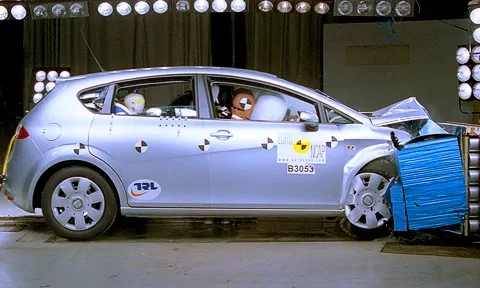
Seat Leon is just entering our market, but in Europe it has been known for a long time. Therefore, EuroNCAP, of course, tested its strength. The result — four stars, which is quite decent. However, for the frontal impact, the Leon received only 12 points. The reason is the front panel, which, according to experts, can injure the driver's legs. But the side impact was handled brilliantly, and pedestrians are not hit too hard in a collision.
Off-camera
test-drive-10.jpg
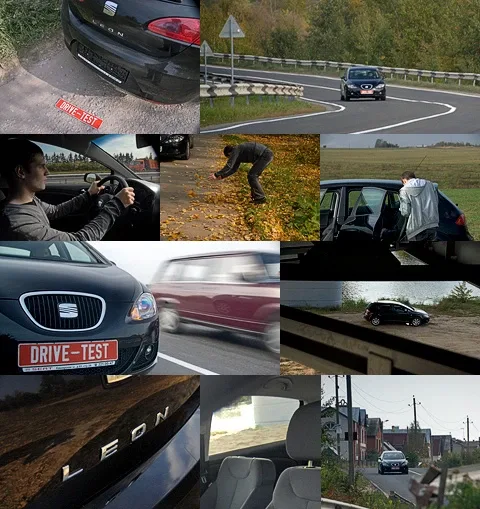
With this car, we were incredibly lucky with the weather during the shooting. We managed to take great shots, bask in the sun, and enjoy the scenery. Plus, we found quite deserted places. This is especially valuable for the Leon, because the Spanish hatchback clearly attracts attention. So, if you plan to get such a “lion”, be prepared for attention.

By the way, attentive readers might have noticed that the test car was missing a couple of headrests. Apparently, one of our colleagues took them as souvenirs. But we got a bonus — the car keys, forgotten in the door pocket. However, we never found the car itself. Too bad. That would have been another DRIVE-TEST.