
Seat Ibiza. The Second Coming
Can one find common features between Spain and Italy? Common roots of language and culture, certain traditions, Mediterranean climate, hot temper of the inhabitants... This list can be continued endlessly. And if we talk about the automotive industry, or more precisely, about budget brands produced in these two countries? Here it is harder to draw parallels. But I can suggest adding one more item to this list – it so happened that automakers from both countries entered our market twice. And if Fiat and Alfa Romeo have already managed to win the hearts of local drivers after returning to Russia, the Spanish Seat is yet to do so. Judging by the energy with which the new distributor of the brand – "Iberia Motor Rus" – has set to work, there is no doubt: the Spaniards will quickly regain lost positions. The very fact that for the first time in the history of the Russian representative office they brought us their entire lineup without exception inspires optimism!
The most successful period for Seat in our country is still considered the late 1990s, when Russians bought about two thousand cars annually. Given that many more well-known companies were content with only a thousand cars sold per year. So the Spaniards' indicators were very decent then, with the most popular being not the cheapest sedan Cordoba. Its current version is still offered by dealers, but in my opinion, the most interesting in the Spanish lineup today is the most affordable and at the same time the most sought-after model – Ibiza. It debuted in 1984 and by now has sold over three million units worldwide. Of course, we are talking about different generations, but this does not diminish its appeal in the least.
The current Ibiza is built on the PQ24 platform, which the Volkswagen Group has been using for a long time (Seat came under VW's control in 1990). On the same base, for example, the previous Skoda Fabia was made. Fortunately, despite close family ties with the Czech "satellite" of the powerful concern, the Spanish brand has avoided the sad fate of VW's budget division – in the corporate hierarchy, it stands alongside such a renowned German brand as Audi. And at the press conference dedicated to Seat's return to the Russian market, company representatives particularly emphasized this circumstance. However, we are accustomed to considering Spanish cars as direct competitors of the more democratic VW, so we will consider them from this point of view, especially since these brands practically do not differ in price. Currently, the simplest version of Ibiza with a three-door body costs about $17,000, that is, roughly the same as the basic "fresh" VW Polo, and both cars have neither ABS, nor power windows, nor air conditioning... For a more decent trim, dealers will ask at least $20,000. In general, Ibiza cannot be called cheap. But if you get a chance to take a ride in it, you will understand that it is worth that money.
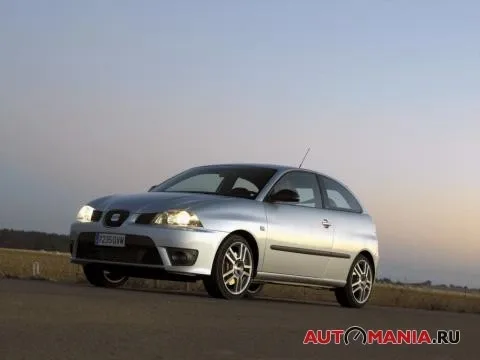
What is so good about Ibiza? Let's start, as usual, with the exterior. Unlike the same VW Polo, the Spanish hatchback, despite the model's age (the next generation should come out in 2008), looks young and dynamic: a predatory squint of the headlights, a frowning "muzzle" with a branded badge in the center, a swift profile, a rear that strongly resembles the back of the Alfa Romeo 147... Everything looks very decent. The comparison with the iconic Italian is not accidental: the current chief designer of Volkswagen, Walter de Silva, worked on the Ibiza's appearance, who before this appointment created not only all modern Audi models but also the Alfa Romeo 156. Maybe that's why Italian motifs are so noticeable in the "Spaniard's" appearance? It turns out that the Spanish and Italian auto industries have another common feature – especially since the comparison with the prestigious "Italian" only benefits Ibiza.
The same "active" style is felt in the interior. The front panel looks quite original, but details characteristic of the aforementioned sports brands can be found here as well. The central console, for example, strongly resembles a similar element of the Alfa Romeo 156's interior – the same turn, only the Italian sedan's console is crowned not with air ducts but with three dials. But the blood-red backlighting of the instrument panel and the shape of the Ibiza's steering wheel remind of Audi interiors. True, in the Spanish hatchback's cabin there is less strictness and more emotion. But functionality, alas, is lacking. Firstly, this concerns the placement of controls on the central console. The small buttons of the standard radio completely discourage touching them while driving; only the duplicate buttons on the steering wheel save the day. Such a trick won't work with the climate control unit, and it's a pity – the buttons there, although larger, are located too low. However, the unpleasant impressions of Ibiza end there. Contrary to expectations, the front seats turned out to be quite comfortable, and drivers who prefer active driving will surely appreciate the developed lateral support. The rear sofa is not as comfortable, but for this class it is quite acceptable. The main thing is not to seat three people in the back. They will be cramped, and the base 1.4-liter engine will not be able to handle such a load. By the way, when the author of these lines learned that he got a car with a 75-horsepower engine and a 4-speed "automatic" for the test, he really wanted to forget about Seat's sports traditions. But the tests showed that even such an Ibiza can show a lively character: it is, of course, not a racing car, but it clearly exceeded expectations. To provide the hatchback with a more or less dynamic acceleration, the engine has to strain – and it copes with this quite confidently. The gearbox honestly "pulls" the gear almost to the cutoff and shifts to the next with a slight push. In short, the dynamics are in perfect order. One can only guess how the "manual" version with a more powerful 85-horsepower unit drives, but now we are not talking about it... What surprised most of all was the relative quietness in the cabin. The wheel arches, alas, the Spaniards did not bother to add extra insulation, but they worked hard on the engine shield – at least up to 3500 rpm, the engine sound is almost inaudible. Then its grumbling becomes more noticeable, but compared to most competitors, Ibiza's acoustic comfort deserves a solid five.
I would also rate the suspension a "five". The smoothness of the ride, of course, leaves much to be desired – on bridge joints and "sleeping policemen" it shakes mercilessly. But this is easy to deal with by simply reducing speed to a reasonable minimum. But in corners, the hatchback is simply magnificent – body rolls are minimal, drifts are easily predictable. In general, I haven't gotten such pleasure from a budget car in a very long time. The steering wheel, by the way, deserves a special mention. Due to the long rack travel, you have to turn it quite a lot, but when on a U-turn you fit into two standard city lanes with a good margin, you forget about all the shortcomings: about the excessive lightness near the zero zone, and the lack of informativeness at high speeds, and the same long travel...
Overall, this car leaves a very pleasant impression: you forgive it everything, including the price. Maybe the Spaniards are not in vain aiming for Audi's laurels... Although in their place, I would leave everything as it is: because when a brand goes from democratic to premium, it automatically ceases to be mass-market, and for Seat such a scenario is akin to death – Bolivar, that is, VW, I'm afraid, will not carry four on its shoulders.
Technical specifications:
| Length (mm) | 3977 |
| Width (mm) | 1698 |
| Height (mm) | 1441 |
| Wheelbase (mm) | 2460 |
| Weight (kg) | 1067 |
| Trunk volume (l) | 267/960 |
| Engine displacement (cm³) | 1390 |
| Max. power (hp) | 75 at 6000 rpm |
| Max. torque (Nm) | 126 at 3800 rpm |
| Max. speed (km/h) | 170 |
| Acceleration 0–100 km/h (s) | 15.6 |
| Average fuel consumption (l) | 7.4 |
| Price | 416250 – 504450 rubles |
Source – AUTOMANIA.RU