
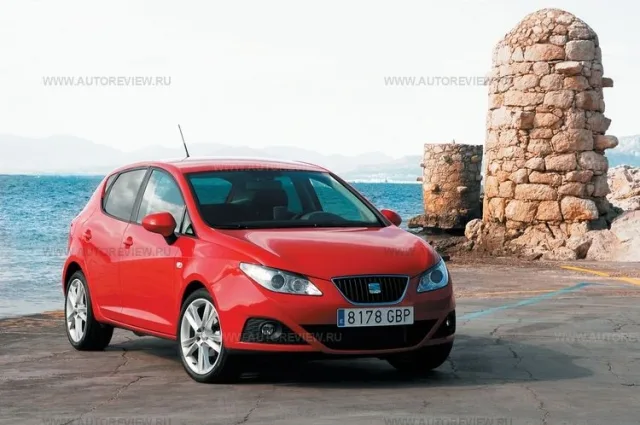
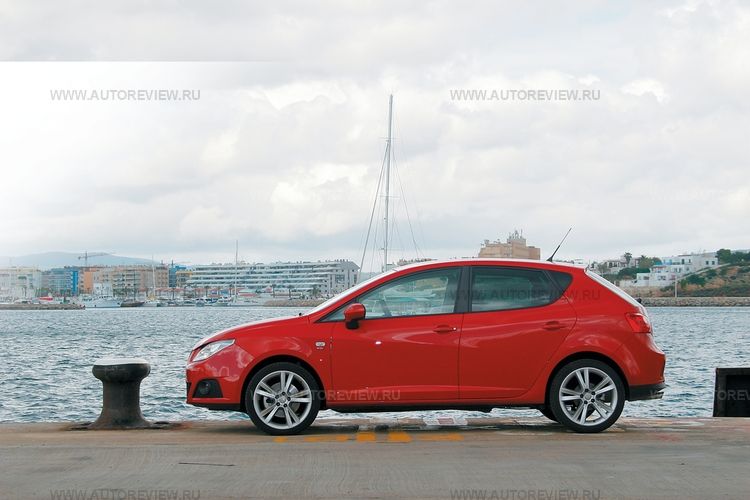
Ibiza greeted us without much warmth — rain, grey sky, slippery asphalt. Where are you, island of celebration, island of parties, land of eternal fun? But its namesake, the Seat Ibiza, looks at me with a smile. Four meters of carefree attitude, independent of the weather!
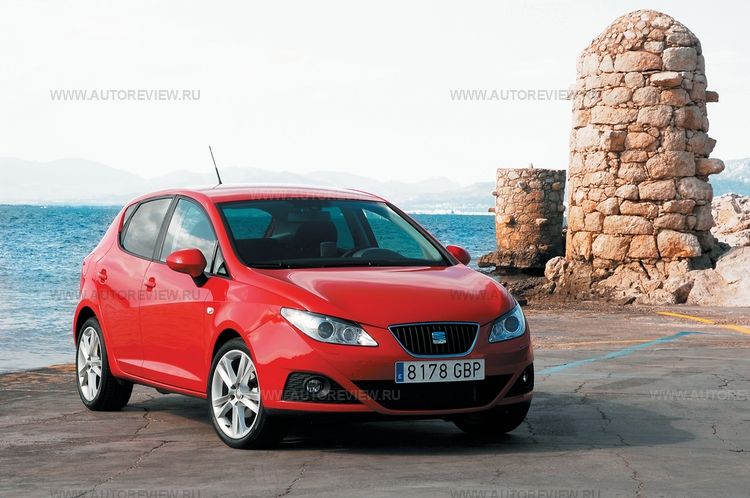
The previous Ibiza, which debuted in 2001 and was created by Walter de Silva, looked stern — like the island in bad weather. The current Ibiza is completely different. A true resort-goer! On the sides are expressive lines, and instead of the former gloominess — a friendly smile across the full width of the body. Belgian Luc Donckerwolke, who gave the world the latest Lamborghinis and replaced de Silva as SEAT's chief designer, did a brilliant job.
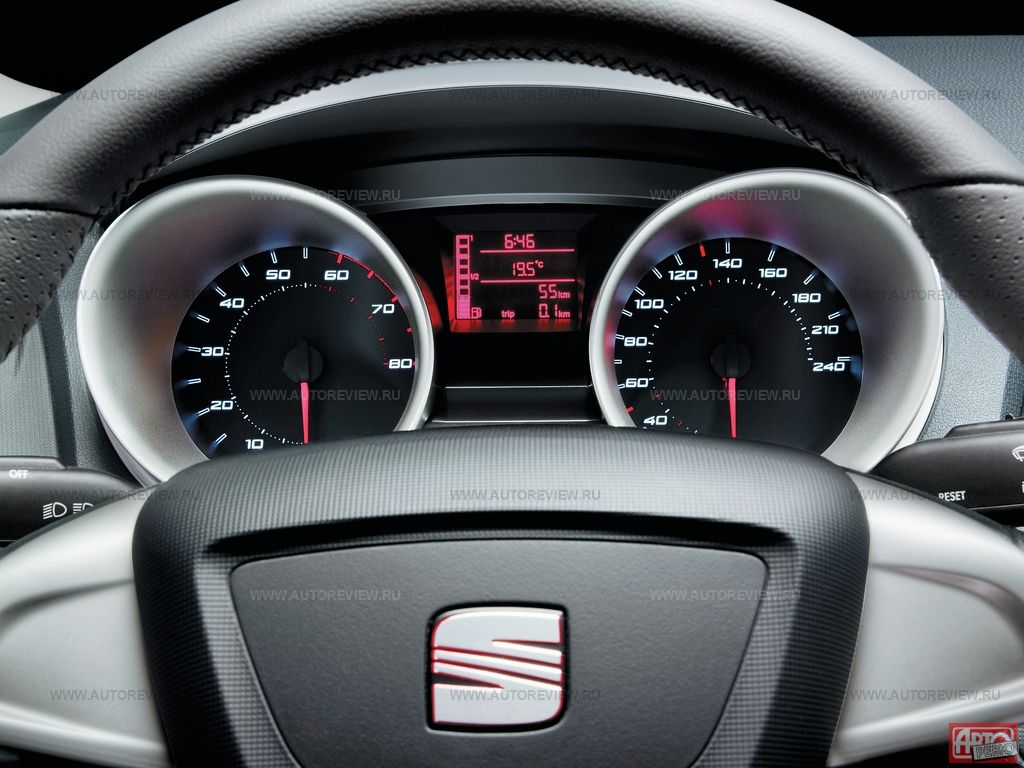 | 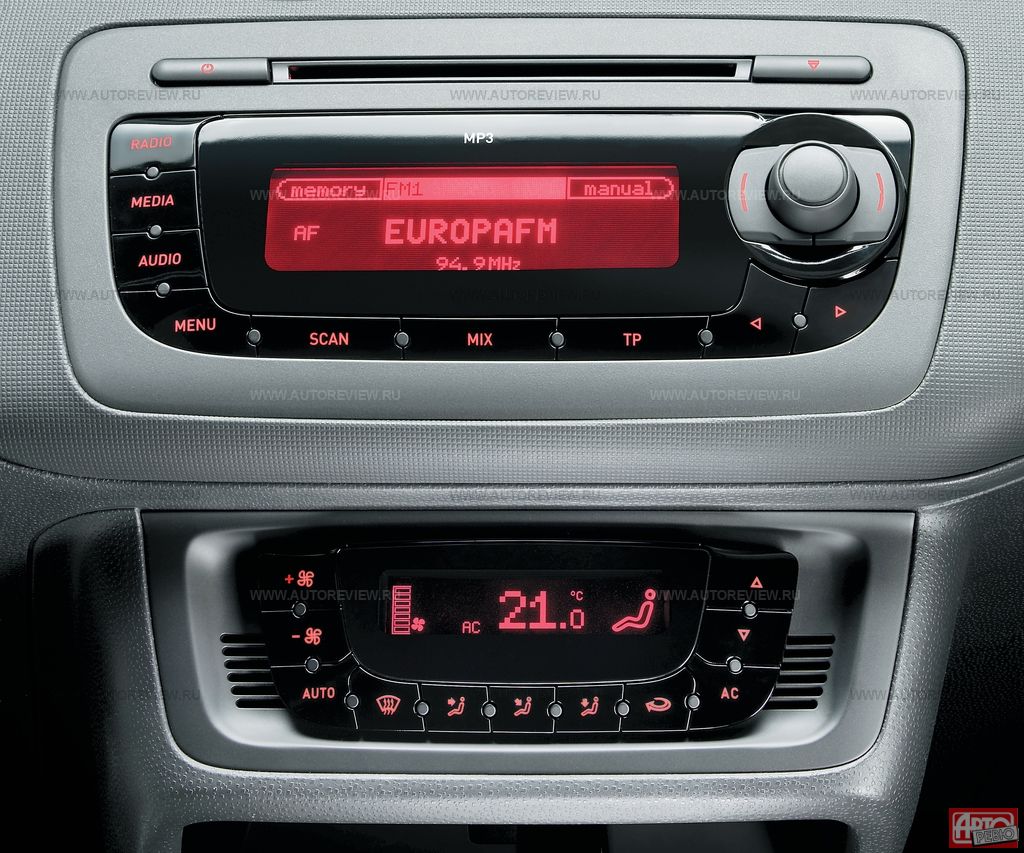 | 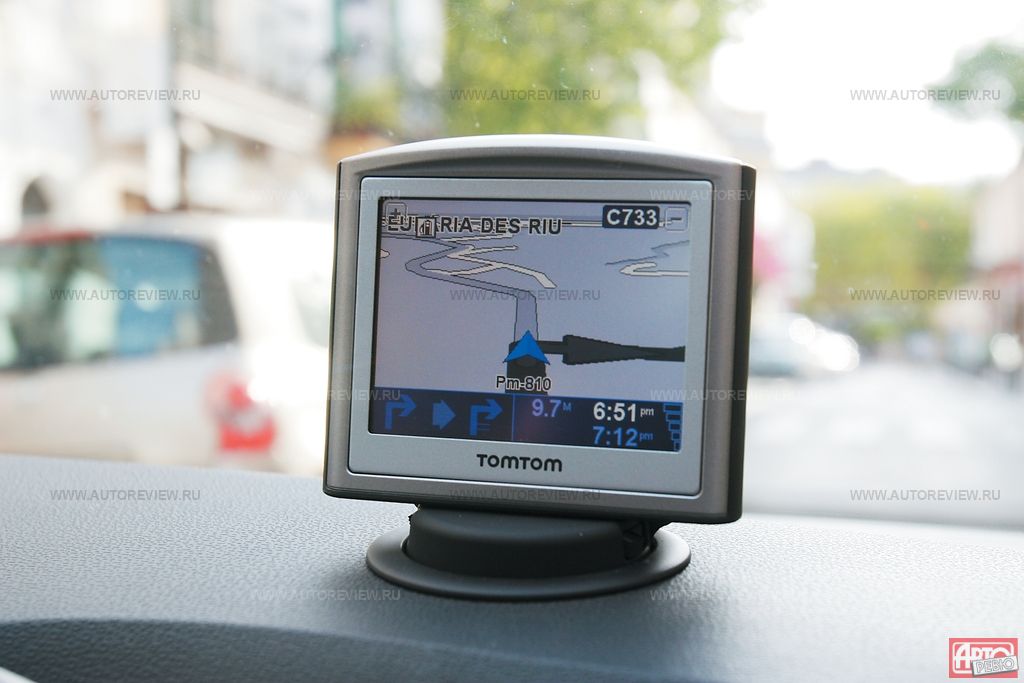 |
| The sleeping instrument needles are lowered in a racing style. The numbers on the scales are hard to distinguish, and the coolant temperature gauge has disappeared altogether | The audio system and climate control are intuitive, but the glossy panel surfaces get dirty even from clean hands | The base equipment includes a mount for a portable GPS navigator |
The Spaniards chose a precise motto for the new model: More emotions, fewer emissions.
As for emissions, that's a reference to more economical and cleaner engines. They, however, were inherited from the predecessor: a three-cylinder 1.2, two four-cylinder units of 1.4 and 1.6 liters, as well as a proven eight-valve 1.9 TDI turbodiesel. They were only adapted to new environmental standards.
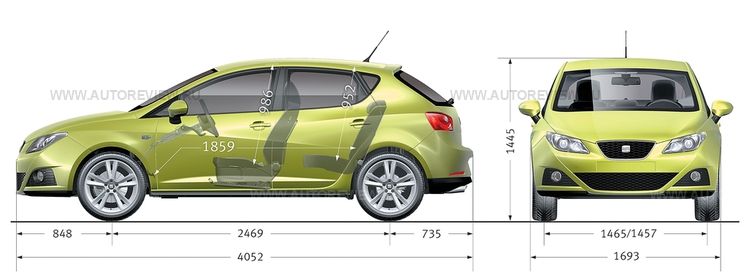
But the chassis here is completely new. The Ibiza became the firstborn of the Volkswagen Group platform, on which the new Polo and Audi A1 will soon appear. The Skoda Fabia, released a year earlier, is essentially just a deep modernization of the old model, but the Ibiza body was developed from scratch. Of course, it is stiffer (an increase of 13 percent in torsion and 10 in bending) and lighter. Yes, the new Ibiza is almost 50 kg lighter than the previous one, although it has stretched by 99 mm!
The front seats are lowered 22 mm lower than in the old Ibiza. That is, the engineers were thinking not about interior space, but about lowering the center of gravity — and therefore about better handling! It's clear why I chose the most powerful version for the first meeting — with a 1.6-liter engine with 105 hp and sports suspension?
The Ibiza pleased with seats with excellent lateral support, a comfortable three-spoke steering wheel, and a front panel facing the driver. A real sports car! The instruments are recessed into deep wells, the displays glow red, the steering wheel, molded for a proper grip, is trimmed in perforated leather, and the floor mats are stitched with scarlet thread. Memories of the former gray-black kingdom of hard plastic remain only in the door handles — the front panel is now soft to the touch, and its blackness is enlivened by silver trims on the instruments and ventilation deflectors. Moreover, you can order a completely cheerful interior — with a half-white panel and the same inserts in the doors. But that's a matter of taste.
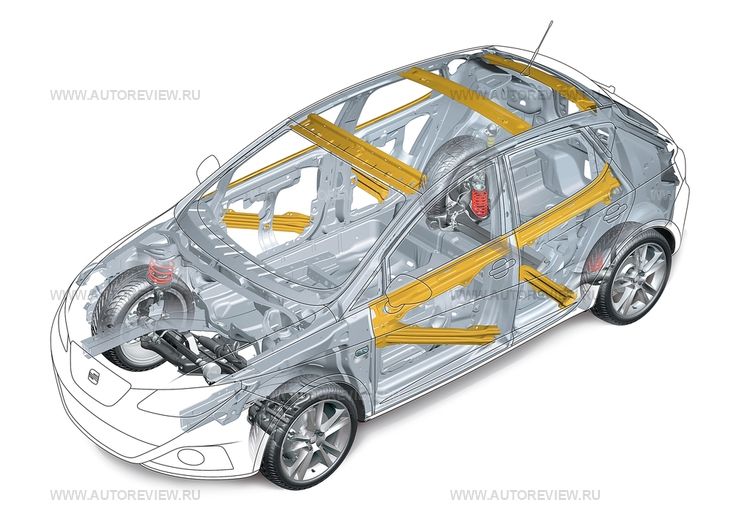
The body has become lighter and 13 percent stiffer than before — thanks to the widespread use of high-strength steels and laser welding
Ergonomics, as before, are top-notch. Except that the clutch pedal travel is a bit long in the Volkswagen style, and the cable-driven gearbox doesn't shine with precision.
The engine pulls well from low revs for its size and spins smoothly, without jerks, to the red zone, gently hitting the limiter at 6200 rpm. Not a fireball, but enough for fast driving. But why so stiff? Why does the Ibiza shake me so much on speed bumps?
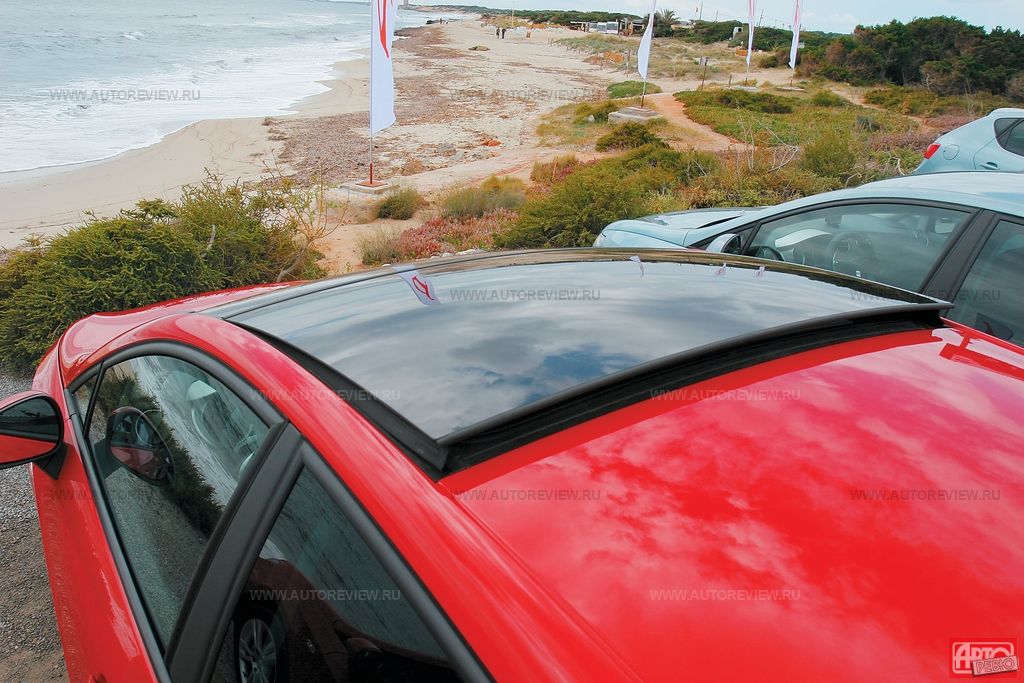 | 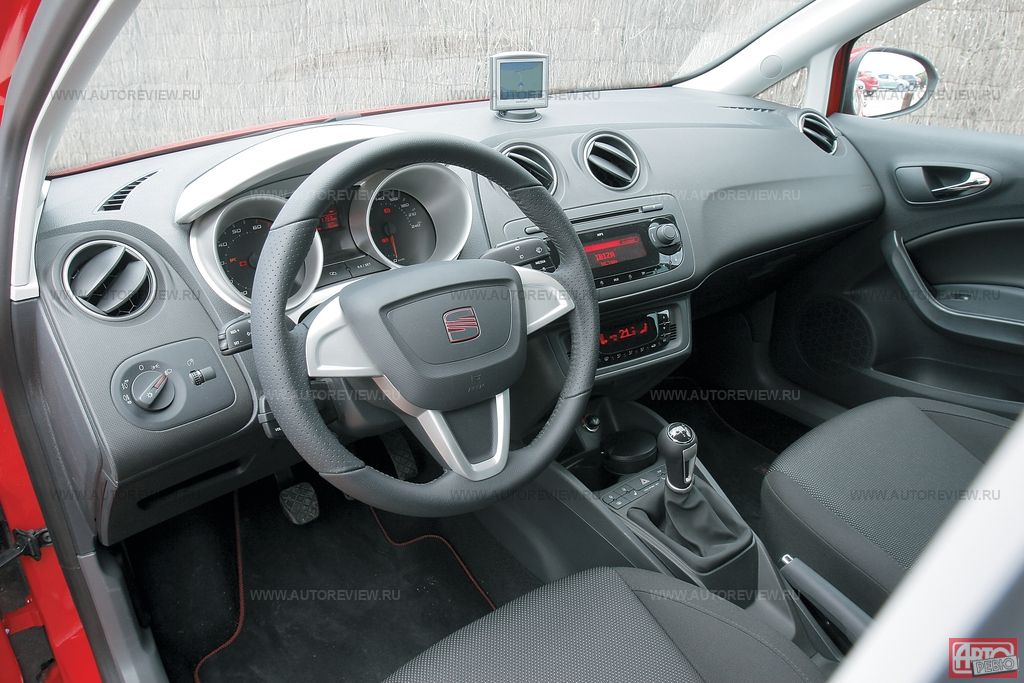 | |
| Even an A5 notebook barely fits in the glove box | Among the options is a sunroof the size of half the roof, which only tilts up | The interior breathes sport: three-spoke steering wheel, console turned to the driver, red backlighting for buttons and displays. "Aluminum" inserts and leather steering wheel trim are a privilege of the expensive Stylance and Sport versions |
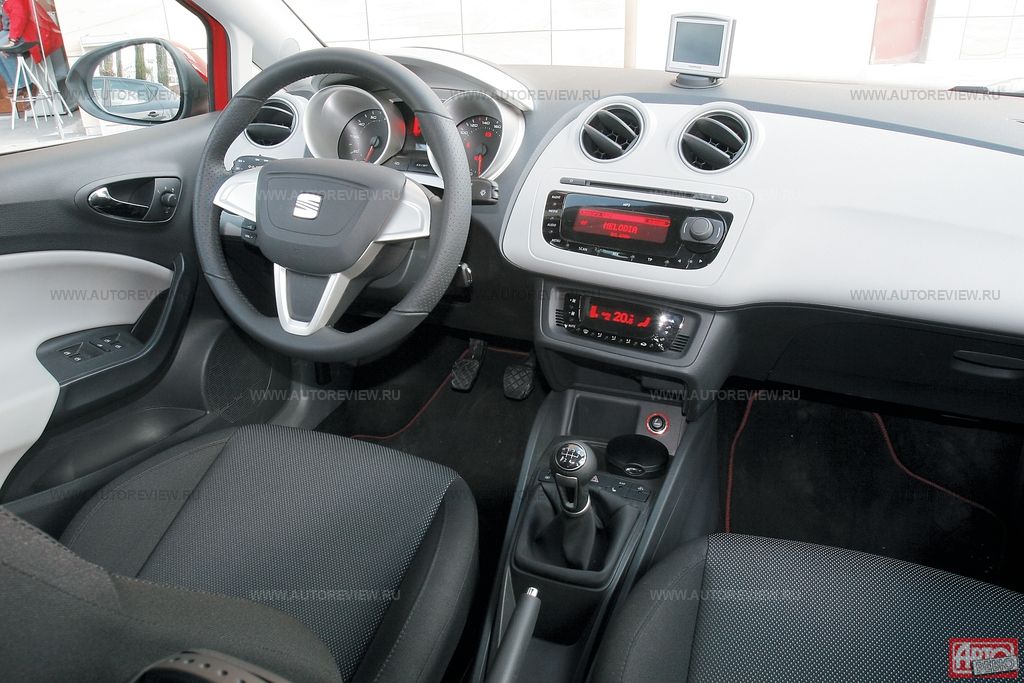 | 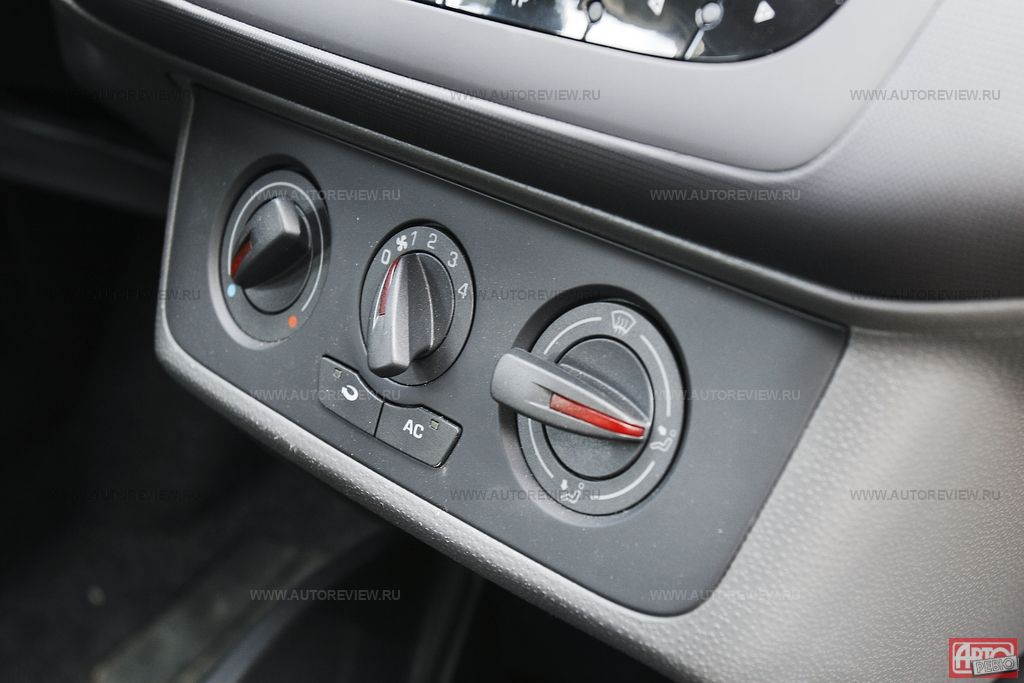 | 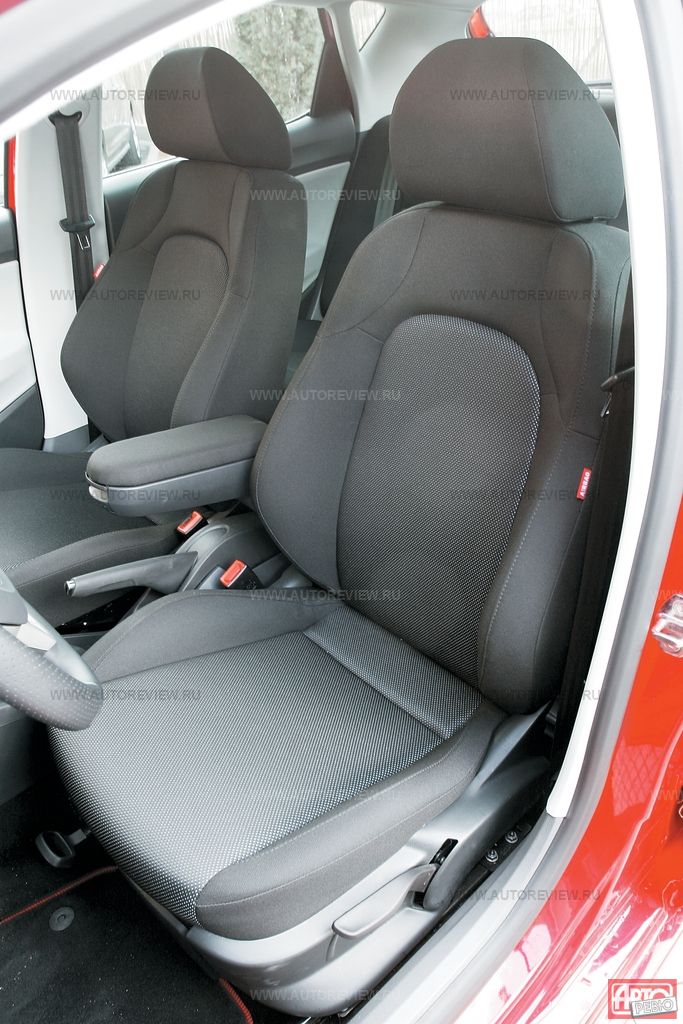 |
| You can also order this interior — with white inserts on the panel and doors | The base Reference trim has manual ventilation and air conditioning control instead of climate control | Sports seats provide excellent lateral support, regular seats are softer and more amorphous. The armrest is an option |
All because sport is sport! The car confidently holds the high-speed straight and happily winds through mountain serpentine corners, gripping the asphalt with far from the most racing 17-inch Goodyear Excellence tires. Body roll is minimal, the moderately "sharp" and precise steering wheel is filled with a pleasant and natural reactive force. It's no wonder the Spaniards kept the electro-hydraulic power steering — even if it's more expensive and complex than electric, it's much more informative.
Mild understeer allows you to freely play with the throttle in a corner — just lift off the gas, and the car only slightly shifts to the inside of the arc. In the worst case, ESP will gently and delicately back me up. The main thing is not to exceed the speed at the corner entry: the stability system cannot cope with understeer.
By the way, why can't ESP be completely turned off? "According to our statistics, less than one percent of buyers prefer to turn off the stability system," answers my question Fermin Soneira, the lead engineer of the Ibiza project. "And why? Did ESP bother you?" No, I say, it only helped. It's just a pity that on the snowy roads of Russia or Finland you can't have your fun...
In general, with or without ESP, the chassis of the new hatchback clearly outpaces its current engines. But more powerful Ibiza FR and Cupra will appear later. The first, as Soneira hinted, will get a 170-horsepower 1.4 TSI engine with twin charging, which is already on the Golf and Touran. And the Cupra will be even more powerful — about two hundred horsepower, like the Renault Clio Sport.
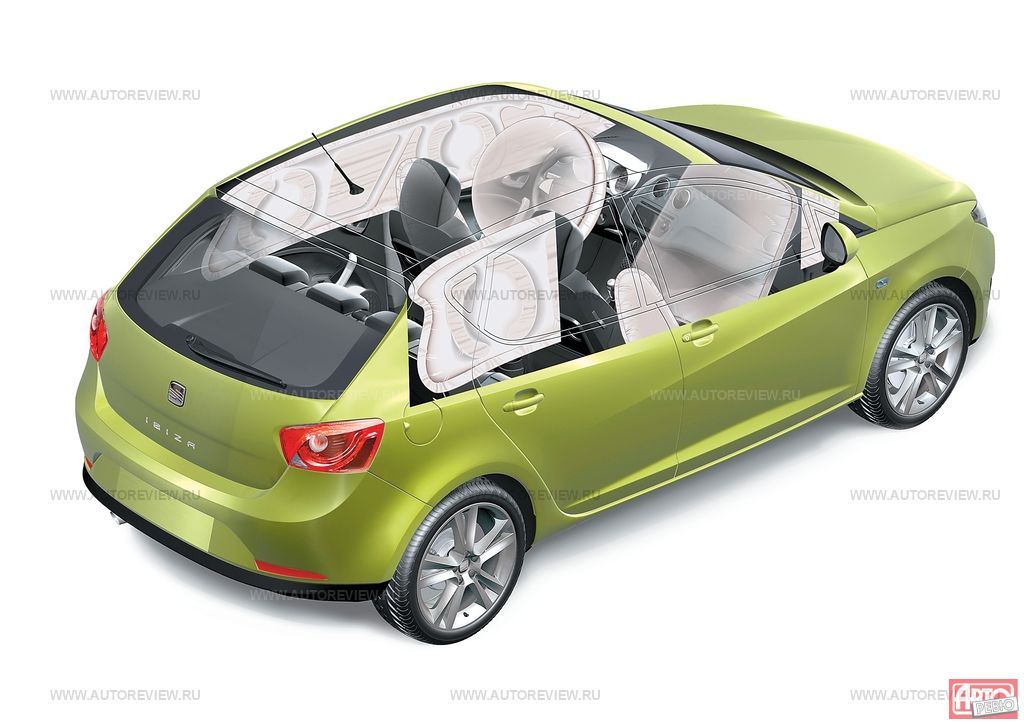 | 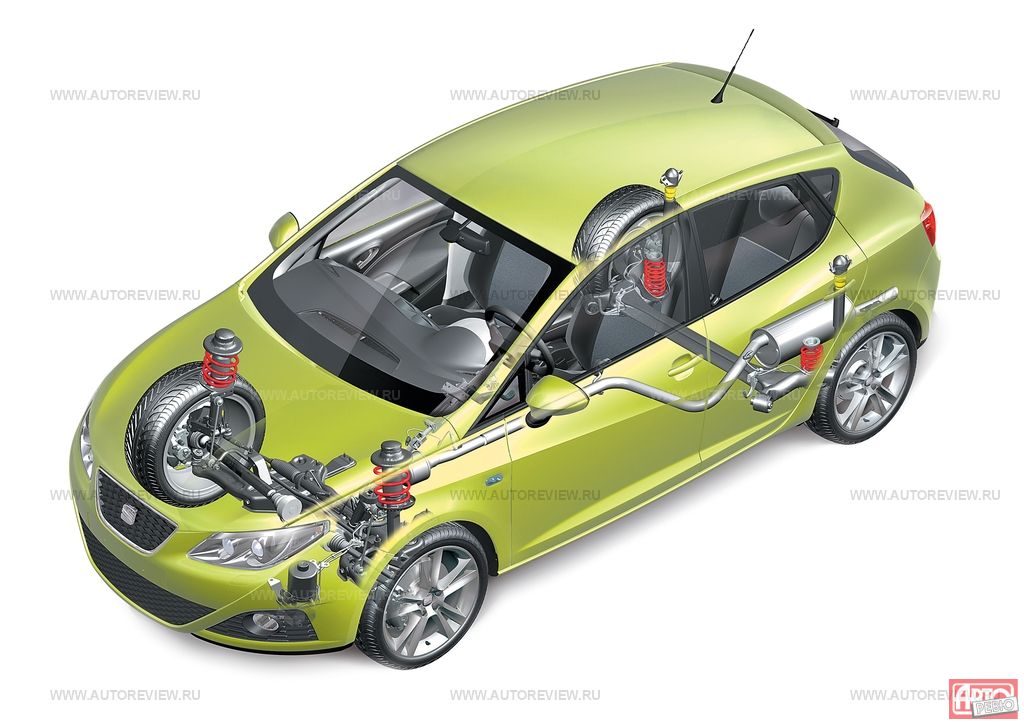 |
| From the factory, the new Ibiza is equipped with front airbags and curtain airbags, while side airbags in the seat backs are offered for an extra charge | The fundamentally new platform retained the layout — McPherson struts in front, a torsion beam in the rear, and steering with an electro-hydraulic power assist. The wheelbase grew by 7 mm, the track by 30 mm. The front suspension subframe is now one-piece, not composite, and stiffer. New arms, bushings, and steering knuckles improved suspension kinematics. The sport chassis option — with stiffer shock absorbers and springs (by 25%), rear beam, its bushings, and a front anti-roll bar 19 mm thick instead of the 18-millimeter one |
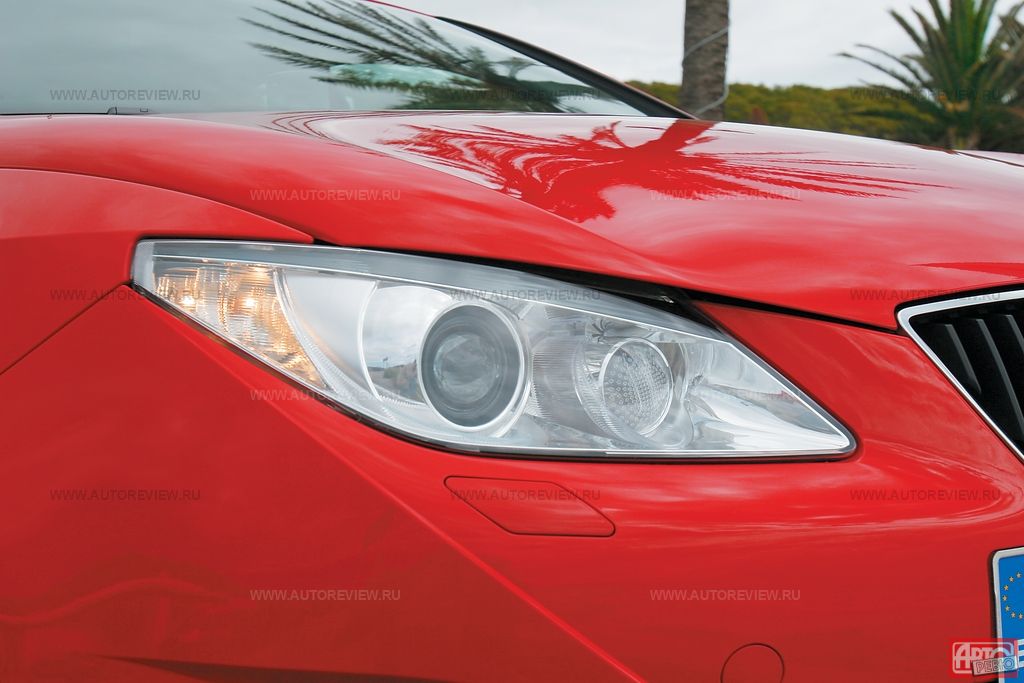 | |
| On request, the Ibiza is equipped with swiveling bi-xenon headlights. The function of illuminating a turn with one of the fog lights is standard for the Stylance and Sport trims | |
Now let's go through the versions in descending order of power. The mid-range 1.4-liter unit producing 85 horsepower is designed so that it differs from its older 1600cc sibling only by a reduced piston stroke. At the same time, at medium revs it subjectively almost matches it in torque. The only thing is it gives up earlier: there's no point in revving the tachometer into the red zone. But this engine runs quieter. As for the 16-inch wheels fitted to the test car, although they grip slightly less in corners, they don't transmit minor road imperfections into the cabin as meticulously.
By the way, the broken rural road we found deep on the island showed that the Ibiza doesn't shy away from outright battered asphalt either. It shakes, of course, but I noticed neither suspension bottoming out nor any wandering off the line.
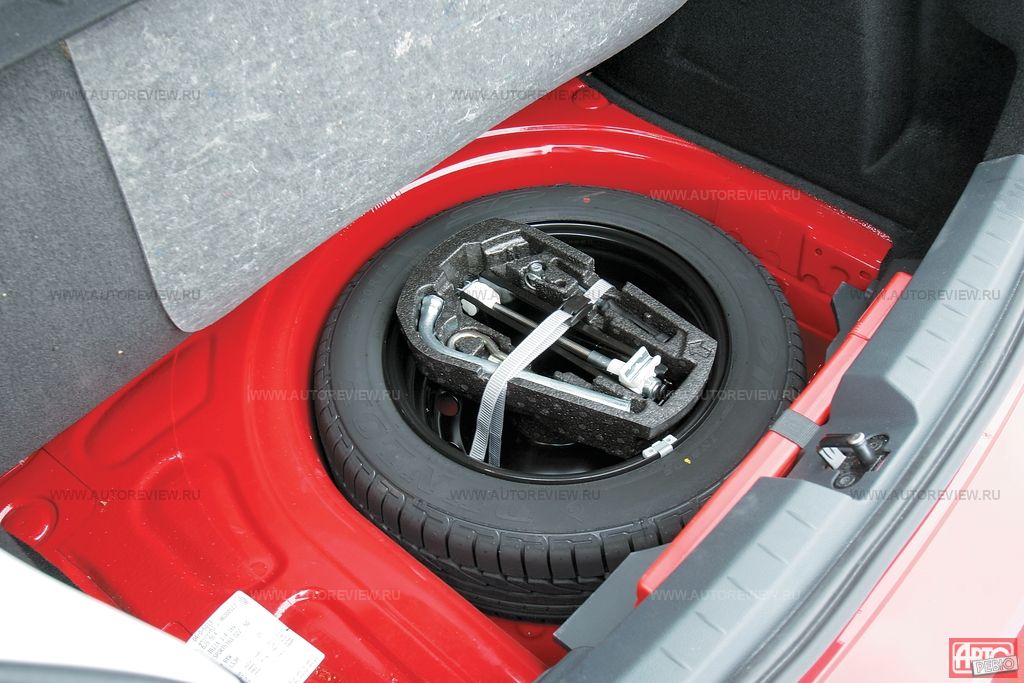 |
| Under the trunk floor is a full-size spare tire |
I also got to drive the base trim with the three-cylinder engine, high-profile 15-inch tires, and standard suspension. The interior of the base model is Spartan: no silver inserts, no leather-wrapped steering wheel, and the seats are somewhat shapeless. Inside it's gloomy and feels cheap. The softer suspension turns the new Seat into an ordinary small hatchback, like many in Europe and Japan. It leans more, and steering response becomes "average." And in terms of ride smoothness, the "regular" Ibiza doesn't make as big a step forward compared to the sporty version as you'd expect from a quarter reduction in spring stiffness.
The 70-horsepower engine, surprisingly, turned out to be quite peppy. True, this is achieved mainly through "short" gears in the gearbox—on the highway there's not enough torque. But according to Russian dealers' forecasts, it's the three-cylinder Ibiza that will become the most popular.
The Russian market won't be without a diesel either. At idle, the car with the heavy-fuel engine rattles like a small tractor and transmits vibration to the pedals and gearshift lever. But when the 240 newton-meters of torque kick in, it accelerates even more briskly than the petrol version! The main thing is not to let the tachometer needle drop below 2000 rpm, otherwise the old eight-valve engine falls into such a turbo lag as if it were dug with an excavator. However, will Russian buyers be interested in the diesel Ibiza, given that it will be the most expensive in the lineup?
Moreover, the version with the optimal 1.4 petrol engine will also cost a pretty penny here—roughly from 420–430 thousand rubles (that is, $17500–18000) in the minimal "gloomy-plastic" Reference trim. And the gearbox there will only be a five-speed manual: the trendy seven-speed DSG "robot" will appear on Ibizas only next year. Therefore, the plan to sell three hundred cars by the end of the year looks overly optimistic.
The sky over Ibiza is frowning again.
And the Ibiza is smiling. In a word, a resort girl!
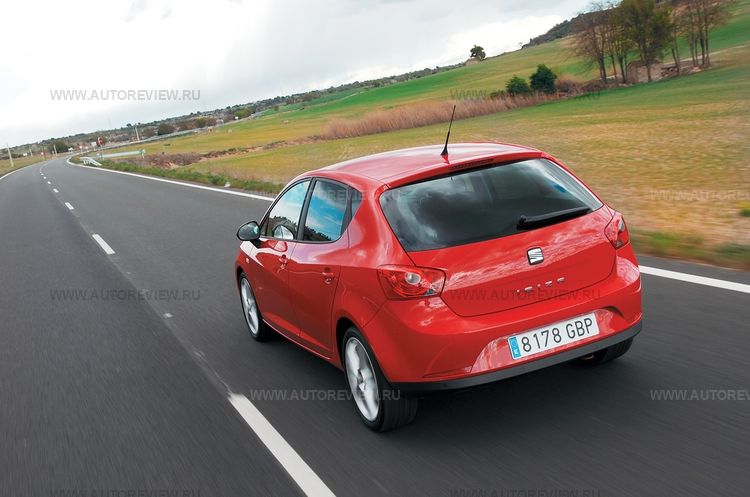
The only controversial point in the exterior is the rear lights: the previous "Alfa Romeo-style" ones looked more interesting. As before, the emblem serves as the button for opening the fifth door
Predecessors
Igor VLADIMIRSKYThe current Ibiza is already the fourth generation of the model. The first hatchback appeared in 1984, and its "donor" was the Fiat Ritmo.
Times were tough for the Spaniards then: since 1979, SEAT had been fully owned by the FIAT concern, but the Italians themselves were experiencing financial difficulties, and in 1982 SEAT signed a cooperation agreement with Volkswagen. However, the Ibiza, which became the first model of the "post-Fiat" era, was still built on the basis of the Fiat Ritmo. The design was handled by ItalDesign studio, and most of the engineering work and fine-tuning were done by Porsche specialists.
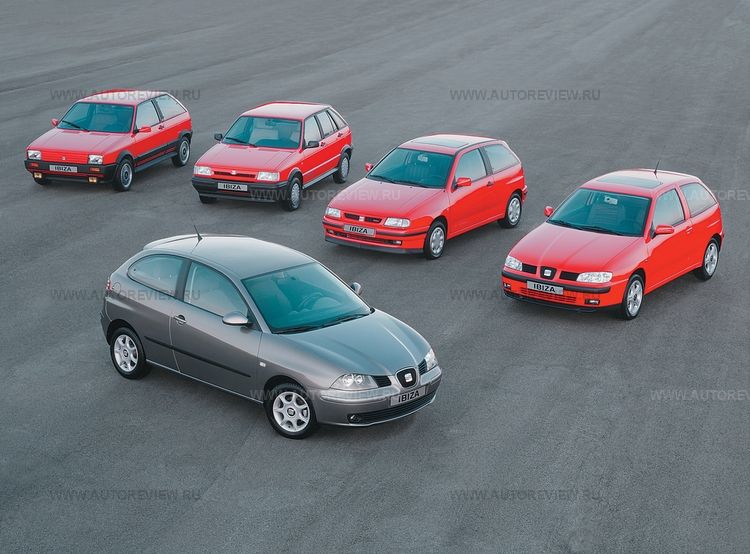
From left to right: Seat Ibiza first generation (1984—1991 and 1991—1993) and second generation (1993—1999 and 1999—2001). In the foreground is a pre-facelift third-generation hatchback. Over 23 years, more than four million cars of three generations were produced
The cheapest Ibiza modifications were equipped with Fiat carburetor engines of 903 cc and 44 hp, while the top Sportline version had a 1.7-liter injected engine producing 98 hp.
At home, the inexpensive Seat was well received, but on export markets the car earned a bad reputation due to mediocre build quality and high noise levels.
In 1986, SEAT fully came under Volkswagen's wing, and the Germans took on modernizing the Ibiza. Two years later, a new interior appeared, and in 1991—a facelift. By the way, the "first" Ibiza is still produced... in China—under the Soyat brand.
In 1993, at the Frankfurt Motor Show, the larger second-generation Ibiza debuted, built on the same platform as the new Volkswagen Polo hatchback. A year later, the Seat Ibiza GTi appeared with a 1.8 twin-cam engine producing 129 hp, and in the mid-90s Volkswagen began instilling a sporty image in the Spanish brand. The first "hot" model was the three-door Ibiza Cupra with a two-liter 150-horsepower engine.
The 1999 facelift brought the Ibiza slightly revised design and an updated engine lineup. The Cupra version received a 1.8 Turbo engine (156 hp), and the flagship became the Cupra R with a 180-horsepower unit and a six-speed manual gearbox.
The third-generation Seat Ibiza debuted at the end of 2001 at the Bologna Motor Show. The grown body by Walter de Silva was again based on the Polo platform, and the base engine was a three-cylinder 1.2 with 64 hp. Interestingly, until 2006, the Ibiza was also offered with a naturally aspirated 1.9 SDI diesel (64 hp). In 2003, the "hot" version Seat Ibiza FR (Formula Racing) appeared with a 1.8T engine (150 hp), and a year later sales of the three-door Ibiza Cupra started, which were equipped with either a 180-horsepower petrol engine or a 160-horsepower 1.9 TDI turbodiesel.
Having survived one facelift, the "third" Ibiza was produced until 2008, when the Seat Bocanegra concept—a harbinger of the fourth-generation car—was shown at the Geneva Motor Show.