
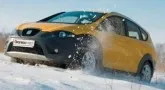
The Spanish brand Seat, part of the Volkswagen structure, presented the Altea Freetrack model to the public. However, before moving on to the car itself, it is worth saying a few words about the preferences that largely determine the fate of the new product on the market. The Russian buyer is very different from the European one. Abroad, compact and economical models are a priority, which mainly carry one, less often two people. Here, the picture is different. Even against the backdrop of rising fuel prices, few people think about saving; powerful engines are favored. Size is also important: the larger the car, the better. And this is despite the fact that most of the time only the driver spends in the cabin. And if you add all-wheel drive to the impressive dimensions, this is almost an ideal recipe. Probably for this reason, cars combining the features of an SUV, a minivan, and a regular passenger car are becoming increasingly popular.
The Spaniards followed this path by creating the Altea Freetrack. Officially, the new product is called a full-fledged crossover, but in reality it is a reworked version of the Altea XL compact van. It is not easy to classify it into any specific class. One thing can be said: the car successfully combines the spaciousness of a station wagon and the ability of a crossover to handle light off-road conditions.
Externally, it is not difficult to distinguish the Freetrack from the regular Altea XL. First of all, the increased ground clearance catches the eye — the ride height has grown by 4 centimeters. A protective black plastic body kit is installed around the perimeter of the body, which not only protects the paintwork from branches and stones but also gives the car a more brutal look. The engineers also redesigned the geometry of the front and rear overhangs. As a result, the approach angle is 17.6 degrees, and the departure angle is 23 degrees. Not every soft-roader can boast such indicators. On the move, the Altea Freetrack behaves predictably. The steering wheel has acceptable informativeness, although a lack of feedback is clearly felt — overall, there are almost no complaints about the handling.
The suspension has been thoroughly refined. The shock absorbers, unlike those of the donor Altea XL, received enlarged oil reservoirs. The chassis settings are selected so that the car confidently holds the given trajectory and takes corners with minor body rolls. At the same time, passengers are comfortable even on broken roads: the suspension quietly and efficiently absorbs small irregularities and adequately copes with large surface defects. Only occasionally can it remind itself with a breakdown.
Confident movement both on asphalt and on dirt roads is facilitated by a whole range of electronic assistants. This includes the TCS traction control system and the ESP stability control system. In addition, there is a function that makes the Freetrack related to real SUVs — automatic braking control during descent DSR. The electronics monitor the braking intensity on each axle and, if necessary, correct the process by sending short pulses to the steering wheel to keep the car on the desired course. There is also an emergency braking system EBA, which, when the brake pedal is pressed sharply, instantly increases the pressure in the circuit to the maximum. Those who like to travel with a trailer will appreciate the trailer stabilization function TSP. This entire arsenal allows you to feel very calm behind the wheel of the Freetrack on any surface, which was confirmed during a test on a snowy track.
In snowy and icy conditions, it is especially noticeable how the stabilization system works. It does not interfere in the process at an early stage, allowing the car to slide a little. But as soon as the amplitude of the skid begins to grow, ESP gently, without sharp jerks, returns the car to the driver's control. The all-wheel drive also connects almost imperceptibly.
The appearance of the 4WD transmission entailed serious changes in the design of the rear suspension. This was done so as not to sacrifice the interior space. For the same reason, the fuel tank was refined, although its volume remained the same — 55 liters. The all-wheel drive scheme on the Spanish crossover is classic: a multi-disc Haldex clutch distributes torque between the front and rear axles. Under normal conditions, the car remains front-wheel drive. The clutch is controlled by an electronic unit that analyzes data from ABS and ESP sensors and redistributes traction. Up to 50% of the power can go to the rear axle. It is not worth storming serious off-road with such a scheme, but on slippery surfaces or snowy virgin lands, you can feel confident.
For the Russian market, only one trim level is provided, and it is very rich. This applies not only to the extensive list of equipment but also to the engine. Of the three engines available in Europe, we get the most powerful one — a two-liter turbocharged unit producing 200 horsepower. It works exclusively in conjunction with a 6-speed manual gearbox. As a result, the car turned out to be truly fast: it reaches the first hundred in just 7.7 seconds, and the maximum speed reaches 220 km/h. For a family car, the indicators are excellent.
Plans, successes, development
General Director of Iberia Motor Rus CJSC, Thomas Dorenwendt:
— The company Iberia Motor Rus has been operating as an importer of SEAT cars in Russia for less than a year. More than ten dealer centers of the brand have already been opened. By the end of 2008, their number will grow to 25, and by 2012 — to 55. The entire SEAT lineup is represented in Russia: Ibiza, Cordoba, Altea, Altea XL, Leon, Toledo, and Altea Freetrack. All new models and trim levels will appear here simultaneously with other countries. Currently, preparations are underway for the launch of the new Ibiza. We adhere to the global brand development strategy, including in the sports direction. In the 2008 season, as part of the Grand Prix RTCC racing series, the SEAT Leon Supercup will be held. Competitions on 300-horsepower cars are already taking place in many European countries, and now they have reached Russia. The pilots will have to perform on very serious equipment.
Driving
The powerful engine provides excellent dynamics. The suspension has been refined taking into account the new operating conditions. Minor comments — about the steering with unclear feedback and the presence of rolls.
Interior
Fully corresponds to the conditions for which the Freetrack was created. The brown inserts may not appeal to everyone.
Comfort
The interior is spacious, there is enough room for all five passengers. A comfortable suspension will allow you to easily cover more than one hundred kilometers.
Safety
The car is initially positioned as a family car, so maximum attention is paid to safety issues.
Price
So far there is only one trim level, and it is distinguished by rich equipment. But will there be buyers for this car at such a price? The question remains open.
Advantages and disadvantages
- Pros: all-wheel drive, large ground clearance, spacious interior, original design.
- Cons: mediocre rear visibility, rolls, high price.
Technical specifications
Make and model — Seat Altea Freetrack
Dimensions — 4493x1788x1622 mm
Engine — petrol, 1998 cm³, 200 hp/5100 rpm
Transmission — manual, 6-speed
Dynamics — max 220 km/h; 7.7 s to 100 km/h
Competitors — Skoda Octavia Scout, Subaru Outback
Our opinion
The Seat Altea Freetrack largely meets the demands of the domestic buyer. It has an attractive appearance, a spacious interior, a wide list of options, and decent qualities both on and off the road. But among other things, our consumer always compares the product with its price. And here lies the main danger. Is the buyer ready to pay 44 thousand dollars for a Spanish crossover?
© 5 Koleso