
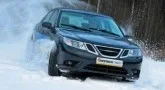
The Swedes from Saab have carried out a deep restyling of their "nine-three" model. The update turned out to be so serious that the car looks completely different.
Saab 9-3. Price: from 868,000 rubles. On sale since December 2007.
Manufacturers constantly resort to restyling — it is a convenient way to refresh a model without creating a new platform, extend its life cycle, and buy time for developing the next generation. For some brands, it all comes down to changing the optics, while others take a more radical approach. The Swedes chose the second path.
If the previous generation car were not standing nearby, the updated 9-3 could easily be mistaken for a new model. At the front, an imposing radiator grille has appeared, which looks more aggressive, new headlights with striking glowing strips of parking lights, a massive bumper with large fog lights. On closer inspection, it is clear that the hood and front fenders have also changed. In profile, the car has also become different: the moldings have disappeared from the body, although the roofline remains the same — the body itself is the same. At the rear, the main update is completely transparent taillights. They somewhat resemble "Lexus" ones, but look more interesting due to the black edging. The trunk lid has lost the stamping that imitated a spoiler. At the rear, a more solid and massive bumper is now installed, which looks like a single whole without a separate "skirt".
Inside, everything remains almost the same. The driver's seat still resembles a fighter jet cockpit — everything is compact, everything at hand, and very convenient. In the Vector trim, which we got for the test, there is a lot of light leather all around.
In this trim, besides the leather, there is another feature — an automatic five-speed gearbox with electronic control located on the steering wheel. To change gears, you no longer need to touch the selector — just press the "plus" or "minus" button on the steering wheel. It's undeniably fun, but the buttons are not positioned very well: with a proper sports grip, your thumbs cannot reach them. Paddle shifters behind the steering wheel, which competitors offer, would be more convenient here.
Clicking through gears with four fingers out of five is much more pleasant than with one, and you don't need to change your grip. But there is another way to intervene in the gearbox's operation. For those who do not want to shift manually but want some excitement, there is an inconspicuous button on the center console with a "shifter" icon and the letter S. After pressing it, the engine revs at the same speed almost double. And then you just have to keep pressing the pedals: the thrust of the 175-horsepower turbo engine is excellent, and for the peak, you don't necessarily have to keep the engine in the high rev range all the time.
However, do not think that the Saab is created only for city racing. It calmly stands in traffic jams with everyone else and can deliver pleasure not only from "aerobatics" but also from measured driving. Especially since the suspension has been retuned. The previous model noticeably shook on our roads, like an airplane in a turbulence zone, but now even at low speeds, the cabin is comfortable and cozy. The main thing is to choose the right direction of travel.
Company history
Saab appeared in April 1937 and started with the production of military aircraft. The idea to produce cars belonged to Gunnar Ljungström. His concept formed the basis of the first prototype Saab 92.001, which saw the light at the end of 1946. The brand's distinctive features were excellent aerodynamics — the aviation school had an effect — and independent suspension. Three years later, the company was already producing two models — Saab Standart 92 and 92 DeLuxe. In 1956, the sporty Sonett with a fiberglass body appeared.
The Saab 95 station wagon of 1959 marked the beginning of commercial success. The Saab 9000, whose development was completed in 1984, opened a new stage in the company's history. In 1989, General Motors bought a controlling stake in Saab, which helped the company enter the European market. By 2000, GM became the full owner of the company.
Driving
The updated suspension has found a reasonable balance between handling and comfort.
Interior
As before, aviation motifs come first, but passenger comfort has not been forgotten either.
Comfort
At a decent level. The only thing missing is a flight attendant.
Safety
The car is equipped with almost all active and passive systems to the maximum.
Price
As before, it is high, which, frankly, does not add to its attractiveness.
Advantages and disadvantages
+ Fresh design, comfortable interior, good sound insulation, torquey engine, rich equipment.
— High price, dubious prospects on the secondary market.
Technical specifications
Make and model — Saab 93
Dimensions — 4630x1765x1430 mm
Engine — petrol, 1998 cm³, 175 hp/5500 rpm
Transmission — automatic, 5-speed
Dynamics — 220 km/h; 9.7 s to 100 km/h
Competitors — Opel Vectra, Cadillac BLS
Our opinion
The deep restyling has benefited the 9-3. The car has become more modern and, let's face it, more interesting. It's just a pity that the interior was barely touched. If it had been at least slightly updated, there would be noticeably more people wanting to buy this car. Although even those advantages that the updated SAAB 9-3 already has are quite enough to gain many fans.