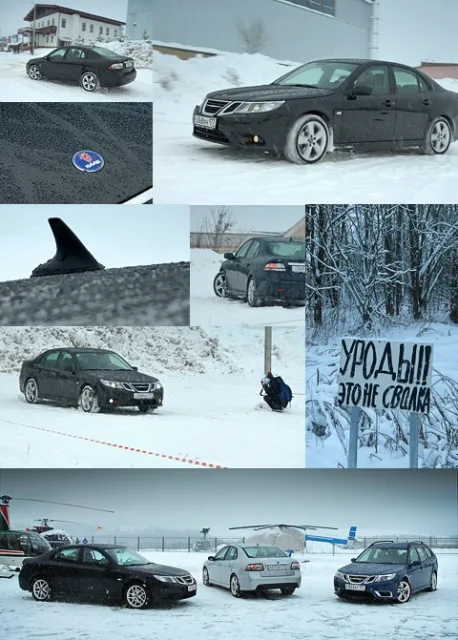
The organizers deliberately timed the presentation of the restyled Saab 9–3 to coincide with winter weather, even postponing it for a couple of weeks to wait until the roads were properly covered with ice and snow. The logic is simple: Saab is a northern car, and our climate should be its native element. I get behind the wheel, turn the key — and the instrument panel lights up with a greeting: “Ready to take off.” Well, the weather is suitable for flying.
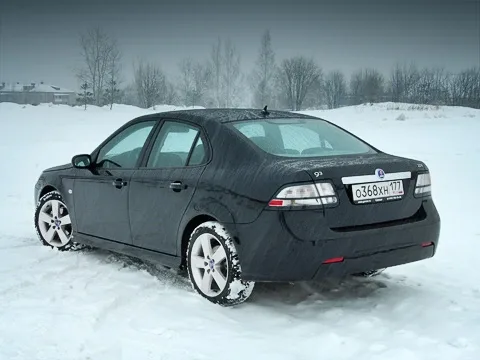
But the main question is not about the weather, but about what has changed in this 9–3 compared to the pre-restyling version. First of all, the exterior catches the eye. The front end is completely new, styled after the Aero X concept; at the rear, there are transparent taillights, and the bumpers have also been reworked. As I walked around the parking lot among the “nine-thirds,” whose LED daytime running light strips glowed through the twilight, the word “new” came to mind, not “updated.”
Upon closer inspection, it turns out there aren’t that many differences. The interior is practically untouched — except that the Aero version now has a new multimedia system with a touchscreen and a Bose audio system. Everything else is familiar. The trim materials are high-quality, the ergonomics are well thought out, visibility is decent, and the equipment is rich. But the car’s age, alas, cannot be hidden by any restyling. It’s betrayed by small details: the mirror control unit, cheap non-folding grab handles on the ceiling, and similar trifles.
The equipment, nevertheless, has become more generous. Dual-zone climate control is now standard, adaptive bi-xenon headlights have been added, the tire pressure monitoring system has been improved, and individual settings have become more advanced. It seems like a small amount, but it’s nice.
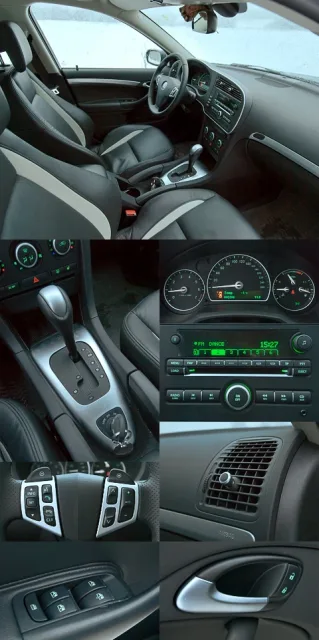
Almost nothing has changed in the cabin, but the ergonomics were good before. The climate control knobs, which replaced the array of buttons and screens on the center panel during the previous modernization, still don’t appeal to me. I’d bring back the buttons — even if they’re hardly more convenient, they had so much charm!
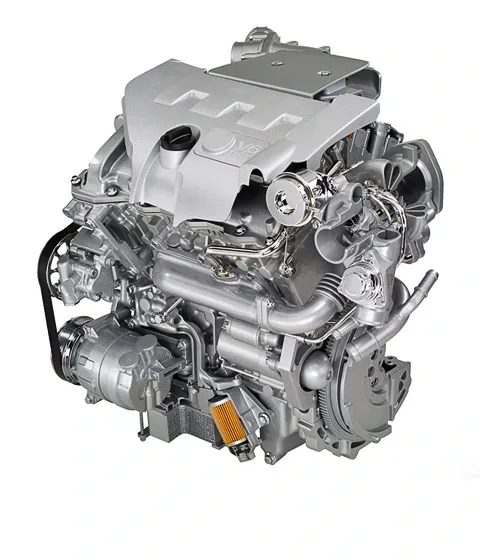
The engines also remain the same. The only exception is the 2.8-liter V6, which got an exhaust gas recirculation system and, along with it, an extra five “horses.” But the two-liter turbo engines (150, 175, or 210 hp depending on the version) and the base 1.8-liter naturally aspirated engine with 122 hp remain untouched. Although no, I’m being disingenuous — the Saab folks saved something for dessert. But more on that later.
The main changes are hidden deeper — where only the very curious or service technicians look. I’m talking about the new body structure: it now consists of 60% high-strength steels, and torsional rigidity has increased to 22,000 Nm/deg (for the wagon — 20,500 Nm/deg). True, this won’t affect the Euro NCAP rating — the previous 9–3 already had an honest five stars.
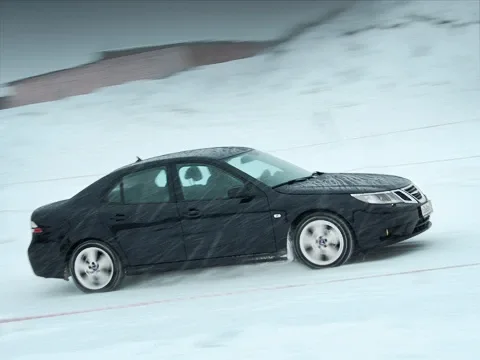
By the way, the aerodynamics of the new body are also top-notch: the drag coefficient Cx is 0.28 for the sedan and 0.33 for the wagon. In this exercise, the 9–3 is one of the leaders in its class.
The kinematics of the rear independent self-steering suspension have also been changed. Most of its components are now made of aluminum alloys. The engineers spent a lot of time tuning the elastokinematics and even gave the passive rear-wheel steering system its own name — ReAxs. In addition to improving handling and comfort, it also helps during braking by slightly changing the toe angle of the wheels.
How much all this has affected the character of the 9–3 is hard to say right away. But on asphalt, I liked the car. The steering responses are calm, not too sporty, but precise and quick. The suspension is composed, moderately firm, and handles almost any bumps without issues. The only thing that bothers me is that the steering wheel is a bit large and not very informative.
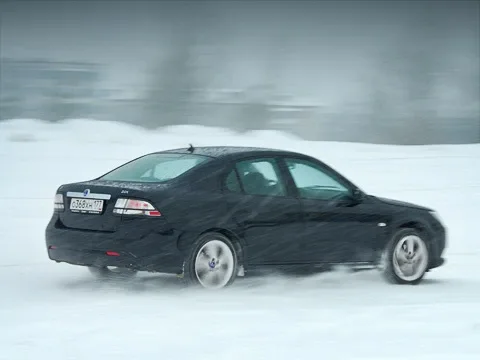
And here’s something interesting. I remember when we drove the 9–3 convertible, we complained about the “empty” steering. But we didn’t nitpick much — a convertible is a convertible. And now — the updated sedan. First the bad news: on asphalt, it’s the same picture — the steering again lacks effort. Now the good news: as soon as you drive onto a snowy road, the steering suddenly fills with excellent effort — every tiny change in the surface is felt distinctly.
But you’re finally convinced of the car’s all-season capability when you drive onto a small snow track marked with cones. The surface there was uneven to the extreme, the “corridor” narrow, but you had to drive. And nothing — the Saab screws into corners excellently and handles throttle well in slides. Stabilizing the car is a piece of cake, and you can only break it into a drift with outright provocation or complete recklessness. Great!
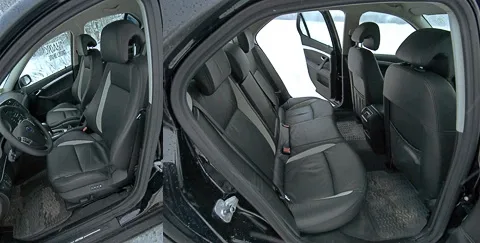
The front seats don’t have sporty lateral support, but comfort is fine. However, there’s less space in the back than I’d like — tall passengers will feel a bit cramped.
But it would have been truly great to see all-wheel-drive Saabs at the presentation. No matter how hard I looked, I didn’t find a single one. So any careless press of the gas pedal — and you’re either polishing the ice or collecting the studs that flew out.
But that won’t last long. The XWD (Cross Wheel Drive) system that the 9–3 will get is developed by Haldex. But not all Haldex systems are the same: the Saab system looks far more interesting than the analogues used, for example, in Volvo or Volkswagen. Torque is distributed between the axles like everyone else’s — via a coupling with a multi-plate wet clutch. In normal conditions, only 5–10 percent of the torque goes to the rear wheels, but at the slightest slip, the coupling redistributes it as it sees fit. Moreover, the coupling itself is more advanced than competitors’ and can send all the traction rearward. But the Swedes decided not to stop there. The 9–3 also has another Haldex coupling at the rear, responsible for locking (up to 85%) the rear differential. In short, it’s damn interesting!
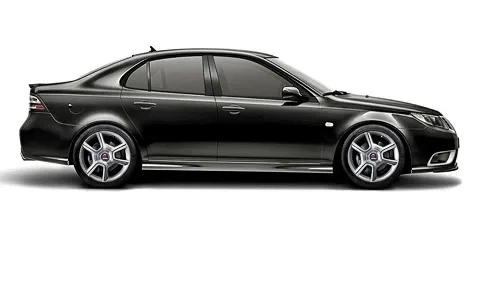
XWD will only be offered starting in February, and initially — on the limited Turbo X version, which will be produced in a run of just 2,000 cars. All of them will be black, with upgraded 2.8-liter engines producing 280 hp, a suspension lowered by 10 millimeters, and special distinguishing marks: unique alloy wheels, numbered plaques in the interior, and different trim. Exclusive, after all. And only then will XWD be available first on the Aero version (also with 280 hp), and then on the 210-hp version.
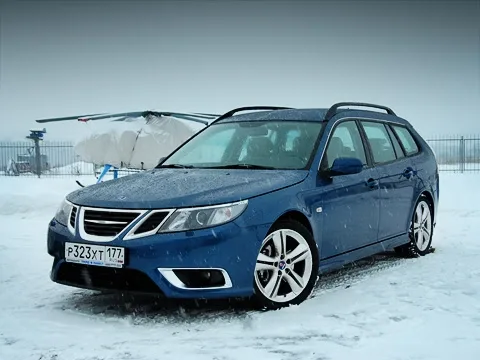
By the way, word has it that all 26 Turbo X cars intended for Russia have already been sold, and the buyers didn’t even ask about the price. Those are fans. But for other customers, the money question could be decisive. And here Saab has good news. The updated 9–3 has gone up in price by only a couple of percent. The most affordable car with the 1.8-liter engine costs 699,000 rubles ($28,500), prices for turbo versions start at 819,000 ($33,400), and for the Aero you’ll have to pay 1,139,000 ($46,500).
The Saab folks aren’t planning to blow up the Russian market. But they do believe that the 9–3 can melt the hearts of many who previously regarded the car with coolness. It’s the updated 9–3 that should become the foundation for the company’s future prosperity. What prosperity? — you might ask — they’d be lucky to survive now. Yes, lately only decline has been noticeable. But this year, the wheel of Fortune has finally creaked in the other direction — sales have finally started to grow. The 9–3 will help spin it further.
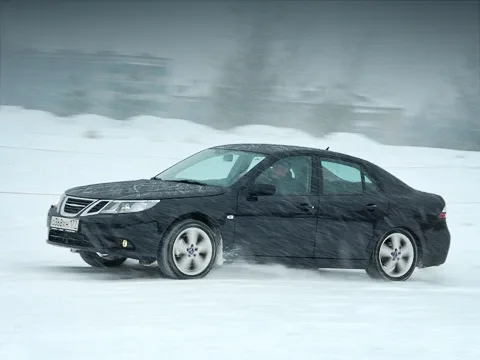
Well, a happy future is already looming on the horizon. In January, in Detroit, the Swedes will show the 9–4X crossover, followed by a fundamentally new 9–5 sedan, and in the more distant future — a golf-class hatchback 9–1, which will compete with the Volvo C30 and Audi A3. But that’s all later. For now, we need to pull out of a prolonged dive. That’s what the 9–3 will do. It knows how to fly well. The main thing is that there are enough pilots.
Technical specifications
| Specifications | Saab 9–3 Sport Sedan Vector | Saab 9–3 Sport Sedan Aero |
|---|---|---|
| Body | ||
| Number of doors/seats | 4/5 | 4/5 |
| Length, mm | 4647 | 4647 |
| Width, mm | 1802 | 1802 |
| Height, mm | 1460 | 1460 |
| Curb weight, kg | 1440–1570 (depending on specification) | 1440–1570 (depending on specification) |
| Gross weight, kg | 1970–2020 (depending on specification) | 1970–2020 (depending on specification) |
| Trunk volume, l | 450 | 450 |
| Engine | ||
| Type | Petrol, with twin-scroll turbocharger, injection and electronic throttle control | Petrol, with twin-scroll turbocharger, injection and electronic throttle control |
| Location | Front, transverse | Front, transverse |
| Number and arrangement of cylinders | 4, in-line | 6, V-shaped |
| Number of valves | 16 | 24 |
| Displacement, cm3 | 1988 | 2792 |
| Max. power, hp/rpm-1 | 210/5500 | 255/5500 |
| Max. torque, Nm/rpm-1 | 300/2500–4000 | 350/1800–5000 |
| Transmission | ||
| Gearbox | Automatic, five-speed | Automatic, six-speed |
| Drive | Front | Front |
| Chassis | ||
| Front suspension | Independent, McPherson | Independent, McPherson |
| Rear suspension | Independent, multi-link, with rear-wheel steering effect | Independent, multi-link, with rear-wheel steering effect |
| Front brakes | Disc, ventilated | Disc, ventilated |
| Rear brakes | Disc | Disc, ventilated |
| Performance characteristics | ||
| Maximum speed, km/h | 230 | 245 |
| Acceleration time from 0 to 100 km/h, s | 8.8 | 7.9 |
| Fuel consumption, l/100 km | ||
| urban cycle | 14 | 16.9 |
| extra-urban cycle | 7.1 | 7.2 |
| combined cycle | 9.6 | 10.8 |
| Emission standard | Euro-4 | Euro-4 |
| Fuel tank capacity, l | 62 | 62 |
| Fuel | AI-95 | AI-95 |
Saab 9–3 trims
| Trims | Vector 2.0TS (210 hp), AT | Aero 2.8TS (255 hp), AT |
|---|---|---|
| Four airbags | + | + |
| Automatic pretensioners for front and rear seat belts | + | + |
| ABS | + | + |
| Electronic Stability Program (ESP) | + | + |
| Traction Control System (TCS) | + | + |
| Power steering | + | + |
| Adjustable steering column (height and reach) | + | + |
| Power seat adjustment | + | + |
| Leather/fabric upholstery | + | + |
| Multifunction steering wheel | + | + |
| Dual-zone climate control | + | + |
| Audio system with AM/FM tuner, CD player, seven speakers and preparation for mobile phone connection | + | + |
| Headlight washers | - | + |
| Fog lights | + | + |
| Power-adjustable and heated exterior mirrors | + | + |
| Front and rear power windows with automatic mode | + | + |
| Cruise control | + | + |
| Central locking for all doors, including fuel filler flap and trunk lid | + | + |
| Body-colored door sill trims and front and rear bumper aprons | + | - |
| Set of sport body parts painted in body color, including spoiler | - | + |
| Alloy wheels, tire size 225/45 R17 | + | - |
| Sport chassis with reduced ground clearance by 10 mm | - | + |
| Alloy wheels, tire size 235/45 R17 | - | + |
| Space-saver spare wheel, special steel disc 4×16 inches | + | + |
| Vehicle price in base trim, rubles (US dollars) | 919,000 (37,200) | 1,139,000 (46,000) |
Technology
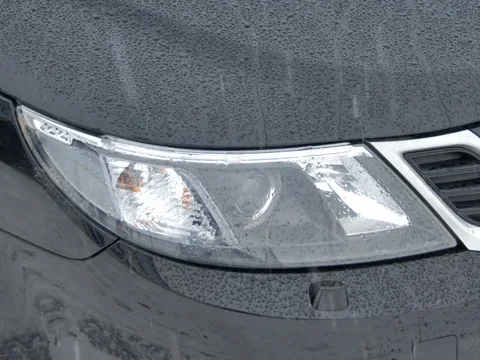
The updated 9–3 features LED daytime running lights and bi-xenon headlights. Moreover, as is often the case, the high beam here is combined: xenon lamps work in pair with halogen ones. But the most interesting thing is that now the inner headlight can turn by 15 degrees, and the outer one by 7.5 degrees. The Swedes also provided a special mode for driving in countries with left-hand traffic: via the menu, you can switch the shape of the light beam to a "mirror" one.
Turbo X
Behind the scenes