
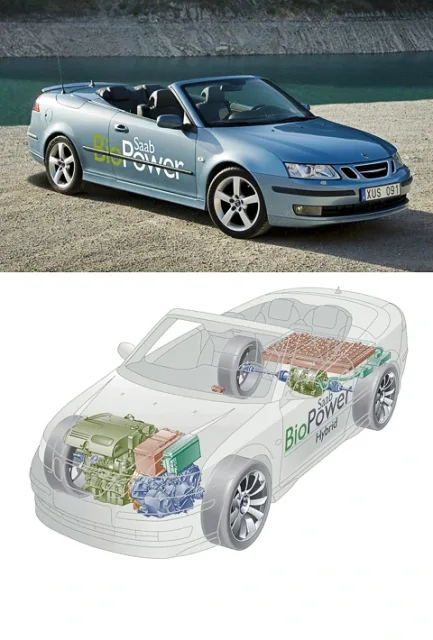
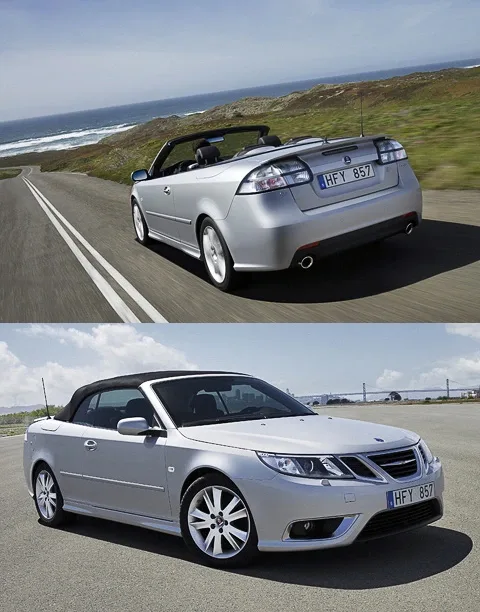
My friend is a Swede named Saab. Officially, it's a Saab 9–3 Aero Convertible. He's neither blond nor brunette, but a sky-blue convertible! How did such a car end up next to me? After all, open cars are as rare as hen's teeth on our roads, and the reasons are obvious. It's enough to listen to weather forecasts and environmental reports more often.
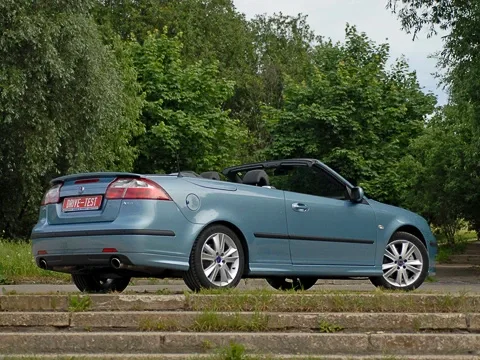
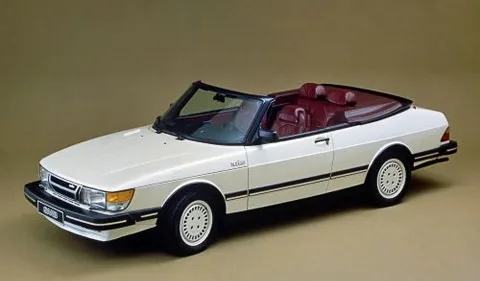
Saab, by the way, recently celebrated a double anniversary: 60 years since the company's founding and 20 years of producing convertibles.
Honestly, my childhood, though happy, was not easy, so I only rode in convertibles in my dreams. And then, as if by magic, dreams became reality — a rare "bird" for our region came to us for a DRIVE test. Its rarity is not that it's a Saab. Nor even that it's a convertible. But that we got our hands on an Aero convertible in an anniversary edition, and that, you'll agree, says a lot. Specifically, a sky-colored car in maximum trim.
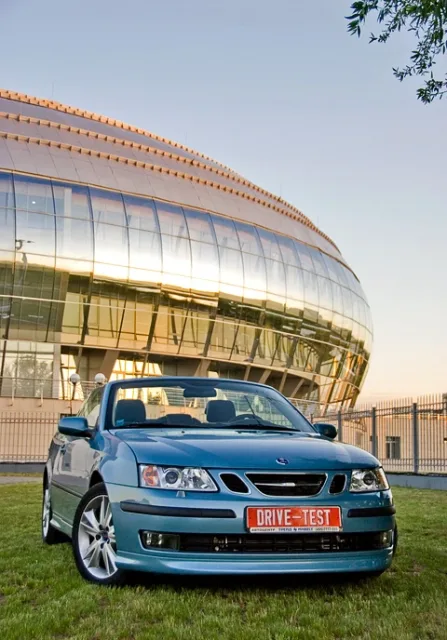
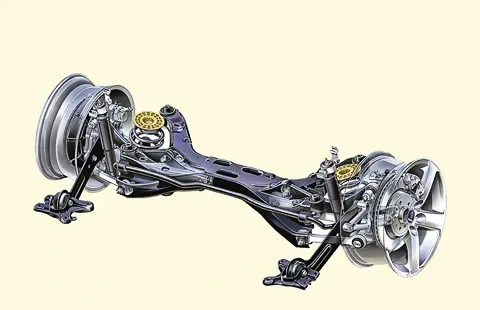
Our convertible, if you look into it, is not from Sweden, but from Austria — it's assembled there at the Steyr-Daimler-Puch plant. The Saab 9–3, like its closed version, is built on the Epsilon platform, shared with GM brothers — Opel Vectra and Cadillac BLS. But most elements are refined and tuned specifically for Saab. For example, the rear suspension became different: some rubber-metal bushings gave way to ball joints for more precise steering. In short, globalization has hardly erased its individuality.
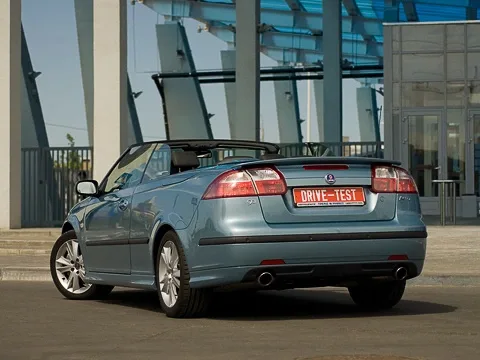
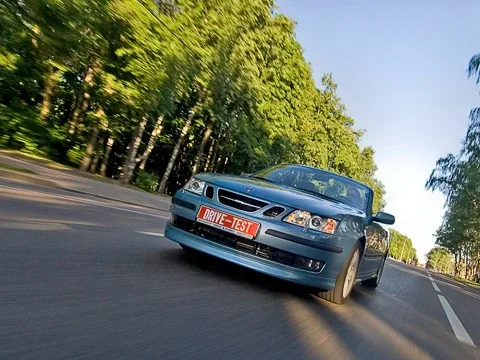
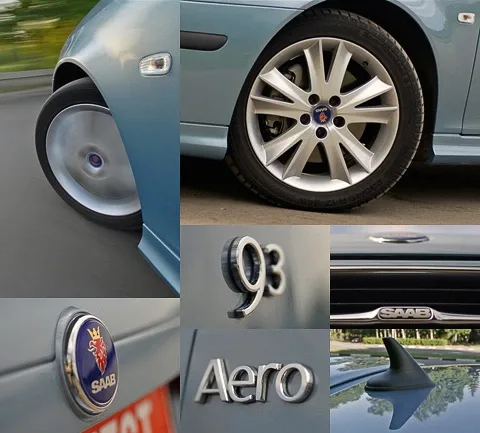
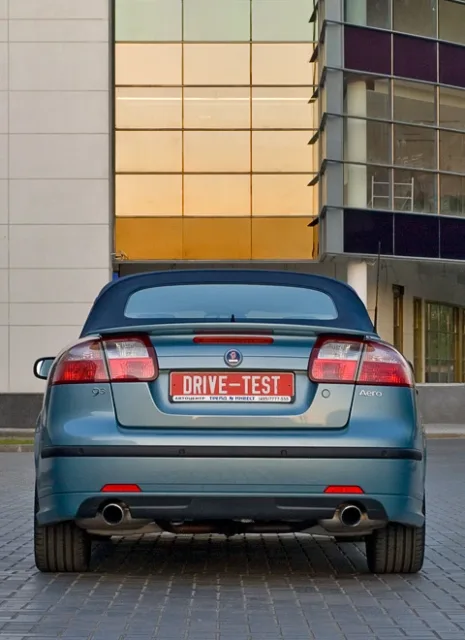
As for the appearance: everyone I talked to called it very expressive. But it seemed to me that the design turned out to be dual. The front of the Swede radiates optimism and complete satisfaction with life. But the rear... No, God forbid I call it ugly. But compared to the front, some metamorphoses happened to it. Satisfaction with life on the rear of our friend grew into insolent self-confidence. But perhaps that was intended. And how: the car's dynamics are such that neighbors in traffic will only see its front in the rearview mirror, and the rest of the time they'll have to contemplate that very insolent rear, on which the sharpest-eyed will spot the Aero badge.
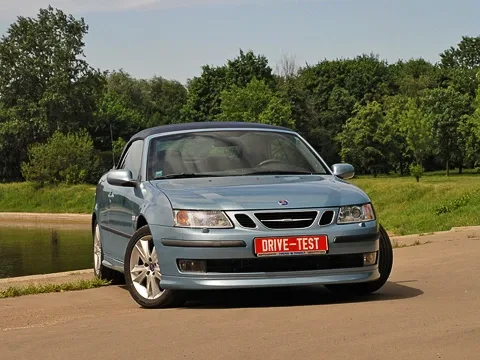
But the car's main "trick" is not just in dynamics. The roof is simply a miracle! A true engineering masterpiece. The process of turning a beautiful convertible into an equally beautiful coupe is fully automated: you press a button on the dashboard and hold it until a conditional signal. It takes 20 seconds in total. But it seems to me that behind these seconds are thousands of hours of design and refinement. The efforts of Swedish engineers were not in vain: the owner of this car can turn the coupe into a convertible (and back) while the traffic light is red. Or even without waiting for it — the car can "transform" not only in place, but also on the move, at speeds up to 30 kilometers per hour. The process itself has a devastating effect on those around.

According to our stopwatch, the car completed the roof-folding standard a second faster than stated in the instructions — in 19 seconds. Measurements were taken at a temperature of +23°C, humidity 75%, pressure 748 mm Hg, and altitude 156 m above sea level.
True, the trunk remained purely symbolic. If the roof is up, you can still put something in it, but if it's folded, there's only room for a couple of small bags. However, this is normal for convertibles.
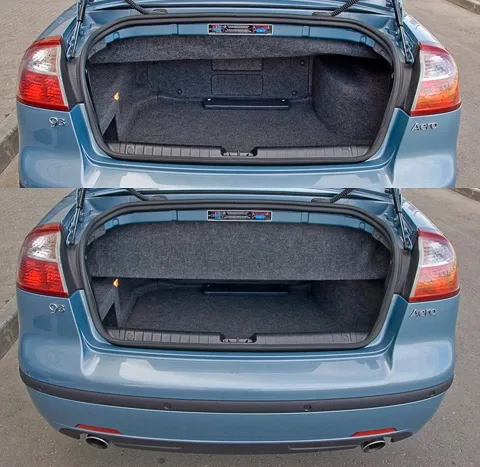
The trunk volume is a known quantity, but variable, and can take two values. With the roof up, it is 352 liters; with it folded, 235.
By the way, about the characteristics. If you open the hood, you'll find... a beautiful cover. And under the cover — a turbocharged "heart" with six "ventricles." The luxurious manual will proudly tell you that this unit produces 250 thoroughbred horsepower and a maximum torque of 350 Nm. When it's transmitted through a six-speed automatic transmission to 17-inch wheels, a real storm begins.
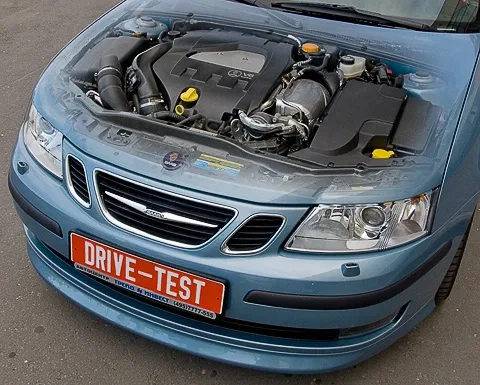
The V-shaped turbocharged "six" is practically devoid of the unpleasant turbo lag effect thanks to a twin-scroll turbine. The electronically controlled throttle adapts the engine's response to different driving conditions. For example, in a parking lot, when "jerky behavior" is unnecessary, the engine, under the supervision of smart electronics, responds to sharp pedal presses smoothly and without jerks. But during overtaking — for a powerful surge — the response time to accelerator presses is significantly reduced.
To "a hundred" Saab "shoots" in 8.1 seconds. Not a hurricane, of course, but if you wear a wig, it's better to take it off in advance. Delays in shifts? Practically none. While the gearbox engages a lower gear, the engine revs up and manages to "fill with juice." By the way, during intense acceleration, the electronically controlled throttle plays a significant role. When shifting to higher gears, it doesn't close completely, thereby keeping the turbine in constant tone and not allowing engine revs to "drop" below critical, to eliminate the turbo lag effect. The engine is very responsive, just a smart one.
So where to put the wig? Of course, in the glove box! The fact is that it's truly huge. Some people don't accumulate as much stuff in their entire lives as fits in this, so to speak, glove compartment. But the Saab's interior is notable not only for its "luggage compartment."
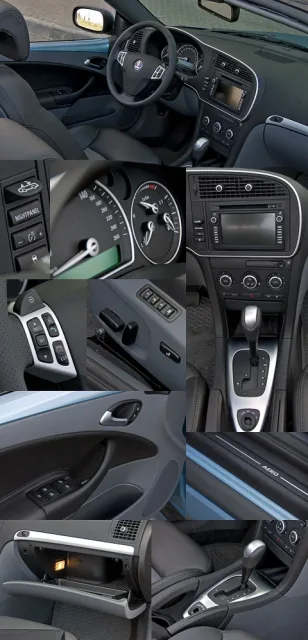
The multimedia system can play DVDs, has a touchscreen, and is equipped with a Bluetooth module so you can connect a mobile phone and talk using the built-in microphone and audio system.
Communicating with this car, you understand the difference between just a good car and a truly great one. In the first, nothing bothers you. Everything works as it should, and that's taken for granted. But Saab is not like that. Every light bulb, every handle, every centimeter of this convertible brings pleasure. The car is pleasant to look at, and (don't think anything bad) pleasant to touch. And about how great it is to press various buttons, I'm already silent...
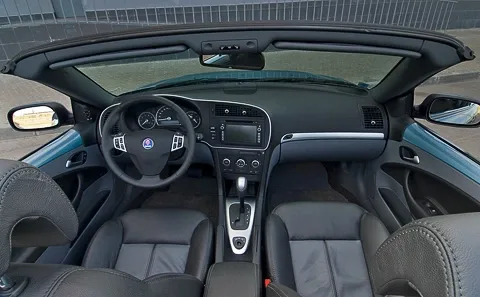
The console turned toward the driver, mesh deflectors, ignition on the tunnel — a hundred percent Saab interior.
And the seats! They are so delightful that personally I'm ready to spend the rest of my life in them. And believe me, that would be a reasonable choice. I don't need mountain landscapes, paragliding, or the beauties of the underwater world! And the office chair is no longer dear to me. For complete happiness, I just need this seat with a bunch of electric adjustments and the most delicate heating, preferably along with the rest of the car as a bonus. And the steering wheel?! Yes, probably it was this very one I held in my hands at birth — and don't tell me that's impossible. And the touchscreen! I would give such a gift to my child, because you can't find a more entertaining toy. True, I would replace the graphics on it with something more beautiful and modern. And I would make the "virtual" buttons not so small. But the "music" plays very cleanly, powerfully, and richly. Very convertible-like.
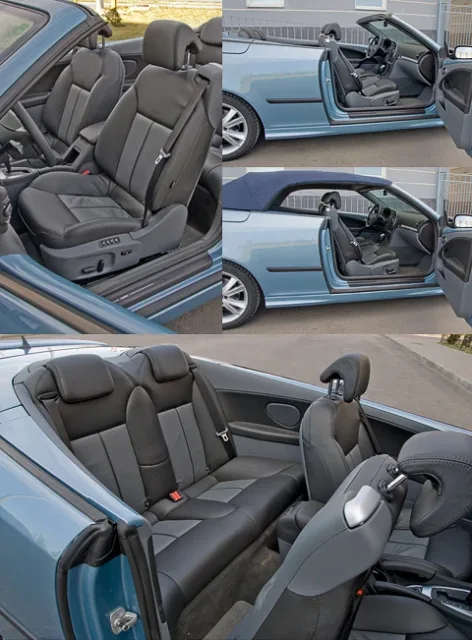
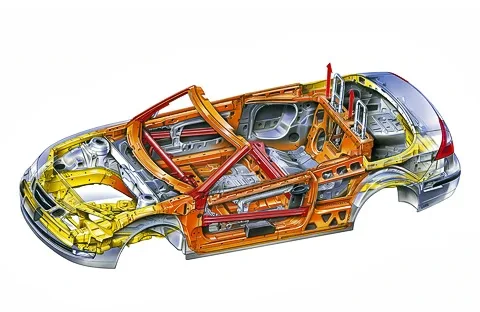
The rear sofa, according to the laws of the genre, is two-seater. There's no escape — in the thick side panels of the body are additional power elements and part of the folding roof mechanism.
One could put forward many theories about the origin of these positive emotions, but personally I'm inclined to explain this phenomenon by the engineering culture of Swedish developers. Precise ergonomics can now be found in many cars, but when buying a Saab, the owner gets something more. He really gets, as it were, an extension of himself.
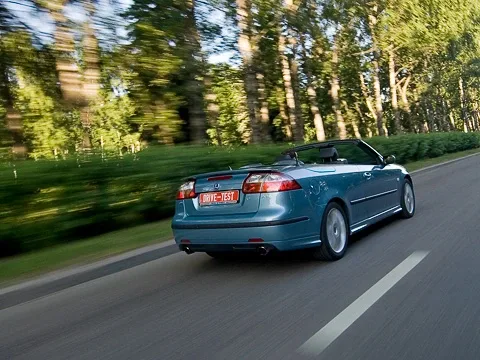
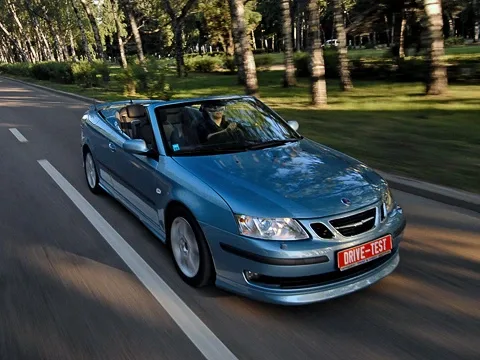
Even at speeds over 100 km/h, there's no tornado in the cabin. And in cool weather, the heater helps a lot.
| Specifications | Saab 9–3 Convertible |
|---|---|
| Body | |
| Number of doors/seats | 2/4 |
| Length, mm | 4635 |
| Width, mm | 1762 |
| Height, mm | 1434 |
| Curb weight, kg | 1680 |
| Gross weight, kg | 2080 |
| Trunk volume, l (roof up/roof down) | 352/235 |
| Engine | |
| Type | Petrol, with twin-scroll turbo, injection, and electronic throttle control |
| Location | Front, transverse |
| Number and arrangement of cylinders | 6, V-shaped |
| Number of valves | 24 |
| Displacement, cm3 | 2,795 |
| Max power, hp/rpm-1 | 250/5500 |
| Max torque, Nm/rpm-1 | 350/2000, 90% of torque available in the range 1500—4500 rpm-1 |
| Transmission | |
| Gearbox | Automatic, six-speed |
| Drive | Front |
| Chassis | |
| Front suspension | Independent, MacPherson type |
| Rear suspension | Independent, multi-link, with rear-wheel steering |
| Front brakes | Disc, ventilated |
| Rear brakes | Disc, ventilated |
| Tires | 235/45R18 |
| Ground clearance, mm | 131 |
| Steering | |
| Type | Rack and pinion with power steering |
| Number of steering wheel turns from lock to lock | 2.97 |
| Performance characteristics | |
| Maximum speed, km/h | 240 |
| Acceleration time from 0 to 100 km/h, s | 8.1 |
| Fuel consumption, l/100 km | |
| Urban cycle | 17.3 |
| Extra-urban cycle | 7.5 |
| Combined cycle | 11.1 |
| Emission standard | Euro-4 |
| Fuel tank capacity, l | 62 |
| Fuel | AI-98 |
- Four airbags
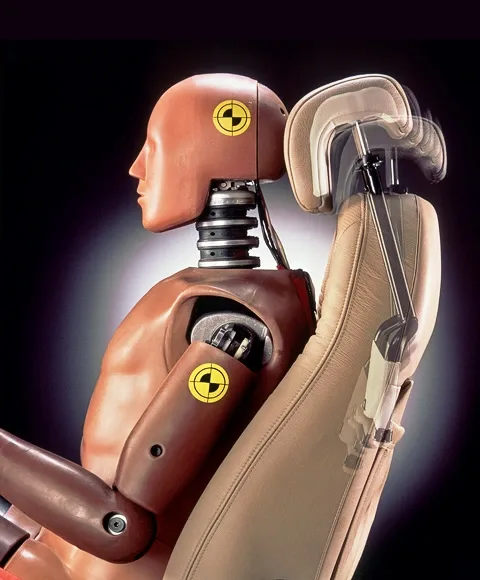
- Automatic seatbelt pretensioners for front and rear seats
- ABS
- Electronic stability program ESP
- Traction control system TCS
- Power steering
- Adjustable steering column (height and reach)
- Power seat adjustment
- Leather interior
- Multifunction steering wheel
- Heated front seats
- Dual-zone climate control
- Audio system with AM/FM tuner, CD player, seven speakers, and preparation for mobile phone connection
- Headlight washers
- Fog lights
- Power-adjustable and heated exterior mirrors
- Front and rear power windows with automatic mode
- Cruise control
- Central locking for all doors, including fuel filler flap and trunk lid
- Rear spoiler
- Five-spoke alloy wheels, tire size 235/45 R17
- Space-saver spare wheel, special steel rim 4×16 inches
- Bi-xenon headlights
- Interior and exterior rearview mirrors with auto-dimming
- Power adjustment for driver and front passenger seats with memory
- Heated front seats
- Ten-spoke alloy wheels, tire size 235/45 R17
- Automatic windshield wipers with rain sensor
- Saab parking assistance system
- Multimedia DVD system with touchscreen LCD monitor, Bluetooth module, and ten speakers
- Full-size spare wheel on 16-inch steel rim
Price of base version — $53,290
Price of tested car $59,609
Car for test provided by
LLC 'General Motors'. Safety
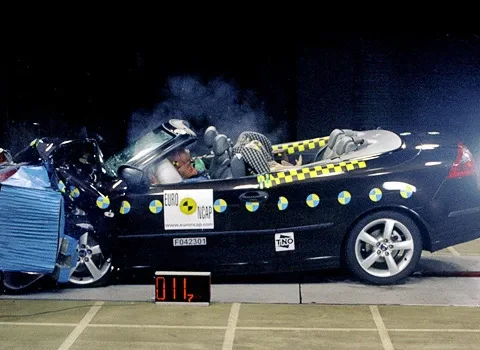
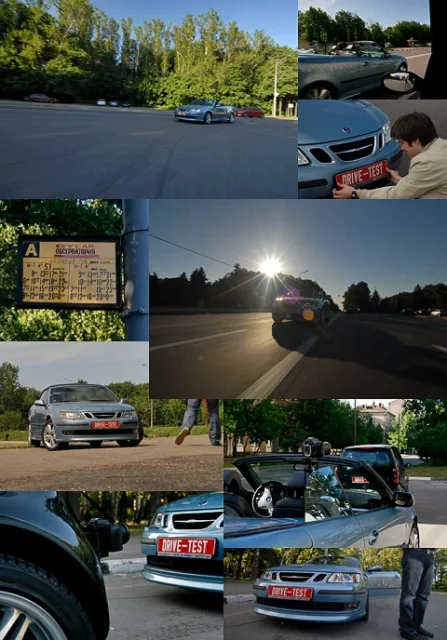
When you plan a convertible test, you start watching the weather forecast with particular excitement. This time, nature decided to play a trick: the day before the test, it was scorching hot at nearly 30 degrees, but on the big day, the sky was overcast, and the temperature dropped to 15. What a twist! But the elements took pity on us, and the sun came out again.
By the way, the Saab 9-3 not only served as a model for the shoot but also acted as a photo car: Anton asked to capture his Smart in motion. It's worth noting that for a photographer, it's hard to imagine anything more convenient than a convertible — you sit in the back row, have a 360-degree view, and can shoot in any direction. As a result, the shots of the Smart turned out quite successful.