
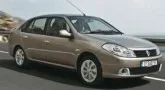
Renault Symbol. Price: from 371,275 rubles. On sale: from October-November 2008.
The new Renault Symbol has finally transformed from an ugly duckling into an attractive duck, which has become a real headache for competitors. If previously its main advantages were decent driving characteristics that favorably distinguished it from classmates, now a truly attractive appearance has been added to them. And most importantly, this significant bonus cost buyers almost nothing!
Very soon, the new generation Renault Symbol will hit the market - company instructors are already actively preparing salespeople, breaking down the new model's strengths. Although, honestly, all the car's advantages over rivals are visible to the naked eye.
The model's history began seven years ago, when the quite attractive Renault Clio II hatchback was turned into the Symbol sedan, intended for developing third-world markets. The idea was sound - in Russia, for example, this body type is still in greatest demand. However, the execution raised big doubts. The protruding trunk, as if stuck to the hatchback by someone's clumsy hand, looked like a rudiment - that same tailbone in humans. However, it wasn't useless: it held a lot of stuff, and sales were going well - the budget newcomer practically overshadowed its more expensive parent. But the main advantage of the old Symbol was that for modest money, the buyer got a European brand car with an automatic transmission.
In the model's new life, this market offering remains just as strong. Even having risen in price by an average of 5%, the car has not lost its advantageous position for Renault. After all, the car itself has noticeably prettier and looks much more confident than its unattractive predecessor. Now the target audience - families with children and especially young girls - won't have to hide their Symbol from acquaintances who previously didn't hesitate to make sharp jokes about it.
The new model is perceived completely differently - and it's no surprise, not a single old line remains on the body! The sedan now looks truly three-box, not "two-and-a-half-box" as before: the body proportions have become correct. The smooth transition from the roof to the trunk creates a cohesive image of the car. And completing this picture is a stamping that wraps around the car and closes on the front bumper. In terms of front-end styling, the Symbol echoes the Renault Sandero - similar headlights and grille. There's even a chrome strip on the hood edge! The same as on the trunk lid: according to the designers' intention, they should give the car sophistication and status.
Chrome inserts on the slightly updated dashboard, as well as noticeable seams with large stitches on the steering wheel and seats, serve the same idea. It is they that bring notes of cosmetic novelty to the interior. Everything else - trim materials, seat configuration and instrument panel, ergonomic solutions - remains the same. And such "loyalty" is largely justified: for its class and price, the "filling" of the previous Symbol was quite decent. But what prevented, for example, revising the steering wheel tilt angle? It is too tilted forward and interferes with proper seating - either your knees hit the rim, or you stretch your arms to the wheel. A real gift for the model was the appearance of third side windows. Together with enlarged exterior mirrors, they improve visibility, which was previously limited by the wide rear pillar.
Another important point from the life of the reborn Symbol: unlike the previous generation, the new model has become a completely independent model, not connected in any way with the Clio hatchback. But the platform and powertrain were inherited almost unchanged. The palette of engines for the Russian market has halved, but the 1.4-liter gasoline engine with 98 horsepower that we got suits the car much better than the previous 75-horsepower unit of the same volume.
With the 4-speed automatic, this engine has a hard time - such a tandem can't be called brisk no matter how you look at it. Smooth, calm driving with even shifts can only be replaced by sluggish, jerky acceleration with slight delays when changing speeds, and in acoustic accompaniment - a chorus of under-hood horses when the tachometer needle goes into the high rev zone. However, among potential Renault Symbol buyers, fans of active driving are a clear minority. For them, there is a more dynamic option - with a 5-speed manual gearbox. This pair has an easier life. You just need to rev the engine to 3000 rpm when shifting, go for overtaking with a time margin, and downshift in advance before hills. But in the cabin, you can calmly talk without trying to shout over the engine noise. And without "bouncing" to the ceiling on bumps: the suspension perfectly handles all road surface defects, practically without breakdowns. And the rolls can't be called large.
The steering wheel with medium sharpness (3.2 turns from lock to lock) has a clear "zero" that eliminates trajectory correction when driving straight. However, in high-speed maneuvering, its lack of informativeness manifests itself - reactions to driver commands are slow.
But let's move from a familiarization raid on capabilities to the model's life realities. The sedan is still produced only for third-tier countries. But with the new model, Renault has global plans: this Symbol will become a symbol of the future renewal of the entire brand lineup. So, we have a chance to soon see equally independent, attractive, and symbolic new cars with a diamond emblem. In the most various senses of these epithets!
Turkish subject
When developing the new Symbol, an international team of Renault engineers actively used digital technologies. Therefore, the model's design was created in record time - two years and two months. As before, the car rolls off the assembly line of the company's Turkish plant in the city of Bursa. The choice of production site is due to the convenient location of the enterprise in close proximity to sales markets: Russia, Turkey, Romania, and Algeria. Investments in the project, including investments directly in production itself, amounted to 100 million euros.
Loved - not loved
Capacious
The car's voluminous 506-liter trunk has a flat floor and a wide opening, which allows convenient loading and easy transportation of a decent amount of things.
Elegant
Optionally, the sedan can be equipped with a nice spoiler that perfectly performs a decorative function.
Technical characteristics of Renault Symbol 1.4
Dimensions - 4261/1940/1439
Engine - gasoline, 1390 cm3, 98 hp/6000 rpm
Transmission - manual, 5-speed
Dynamics - max 186 km/h; 11.2 s to 100 km/h
Competitors - Chevrolet Aveo, Hyundai Accent, Peugeot 206 sedan
Advantages and disadvantages
+ New attractive appearance, pleasant price, good driving qualities, spacious trunk.
– Uncomfortable steering wheel position, mediocre dynamics with automatic.
Driving
The car accelerates measuredly, brakes well, and holds the road well. Only high-speed lane changes are difficult for it.
4 points
Interior
There is enough free space to transport four adults, trim materials are modest, and ergonomics are pleasant.
4.5 points
Comfort
The suspension engineers did an excellent job. True, even with that model.
5 points
Safety
One airbag and a reinforced body structure are already not enough today.
2 points
Price
The model is new, but the price is almost old.
5 points
Our opinion
Love us bad, everyone will love us good. That was the motto of the Renault Symbol before. And it was chosen by those for whom the car's capabilities and price are more important than appearance. Having retained all the advantages of its predecessor, the new model has gained attractiveness, which will clearly have a positive effect on its sales.
October 3, 2008
Author: Dmitry Tytyuchenko
© 5 Koleso
It seems you have sent only a fragment of the HTML code (closing tag ``, tag `
` and tag `
`) without the actual test drive text. To rewrite the article, I need the full original text. Please paste the original test drive text in full, and I will complete the task: rephrase each sentence, preserve all numbers, facts, and the author's impressions, as well as the structure and tags.