
The compact sedan Symbol spent six years on the assembly line of the Turkish enterprise Oyak-Renault, during which it managed to change its appearance and add an automatic transmission to its arsenal. Now we have before us the result of the final update — a good reason to test the car in action.
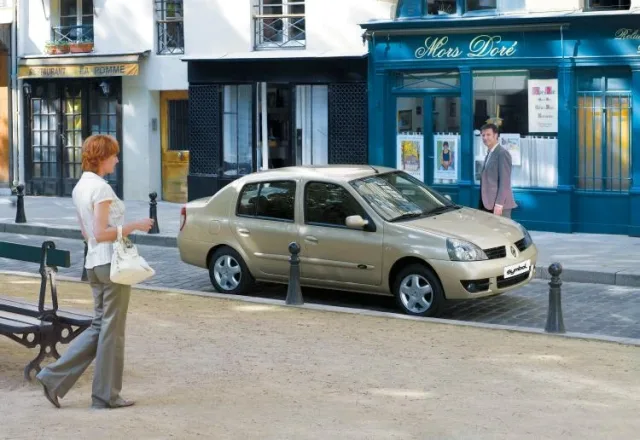
 Last year, Russian representatives of Renault missed their forecasts. Focusing their efforts on the Logan, they did not pay attention to the gradually aging Symbol, allocating a modest quota for 2006 — just three thousand cars — for the rapidly growing demand.
But, as my former colleague, now a Renault marketer, Anatoly Kalitsev says, there are still plenty of people wanting to buy a Symbol. Therefore, for the next year, it was decided to increase the volume of supplies several times.
What is the secret of the Symbol's appeal, especially after the modernization?
The exterior update is purely cosmetic. Rear-view mirrors, door handles, and sill trims are now painted in body color, and the black inserts on the bumpers have disappeared. The air intake grille in the front bumper is visually divided into three sections: the middle one is real, while the side ones with "fog lights" are nothing more than decoration.
Inside, you get the feeling of sitting in a previous-generation Clio: the dashboard and door cards are identical. The interior seems more expensive, although the plastic feels as hard as in the Logan. The seat fabric and instrument panel look slightly different — instead of strict dark dials, lighter and more cheerful ones have appeared. But once you start the engine and turn on the lights, it becomes clear: experimenting with the instruments was in vain — their readings are completely unreadable in daylight.
 |  |
| The lid is now upholstered (photo on the left), and the floor is flat (the recess in the rear part is covered). The rear seat backrest folds as a whole, opening a low opening (photo on the right) | |
Do not expect any surprises in behavior from the updated Symbol — the chassis and engines remain the same. As before, two petrol engines are offered: a 1.4 with eight valves (75 hp) and a 1.4 with sixteen (98 hp), as well as a manual or automatic gearbox. The sedan, as before, pleases with confident, albeit not sporty, handling, smooth ride, and acoustic comfort — this is especially noticeable after the noisy editorial Logan. Although, to be fair, it is worth noting: the Logan holds its course more accurately and collectedly, and there is noticeably more space in it...
So why choose the Symbol? The reason is its quietness on the move and the presence of an "automatic". And for the B-class, such an option is a rarity!
In our market, only one compact sedan with an automatic transmission costs less than the Symbol — this is the hit of the budget segment, the Taganrog Hyundai Accent ($13,390 vs. $13,800), which already has air conditioning in the base version. But, unlike the Renault, for this money the Accent will not offer an airbag. If you add air conditioning and an electric package to the Symbol, the price will jump to $15,400 — which is $600 more than a similarly equipped Ford Focus with a 100-horsepower engine!
 |  |
| The front panel and door trim are from the "second" Clio. At the bottom of the center console is the climate control unit | The new design of the instruments harmed the readability of the readings |
Maybe it is wiser to take a Symbol with a "manual" and air conditioning? But even in this case, the Renault will cost more than competitors — $13,550 vs. $12,940 for the Hyundai and $13,070 for the Peugeot 206 1.4 Sedan. Do not forget about the Chevrolet Aveo 1.2 (72 hp) with air conditioning — from $12,530.
However, the Symbol with a 16-valve engine now has climate control — for $14,720. You can look for a cheaper option (we are talking about the Iranian Peugeot 206 Sedan for $14,560), but there is only a weak 75-horsepower unit. The top version of the Symbol ("climate" and "automatic") for $15,720 looks more attractive than classmates — Chevrolet Aveo (from $17,160) and Peugeot 206 (from $17,280), although it is still more expensive than the Focus with climate.
As a result, buying a Symbol is not always financially justified. But the choice in this segment is small, and demand exceeds supply — buyers snap up everything that appears. When the updated Symbol appears in showrooms, it will be snapped up too. And the calculations of Anatoly Kalitsev and his colleagues will turn out to be correct.
So the Symbol is the embodiment of the rapidly developing and insatiable Russian market. And that is not bad, is it?
| Technical specifications (manufacturer data) | ||
| Vehicle | Renault Symbol | |
| Body type | sedan | sedan |
| Number of seats | 5 | 5 |
| Trunk volume, l | 510 | 510 |
| Curb weight, kg | 1050 | 1050 |
| Gross weight, kg | 1500 | 1500 |
| Engine | 8V | 16V |
| Type | petrol, with distributed fuel injection | petrol, with distributed fuel injection |
| Location | front, transverse | front, transverse |
| Number and arrangement of cylinders | 4, in-line | 4, in-line |
| Displacement, cm3 | 1390 | 1390 |
| Compression ratio | 9.5:1 | 10.0:1 |
| Number of valves | 8 | 16 |
| Max. power, hp/kW/rpm | 75/55/5500 | 98/72/6000 |
| Max. torque, Nm/rpm | 114/3000 | 127/3750 |
| Gearbox | M5/A4* | M5/A4* |
| Drive | front-wheel | front-wheel |
| Front suspension | independent, spring, McPherson, with stabilizer | independent, spring, McPherson, with stabilizer |
| Rear suspension | semi-independent, spring | semi-independent, spring |
| Front brakes | disc, ventilated | disc, ventilated |
| Rear brakes | drum | drum |
| Tires | 175/70 R13 | 175/65 R14 |
| Maximum speed, km/h | 170 | 186 |
| Acceleration time 0—100 km/h, s | 12.5 (14.1)** | 11.2 (12.9) |
| Fuel consumption, l/100 km | ||
| urban cycle | 9.7 (9.9) | 9.9 (10.0) |
| extra-urban cycle | 5.7 (5.9) | 5.4 (5.8) |
| combined cycle | 7.1 (7.4) | 7.0 (7.3) |
| Fuel tank capacity, l | 50 | 50 |
| Fuel | petrol AI-95 | petrol AI-95 |
| * M5 — manual 5-speed gearbox, | ||
| A4 — automatic 4-speed gearbox | ||
| ** Data in parentheses — for the version with "automatic" | ||