
Renault Scenic. French suitcase
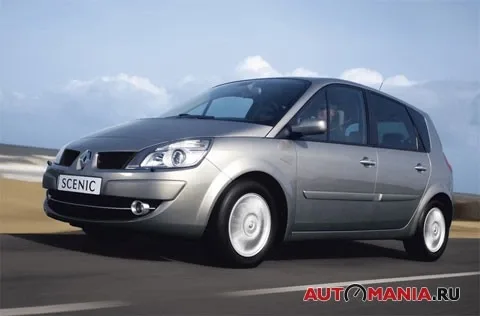
Once upon a time, the Renault Megane Scenic caused a real sensation by offering a spacious interior while maintaining the compact dimensions typical of the golf class. This car became a dream for many Europeans. But times have changed: such cars are no longer a rarity, and now in Europe more than a million similar minivans are sold annually. Almost every major automaker has a similar model in its arsenal. The buyer has a huge choice. However, the French car has not gotten lost in this diversity. Its successor, the Scenic II, turned out to be quite in demand and able to compete.
The appearance of the new model is strikingly different from its predecessor. The first generation was emphatically "minivan-like" and rounded, while the second looks like a slightly enlarged Megane II. Take, for example, the broken line of the rear, as if tilted back, and the convex glass of the fifth door — all this was already in the hatchback. The kinship of the models is also revealed by the front part, made in the signature soft nose style with a characteristic radiator grille and a diamond in the center. As a result, the exterior of the minivan turned out to be dynamic and quite recognizable.
The pursuit of style and the desire to stand out played a cruel joke on the Scenic. In an effort to add expression, French designers seem to have forgotten about practicality. They sacrificed the most valuable thing — the trunk volume. The beautiful broken profile of the fifth door is absolutely impractical, especially when transporting long or bulky items. In this case, lost cubic centimeters can become critical. However, this is perhaps the only serious complaint. As for small things, there is always a place for them. The French are especially proud of the sliding central box with cup holders and armrests. It looks like an ordinary drawer, but in reality it is much more spacious: an item as tall as a half-liter bottle can easily fit there. True, this compartment is available for an additional cost. But hiding places in the floor and drawers under the seats are in most cases included in the basic equipment. For example, containers under the front seats are available even in the simplest versions. It is also pleasant that the backrest of the front passenger seat folds down, and folding tables will be useful for family trips.
Now about the passengers. Formally, the Scenic has five seats, and each is equipped with a separate adjustable seat, so everyone can sit comfortably. The legroom is sufficient — thanks to the almost vertical, "bus-like" seating position. There is also plenty of air above the head, but a bit cramped in the shoulders and elbows. But do not forget that the model is built on the basis of a C-class car, which has left its mark. Renault designers also offer an extended seven-seat version — Grand, with two additional seats in the trunk. However, in our country, this modification is not in demand. Perhaps we have few large families, or maybe the point is that we prefer a spacious trunk to extra seats... In short, we like the five-seat versions more.
The transformation of the seats in the car is simple and convenient. To fold any of the three parts of the second row, you need to do only two steps: pull the loop to fold the backrest, and then, pressing the lever, put the resulting "sandwich" vertically. No additional actions are required: the Scenic seats are fixed in this position by themselves. If desired, you can continue and remove the second row entirely, increasing the trunk volume to 1840 liters. However, the seats weigh about 16 kg, and you will have to carry them in your arms — no handles or holders are provided by the design. But this seems to be the only significant drawback of the interior of the French minivan; otherwise, it is very friendly to passengers.
This is especially noticeable in the comfort of the front seats. Sitting in the first-row seats is very comfortable. They are located high, but have a successful profile, and the range of adjustments is quite wide. So any driver will find the right position. The steering column is adjustable both in height and reach. Visibility is also in order. Large side mirrors and a huge glass area make it easy to control the situation around. Difficulties arise only with the front corners: the hood is practically invisible, so maneuvering in tight spaces has to be done literally by feel. But, it must be admitted, you get used to this feature of the Scenic quite quickly.
In the interior design, the French followed a proven path. They placed the electronic instrument panel traditionally — in the center of the front panel. It is perfectly visible to everyone. At first, you do not get used to this location immediately, but over time you get the hang of it. You will also need to get used to the not quite usual placement of the gearshift lever (on the protrusion of the central console), if, of course, you have not driven a similar car before. But here, too, the French have thought everything through to the smallest detail: the handle fits right into the palm, so you do not spend much time on shifting. Slightly higher are the control units for onboard systems. Here is both the air conditioner (which, by the way, is included in the basic equipment) and a quite decent audio system with a CD player. To prevent the driver from being distracted from the road, the designers duplicated the music control with a joystick on the steering column. The only thing it cannot do is switch radio frequencies, so while driving you will have to "jump" through pre-saved positions.
Now about how it all drives. For the Russian versions of the Renault Scenic II at that time, two gasoline engines were offered with a volume of 1.6 and 2 liters and a power of 115 and 136 hp, respectively. With the first engine, a five-speed manual or a four-speed automatic could work, and with the second — the same automatic or a new six-speed manual. We deliberately will not raise the question of which engine is better. One is simpler and more economical, the other is hotter, so the buyer should choose based on personal preferences and budget. Within the framework of this material, we will focus on the first, calm option, especially since the demand for it is much higher.
A car with such an engine drives quite decently. Of course, a one-box car is not a sports coupe, but at traffic lights and during short overtakes it does not lag. True, the engine constantly has to be "revved up", often shifting to lower gears. The "Frenchman" also pleased with its sharpened handling. There is nothing surprising in this, because this Renault is created on the Megane II platform, and only the wheelbase, increased by 60 mm, was modified. The smoothness of the ride also did not cause complaints. The suspensions are comfortable, but without excesses. They dampen small defects and road waves well, but they let through large potholes, although it usually does not come to a breakdown. Rolls in corners are large, but not critical.
It should be noted that a family one-box car a priori does not claim to be a driver's car, so "showing off" on the Scenic is, in general, useless. But its excellent adaptive power steering can be praised. This system independently adapts to the style of a particular driver and, depending on the characteristics of the car (mass, engine model, tire type), selects one of sixteen preset programs. In addition, the "Frenchman" has the function of active return of the "steering wheel" to the zero point (active return), which adds sharpness to driving.
Technical characteristics:
| Dimensions: | Renault Scenic |
| Length (mm) | 4259 |
| Width (mm) | 1805 |
| Height (mm) | 1621 |
| Wheelbase (mm) | 2685 |
| Weight (kg) | 1320 |
| Trunk volume (l) | 406/1840 |
| Engine displacement (cm3) | 1598 |
| Max power (hp) | 115 at 6000 rpm |
| Max torque (Nm) | 152 at 4200 rpm |
| Max speed | 185 |
| Acceleration 0-100 km/h (s) | 11.7 |
| Average fuel consumption (l) | 7.2 |
| Price (rub.) | From 604,750 |
Magazine "Autoguide" March 21, 2008 No. 58
Source – AUTOMANIA.RU