
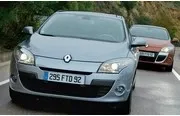
Raindrops drum on the glass, driven by gusts of wind. The bad weather seems to have settled in for good, and visibility on the road is almost zero. We are leaving Madrid, and it feels as if we've ended up somewhere in the north of Scotland in the middle of winter. However, there is a silver lining to this storm: such conditions are a great opportunity to thoroughly test the new Megane. Finally, we are behind the wheel of the third-generation model, after all the premiere shows. Its predecessor, the 2002 Megane, was striking at first glance with its extravagance, clearly inspired by the then style icon of Renault — the Avantime coupe. The new model is not so outrageous; rationality dominates its appearance. Without this, it's impossible to survive in the dense ranks of competitors today.
LIVING ROOM ATMOSPHERE
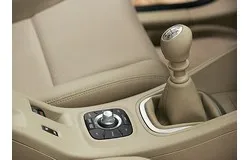
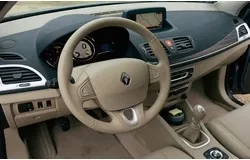
To realize the scale of changes in the Megane, you need to spend some time in its interior. We spent long hours behind the wheel under the pouring Spanish rain, often in almost critical conditions, and were able to fully appreciate not only the ergonomics of the seats but also the titanic work of French engineers on sound insulation. To get inside, as with other Renault models, you just need a magnetic card: you approach the car, and the locks open. When opening the door, you feel the solidity and quality of the body. And this is despite the fact that the model has become 9 cm longer (4300 mm) and at the same time 8 kg lighter. The seats with dense padding are very comfortable, which is especially valuable on a long highway journey. The steering wheel adjusts both for tilt and reach. The cabin is generously dotted with compartments for small items. Instead of the traditional handbrake, there is a small lever on the central tunnel, in front of the armrest box. When the engine is turned off, the parking brake activates itself, and when you press the gas, it automatically releases the wheels. A great remedy for forgetfulness, but unfortunately, it's not available in the base trim.
 |  |
|
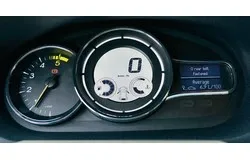
NEEDLES AND NUMBERS The instrument panel is made in the spirit of minimalism. On one cluster, analog scales coexist with digital screens. The round central display has white backlighting, which doesn't tire the eyes at all. Information on the right display is not read perfectly
|
The instrument panel is quite unconventional. No usual multicolor — only minimalism. On the left, there's an analog tachometer, in the center — a digital speedometer with coolant temperature and fuel level indicators. And in the background — another display with data on consumption, range, and other operational information.
POWER VARIATIONS
One of the main advantages of the new Megane is incredible comfort for the driver. It seems the newcomer has taken the best from the older model — the Laguna. They abandoned the steering system familiar from the Megane II. The electric power steering was retained, but the electronic unit was replaced and a force sensor was added.
The steering wheel has decent precision, but it lacks a bit of feedback. The six-speed manual makes the 130-horsepower 1.9-liter turbodiesel very flexible. The engine itself gains torque smoothly and evenly. The variable-geometry turbo eliminates any dips between pressing the gas and revs rising. And it performs best when driving at a constant speed. The engine range includes six units: two petrol (1.6 — 110 hp and 2.0 — 140 hp), three diesels (1.5 — 90 hp, 1.5 — 110 hp, 1.9 — 130 hp), and another 1.6-liter running on liquefied gas. In 2009, the lineup will be joined by a 1.4 petrol engine (130 hp) and two new two-liter diesels — 150 hp and 160 hp. The suspension compared to the previous model is like night and day. A reinforced stabilizer was installed at the front to increase roll stiffness. The engine is now mounted to the subframe, which better isolates the cabin from vibrations. During hard braking, the car stops surprisingly short. This is thanks to disc brakes (front — 280 mm, rear — 260 mm) working in conjunction with the dynamic stability system, which also includes an emergency braking function that sharply increases pressure in the circuits.
In Europe, the car is sold in three trim levels. The base version includes air conditioning, an MP3 stereo, and an electronic key. For an extra charge, a second-level trim is available: 16-inch alloy wheels, cruise control with speed limiter, chrome trims, and a leather steering wheel. The top version adds parking sensors, dual-zone climate control, and folding mirrors with electric adjustment. The starting price for the petrol version 1.6 (110 hp) is 17,450 euros, and for the two-liter 140-horsepower in the middle trim, they ask 20,950 euros. The initial diesel modification (1.5, 90 hp) costs 18,450 euros, and for the 130-horsepower 1.9 diesel, you'll have to pay 21,450 euros (prices are for the second trim level). In a few months, the appearance of a small-displacement turbo engine 1.4 (130 hp) is expected.
It's too early to talk about the timing of the new model's appearance in Russia. Everything will depend on how quickly the economic situation stabilizes. So we have to be patient and recall the saying: "As soon as — so immediately."
CHANGE OF COURSE
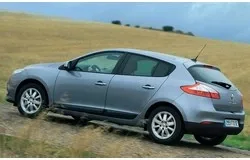
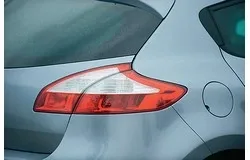
Instead of the defiantly avant-garde "broken" silhouette that the second-generation Megane boasted, there are more than calm smooth contours promising practicality.
 |  |
How it was
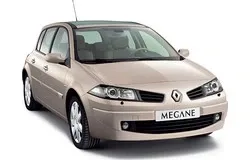 |
AVANT-GARDIST The second generation of the model was remembered for its bold design. For the sake of an extraordinary appearance, designers sacrificed practicality, making the hatchback's trunk not the most convenient shape. |
Renault Megane Coupe
APPEARANCE
MATCHING THE CHARACTER
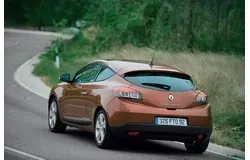 | 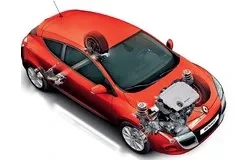 |
Meeting a car only "by its clothes" is a mistake. The Megane Coupe indeed has a memorable, assertive appearance with clean lines, but that's not the point. The car shows its character in the very first turn — the main thing is not to lift off the gas. The ground clearance is 12 mm lower than the hatchback's, the springs are stiffer, and the diameter of the anti-roll bar is increased (22.5 mm versus 20 for the five-door). The car confidently takes corners at speed and holds its line during sharp lane changes. Comfort in the cabin is at the level of the hatchback. The body is certainly different, but the modifications are not radical. On Spanish roads, we tested the coupe with the lively two-liter petrol turbo engine TCe producing 180 hp and a six-speed manual. The car accelerates smoothly and confidently, it's just a pity that the exhaust isn't tuned — the sound could be more aggressive. In the back, two people can sit quite comfortably, and if necessary, three adults — the bench is the same as in the hatchback. But rear visibility, especially when parking, is noticeably worse: the rear window is narrow, and the shape of the rear doesn't help. The most powerful version with the 180-hp TCe engine costs 22,500 euros in Europe. The price was clearly set with an eye on the direct competitor — the Volkswagen Scirocco. True, for this money you get the top trim on 17-inch alloy wheels and with dual-zone climate control.