
Renault Megane II. Classic of the Genre
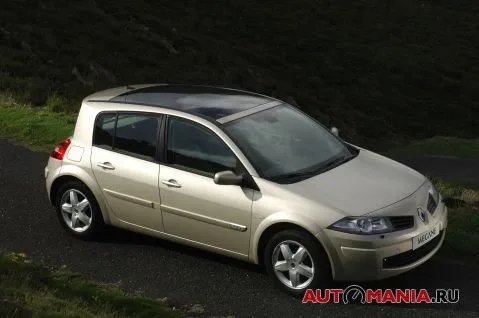
The main feature of the Megane II family is its many faces. It can adapt to any buyer. All body types are available at dealerships — sedan, hatchback, and station wagon, each with its own character and unique appearance. For instance, the sedan looks more restrained against its siblings. At the same time, despite the classic shapes typical of this body type, it doesn't seem bulky. On the contrary, its lines are so swift, as if the car just left the factory floor. But the most expressive in the family is undoubtedly the hatchback — and that's what we'll talk about.
In Russia, the five-door Megane debuted in 2003, and quite quickly it could be seen on the streets. The secret of the "Frenchman's" popularity lies in its controversial but catchy appearance. It differed strikingly from other hatchbacks and attracted attention. This novelty, which hadn't yet become tiresome, sparked lively interest. When the Megane II races down the highway, it seems as if it's carved from a single piece of some weightless material. Every body line, every detail, even the signature Renault diamond — everything is fused together... The French managed to achieve complete harmony: in contours, style, and sensations. Such a car simply couldn't remain in the shadows, and it was destined to be a hit from birth.
The hatchback's interior also deserves praise — the French tried to combine comfort and practicality without forgetting design. The hi-tech style cabin looks excellent: strict lines, smooth surfaces, sharp angles, a symmetrical front panel with a slight curve toward the passengers, and a center console generously adorned with polished aluminum... The entire concept is carried out to the smallest detail — down to the steering column switches, door handles, and the U-shaped handbrake lever.
However, not only artists worked on the cabin: although the Renault isn't as warm and cozy as, say, the Mazda 3, in terms of ergonomics the "Frenchman" won't yield to the Japanese. Anyone can get comfortable behind the wheel, as both the seat and steering column adjust over wide ranges. And importantly: even when the front seats are pushed all the way back, two adults will have plenty of space on the rear bench — enough room for legs and knees.
The French also thought about transporting things — from small items to large suitcases. Wherever you look, there are boxes, niches, compartments... The total volume of these spaces reaches 44 (!) liters. The hatchback's trunk is also quite spacious, and although at first glance it doesn't seem large, it actually meets the standards of its class.
The sedan, however, is a true giant in this regard: its trunk holds 520 liters, the backrest folds in a 40:60 ratio, but in terms of ergonomics it's noticeably inferior to the hatchback. It's not always possible to fully use its volume — into the wide but low opening, only a suitcase, bag, or a couple of bulky packages will fit. Something large will have to be loaded through the rear door after folding the seatback, or placed directly on the seats. Moreover, when we tested the sedan, another flaw emerged — even with long arms, you can't reach the far edge of the trunk, and you literally have to climb inside, pressing your head against the lid. The hatchback owner won't face such torment. The only thing to worry about is the cleanliness of your clothes: it's easy to get dirty on the rear bumper.
However, you forget such trifles when you learn how seriously the Megane II approaches passive safety! In fact, it was the one that paved the way for its classmates to get "fives" in European crash tests. And not without reason: in the top trim, there are six (!) airbags, not counting two-stage belt limiters and pretensioners. In the base, of course, the set is more modest — only a pair of front airbags. But even the cheapest version gets ABS, EBV (electronic brake-force distribution), and AFU (emergency braking assist).
Modifications differ not only in options but also in powertrains and gearboxes. Diesels, by the way, were never brought to us, and the base 1.4-liter engine wasn't offered with an automatic. Our test car had the most demanded engine here — 1.6 liters, 115 hp, 16 valves — and an equally popular 5-speed manual.
When examining the technical content of the Megane II, the first thing you notice is the unusual pedal settings. They amaze with their weightlessness. Everyone knows the electronic gas pedal is very soft here, but the "clutch" and "brake" turned out to be the same. Because of this, you don't feel the pedals under your feet at all, and you have to start moving by ear, relying on the engine's sound. Over time, though, you get used to it. On the move, despite the small displacement, the car accelerates briskly in first and second gears, but already in third the enthusiasm fades — the Megane turns into a typical C-class family car with predictable behavior, which makes it a bit boring.
The same applies to the suspension: it conscientiously smooths out most irregularities, and passengers don't even suspect the road condition. Notably, the high ride smoothness for its class coexists perfectly with confident stability at speed and moderate body roll in corners. But the Renault's steering wheel, on the contrary, is too light: the car, of course, clearly follows the set trajectory and holds the straight well, but you can't truly "feel" the road. The brakes don't surprise, given how much electronics is packed into the car. However, the "soft" pedal requires precise force dosing: during hard braking, the hazard lights automatically turn on (all Megane II are equipped with this system), and how drivers behind will react remains to be seen.
And finally — about prices. The base version of the Megane II, which includes an onboard computer, adaptive electric power steering, a chip card instead of a key, an electronic anti-theft device, and front power windows, will cost a reasonable 486,600 rubles. Air conditioning — for an additional 27,050. But the top trim will cost 737,000 rubles. For this money, you get a full power package, an audio system with a CD/MP3 player, a rain sensor, automatic headlights, and air conditioning with a fine dust filter. Options include xenon headlights, climate control, a power sunroof, and cruise control.
Dimensions:
| Length (mm) | 4210 |
| Width (mm) | 1775 |
| Height (mm) | 1455 |
| Wheelbase (mm) | 2625 |
| Weight (kg) | 1230 |
| Trunk volume (l) | 330/1190 |
| Engine displacement (cm3) | 1598 |
| Max. power (hp) | 115 at 6000 rpm |
| Max. torque (Nm) | 151 at 4200 rpm |
| Max. speed (km/h) | 192 |
| Acceleration 0–100 km/h (s) | 10.9 |
| Average fuel consumption (l) | 7.7 |
| Price (rub.) | 486,600–505,150 |
Magazine "Autoguide" November 9, 2007 No. 41(41)
Source – www.automania.ru