
After Olshevsky sent a letter to the Russian representative office of Renault, the response was not just an official reply, but an invitation to the test track in Aubevoye — about an hour's drive from Paris. And here we are, sitting in the semi-darkness of a conference room, while Patrice Boulanger, who heads the testing department for the entire brand, shows us diagrams and explains why Olshevsky's car did not have a stabilizer bar.
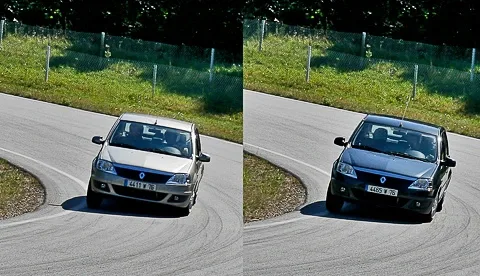
The French divide the evolution of the chassis into "Generation-1" and "Generation-2". The light-colored Logan with the first-generation suspension reacts particularly sensitively to driver inputs. For a budget car, this is excellent behavior. But what delights a professional is unnecessary complexity for the average buyer.
In short, the stabilizer bar is absent for reasons of economy. When developing the Sandero hatchback, the French wanted to make the chassis of the two budget models completely identical. And since the Sandero rides without a stabilizer bar, the Logan is now also not entitled to one. The exception is the version with the 110-horsepower sixteen-valve engine and the 1.5 dCi turbodiesel, but such an engine is not supplied to Russia.
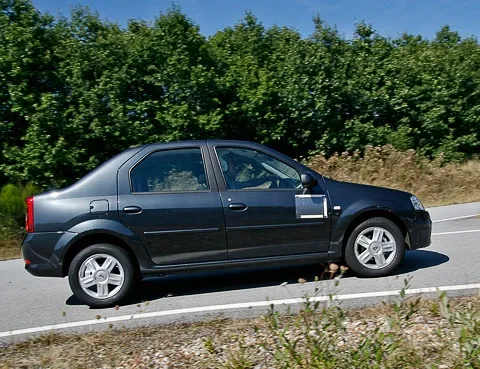
The shock absorbers of the second-generation suspension have become stiffer: by 60% in compression and 20% in rebound. The angular stiffness of the front suspension has tripled, and the rear has doubled.
But this does not mean that the metal part was simply thrown away, as Russian buyers decided. Instead of a stabilizer bar, the Logan received a completely retuned suspension. The silent blocks, springs, and shock absorbers have become stiffer, and the rear beam — thanks to a smaller-diameter stabilizer bar — has, on the contrary, become more compliant.
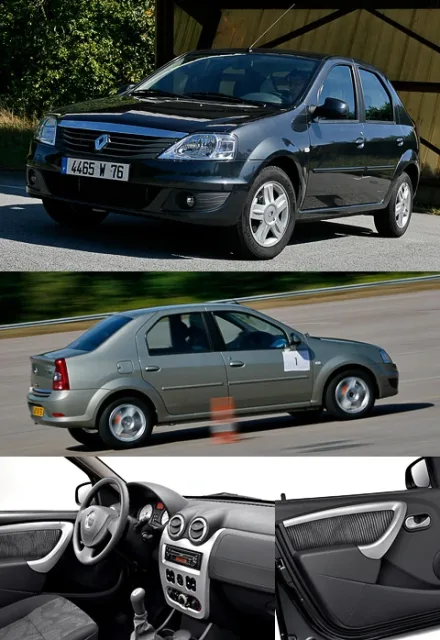
It is also worth mentioning the facelift. The Logan remained itself but became more elegant: bumpers in body color, chrome trims. The updated interior also made a pleasant impression. Although, in my opinion, the new door handles are a fetish for owners of current cars — they are simply screwed onto the old panels. I wonder if they can be installed independently?
The modernized Logan has not become more dangerous — on the contrary, it has been given a vaccination against understeer. I became convinced of this during a short session on a winding dry handling track and while performing the "moose test" behind the wheel of a couple of facelifted Logans: one with the old chassis, the other with the optimized one.
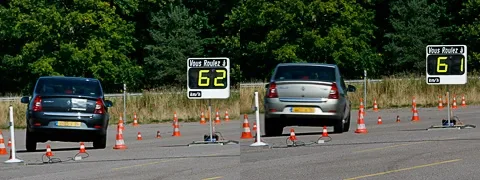
On the standardized "moose test" (ISO 3888-02), we were given three attempts on each car. They say that factory experts perform the "moose test" at a speed of 69 km/h regardless of the suspension type. I turned out to be the fastest among the journalists — 66.67 km/h. But I managed to safely pass the "moose" only in the car with the modernized chassis without a stabilizer bar. The pre-facelift Logan has too stretched-out sliding phases, and the Aveo has a strong tendency to oversteer.
The body rolls, which were expected to increase after removing the stabilizer bar, remained almost at the same level — because the angular stiffness of the front suspension has increased. An average buyer is unlikely to detect the absence of the device by the car's behavior. On the other hand, for a person with certain pretensions, the car's behavior has become more boring.
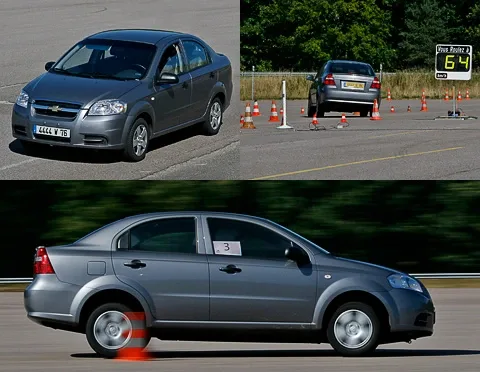
For variety, we were also given one of the competitor cars to tear apart — the Chevrolet Aveo, which is not known for its gentle nature. Against its background, the Logan, both before and after the modification, looks advantageous.
How vividly the old Logan responds to changes in fuel supply! Under acceleration, it straightens the trajectory, and when you lift off, it willingly goes into a slide with the rear wheels. True, the point is not the presence or absence of the front stabilizer bar, but the tuning of the rear suspension. However, here I agree with the French: for the average person, a lesser tendency to oversteer is a benefit.

Patrice Boulanger led the ride and handling refinement program on the Logan project. Having driven the Logan for the first time at the test track, I personally consider the result of this work outstanding. Now Boulanger is responsible for the character of all Renault passenger cars. He calls the four-wheel-steering Laguna coupe his favorite child and admits that, despite the growing role of computer modeling, expert opinion remains decisive in evaluating driving properties.
The new chassis (as you understood, we are talking about a solution already implemented in production) has made the Logan stiffer. The micro-profile of the road surface is better felt in the cabin. But at the same time, there is a feeling of a certain sportiness: the tightened suspension gives the impression of being more energy-intensive. At the same time, the car is less prone to body pitching and does not follow the transverse profile of the road as meticulously as before.
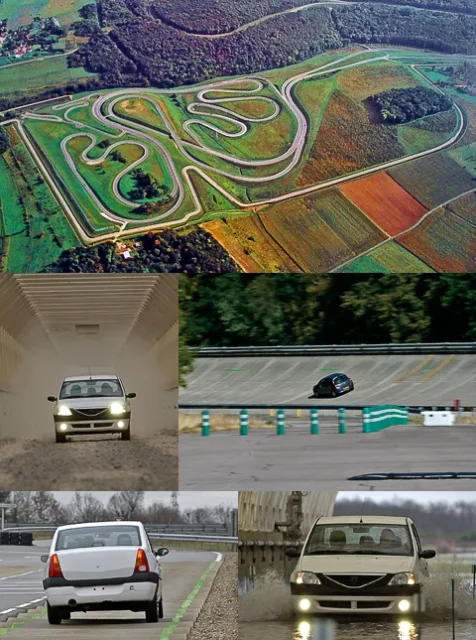
The test center in Aubevoye has existed since 1982. Since then, the track has been modernized several times: new roads have been added to the complex. The latest addition — a mountain serpentine for 50 million euros — was completed in 2000 (photo above). All test work is carried out in Aubevoye: from getting the first prototypes on their feet to endurance tests of production samples using corrosion chambers, aerothermal stands, and roads simulating the features of different regions. Soon, they will also begin refining Nissan cars intended for the European market here — also cost optimization. In parallel, construction is underway in Romania of a comparable-sized test track (the construction budget, about 100–200 million euros, is comparable to the cost of developing a car), where new models of the Renault-AvtoVAZ alliance may be nurtured.
For someone who has been to the Dmitrov test track, the center in Aubevoye will seem cramped: the length of the profiled high-speed ring, for example, is only three kilometers here instead of Dmitrov's fourteen. But the ring has its own control tower! At the test track, which resembles a continuously running clockwork mechanism, 50–70 cars operate around the clock simultaneously, accumulating a total of three million kilometers per year.
But the main thing in this whole story, in my opinion, is by no means the Logan with its safe settings. Nor is it the savings on metal and man-hours. Even if, given the global production volumes of the Logan and Sandero, they probably amount to significant sums. We have before us an example of cost optimization of a different order.
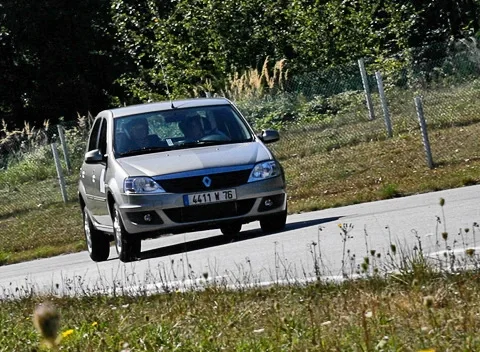
Renault decided that it was better to drag journalists to the French test track than to prove their case in court, dealing with each customer complaint individually. The result would have been the same, but litigation is harmful to Renault's reputation. And a good name has now been declared the company's main treasure. It is nice that they care about their reputation even in Russia, where we are not spoiled by decent treatment of customers. Although, you must admit, the French could have avoided any incidental costs associated with this modernization if they had themselves informed consumers about the innovations in a timely and proper manner.
Behind the scenes 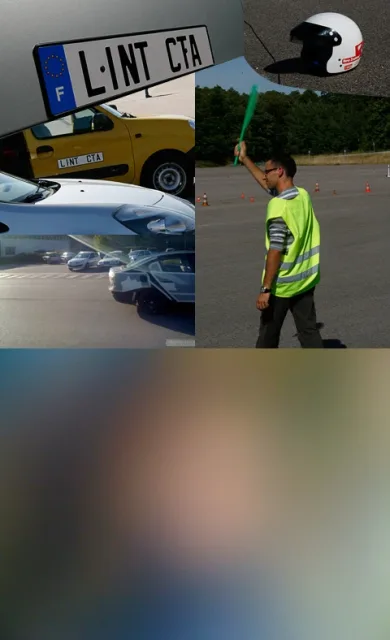
What kind of "behind the scenes" is there at a secret facility where filming was allowed only during the exercises? What, for example, is shown in the bottom photo? Perhaps it is a new secret Renault prototype or Nikita Gudkov from "Autoreview". Visitors' mobile phones at the test center are packed in special plastic that blinds the built-in cameras.