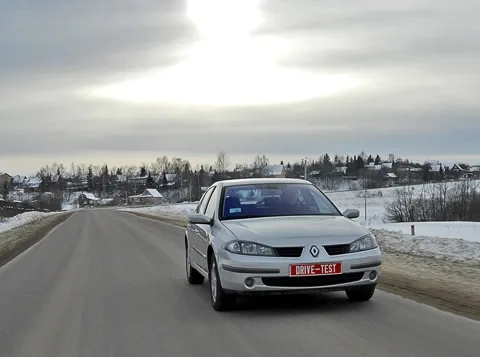
Generally speaking, the French love to surprise the world. Both in a good and a bad sense. And they do it in their own unique manner. They are just one step away from the beautiful to the disgusting, and sometimes these concepts are completely intertwined. The automotive industry only confirms this — just recall the disgusting charmer Citroen 2CV, nicknamed the "ugly duckling" or "umbrella on wheels," which nevertheless claimed the title of the greatest car of the 20th century. Renault is not lagging behind Citroen, so its model range includes delightful models like the Vel Satis, and a horror alien, the Symbol. But for this test I got a Renault Laguna, and I have to figure out which is more in it — merits or drawbacks. Renault has produced a strange car: the front and rear have completely different moods. However, the French are known masters at creating exactly such cars. I got the car in the top trim — Dinamique. To understand that such a Laguna should drive at least dynamically, you don't need to know French. And most likely, that's the case — under the hood is a two-liter turbo engine with 170 horsepower. But a joyful exclamation stuck in my throat when I saw the five-speed automatic transmission. Among other options, I'll highlight the Cabasse audio system, dual-zone climate control, heated windshield, and cruise control. You'll find the full list of equipment at the end of the article, and I can't wait to get to know this "French lady" better. First and perhaps most importantly, the Laguna has a damn attractive rear end. This is exactly the rear that this car should have. If someone calls it perfect, I won't argue. But you'll agree, few men choose a life partner only because of gorgeous curves. There must be something else, like a pretty face. So we walk around the Laguna… And what do we see? We see that something is wrong with her "face." No, you can't call her ugly. But you can't call this face beautiful either. It's as if a woman past her prime, before prom night, put on makeup so heavily that it's a sight to behold, dressed in her best dress, and generally — trying with all her might to look attractive. But the result is so absurd that those around her don't freeze in admiration but look away in embarrassment. Here it's exactly the same story. Before the facelift, the Laguna wasn't a beauty either, but it looked much more harmonious. In short, the front of my companion is so-so. The French messed up. It's a pity, because they know how to make beautiful cars. Here it is, the element of this car. On smooth and straight sections, the turbo engine reveals its full potential, and the Laguna quickly and comfortably delivers passengers to their destination. Well, okay. After all, people buy cars not only to look at them but also to drive them (I just discovered this myself). And since owners spend most of their time inside, not outside, I'll probably get in there. The interior, by the way, is good. Very good! Even just looking at it is a pleasure. But you can also touch it. This only enhances the impression. The materials are pleasant to the touch, making the cabin look quite expensive. Plus, it's also very neat and cozy. You settle in so quickly and easily that after a couple of minutes you want to bring in your house slippers, a floor lamp, and your favorite book. The seat is a whole separate topic. A person of absolutely any build will feel equally comfortable in it. The cabin, though creaky, is beautiful. Contemplating it is almost as pleasant as Raphael's Sistine Madonna. The dashboard initially surprised me with an abundance of various buttons, but it didn't bother me right away. "I'll figure it out later," I decided lightly. First, it was more important for me to test the combination of the two-liter turbo engine with the automatic transmission. So I make sure the key card is with me and quickly press the START ENGINE button. A rather unusual engine start system and, I must say, very convenient. After a couple of days, all the unusualness disappears, and the credit-card-sized key card in your pocket is perceived as something taken for granted — as if the very first Benz car had exactly the same one. During the entire time with the Laguna, I never managed to get used to the intricate interface of the music system and the completely unreadable speedometer. That's the end of the list of complaints. Everything else is very convenient and clear. The two-liter turbo engine reveals itself only at the moment of startup. Then it behaves extremely modestly. No, the presence of turbocharging doesn't at all make the Laguna akin to the numerous Japanese "lighters" with straight pipes. To understand whether the engine is running or stalled, you have to strain all your six senses or give it some gas. I didn't want to strain, so I press the pedal. Aha, it's running, where else would it go! Well, we've warmed up, let's go. Finally finding the handbrake (it turned out that it, the rascal, was hiding in the lower left corner of the dashboard disguised as an ordinary button) and calming down, I set off. Carefully I make my way through deserted alleys to a traffic light. I take pole position. Just what we need. Green! The car smoothly picks up speed, the "automatic" imperceptibly shifts something… Whoa, and the speed is already 130! We urgently moderate our ardor. For such driving, neither my bosses nor, especially, the readers will praise me, because racing like that in the center of Moscow is, to say the least, unreasonable. What did they give me for the test: a Renault Laguna or an airplane? I think it's all the tricks of the turbo engine — it's certainly a good one, no doubt. But the speedometer… At night, it's impossible to read anything on it. The odd scale, along with the narcotic murky red backlight, does everything to ensure the driver never learns his true speed. And the sound insulation is excellent. Apparently, it was secretly taken from Jacques Chirac's limousine; he's retiring anyway. The developers should have taken something else from the presidential car. For example, the notorious "automatic." This one, although adaptive, is frankly sluggish. However, there is a manual mode, and I immediately used it… only to turn it off a couple of kilometers later. It's all just fun and games. You can't turn an "automatic" into a "machine gun" with any manual modes. The profile of the Laguna was a success for the designers. The car looks very well-proportioned and recognizable. In a sober mind, it's almost impossible to confuse it with anything else. I got a bit upset. But what happened next is enough to drive anyone to a psychiatric clinic. I decided to tune the radio while the traffic light was red. It seemed simple enough — press the frequency scroll button and wait for the receiver to hit the desired station. But traffic lights changed one after another, I almost got home, and the needed radio station just wouldn't be found. When I realized what was going on, my brain was ready to boil. It turned out that in the Cabasse music system installed in this car, pressing the button with the "up" arrow decreases the radio frequency, and pressing the button with the "down" arrow increases it! For a long time, I refused to believe it and checked myself more than once — that's exactly how it is. A funny interface, though it completely ignores all laws of ergonomics. But if you have the patience to figure it out, you'll get a "prize" — quite decent sound. And the glove box? No, it's not a glove box at all; you can't make a mess in it no matter how hard you try. The phrase "glove compartment" very accurately reflects the purpose of this container. Besides gloves, and maybe sunglasses, nothing else will fit in there. Yes, it has drawbacks (and where have you seen a perfect car? Or maybe you know a perfect woman? Introduce me then, I'd be grateful). But they are mainly caused by difficulties of getting used to it, and that quickly passes. Already the next day, I looked at the car with completely different eyes and saw a mass of advantages.
The appearance of this car is certainly an acquired taste. But if you don't take the front part into account, the Laguna looks truly attractive, and this car is not at all criminal. Yes, the "automatic" here is not the quickest, but it is positioned as adaptive. True, it's the driver who has to adapt to it first. And as soon as I found a common language with the car, I immediately got that very driving pleasure that Renault Laguna advertising talks about. The engine in the Dinamique version is perfectly matched, and sitting behind the wheel, you are confident that you can easily leave 90% of Moscow's car fleet behind, and do it comfortably. The Laguna accelerates briskly and brakes excellently. I didn't even need to get used to the brakes — they are so precisely tuned. The ride smoothness is top-notch: passengers aren't shaken, and only sounds from outside reveal that the asphalt under the wheels isn't ideal.
test-drive-9.jpg
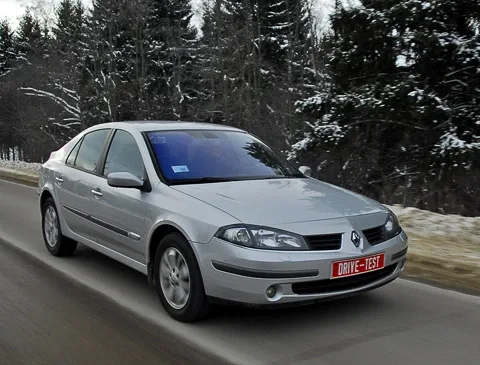
The bluish tint of the windshield is not just design. It's an athermal coating and a built-in mesh of electric heating filaments. For our climate, an extremely useful thing.
This car is well suited for the city. The mirrors are adjusted perfectly, so you can navigate in dense traffic without problems, and the "automatic," once you get used to it, turns out to be very handy in traffic jams.
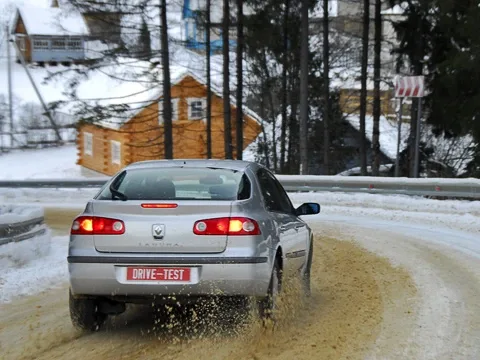
Going out of town with a large company is not a problem either. The company itself, of course, will enjoy the ride, but someone will definitely notice the creaks and noises in the cabin. There's no arguing with that — the cabin is indeed rattly. But it is comfortable and beautiful. It would be much worse if it were the other way around. And I liked the thick steering wheel rim so much that I would gladly take it as a souvenir. As for the many buttons that you can't figure out right away, the answer is simple — read the manual. Then you'll quickly find the parking brake, cruise control, and other systems the car is packed with. Including the ESP off button. It deserves a special mention. The system works surprisingly smoothly and effectively, especially on slippery surfaces. I got the impression that flying off the road in a Laguna with ESP on is only possible if you deliberately want to. And Renault did the right thing by making it standard equipment.
test-drive-10.jpg
The electronics on this car are so good that any corner is taken easily and effortlessly. It seems you can only fly off the road if you really want to.
This is not a car you can just get in and drive. To like it, you need to understand and feel it. As soon as I managed that, we established complete mutual understanding and almost idyllic relations. After driving the Renault Laguna, I realized one thing: the people who created it are true enthusiasts. They love cars and try to do everything for future drivers and passengers. Sometimes it comes out clumsy, but it's precisely these little things that give the Laguna its special charm. It's like a dog that happily brings you its new bone instead of slippers. No one would think of scolding the dog for that (it has charm).
The main thing about the Laguna is the mood. Behind the wheel of this car, you absolutely don't want to weave through traffic and overtake everyone. You don't want to argue or quarrel. And there's certainly no need to stress over trifles. You want to drive calmly and with self-respect along the roads, buckled up, letting pedestrians, women drivers, and those always in a hurry pass. And when you arrive at your destination, look at your watch and find that you're right on time.
test-drive-11.jpg
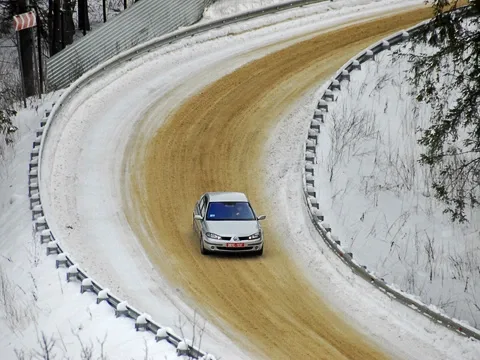
The Laguna looks equally good on the promenade in Nice as it does among Russian forests.
In our country, there are, frankly, few such refined "intellectuals" from the world of cars. But the Laguna will surely charm its owners and passengers with comfort, dynamics, and special charisma. So it's no surprise that I missed this "Frenchwoman" just 20 minutes after parting with her.
Technical specifications
Specifications Renault Laguna Dinamique 2.0T AT5
Body
Body type 5-door hatchback
Trunk volume, l 475
Curb weight, kg 1320
Gross weight, kg 1835
Engine
Type Petrol, with multipoint sequential fuel injection and turbocharging
Displacement 1998
Number and arrangement of cylinders 4, in-line
Number of valves 16
Maximum power at rpm (hp/rpm) 170/5000
Maximum torque at rpm (Nm/rpm) 270/3250
Transmission
Drive front
Gearbox automatic five-speed
Chassis
Front suspension McPherson, with anti-roll bar
Rear suspension semi-independent, coil spring, with linked arms, with stabilizer
Front brakes Ventilated disc
Rear brakes Disc
Performance characteristics
Exhaust emission standards Euro-4
Maximum speed, km/h 216
Acceleration from 0 to 100 km/h, sec 9.2
Fuel consumption — extra-urban cycle (l/100 km) 6.5
Fuel consumption — urban cycle (l/100 km) 12.7
Fuel consumption — combined cycle (l/100 km) 8.9
Fuel tank capacity, l 70
Fuel petrol AI-95
Equipment of the tested car Standard equipment
  • 16-inch alloy wheels Lazuli
  • Upholstery: Catanzaro fabric + Dune leather in dark gray
  • Leather steering wheel
  • Automatic parking brake
  • "Follow me home" system
  • Fog lights
  • Headlight washers
  • Chip card, "Start/Stop" button instead of key
  • Keyless entry system
  • Height adjustment for driver and passenger seats
  • Driver's seat lumbar adjustment
  • Steering wheel adjustment for height and reach
  • Dual-zone climate control
  • Power-adjustable and heated exterior mirrors
  • Exterior mirrors with power folding
  • Power windows for front and rear doors with automatic mode
  • Folding rear seats in 2/3 ratio
  • Rear and side sunshades
  • Rain and light sensors
  • 6 airbags
  • ABS
  • EBV — electronic brake-force distribution
  • AFU — emergency braking assistance system
  • ESP — electronic stability program
  • ASR — anti-slip regulation
  • CSV — understeer control system
  • Electronic immobilizer
  • Automatic door locking while driving
  • Increased ground clearance
  • Engine adaptation for cold climate starting
  • Engine and wiring protection with steel plates
Additional equipment
  • Speed limiter/cruise control — $453
  • Heat-absorbing windshield with electric heating — $505
  • Rear and side sunshades — $52
  • Metallic paint — $464
  • Heated front seats — $361
  • Audio system 4×40 W with 6-disc CD changer in dashboard — $711

Base price $31269
Price of tested car $33645


Test car provided by
OJSC "Avtoframos".
Behind the scenes
test-drive-12.jpg