
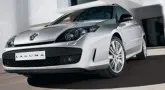
The test drive of the Renault Laguna GT was conducted, of course, in France. But the location was not chosen randomly — due to the sporty nature of the GT version, the route was laid along the serpentines of Corsica, the island where Napoleon was born.
The appearance of the new model compared to its predecessor has transformed beyond recognition. Sharp, broken lines make the silhouette bold and swift. Whether you like it or not is a matter of taste, but the fact that the image turned out fresh and memorable is indisputable. The GT differs from the regular Laguna with different bumpers with air intakes on the sides, sill overlays, black mirrors, a dual exhaust system, and signature 18-inch Celsium wheels. According to specialists, technologies from Formula 1 were used in their development.
Inside, there are even more changes than outside. The front panel pleases with strict lines. Everything is thought out and convenient. The quality of trim materials does not disappoint either. GT owners additionally get aluminum inserts, perforated pedal pads, a three-spoke steering wheel, and seats upholstered in black Riviera leather with excellent lateral support. The latter is especially useful, because the Laguna is capable of entering corners very sharply.
Even more interesting is the technical content of the Renault Laguna GT. Let's start with the engines available for this version. Here, unlike many competitors, there are two — diesel and gasoline. Each is good in its own way. The gasoline unit has a torque plateau in the range from 2500 to 5000 rpm, which is usually characteristic of diesels. This gives the driver constant confident traction. The downside is that this engine is very sensitive to gear selection. Driving "in tension" is difficult. If you engage a gear higher than needed, then until the revs reach at least 3000–3500 rpm, the Laguna accelerates reluctantly. If you engage a lower gear, the engine briskly revs up to the cutoff at 6500 rpm.
The diesel is not so demanding on gears and does not have a pronounced torque plateau, but it picks up already from 1800 rpm. The cutoff occurs at 5000 rpm, but revving it up to that is pointless — during intense acceleration, it is just a waste of time. It is optimal to shift in the range of 4000–4500 rpm. For dynamic driving, you will have to get used to the Laguna's gearbox. At first, the not too clear and long lever strokes interfere. For a civilian version, this could be forgiven, but from a sporty modification you expect more.
In terms of dynamics, the engines are almost equal: acceleration to 100 km/h differs by only 0.7 seconds (7.8 for the gasoline versus 8.5 for the diesel) with a power difference of 25 hp. Both engines do not annoy with noise in the cabin even at high revs. The sound insulation of the new Laguna is at its best. Sitting behind the wheel of a D-class car, you hardly believe in its sporty inclinations, or rather, in its impeccable handling. Many can make a big car go fast, but few manage to unconditionally subjugate such a machine to the driver's will. The engineers of Renault and Renault Sport Technologies succeeded.
The Renault Laguna GT is equipped with a new Active Drive chassis with all-wheel steering (4WS). This allows you to confidently take corners at high speeds and maneuver deftly in a cramped city. How does it work?
On the rear axle, an electric drive and a controller from the Japanese company Aisin are installed. The electric drive is responsible for turning the wheel to the desired angle. The controller, which collects data from the steering wheel angle sensors, speed, and the stability control system, transmits commands. Depending on this data, the rear wheels change their angle. At speeds up to about 50 km/h, they turn in the opposite direction to the front wheels. During acceleration, the wheels begin to turn in the same direction. As a result, centrifugal forces are significantly reduced, and the car becomes more stable during maneuvers. The steering angles of the rear wheels are small — 3.5 degrees in each direction. But the total seven degrees reduce the turning radius by almost two meters — from 12.05 to 10.8 m.
The new steering system had a positive effect on informativeness and feedback. At the technical presentation, we were given figures: if earlier to turn the wheels by 1 degree, you had to turn the steering wheel by 16 degrees, now — by 2.5 degrees less. And to make the rear wheels deviate by the maximum 3.5 degrees, the steering wheel needs to be turned only 12 degrees. While driving, you feel the work of Active Drive by the absence of rear axle drift. The car is generally impossible to send into a skid — at an early stage, the steering rear wheels will stop the dangerous tendency. And if they fail, the stabilization system will come into play.
The sporty version of the Renault Laguna GT turned out well: powerful engines, balanced suspension, precise control. The manufacturer believes in the new product so much that it increased the factory warranty to three years or 150 thousand km. In Europe, sales of the sporty version will start very soon. As for Russia, the issue of supplies remains open. We will wait and envy the Europeans.
Not standing still
In the Renault Laguna GT, not a single wheel stands still — each participates in maneuvering. At different speeds, this happens differently. At low speeds, the rear wheels turn in the opposite direction to the front ones. When the speed exceeds 50 km/h, they turn in the same direction. The system is called Active Drive (4WS), or all-wheel steering. It repeatedly increases stability during maneuvers. At high speeds, centrifugal forces drop, and, as a result, the speed of cornering increases. At low speeds, the car becomes more agile — the turning radius decreased by two meters. Such results were achieved by installing an electric drive and a 4WS control unit. The first is directly responsible for turning the wheels, and the second, accumulating data from the ABS and the stability control system, sends a signal about the required steering angle. The angles are small — only 3.5 degrees in both directions. But, as tests show, this is enough to radically change the behavior of the car.
Driving
The GT version is distinguished by a balanced suspension and good dynamic performance. There are no complaints about the handling. The only criticism is the gearbox with long and unclear strokes. It is worth getting used to its operating mode on one or another engine.
Interior
The interior attracts with solidity, novelty, and the quality of trim materials. The seats with good lateral support deserve attention.
Comfort
Despite the sporty character, a ride in the GT will please not only the driver but also passengers. The Renault Laguna GT does not bother with excessive shaking and rolls. The abundance of free space in the back and the volume of the luggage compartment are pleasing.
Safety
In addition to various passive safety systems, a number of active safety systems are already installed in the base.
Price
Not determined.
Advantages and disadvantages
+ Excellent handling, comfortable suspension.
Test drive of the Renault Laguna GT: a sports car in a station wagon suit
The first thing that wins you over in this car is that it does not try to seem like something it is not. The Laguna GT honestly delivers on every stated characteristic, and this is perhaps the main impression from the trip. The car is literally created for those who are not ready to choose between comfort and drive.
Under the hood is a gasoline unit with a volume of 1998 cubic centimeters, producing 205 horsepower at 5000 rpm. From a standstill to a hundred, the car accelerates in 7.8 seconds, and the maximum speed is limited to 232 kilometers per hour. These figures, of course, are impressive, but what surprises even more is how the Laguna GT does it. The engine is elastic, traction is distributed evenly, and even at high revs, the engine does not break into hysterics.
The manual is six-speed, but there are questions about it. The lever strokes are a bit long, and gear engagement is not always clear enough. In city traffic, this is not annoying, but on a winding road, where you want to shift quickly and accurately, you begin to catch yourself thinking that the gearbox could use more composure. However, this is more of a nitpick than a serious drawback.
Much more joy comes from the chassis. The engineers clearly did not slack off: the Laguna GT received a suspension that balances on the edge of comfort and sporty stiffness, and does it virtuously. On bumps, the car does not shake, and in corners, it stands confidently, without excessive rolls. The Active Drive system deserves special attention — it is unique for this class. It really works, helping the car literally screw into corners, and this is felt immediately as soon as you start driving faster.
Interestingly, many of the solutions used here came from the world of real racing cars. This is felt both in the steering settings and in the behavior of the car at speed. At the same time, the new product has not turned into a "track tool": in the city, you can drive it with the same pleasure as on a country highway.
A separate plus is the factory warranty, which was increased to three years. For the Russian buyer, this is a weighty argument, although, alas, it is not yet entirely clear whether this version will appear on our market at all. I really want to believe that the Laguna GT will still make it to the showrooms of Russian dealers, because the car deserves it. But even if this does not happen, the very fact of the existence of such a car is already a reason for respect.
The dimensions — 4695 millimeters in length, 1811 in width, and 1445 in height — make it quite practical for everyday life. The interior is spacious, the seating is comfortable, and the interior does not look outdated. As alternatives, you can consider the Ford Mondeo or Mazda6, but each of them has its own character, and the Laguna GT in this trio will definitely not be a black sheep.
To summarize: the Renault Laguna GT is a rare case where the manufacturer didn't just slap a sporty badge on the car, but actually invested in the engineering. Yes, the gearbox could be more precise, but everything else — the chassis, the engine, the overall solidity — leaves a very pleasant aftertaste. I hope that Russian fans of the brand will still get to experience these emotions firsthand.