
Renault Koleos

All-wheel drive
Engine — 2.5 L
Peak power —
171 hp/6000 rpm
Maximum torque — 226 Nm/4400 rpm
Top speed (km/h) — 188
0-100 km/h sprint — 10.3
Fuel consumption (L/100 km):
city — 12
highway — 8
combined — 9.5
Electronic friction clutch connecting the rear axle
Continuously variable transmission
Length — 4520 mm
Width — 1855 mm
Height — 1710 mm
Ground clearance — 206 mm
Curb weight — 1655 kg
Tires 225/60R17
Price $ 36,451 (291,600 UAH), base version costs $ 29,329 (234,631 UAH)
Equipment:
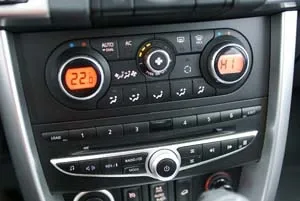
Electric parking brake, parking assistant, ESP, hill descent control HDS, keyless entry with card, power driver's seat, dual-zone climate control, rear air vents with adjustable airflow, Bose audio system, rain sensor, panoramic roof
Maintenance schedule:
Service interval:
10000 km
Service 1 at 10000 km — $ 270 (2,160 UAH)
Service 2 at 20000 km — $ 270 (2,160 UAH)
Service 3 at 30000 km — $ 270 (2,160 UAH)
Service 4 at 40000 km — $ 270 (2,160 UAH)
Service 5 at 50000 km — $ 270 (2,160 UAH)
Service 6 at 60000 km — $ 443 (3,537 UAH)
Service 7 at 70000 km — $ 270 (2,160 UAH)
Service 8 at 80000 km — $ 270 (2,160 UAH)/FONT>
Service 9 at 90000 km — $ 355 (2,835 UAH)/FONT>
Service 10 at 100000 km — $ 270 (2,160 UAH)/FONT>
Service 11 at 110000 km — $ 270 (2,160 UAH)/FONT>
Service 12 at 120000 km — $ 443 (3,537 UAH)/FONT>
Warranty — 3 years or 100000 km
Rivals:
Nissan X-Trail
Toyota Rav4
Honda CRV
Landrover Freelander
Mazda CX7
KIA Sportage
Hyundai Tucson

Marat Makhmutov, «Kazan School of Higher Driving Skills»
French manufacturers were in no hurry to conquer the crossover segment, but recently they have noticeably become more active. Given that Japanese and Korean brands have long dominated this market, it would seem that newcomers have nothing to do here. However, the crisis played into the hands of such cars: many owners of large SUVs switched to more economical SUVs. The French quickly got their bearings and rolled out their options: «Citroen C-crosser», «Peugeot 4007» and «Renault Koleos». The first two are based on the «Mitsubishi Outlander» platform, while «Renault» used the «Nissan X-Trail» platform. This approach is understandable: the alliance of French and Japanese engineers has existed for a long time, and using a proven base is the cheapest way to establish oneself in a new class. True, «Citroen» and «Peugeot» limited themselves to changing only the front end and the emblem. But we got the «Koleos» for the test.


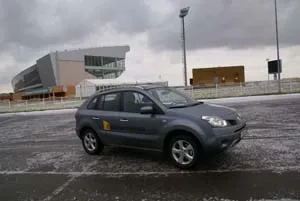
A silver car meets us on the lot. On the outside, it is completely unlike its «Japanese» donor! The streamlined body lines make it visually more compact than it actually is, and this is its main difference from the more angular «X-Trail». The front optics even remotely reminded me of the «Lexus RX». At first, I was confused by the strange stampings on the bumper on the sides — it seemed that the car had been in an accident. But it turned out to be just a design move, a kind of French touch. In profile and from the rear, the «Koleos» somewhat resembles the new «Kia Sportage». By the way, the Korean influence here is not only external: the model is assembled at a plant in Busan, South Korea.
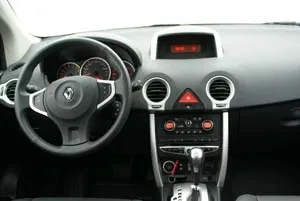
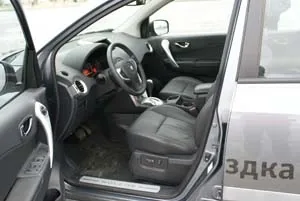
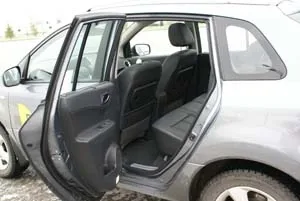
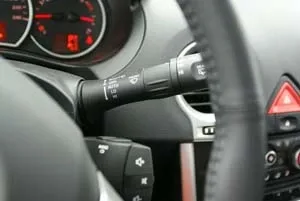
Inside, you immediately understand that you are in the top version. Leather interior, leather steering wheel, CVT, climate control with separate temperature settings, rear window shades, premium audio system, and, of course, a huge panoramic roof of two sections with a total area of 0.75 square meters. There will definitely be no feeling of cramped space here. There are plenty of compartments for small items, they are even hidden in the armrests of the front doors. French originality also manifested itself in the details: the mirror control unit is built into the driver's door handle, and the handles themselves have an unusual shape, somewhat resembling a golf club head. The quality of trim materials is top-notch, noticeably better than in the «Citroen». It's comfortable behind the wheel: all controls are at hand, the instruments are perfectly readable. The cup holders can be cooled or heated depending on the climate settings — this feature came here straight from the «X-Trail».
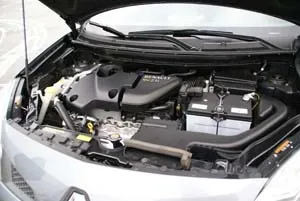
As per tradition, after checking dynamics, brakes, and handling on the asphalt pad, we head out onto regular roads. And, as always, I get behind the wheel first. They didn't let me turn on the music from «Bose»: Vadim insisted that we drive in silence and evaluate the noise insulation and suspension performance. Okay, we drive in silence. The engine from «Nissan» with a volume of 2.5 liters and 170 horsepower paired with a CVT gives the «Koleos» quite decent dynamics, the car confidently picks up speed, and the electric power steering allows for agile maneuvering in city traffic. But that's not the main thing. What impressed me most was the smoothness of the ride! There were four adult men in the cabin, and everyone was discussing the car's features. No one even noticed that we were driving at a decent speed on a road with a «washboard» surface — so filigree was the suspension in smoothing out these bumps. I pointed this out, and only then did everyone realize that the road was uneven. Bravo to the Japanese-French chassis engineers! Just what we need for our roads! True, on completely broken asphalt with large potholes, the car is not so kind to passengers, but for roads of average quality, the suspension tuning is almost ideal.
«The intelligent all-wheel drive system All mode 4x4 constantly monitors wheel traction and, depending on the road situation, transfers torque to where it is needed most — to the wheels with the best traction.» A familiar phrase from the «X-trail» advertisement, but we decided that it suits the «Koleos» perfectly as well. So without much hesitation, we sent our test car to a place where we could test it off-road. True, we didn't completely «kill» it — after all, it's not a real off-roader. But no one had any doubts that on a slightly frozen (about -1°C) and muddy autumn road, the «Renault» would not let us down. The climb up the broken dirt road was effortless, and we didn't even need to engage the forced 4 WD-lock mode (which splits torque between the axles equally, 50:50). Then we just had fun at the top — the crossover carelessly drove us around on the icy mud. We decided not to tackle the deep puddle: the geometry of the «Frenchman» wouldn't allow it, and we had nothing to pull it out with. But on the descent, the hill descent control came in handy: we pressed the button, took our feet off the pedals, and the car drove down by itself, with the brakes crunching, maintaining a speed of no more than 7 km/h. All we had to do was steer. The package also includes a hill start assist for slopes of 10 degrees or more — it activates automatically and prevents the car from rolling backward.
Summing up, I will say: the product of the «Renault-Nissan-Samsung» alliance, in my opinion, turned out to be very worthy. French charm, legendary Japanese quality, and a pleasant Korean price — that's the formula for success. A car has hit the market that successfully combines the features of a sedan, minivan, and SUV. Assembly and materials are at a high level, noise insulation and ride smoothness do not disappoint, the engine and CVT work as they should, and the price remains competitive. So the «Renault Koleos» has every chance not to get lost in the sea of SUVs. And the creators of that commercial where a car with a family drives up to a snowy peak that only climbers had reached were not so far from the truth.

Vadim Sadykov, «Autoclub-Kazan»
When I recall cars from old tests, usually only a couple of phrases come to mind. You can't hold onto all the details, only the brightest moments remain. And I've noticed: if there's almost nothing to remember about a car, that's more of a plus — it means it has no obvious flaws, just a solid car. What am I getting at? Well, writing about the Koleos is difficult even with fresh impressions. It's too even. There's nothing to criticize — I found no flaws. But there's also nothing to rave about. An ordinary car without bright features, created for ordinary calm driving.

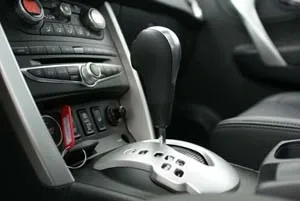
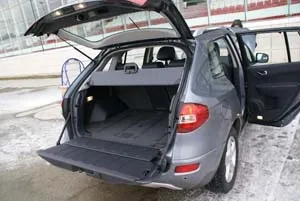
Although... a couple of little things still lean toward pros or cons. Rear passengers are slightly less comfortable. Sound insulation fell short: studs are heard too clearly. And there's not enough knee room in the back — because of the sloping roof, designers sacrificed the cabin in favor of the trunk. The drive mode selection button seemed inconvenient to me. In the related Nissan X-Trail, this is done much better: a round washer with clear labels "2H", "4H Auto", "4H Lock". Now about the good stuff. Alfred and I have noticed more than once: for a crossover, a 2.0 engine is too small. Here it's optimal — 2.5, both in traction and fuel consumption. Power is enough: on the highway you overtake slow trucks quickly and without fear, in the city the low-end torque also pleases. The Koleos has decent off-road capability. It may be a crossover, but it has a lock. There were no tractors around, so we limited ourselves to a light program. Another plus: the CVT mimics an automatic transmission — during acceleration, the tachometer needle rises and falls as if gears are shifting. The result? No annoying needle freezing at 6000 rpm and no dull hum. The CVT is lively, and manual mode doesn't add speed — which, however, is fine.

"Ordinary" — that's the one word that best describes the Koleos. Some might find such cars boring. But for me, it's a compliment. After all, a car is needed for ordinary, everyday life. It's just a tool that helps us work and rest every day. And everyday clothes shouldn't be extravagant or impractical.

Alfred Mardanov, "Autoclub-Kazan"
There are more and more crossovers! It seems this is now the most fashionable direction among automakers. Maybe our Russian market, which this year surpassed the European one in sales, set the trend? As is known, such cars are especially loved here and in America. But in the Koleos's homeland, it would hardly be so popular. Although where is its homeland? The jacket is French, the tailor is Japanese, the manufacturer is Korean. It's the brainchild of Renault Samsung Motors, a "daughter" of the Renault-Nissan alliance. They are assembled in Korean Busan, which is good — we have high trust in the quality of Korean assembly. I'm saying this now being smart, but before the test, I was tormented by the thought: isn't the Koleos a "twin" of the C-Crosser and Peugeot 4007? "What the hell," I thought, "did they make another 'Mitsu' in French guise?" But no, I was wrong, the donor here is Nissan. I remember how we collaborated with television on test drives back then. I still see the terrified face of the TV guy when we dived into a mud bath at full speed, splashing mud and debris. The Nissan X-Trail performed excellently then, and it became the basis for the current Koleos. That's great: those who don't like the brutal square design of the X-Trail now have its French version. True, the appearance didn't impress me much — it looks like something that grew out of the "ugly duckling" Clio.

There's something elusively familiar in the design. I'll look, close my eyes, try to imagine — and I see a Lexus 350, only stamped differently. Well, that's the French vision, but almost all their cars get five stars in EuroNCAP crash tests. Our Koleos is no exception. We've already talked about the interior; I'll just note: the instrument panel is more convenient and reads better than the X-Trail's. The electric seat adjustments work surprisingly quickly. Slightly move the lever — and you're already moving with the seat. Unusual! I sat behind the wheel first and drove the car myself from the salon to the hippodrome, carefully avoiding puddles so as not to splash it before the photo shoot. I remember how well the CVT worked on the X-Trail — smooth, assertive traction without dips. Here everything repeats exactly, including the CVT's noise. Especially audible on the highway: at above-average revs, an unpleasant ringing sound appears, but it's drowned out by the studded tires, which bother rear passengers the most.
This brings us back to the issue of sound insulation: in the city and at low speeds, everything is quite decent, but on the highway the situation noticeably worsens. The first acquaintance with the car took place at the hippodrome, where the surface was almost icy, and I was sitting next to the driver — Oleg Shatov, who heads the school of high driving skills, was at the wheel. He drove the car through various trajectories and exercises, switching all modes: with ESP and without it, with 4WD-lock engaged, and in the normal position. Later, I tried to repeat most of these maneuvers myself, but with ESP off. Interestingly, the system allows a bit of hooliganism, but up to a certain limit, and if you turn it off, it doesn't reactivate on its own. I didn't do a full 360-degree turn, but I did do turns, drifts, and slides, and the electronics never intervened — perhaps I didn't have enough speed, since everything happened at no more than 70 km/h.
The car behaves very docilely, and even when I deliberately provoked it to slide, I never felt a loss of control for a moment. This is largely thanks to excellent brakes, clear steering, and confident engine traction. As for off-road, as I mentioned, there was no serious extreme there, although the car's potential is clearly greater than what we used. The hill descent control system was just tested when I was behind the wheel. The car smoothly crawls down, you don't need to touch the pedals at all — you just set the direction with the steering wheel. Such functionality is another sign of a true SUV, and the manufacturer clearly isn't in vain emphasizing its increased off-road character. In the class of crossovers with enhanced off-road capability, there's one more worthy player!