
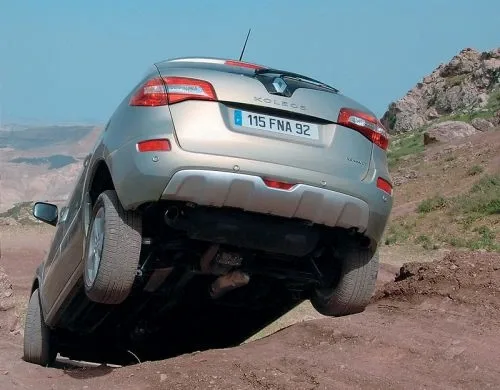
Renault Koleos. Price: from 870,000 RUB. On sale: since September 2008.
Renault is presenting its Koleos crossover to the European market with great fanfare, with the first tests having taken place in North Africa. Interestingly, a decade ago it was in Morocco that the all-wheel-drive Scenic RX-4 made its debut. But back then, that model failed to find its buyers and quickly disappeared from the production lineup. Let's see what the new contender has in store.
2009 Renault Koleos
© Photo: Renault
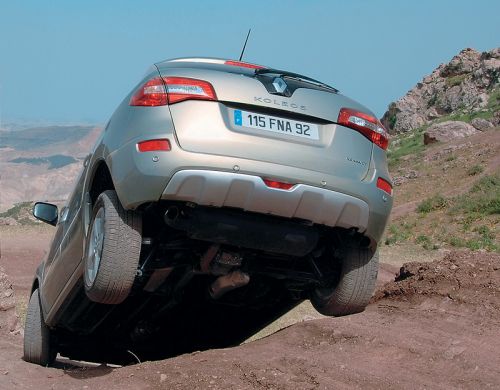
Before us is the Renault Koleos crossover, aimed at taking on such recognized segment leaders as the Toyota RAV4 and Honda CR-V. We shouldn't forget the Hyundai Santa Fe and VW Tiguan either. The newcomer's appearance can be called successful and balanced. The side profile, generous ground clearance, and flared wheel arches directly hint at its off-road potential. The sloping rear window adds dynamism to the image — so says Renault's chief designer Patrick Le Quément. The front end clearly echoes the Clio. At the same time, the crossover's design lacks those avant-garde or controversial details that were present in models of the previous generation.
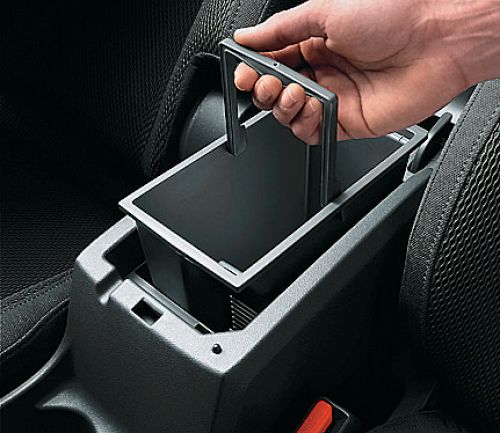
Inside, there's the same minimalism, and that can be counted as a plus. The Spartan atmosphere of the cabin underscores the character of a true SUV. The creators assure that they have achieved the best visibility in the class: 31° forward vertically and 36.3° horizontally. Rear visibility — 27.5° — also deserves approval. It's not an absolute record, but a very respectable figure. Another record is the cabin height, which is 946 mm. As practice has shown, rear passengers have plenty of room — both above their heads and in the shoulders.
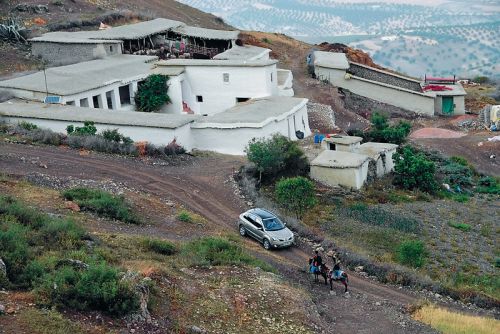
To emphasize the off-road essence of the Koleos, Renault's marketers chose an unusual location for the test. The presentation was organized in North Africa, near the Moroccan city of Fez. It's clear that the roads there are far from ideal, and this is a great opportunity to test the car in harsh conditions. And where there is asphalt, drivers are waylaid by local daredevils in ancient cars, tractors, trucks, and even donkeys. Well, let's conduct a "donkey" test.
2009 Renault Koleos
© Photo: Renault
2009 Renault Koleos
© Photo: Renault
Time to get going, but the scorching cabin prevents getting behind the wheel. We start the engine and turn the dual-zone climate control to full power, which has separate vents for rear passengers. Continuing the heat protection theme, it's worth noting the sunshades in the rear doors.
Once the cabin has cooled down — we can head out. In city traffic, the Koleos hardly feels like a crossover; rather, it resembles an ordinary minivan. Dynamics are decent: the 2.5-liter gasoline unit accelerates the car to 100 km/h in 9.3 seconds. True, for a confident start, the engine needs higher revs. But the crossover's clutch is quite stiff, and without getting used to it, you constantly stall. However, after an hour or two, you get used to this model's quirks. The top speed, which we never managed to reach during the test, is officially 185 km/h. We'll take their word for it.
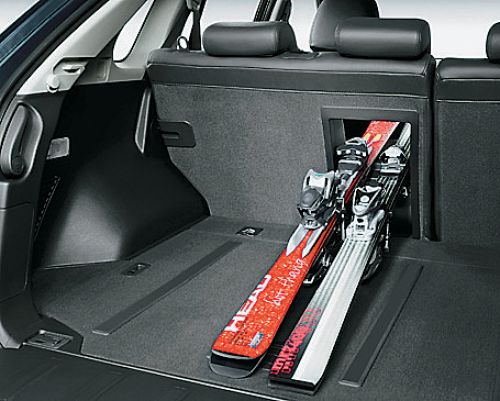
2009 Renault Koleos
© Photo: Renault
The engineers, who combined the efforts of France, Japan, and Korea, paid special attention to sound insulation. The cabin is almost completely quiet — both on decent asphalt and off-road. For this, we should thank the multilayer windshield, a special engine subframe, and effective soundproofing materials on the firewall, under the floor, and in the wheel arches.
Soon the asphalt ran out. Ahead were low but steep mountains, where the roads resembled trails more, and sharp stones crunched menacingly under the wheels. Here it was time for the all-wheel-drive transmission, partially borrowed from the Nissan X-Trail. An unprepared driver can safely rely on auxiliary systems like All modeI, Hill Start Assist, and Hill Descent Control, which will help both climb a hill and descend safely. Off-road ambitions are also confirmed by the 206 mm ground clearance. Note the approach and departure angles — 27 and 31 degrees, respectively. Theory was confirmed by practice: the new crossover conquered African off-road terrain without much effort.
Cosmopolitan
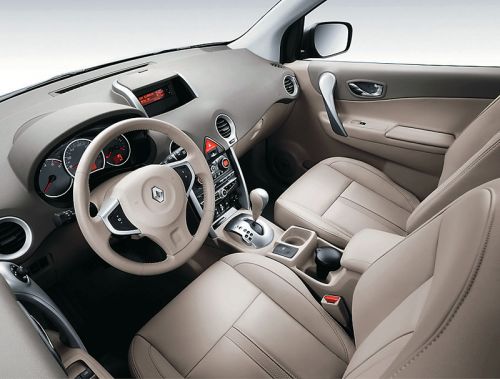
2009 Renault Koleos
© Photo: Renault
The first Renault crossover, named Koleos, can without exaggeration be called a cosmopolitan. Judge for yourself: under the French brand, a car is produced that was developed with the participation of the Japanese company Nissan and assembled at the Samsung plant in South Korea. There it is — globalization in action. The situation would become even more tangled if Renault's management decided to assemble the car in Moscow at Avtoframos or in Tolyatti at AvtoVAZ. But for now, let's leave those plans aside and focus on the product itself. Nissan and Renault engineers tried to cross a sedan, a minivan, and an SUV. The hybrid turned out quite successful. Unlike many competitors, the new crossover has a brutal appearance that will appeal to many. The Spartan cabin also adds charm. In other words, the creators of the Koleos offered the market something unusual and distinctive. Such an approach always deserves praise.
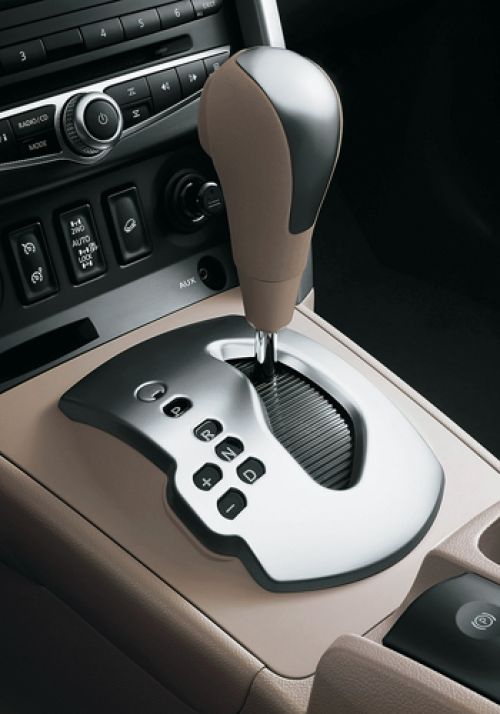
2009 Renault Koleos
© Photo: Renault
Driving
The car holds confidently both on asphalt and off-road, demonstrating good acceleration dynamics.
Interior
Kept in a minimalist style. But ergonomics are top-notch.
Comfort
Passenger convenience and acoustic comfort while driving deserve the highest marks.
Safety
Nine models created by the Nissan-Renault alliance engineers received five stars in EuroNCAP crash tests. The Koleos also claims the same result.
Price
The base version Expression will cost 870,000 rubles. Luxe Privilege will significantly exceed a million. Expensive or cheap? It's fine.
Advantages and disadvantages
+ Good off-road qualities, decent dynamics, excellent sound insulation.
- Specific clutch that takes a long time to get used to.
2009 Renault Koleos
© Photo: Renault
Specifications
Make and model — Renault Koleos
Dimensions — 4520x1855x1695 mm
Engine — gasoline, 2488 cc, 170 hp/rpm
Transmission — manual, 6-speed
Dynamics — max 185 km/h; 9.3 s to 100 km/h
Competitors — Toyota RAV4, Honda CR-V
Our opinion
The Renault Koleos is the French company's second attempt to create an all-wheel-drive vehicle. The pioneer about ten years ago was the Scenic RX-4, which faded into oblivion due to low demand. But if back then engineers tried to refine a compact van, now we're talking about a completely new design. And this path is the right one.
© 5 Koleso