
The French literally beg not to draw parallels between the Fluence and the old or new Megane. "This is a completely independent model, which is why we named it Fluence. No Meganes!" What is the reason for such zeal? It is that we are not just looking at a hatchback with a trunk attached. The body panels of the Megane and Fluence are completely different. The platform is shared, but the rear torsion beam with more comfort-oriented settings is borrowed from the American Nissan Sentra.
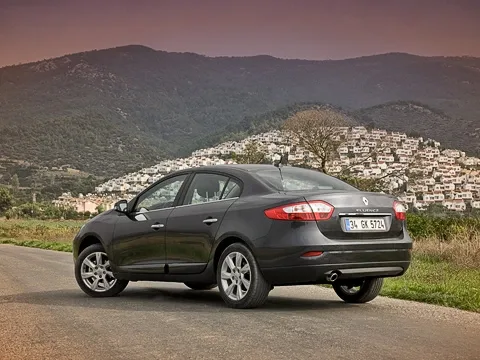
Like its predecessor, the Fluence is assembled at the Renault plant in Bursa, Turkey. But now the car has become global: it is planned to be sold worldwide, except perhaps North America. The previous Megane sedan was intended only for developing countries, to which the French also counted Russia. And sedans accounted for more than 90% of all Meganes sold here.
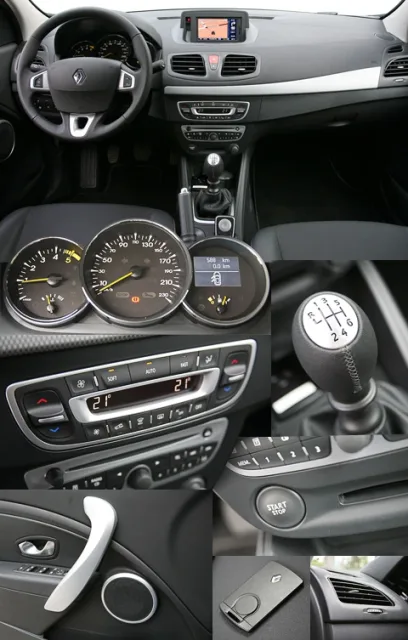
- Each interior detail individually is not impressive, but together they create a very pleasant picture. Tip: it is worth looking at the version with a light interior — it looks more expensive than this one.
- Ergonomics are also in order. Climate control and the stereo have separate control units, so you won't get confused with the buttons. Even in the base trim, the Fluence is equipped with keyless entry. True, to start the engine, you still need to insert the card into the slot, and only then press the starter button.
- The dual-zone climate control can operate in three modes: Auto (automatic), Soft (quiet and gentle), and Fast (quick ventilation after heat).
- All the small-item compartments together hold 23 liters.
The wheelbase of the Fluence sedan, like that of the new Megane estate, has increased by 6.2 cm — to 2702 mm. The previous model had a distance between axles that was 16 mm less. By this indicator, the Fluence can already compete with D-class cars. The Toyota Avensis has a base that is even a couple of millimeters shorter! And in length, the Renault has grown to 4618 mm (+120 mm): only 77 mm short of the new Laguna.
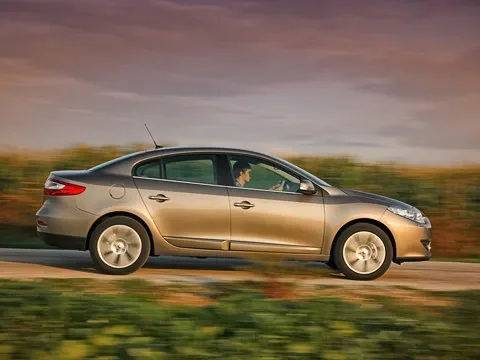
Unsurprisingly, this affected the interior. Engineers claim that in width at elbow level and in height, the Fluence's cabin is the best in its class. I didn't take out a tape measure, but subjectively there is plenty of space here. Even tall colleagues could easily sit "behind themselves" without touching the ceiling with their heads. And the doors, which open at a wide angle, make getting in easier. But you still need to bend down — the sloping roof can leave an unpleasant mark on your forehead.
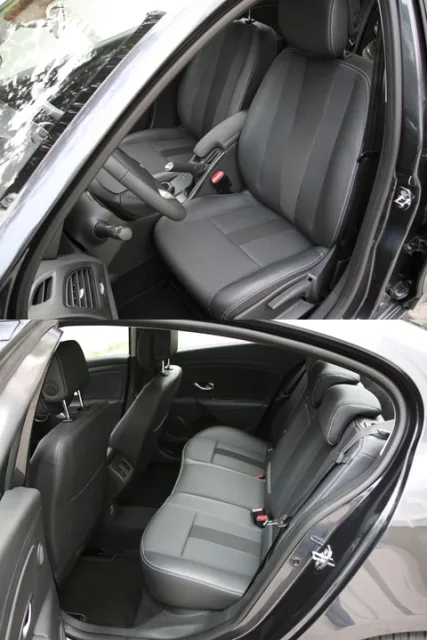
- The front seats are comfortable, and there are enough adjustments to tailor the seat to any driver.
- There are no complaints about the second row, except that the driver is hindered by high headrests and a large third brake light — they block the rear view.
Inside — it's like being in an Ikea furniture store. Stylish simplicity, softness, and warmth. The interior completely mirrors the new hatchback. The panels are perfectly fitted, the materials are high-quality and pleasant to the touch — it feels like a car from a higher class. Before the trip, the French told us that for acoustic comfort, they had driven test "mules" over five million kilometers in different climate zones, including Russia. The "crickets" were supposedly completely defeated... However, in our car with less than a thousand kilometers on the odometer, something was constantly squeaking.
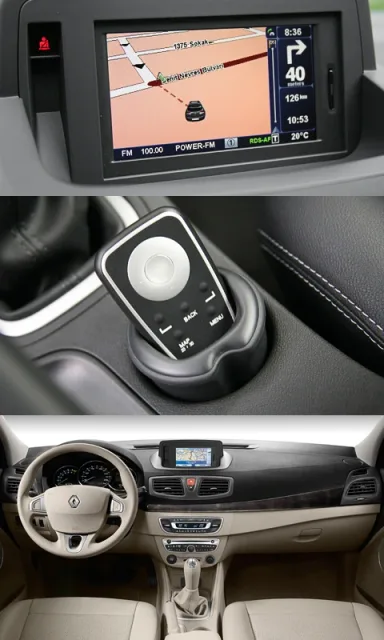
- The Tom Tom navigation for less than 500 euros is simple and convenient. It is controlled via a remote. While you figure it out, you press all the buttons on the panel and on the steering wheel.
- The maps are stored on an SD card, and they can be updated via a special Renault website.
- During the test, the navigation failed twice: after restarting the engine, it "forgot" the route. Renault representatives admitted that our car is not the only one with this problem. In Russia, Tom Tom will appear at the end of the first quarter of next year.
It is claimed that the Fluence is a quarter quieter than the old model thanks to a generous layer of soundproofing "felt." It's easy to believe: only a soft thud of wheels on bumps and unobtrusive aerodynamic noises reach the passengers. I don't know how the Fluence's suspension will behave on Russian roads after adaptation, but in Turkey, the main source of noise was the engine. The familiar 1.6 "four" from the Megane. While it runs at low revs, the cabin is quiet. But by 4000 rpm, the howl pierces to the bone worse than the morning screams of Slipknot from my alarm clock. And you can't avoid revving the engine: maximum torque of 151 N•m is achieved at 4250 rpm, and power of 110 hp — at six thousand.
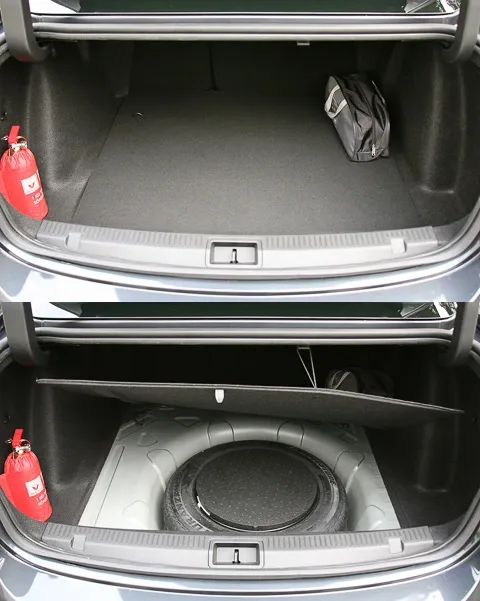
- The trunk is 530 liters, 10 more than the Megane sedan. The volume can be increased by folding the rear seat backs.
- The loading height is about the same as the Lancer's — 727 mm. There is no handle inside for closing the lid — clean hands won't be lucky.
- Under the floor is a full-size spare wheel.
There are two options — throw yourself out the window or forget about overtaking and engage a higher gear. I choose the second and get the promised 25% of silence. But approaching maximum revs in fifth, I can't give the engine the sixth gear it so begs for. All the efforts of the French acousticians go down the drain at that moment. At least the gear ratios are well chosen, the lever throws are short, and the shifts are precise. But during shifts, the long-travel, mushy clutch, which engages at the very end of the travel, is annoying. And there's not enough thrust, especially uphill. But the appetite is moderate — 6.5 liters per 100 km.
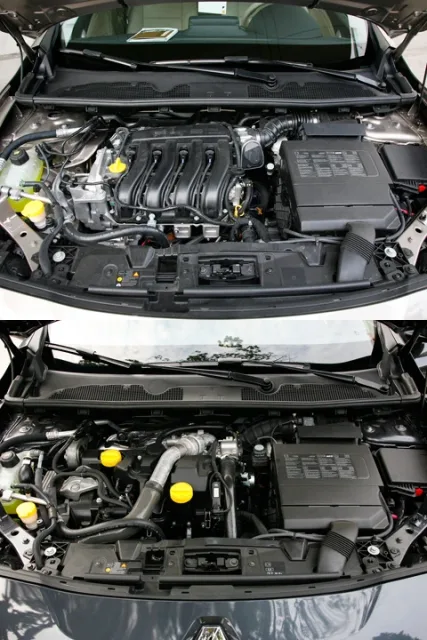
- Initially, the Fluence will be sold with two petrol engines. The naturally aspirated 1.6 with a five-speed manual produces 110 hp (151 N•m), and with a modernized four-speed automatic — 105 "horses" (145 N•m).
- The 1.5 dCi turbodiesel also comes in two variants — 85 hp (200 N•m) and 105 hp (240 N•m). Transmissions are only manual, five- or six-speed.
- Later, a two-liter 140-hp petrol unit, a Nissan CVT, and a robotic EDC gearbox with two clutches are promised. But the "preselective" will first get only the 105-hp turbodiesel, and even then, in a year.
With the 1.5-liter turbodiesel, things are more pleasant. Even if it has the same vague clutch, even if there are fewer "horses" and there is a dip at low revs when starting... But the diesel runs surprisingly quietly, and the torque is a full 240 N•m. And the "manual" has six gears. So when overtaking another overloaded Turkish truck, you don't risk testing passive safety. In the city, the engine allows brisk acceleration to the permitted sixty. Alas, the modern unit with a particulate filter is unlikely to reach Russia. At least in the near future.
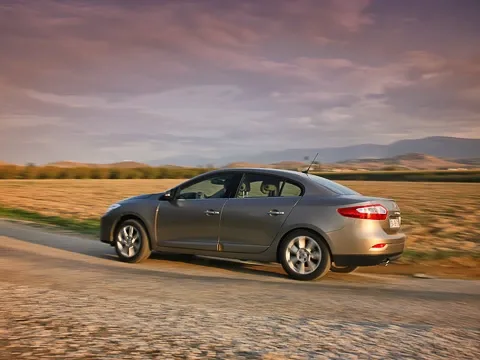
However, even the diesel version doesn't help me keep pace with Oleg Rastegaev, one of the fastest Russian journalists. There's no confidence in the car. The winding mountain road in the most dangerous places has no barriers, and at the edges — an abyss. And the Fluence smoothly, with a large roll, slides into a corner nose-first — toward the roadside, toward the cliff. I know even without a test drive that the flying qualities of a Renault, like any car, are mediocre. Neither I nor my colleague-passenger want to test them on ourselves. So let Oleg dust ahead in his old tester's habit.
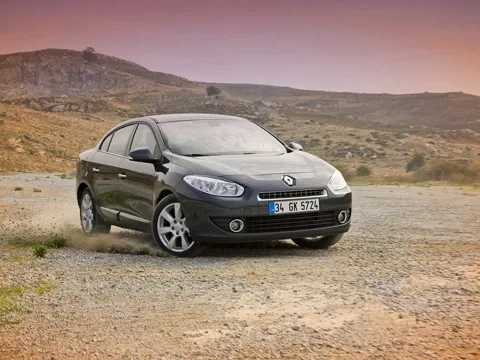
The steering wheel of the Fluence is comfortable. But absolutely empty. Yes, the optical steering angle sensor was replaced with a more modern inductive one. Yes, its readings are now read up to a thousand times per second, and the power steering actuator has become more powerful. The bottom line — no proper feedback. You have to screw the car into a turn blindly. The old Megane sedan also sinned with synthetic effort, but it felt more responsive and understandable. I still managed to get used to the Fluence's dull handling: by the end of the route, I felt the car better, but it remained cold and bland. But I liked the brakes right away. And although the sedan noses down when braking, on Turkish roads with their surprises, I want to thank the French for the informative pedal feel.
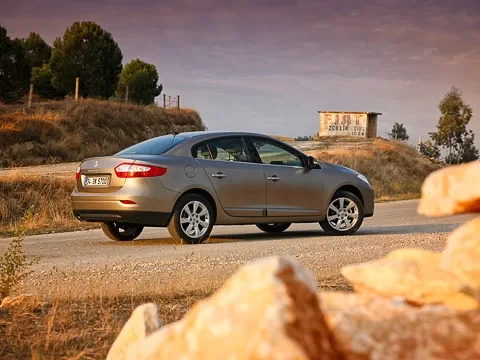
Ten kilometers of scorching mountain serpentine near Turkish Izmir — a place seemingly made for a completely different car. A new hot hatchback Renault Megane RS would have been fitting here, weaving intricate patterns through corners, overtaking barely alive Turkish cars and unhurried tractors. Behind the wheel of the Fluence, it is much more pleasant to find a straighter route and calmly roll forward, without trying on the images of Loeb or Gronholm. Or even better — temporarily move to the passenger seat. The suspension here handles both small and large road imperfections with equal composure — whether at a crawling pace or cruising at 120 km/h. Rocking on asphalt waves is not bothersome, and ride smoothness is beyond all praise.
The Fluence will arrive on the Russian market with a service interval of 20 thousand kilometers next spring, and with an increased ground clearance. After all, the 120 millimeters of European road clearance, which the test cars had, are completely unsuitable for our buyer. Prices are still kept secret. At the Russian Renault office, they promise not to inflate them to the skies, but they are not going to dump either. They believe that buyers are ready to pay for impressive dimensions and solid finishing. The French believe that the Fluence is unconditionally a head above most golf-class sedans. It is curious how much exactly — in rubles.
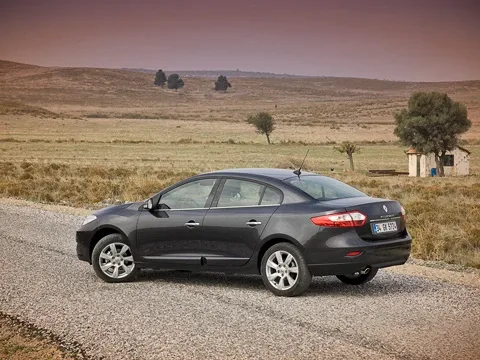
For me, however, the price is of purely reference interest. In the Fluence, I feel best on the rear sofa. Watching Turkish houses with solar panels on roofs through the window is much more fascinating than uselessly turning the steering wheel and shifting gears in search of acoustic comfort. If I owned a taxi fleet, a dozen green-eyed Fluences would instantly find their place in the garage. This car is one of those that is unlikely to win the main COTY prize, but it will fully deserve the title of an ideal taxi. And isn't that the best reward for a former conqueror of the third world?
Technical specifications
* Gearboxes: M5 — manual five-speed, M6 — manual six-speed, A4 — automatic four-speed.
| 1.6 | 1.6 Auto | 1.5 dCi | |
|---|---|---|---|
| Body | |||
| Body type | sedan | ||
| Number of doors/seats | 4/5 | ||
| Length, mm | 4618 | ||
| Width, mm | 1809 | ||
| Height, mm | 1479 | ||
| Wheelbase, mm | 2702 | ||
| Track front/rear, mm | 1541/1563 | ||
| Curb weight, kg | 1225 | 1258 | 1277 |
| Gross weight, kg | 1725 | 1760 | 1777 |
| Trunk volume, l | 530 | ||
| Engine | |||
| Type | petrol | petrol | turbodiesel |
| Location | front, transverse | ||
| Number and arrangement of cylinders | 4, in-line | ||
| Number of valves | 16 | 16 | 8 |
| Displacement, cm3 | 1598 | 1598 | 1461 |
| Compression ratio | 9.7 : 1 | 9.7:1 | 15.3 : 1 |
| Max. power, hp/rpm | 110/6000 | 105/6000 | 105/4000 |
| Max. torque, N•m/rpm | 151/4250 | 145/4250 | 240/2000 |
| Transmission | |||
| Gearbox | M5* | A4 | M6 |
| Drive | front | ||
| Chassis | |||
| Front suspension | independent, coil spring, McPherson | ||
| Rear suspension | semi-independent, coil spring | ||
| Front brakes | disc, ventilated | ||
| Rear brakes | disc | ||
| Ground clearance, mm | 120 | ||
| Performance characteristics | |||
| Maximum speed, km/h | 185 | 180 | 185 |
| Acceleration time 0-100 km/h, s | 11.7 | 13.9 | 10.4 |
| Fuel consumption, l/100 km | |||
| — urban cycle | 8.8 | 10.6 | 5.3 |
| — extra-urban cycle | 5.3 | 5.8 | 4.1 |
| — combined cycle | 6.5 | 7.5 | 4.5 |
| Toxicity standard | Euro-4 | ||
| Fuel tank capacity, l | 60 | ||
| Fuel | AI-92–95 | AI-95 | diesel |
Technology
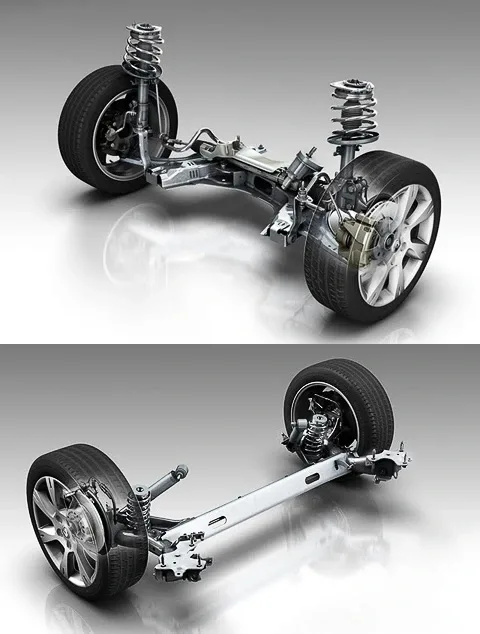
- Although the Fluence is built on the platform of the third-generation Megane, the softer rear semi-independent suspension is borrowed from the related sedan Nissan Sentra for the American market. This solution saved not so much on production as on development.
- The front suspension subframe was inherited from its predecessor. The electric power steering is like that of the third-generation Megane, but with an increased gear ratio for greater comfort.
Safety
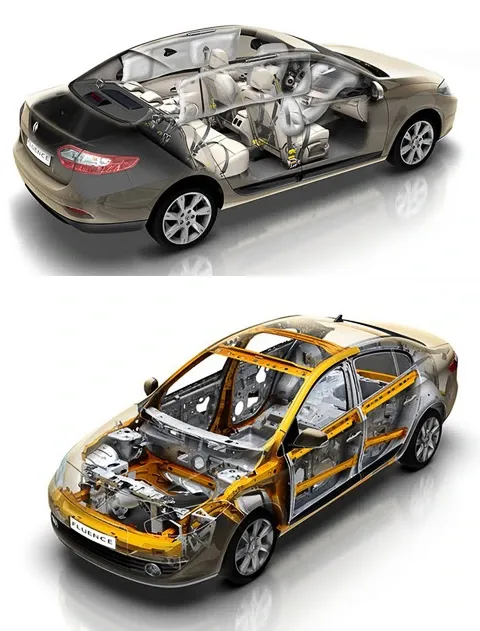
The related third-generation Renault Megane hatchback brilliantly passed Euro NCAP tests, receiving the maximum five stars. The Fluence, however, is only preparing for the crash test. But the French are already confident in its five-star result. How it turns out in practice — time will tell, but additional points for the sedan are almost guaranteed thanks to six airbags and the ESP system in the base configuration. By the way, the second-generation Megane sedan in 2002 was also a Euro NCAP excellent student.
Design
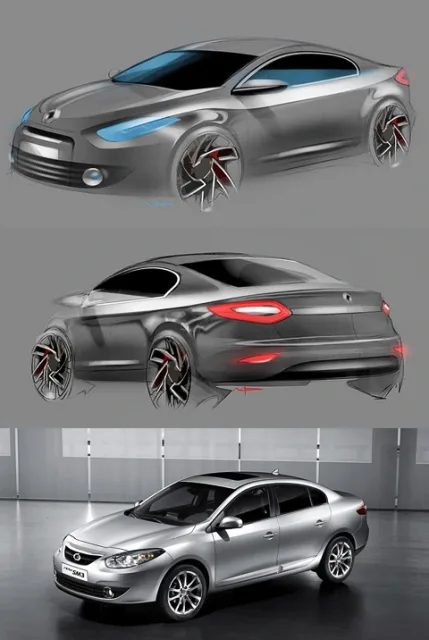
Under the name Samsung SM3 in Korea, the "twin brother" of the Fluence sedan is sold. This model replaced the sedan known in Russia as the Almera Classic. The new SM3 became a development of the eMX concept. The production version debuted in April at the Seoul Motor Show.
Renault Fluence ZE
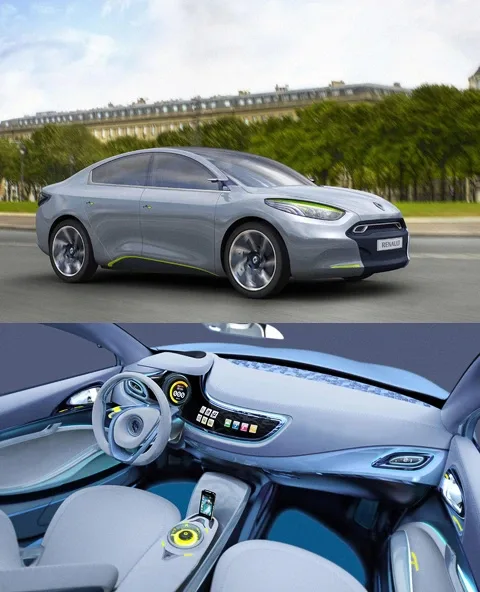
In addition to traditional petrol and diesel modifications, the Fluence will also have a fully electric version. The Fluence Z. E. concept, shown by the French at the autumn motor show in Frankfurt, is gradually turning into a production car. Recently, Renault representatives announced that already in the first half of 2011, the car will appear at dealers in Western Europe.
The Fluence Z. E. is powered by an electric motor with 95 hp (226 Nm), fed by a set of lithium-ion batteries. The range is 160 km. The electric sedan will be assembled at the Renault plant in Bursa, Turkey, next to the regular versions.
Sport Way
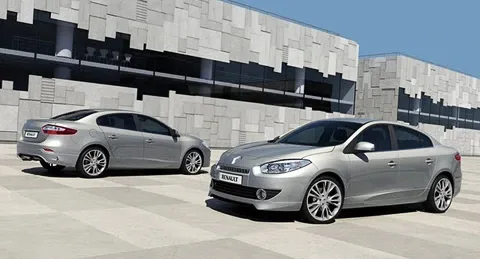
Next year, the French will release the Sport Way version. Under the hood — only a petrol two-liter engine with 140 hp, paired with a six-speed manual. Externally, the sporty version is distinguished by 18- and 19-inch wheels, different bumpers, and a spoiler. Inside — seats with pronounced lateral support. Whether this modification will reach Russia is still unclear.
History
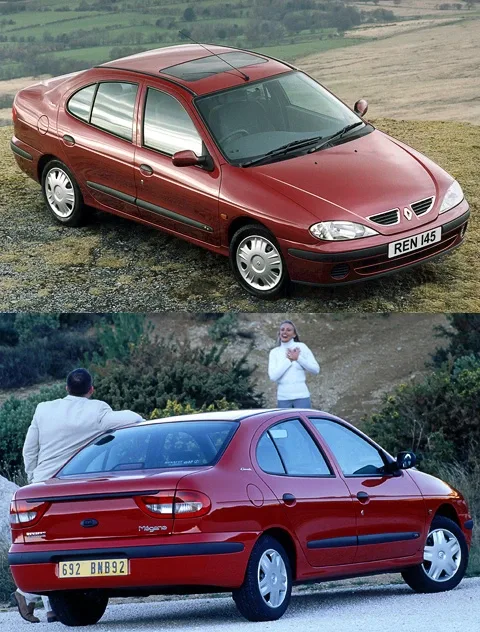
The first-generation Megane sedan, known as the Classic, was produced from 1996 — it replaced the four-door version of the Renault 19. In 1999, after a facelift, the model received new engines, including diesel ones. For the Russian market, some sedans were assembled at the Avtoframos plant.
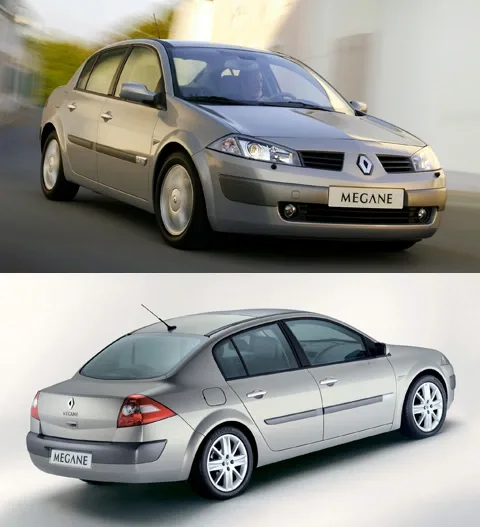
In the second generation of the Megane family, which debuted in 2002, there was also a place for a sedan. The wheelbase of the four-door was increased by 61 mm compared to the hatchback. In 2006, it was slightly updated outside and inside. Sedans are assembled in the Turkish city of Bursa.
Behind the scenes
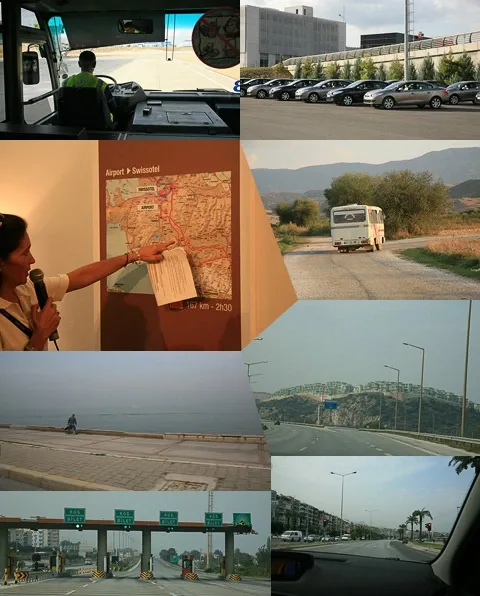
The test drive took place in southern Turkey, near Izmir — the third largest city in the country. The organizers chose the route excellently. Everything was here: endless straight toll roads with impeccable asphalt, mountain serpentines, and broken roads passing through slums that are depressing in their appearance.