
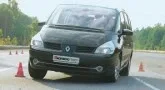
Renault Espace. Price: 1,331,000 RUB. On sale: since September 2006.
Even in reckless Russia, safety is gradually gaining importance when choosing a car. And in this sense, it is hard to find fault with the Renault Espace IV: in 2003, it received a very flattering assessment from EuroNCAP experts. But, as martial arts masters say, the best fight is the one that never happened. Is the minivan ready for critical situations on the road?
The school wisdom that repetition is the mother of learning came to mind again thanks to an old acquaintance — the Renault Espace. A couple of months ago, we already had the chance to study this model inside and out, and then there were far more positive impressions than negative ones.
The transformable interior, striking with its spaciousness, effortlessly turned into either a cargo compartment or a strict mobile office — all it took was a little fiddling with the seats. The interior, although it caused slight bewilderment upon first acquaintance (the buttons are located not at all where the eye is used to finding them), turned out to be quite convenient in practice. On artificial bumps, the car only swayed slightly, and the suspension swallowed minor road surface defects without disturbing passengers. The turbocharged two-liter engine allowed this "multi-tool" to pull away from traffic lights among the first, despite its solid dimensions and weight. The whole picture was somewhat spoiled by the five-speed automatic, which, when trying to accelerate sharply, each time paused for a long time. But this did not affect the final assessment — it rightfully earned its five points for consumer qualities. However, that was the mode of calm, measured operation typical of minivans. But how will the Espace behave under the strict conditions of test track trials? After all, no one is immune from troubles on the road.
One such surprise was waiting for us even on the way to the test site. The instrument panel suddenly "woke up" and displayed a message about the need to change the oil. Isn't it a bit early for a nearly new car with a mileage of less than ten thousand kilometers? But even stranger seemed the mysterious alphanumeric code accompanying the warning signal. What the combination "five hundred N" meant, none of us understood. After inspecting the car from all sides and calling the service center specialists, we decided to chalk it up to a temporary system glitch. Turning off the ignition erased the incomprehensible message, and after a while, it was forgotten.
Despite its external clumsiness (the heavy "suitcase" rear noticeably contrasts with the sharp "chisel" front), the Renault Espace has excellent dynamics. The 170-horsepower engine gets down to business with enthusiasm: the hundred on the electronic speedometer appears in just 11.4 seconds. You would expect such a result more from a light C-class hatchback than from a two-ton minivan. At the same time, the noise during acceleration does not go beyond reasonable limits: you won't have to interrupt a business meeting in the cabin because of the engine roar.
The car's handling left a pleasant impression. Precise steering allows the "Frenchman" to confidently hold a given trajectory, responding to the driver's actions with only a slight delay. This was especially evident when passing both lane-change maneuvers, which the massive and large MPV overcame at unexpectedly high speeds. True, the steering wheel requires fairly active work — it makes three and a quarter turns from lock to lock, so on the "snake" you have to turn it more intensely than you would like. In sharp turns, the car demonstrates slight oversteer, which is easily extinguished by releasing the throttle. The high center of gravity and soft suspension do not allow the Espace to cope with body roll, to which it is quite susceptible. In a loaded state, the roll tendency increases, the car becomes less maneuverable and more diligently slides outward with the front wheels, but even in this case it remains controllable. The brakes of the Renault turned out to be unusually heat-loving. When cold, the car slowed down not so confidently, but as the mechanisms warmed up, their efficiency grew, and it more readily gripped the asphalt. The difference between the first and tenth run was three meters. Is that a lot or a little? Depends on the situation... But the Espace brakes evenly, without yawing or pulling to the side.
Meanwhile, it was getting dark. The test was coming to an end, the last data was being transferred to the laptop. The on-board computer screen unexpectedly lit up again with the inscription Change Oil, which, as before, was accompanied by the already familiar cipher — "five hundred N". Why it didn't immediately occur to me that the first digit looks very much like a Latin letter — I have no idea. The mysterious cryptogram turned out to be the English word SOON, and the meaning of the message that alarmed everyone was merely a warning about an "imminent oil change"...
As our "rigorous repetition" showed, the car is quite ready for road surprises. The Renault Espace is capable of getting out of many emergency situations "without a fight." The driver just needs to remember some features of the brakes and body design, and otherwise, you can fully rely on the minivan.
The first of the minivans
In 2003, EuroNCAP recognized the fourth-generation Renault Espace as the safest model in its class. Based on the crash test results, the car earned 35.11 points out of 37 possible, becoming the first minivan in history to receive such a high rating. This result was achieved thanks to a unibody made of high-strength steel and a comprehensive safety system (SRP3). It includes adaptive front airbags, side airbags to protect the chest in the front and rear seats, inflatable curtains to protect the head, and adaptive seat belts with dual pretensioners.
Body
+ Distinctive appearance, spacious interior, roomy trunk
- Creaking of interior panels while driving
Ride comfort
+ Comfortable seats, ergonomic interior, good sound insulation
- Poor visibility, weak sense of dimensions
Powertrain
+ Good dynamic performance
- Sluggishness of the gearbox during sharp accelerations
Handling
+ Decent handling, informative steering wheel
- Large longitudinal pitching and lateral body roll
Safety
+ Good equipment in the base trim
- Cold brakes are not fully effective
Ecology
+ Fuel consumption at an acceptable level