
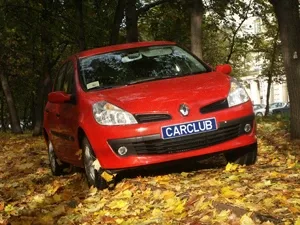
Small French cars traditionally haven't been a hit on the Russian market, but Renault managed to reverse this trend. Launching production of the Logan sedan at its own Avtoframos plant allowed the French to seriously squeeze affordable Korean models and noticeably boost sales. In the first nine months of 2006, sales of the Logan alone reached 32,845 units, showing a 135.2% increase compared to the same period a year earlier.
Encouraged by this success, the company rolled out another new model for our market. It's unlikely to break sales records, but it's simply impossible to ignore due to its striking looks, which is why we decided to take it for a test. The new third-generation Clio, which only reached Russia in early September, debuted in Europe a year earlier and had already earned the prestigious title of "Car of the Year 2005." The French explain the delay by preparing for harsh Russian realities: increased ground clearance, engines adapted to our fuel, and an interior ready for cold weather. It's interesting to see what came of this. For the test, we took the most powerful and expensive Clio trim — with a 110-horsepower 1.6-liter engine and a four-speed automatic. This combination is traditionally considered feminine, which is fine, since the car itself aims to be the second vehicle in a family.
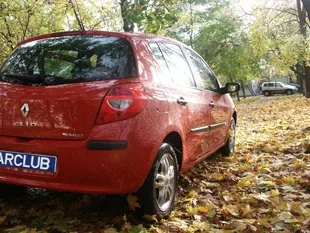
 The third-generation Clio became the first model in Renault's new corporate design. Its features are hard to describe in words, but on the road the car looks recognizable and won't get lost in traffic. At first, the exterior seems overly calm and even restrained for a French car, but upon closer acquaintance, a second layer of appeal unfolds. Like good wine, the Clio reveals itself gradually — you need to give it time and attention.
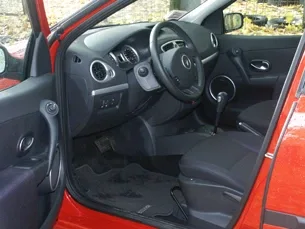
 The interior is also not as simple as it seems in the first moments. You immediately notice the austerity, but then you pay attention to the soft plastic of the dashboard, climate control, and a CD stereo. True, the audio system is built into an outdated 1DIN slot, which is now rarely used. The savings resulted in small buttons with poorly readable labels — it's not easy to hit them. Fortunately, the driver doesn't need to aim at them: there's a convenient remote on the massive steering column that fully duplicates the stereo's functions, and all information is displayed on the central screen.
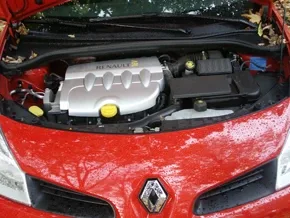
But the 115-horsepower engine didn't impress on the first try or any subsequent ones. However, the modest dynamics are likely not the engine's fault but the four-speed automatic transmission's. It lacks smoothness and clarity in its responses to throttle input. As a result, the Clio either accelerates lazily, sometimes lagging behind traffic, or lunges forward, revving the engine to the redline on every gear. Despite decent power, finding a middle ground proved extremely difficult. Theoretically, you could use manual mode to dose acceleration more precisely, but then why have an automatic at all? Especially since fuel consumption in the city is 12–13 liters per 100 km — a bit much for a compact B-class car.
 The transmission's main problem is its overly clever adaptive algorithm. It constantly tries to adapt to the driving style, which is fine for calm drivers, but an active driving style is precisely unpredictable. The electronics try to guess the driver's intentions, though it would be more logical to simply follow commands, and the driver would adapt to the transmission's behavior. Honestly, about one in three times the automatic manages to read your mind and select the right gear, but since you never know how perceptive it will be next time, mutual understanding never develops.
 However, the French nailed the suspension tuning. Increased springs and soft shock absorbers give the car that energy capacity that many competitors lack. Speed bumps and tram tracks can be taken without fear — the suspension swallows everything without a hint of a harsh impact. It works similarly on the Logan, but in the Clio it's even more comfortable. This is exactly what's needed for Russian roads — both in Moscow and beyond. Of course, the softness robs the car of sportiness: some might say body roll in corners is excessive, but that's a fair price for the ability to ignore road surface quality. Besides, not everyone aspires to be a street racer.
By the way, in a corner at the limit, the Clio holds very predictably and even allows a bit of hooliganism — the main thing is to get used to the nuances. Before a bend, it's better to engage manual mode and select the right gear, and since there are only four, it's hard to go wrong. You have to turn the wheel almost blindly — feedback is nearly zero. But instead of the expected understeer, the Clio surprisingly clings to the line for a long time, balancing on the edge of neutral handling. Right after the apex, you can confidently add throttle and accelerate without risk: the long-travel shock absorbers ensure contact with the road even on broken pavement.
 The power steering operates on a variable algorithm: up to 70 km/h it almost completely lightens the wheel, which is convenient for parking, but in sharp turns it sometimes gets in the way. At higher speeds, the assist seems to switch off entirely or even start to interfere. The wheel fills with noticeable resistance and fights any attempt to deviate from straight-line motion. This character suits a compact car well, as they often suffer from excessive twitchiness at speed. The Clio, however, is solidity itself. Ignoring ruts and potholes, the little car allows you to hold a mature 150–170 km/h on the highway without strain. But the engine sounds too strained at such speeds: even in top gear, revs approach 5000 rpm, which doesn't help economy or comfort. For relaxed driving outside the city, the Clio even comes with cruise control — a rarity in the compact class. It's just inconvenient to use: the activation button is hidden on the panel left of the steering wheel, invisible and hard to find by touch. But then control is via buttons on the chunky steering wheel. The electronics can not only hold speed but also sound an alert when exceeding a set limit. This option will surely come in handy for enthusiastic drivers.
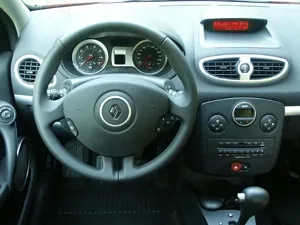 Despite its grown dimensions, calling the Clio spacious is a stretch. At 180 cm tall, rear passengers sit not very comfortably, though they do fit, with knees slightly touching the front seatbacks. The driver's seat is also not ideal: over three days of testing, I never found a comfortable driving position. There's no reach adjustment for the steering wheel, so you have to choose between outstretched arms and bent legs. The seat itself is quite comfortable, though. The backrest is soft but holds the body well in sharp turns — a combination found only in French cars, and I definitely like it. Surprisingly, the trunk also doesn't impress. It's heavily squeezed from the sides by wheel arches, and the opening could be wider.
 Overall, the Renault Clio is quite good, though not without flaws. The main issues are the overly intelligent automatic (which can be replaced with a manual for $900 savings if desired) and the inflated price. The tested car is priced at $19,549 — only $1,500 cheaper than the larger and equally stylish Mazda3, and $2,500 more expensive than the Hyundai Getz with a similar engine. The base Clio with the 1.2-liter engine (75 hp) is no bargain either — prices start at $15,749.
Leonid Pavlov