
Alexander DIVAKOV, Oleg RASTEGAEV | Photo by Mikhail Kryukov and Oleg Rastegaev
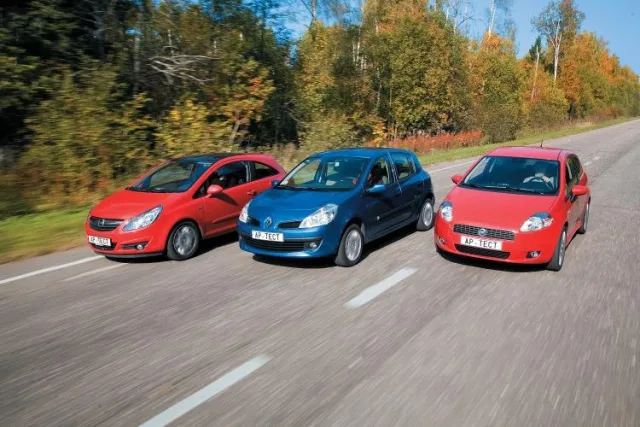
The perfect car for those who live the nightlife! When you turn the steering wheel, not only do the wheels change direction, but the headlights also adjust, deflecting the light beam by 15 degrees. And when parking at low speed, additional side lighting bulbs turn on — making any maneuver a simple pleasure! Just a couple of years ago, owners of B-class cars couldn't even dream of such things. Today — adaptive headlights, heated steering wheel, and even a built-in bike carrier integrated into the body... This is the Opel Corsa. And what will the rivals offer? Let's check: together with the newest Corsa, our test includes the Fiat Grande Punto and the fresh Renault Clio. They are united not only by European origin and the same class, but also by the fact that they all hit the Russian market this autumn. Time to count the chickens.
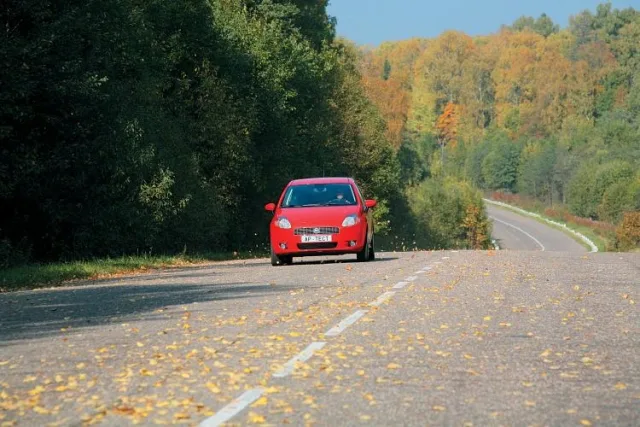
Interest in small cars is growing every day. Even though in the total volume of new foreign cars in Russia, the B segment currently holds only the third position (8.5%), behind the golf class (63.1%) and SUVs (9.5%), it's quite likely that soon the "little ones" will push the jeeps off the second place. Within the B class itself, Hyundai Getz has been leading for several years. This is not surprising: besides the car itself being very successful, its prices start from $10,590 — with similar equipment, European classmates cost three to four thousand dollars more. Among European newcomers, the most attractive price tags are for the Opel Corsa: the three-door with a 1.0-liter engine producing 60 hp is priced at $11,990. The Fiat Grande Punto in base with a 1.2 engine (65 hp) costs significantly more — $15,690; about the same is asked for the new Renault Clio 1.2 (75 hp) — $15,750. For our test, we got more equipped and, accordingly, more expensive modifications — with 1.4-liter engines and manual transmissions. The Corsa and Grande Punto are three-door, while the Clio is five-door: Renault does not supply three-door versions to Russia.
| In the dark, the Fiat's instrument readings are best read (center). But on the Opel (left) and Renault (right) panels, the font of the numbers is poorly chosen | ||
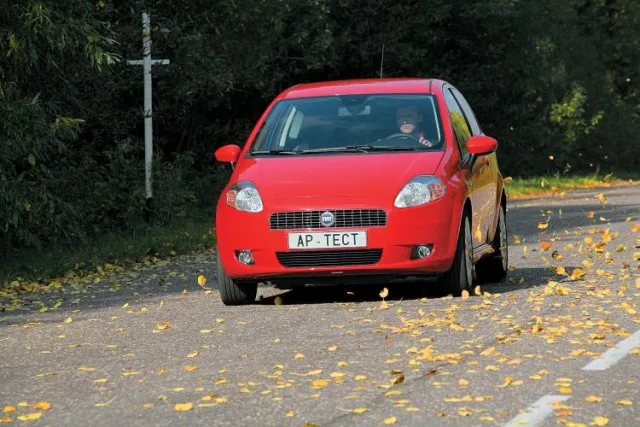
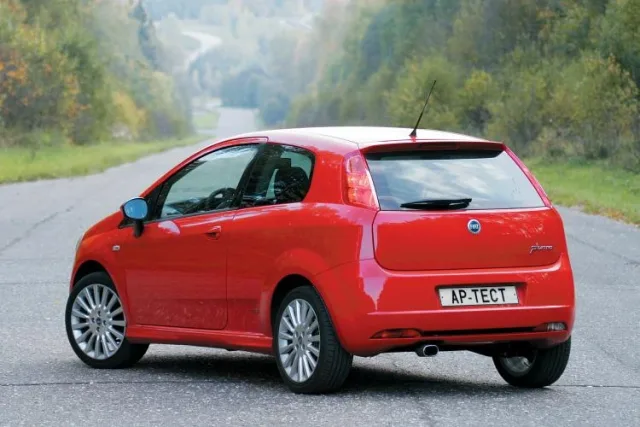
And rightly so! Look how elegant the three-door Fiat and Opel are! The Grande Punto's design was worked on by Giugiaro himself, the head of ItalDesign studio, as evidenced by the badges on the body. And even though the maestro couldn't turn the Fiat into a Maserati, you must admit, there's something to it...
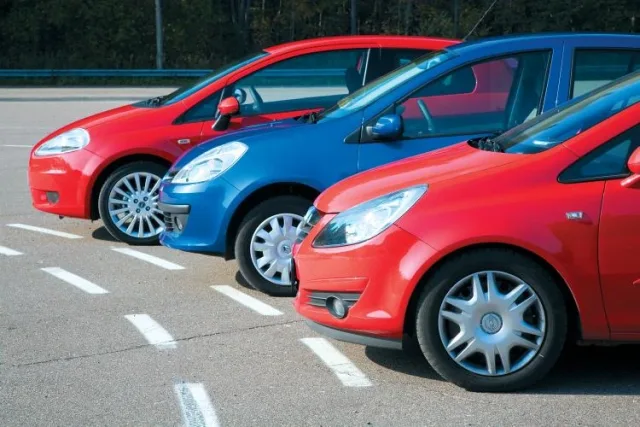
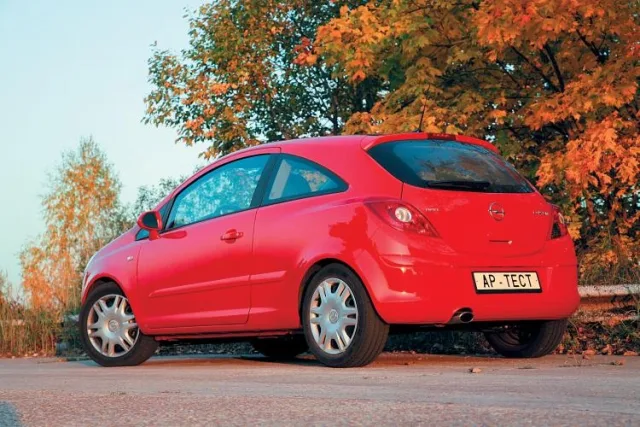
And the Opel looks great too! Especially the three-door: you can admire both the whole car and individual details. Take the rear lights, for example — in the dark they resemble flames.
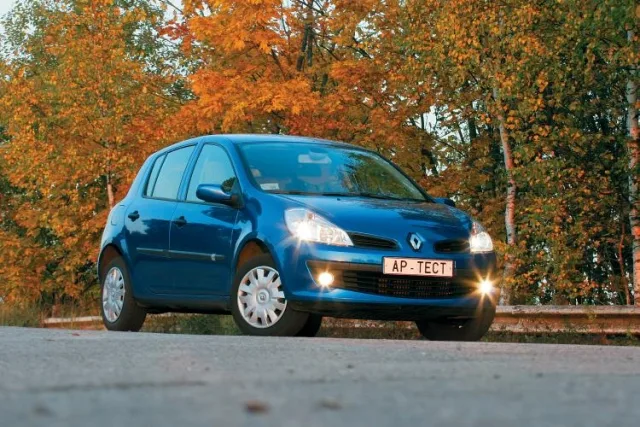
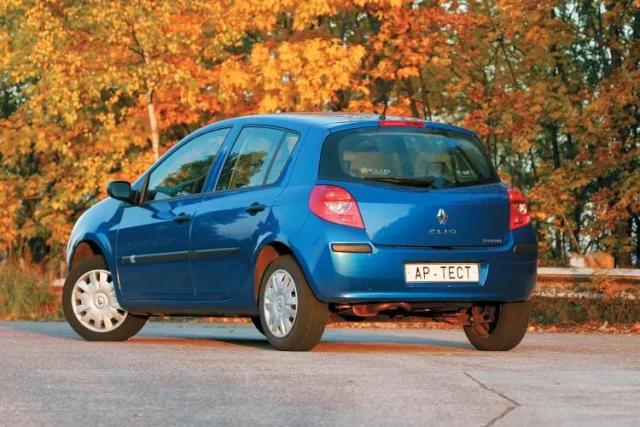
The Clio also looks good. With its shapes and proportions, it strongly resembles the larger Megane. True, there are fewer bright, memorable elements here.
The Clio's interior leaves a feeling of toy-likeness: the trim materials are too "plasticky." And you can't fault the equipment: the Clio is presented in the "middle" Expression trim! But even for an extra charge, Renault can't boast a dual-zone climate control like the Fiat, or a color display like the Opel. The Clio's steering wheel is comfortable in shape, but without leather wrapping, and it adjusts only for height. However, the seat pleases with adjustment ranges: a driver 190 cm tall fits with room to spare. It's a pity that the shape of the seat itself is far from ideal. And the seat heating buttons are hidden in a "blind" zone.
 |  |  |
| In the Sport version, the Grande Punto's interior is decorated with metal and kevlar inserts | The seats look luxurious, but the flat backrest holds the body poorly | Only the Grande Punto has climate control with separate temperature and airflow adjustment |
 |  |  |
| Music volume can be changed with buttons on the steering wheel | The "fog light" and onboard computer buttons are to the left of the steering wheel | The six-speed gearbox doesn't get along very well with the 1.4 engine |
The pedals are clearly set for a woman's foot, but you'll have to lift your left leg high — the clutch pedal with a long travel engages at the very end. Among the undeniable pluses of the Clio's interior are the spacious cooled glove box, ceiling handles with micro-lift, and a convenient radio control unit on the steering column.
 |  |  |
| The glove box is small, but the logo above it is nice | White dials on a "kevlar" background — the hallmark of the Sport version! | The folding armrest has a niche for a phone |
 |  |  |
| Electric windows are already in the base | The quality of materials is top-notch | In the back it's beautiful and cozy, but there's not enough space |
The Fiat Grande Punto came to us in the Sport version — a stylish steering wheel, seats with suede-like upholstery, white dials on a kevlar background... Impressive! But not everything is so smooth... The seats turned out to be uncomfortable: the almost flat backrest holds the body poorly. And the contoured steering wheel with a leather rim allows only one grip, with your thumbs on the spokes. However, the dual-zone climate control pleased: the driver and passenger can set not only the temperature but also the airflow distribution pattern!
But the most pleasant interior is in the Corsa: an excellent seat (a privilege of the top Cosmo version) reliably holds the body, providing excellent connection with the car, and the compact steering wheel begs to be held. If your arms are long — you can move the wheel away and raise it; if short — lower and bring it closer. The buttons and rollers on the steering wheel spokes are also handy — you can switch music without taking your hands off. The center console is adorned with a color display. And just touch the climate control knobs — and for a couple of seconds, the needed picture appears in a separate window. Clear and friendly. And why are there two narrow slots on the console? Could it be DVD? Exactly, one is for music discs (including mp3), the second for DVD. But you can't watch movies in the Opel: this drive is intended for the "navigation" disc, so it's doubly unfortunate that GM dealers don't yet have discs with maps of Russia.
In the Opel, the steering column stalks with non-latching positions and the small exterior mirrors didn't appeal to me. However, the visibility shortcomings during the day are more than compensated at night: remember the swivel headlights and side lighting!
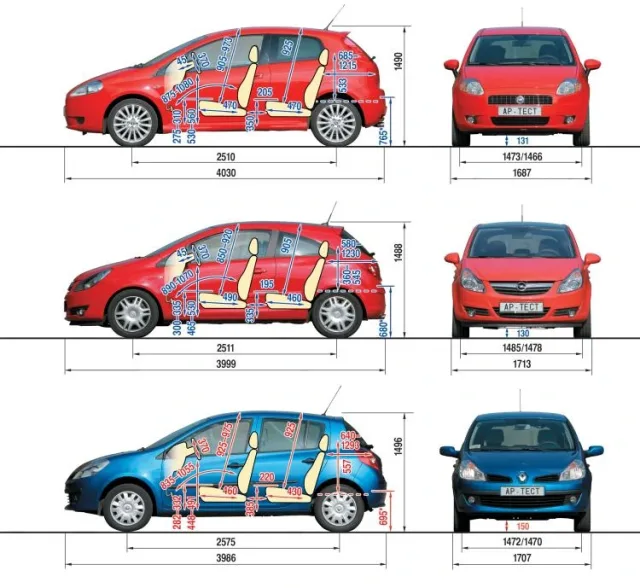
We didn't expect much space in the back from any of the cars — with such modest dimensions and wheelbase, there's no room to stretch out. And so it turned out. It's clear that getting into the rear row in the Renault is easier — thanks to the "extra" doors, but sitting there isn't more comfortable than in the three-doors. The only plus is that the windows roll down.
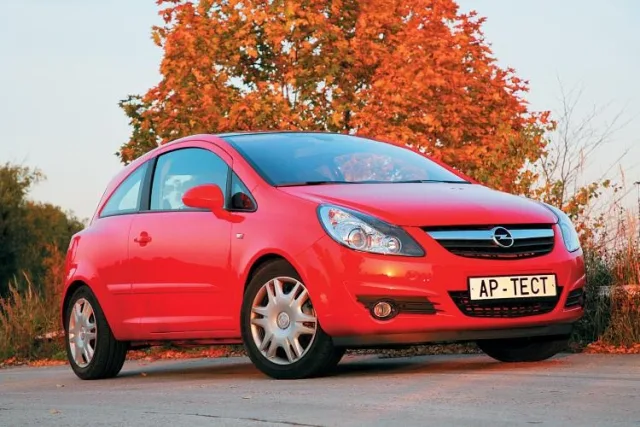
The trunk volumes are roughly the same for all. But the Opel's transformer trunk turned out to be more convenient. The trick is that the floor can be installed at two levels: in the lower compartment, you can hide, say, dirty items, and put grocery bags on top. Very practical.
 |  |  |
| The Corsa's interior is laconic and stylish | In the Cosmo version — excellent seats | Russian cars will not have navigation |
 |  |  |
| The roller on the steering wheel adjusts the volume | The gearshift mechanism lacks precision | On the glove box lid — a pen holder and a cup holder |
 | ||
| Corsa with the 1.4 engine is the most powerful version on our market | As in the Astra, instead of an engine temperature gauge — warning lights | The color display shows trip computer data and climate control mode |
As for spare wheels, all three are fine: in Europe, both the Fiat Grande Punto and Opel Corsa are supplied without a fifth wheel — only a repair kit with sealant and compressor. But in Russia, the hatchbacks arrived with full-size spares. A pleasant surprise.
If you look under the cars, it becomes clear why the Italian and the German have so much in common: the floor, subframes, and floor shape are almost identical, and the rear suspensions with torsion beams are just twins. The secret is simple: these cars were developed during the active partnership between GM and FIAT. But then the companies parted ways, and different engines ended up under the hoods. Which one is more interesting?
 |  |  |
| When choosing the base Essentia trim, you'll have to pay an extra $300 for power windows | In the front doors of the Corsa — large pockets | The handles are made of metal, like on "adult" cars |
 |  | |
| The sunroof only slides outward and causes wind whistle already at 60 km/h | To the left of the steering wheel — the light control unit | In the back, the Corsa is no more spacious than the other two cars |
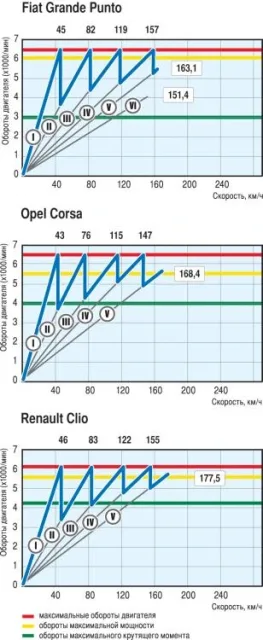
According to the technical data, the Fiat looks preferable: it has five more horsepower, and the gearbox is six-speed rather than five-speed. But in reality, the Opel demonstrates better acceleration dynamics and a higher top speed. It's not just about torque, but also about gear ratio selection. It seems that for the Corsa, the transmission was specially matched to this engine, while the Grande Punto's gearbox was likely designed for a different, more powerful turbodiesel (130 hp). Otherwise, it's hard to explain why the first four gears of the Fiat, despite having a sixth, turn out to be "longer" than those of the Opel. On the dynamometer road, the Corsa adds more than 20 km/h in fifth gear, while the Grande Punto only adds 6 km/h, although the opposite was expected. You rarely engage sixth gear in the Fiat on the highway: a slight incline and the engine already "gives up." Just an extra gear, nothing more.
The most spirited in this company turned out to be the Renault Clio. Its engine willingly revs up to the maximum 6500 rpm, and gear changes occur without delays or dips. As a result, the Clio beat the Corsa by a second in the sprint to 100 km/h and by 9 km/h in top speed! And in normal city driving, managing the throttle in the Renault is more pleasant: the lever moves easier and softer than in its rivals.
The brakes in all three cars feel similar. The Clio slightly lost in braking distance — possibly due to narrower tires (175 mm versus 195 mm for the Corsa and 205 mm for the Grande Punto). But it was the Fiat that proved less convenient in controlling deceleration: its sensitive pedal requires very careful handling — press a bit harder, and the car already noses down.
The Grande Punto drives without emotion but very predictably. It's stable in a straight line, handles corners confidently, without sharp reactions. If you lift off the throttle, the car just slightly tightens the line inward, without scaring the driver. The steering is responsive, with sufficient feedback for precise control. And if something goes wrong, the non-switchable stability system intervenes (in the Sport version it's already standard). Girls who don't want to delve into handling nuances will surely like the City button: press it, and the steering becomes a quarter lighter. Parking and cruising around town in this mode is easier. However, the "light steering" only works at low speeds: when accelerating to 100 km/h, the wheel fills with normal effort again.
 |  |  |
| The Clio's interior is nice, but too "plasticky" | Gears engage easily and precisely | The seat heating button is in a "blind" zone at the base of the cushion |
 |  |  |
| The steering column stalks are short, but the "music" control unit is good | The glove box is the largest, and it's even cooled | |
 |  | |
| Instead of needle gauges, the Clio has unreadable "thermometers" | The display is more modest than in the Corsa | |
The Opel feels livelier and sharper. Reactions are quick; for lane changes or trajectory corrections, microscopic steering movements are enough — sensitivity here is noticeably higher than in the Fiat! But the steering's feedback lets you down: the electric power steering with variable ratio creates a somewhat synthetic effort, especially noticeable in transitional modes.
The Corsa instantly responds to throttle lift-off — the car immediately starts "turning in" to the corner. And if you sharply crank the wheel at the entry, the rear wheels easily break into a slide. Handling with a kick. Maybe even overkicked? There's no stability control here at all. On a race track, we'd praise such settings, but for a city hatchback, this kind of sharpness is perhaps excessive.
 | ||
| To the left of the steering wheel — the headlight leveler and instrument illumination adjuster wheels | The vents open by rotating cute little balls | Electric front windows and mirrors are even in the base Authentique trim |
 |  |  |
| First the cushion folds, then the backrest lowers | The driver's seat has lumbar support | The key is ordinary, without a chip |
The Renault Clio is the complete opposite of its rivals! A car with low steering sensitivity, understeer, and smooth reactions is made for city hustle. On the highway, it's also pleasant: the Clio responds more softly to bumps, changes lanes more smoothly, and even at 180 km/h doesn't make you tense up. But in an emergency situation, everything changes: low sensitivity, body roll, and an almost empty steering wheel let you down. The "moose test" showed that three out of five drivers couldn't avoid the obstacle, although in the other two cars they managed easily.
Yes, the Clio doesn't claim to offer thrilling handling. But it has every chance of becoming the most comfortable hatchback in its class! The suspension, adapted to our roads, swallows both small joints and pavement waves perfectly. After the Renault, the other two participants feel like stools. Both the Opel and the Fiat transmit the road profile too meticulously, hitting hard at joints. And in the Fiat, vibrations from unsprung masses are also too noticeable.
By the way, for $100 on the Opel, you can order a package for bad roads — with it, the car will surely become more comfortable.
Sound insulation is roughly the same for all, but the sources of noise differ: the Opel's engine is louder, the Fiat's tires, and the Renault's wind. But none of this is annoying. The cars are quite quiet.
 |  |  |
| Fiat Grande Punto: engines 1.2 (65 hp), 1.4 (77 hp), or the sixteen-valve 1.4 (95 hp) | Opel Corsa: a liter three-cylinder 60-hp engine or "fours" 1.2 (80 hp) and 1.4 (90 hp) | Renault engines are more powerful: 75 hp from 1.2 liters, 98 hp from 1.4 liters. At the top is a 110-hp 1.6 engine |
If we sum up the expert assessments, we have two leaders — the Fiat Grande Punto and the Opel Corsa. But if we recall the price and Fiat's not-so-great reputation… $15,690 for the base version of the Grande Punto is too expensive. And $23,700 for a three-door with a 1.4 engine (the price of the tested car) is sheer madness.
 |  |  |
| Trunk volumes are roughly the same, but the Opel Corsa stands out from competitors with its Dual Floor transformation system — the double floor allows dividing the trunk into two parts. | ||
The Opel Corsa at $20,120, and also in a decent trim, looks like a much more reasonable purchase. And at night… Where else can you find adaptive lighting for that kind of money?
 |
| All three cars are supplied to Russia with full-size spare wheels |
The Renault Clio lags in total points, but it has two strong trump cards — acceleration dynamics and ride smoothness. And the downside, like the Fiat, is the price: $15,750 for the base version is too much… Of course, Renault has inexpensive and decent sedans in the same class — Logan and Symbol, so marketers probably hope that the Clio will be perceived as a kind of exclusive. But, frankly, we found no compelling arguments in favor of such an approach. At least within this test.

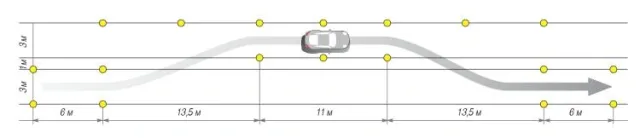
"Moose Test"
We conduct the simulation of avoiding a sudden obstacle in two stages. First, five drivers, already familiar with the cars in normal modes, try to "avoid the moose" on the first attempt at 65 km/h. Then an expert, in a series of runs, determines the maximum speed of the maneuver. All runs are with stability control systems enabled (if available).
The Fiat Grande Punto, according to five drivers, turned out to be the safest: no one "got into an accident," everyone chose the right actions and acknowledged that the car executed commands very precisely and went exactly where it was directed.
The expert achieved the highest speed in the Fiat — 81.8 km/h. This is the only car in the test with a stability control system. When it engages, it noticeably reduces speed, effectively dampens the skid, and, exiting the game in time, almost doesn't interfere with rapid trajectory changes. The precise reactions are also aided by wide low-profile tires.
 |  |  |
| The Grande Punto's reactions are precise, yet soft | Renault Clio: low sensitivity, large body rolls, and a lack of reactive action on the steering wheel | Opel Corsa with sport suspension features high sensitivity and quick reactions |
The Opel Corsa also allowed all five to avoid an accident, but it was harder to do than in the Fiat. The reactions were sharper than expected, but the quick responses gave drivers a margin to correct mistakes. The high pace of reactions also helped the expert achieve a decent result. However, the increased tendency to oversteer didn't allow the speed to exceed 76.7 km/h.
| Maximum speed in the "moose test," km/h | |
| Cars | Speed |
| Fiat Grande Punto | 81.8 |
| Opel Corsa | 76.7 |
| Renault Clio | 74.5 |
The Renault Clio turned out to be the most "accident-prone" in this exercise. Sensitivity to steering during an emergency maneuver dropped so much that two drivers couldn't avoid the obstacle, and a third, though he dodged, couldn't hold the car when returning to his lane.
| "Moose test" on the first attempt at 65 km/h* | |
| Cars | Maneuver completed |
| Fiat Grande Punto | 5 out of 5 drivers |
| Opel Corsa | 5 out of 5 drivers |
| Renault Clio | 2 out of 5 drivers |
| * 5 drivers participated in the tests | |
Due to a lack of sensitivity, the tester also had a hard time. The soft suspension caused large body rolls, narrow high-profile tires — the largest front-wheel drifts, and at the limit — understeer. This forced very fast steering at large angles, which didn't allow the speed to exceed 74.5 km/h.
Battle of "Hot" Hatches: Fiat Grande Punto vs Opel Corsa and Renault Clio
When it comes to compact cars with character, three names immediately come to mind: Fiat Grande Punto, Opel Corsa, and Renault Clio. We brought them together to find out who truly can deliver driving pleasure and who merely settles for the status of a simple city dweller. This test features versions with 1.4-liter petrol engines, and each contender has its own trump cards up its sleeve.
Design and First Impression
Let's start with the exterior. The Fiat Grande Punto looks the most emotional: its swift lines and the "gaze" of its headlights immediately catch the eye. It seems to have stepped off the covers of fashion magazines, and that's its undeniable advantage. The Opel Corsa is more restrained, but no less attractive for that. Its German practicality is evident in every detail, and the interior, though not as bright, is very well made. As for the Renault Clio, it seems the simplest and even a bit old-fashioned compared to its rivals. Its exterior is calm, but inside — the same story: functional, but without spark.
Looking into the cabin, I immediately noted that the driver's seating position is better thought out in the Italian and the German. The Fiat has a comfortable steering wheel with a wide range of adjustments, and behind the wheel you feel like you're in a real "hot" hatch. The Opel also has everything in its place, but the Clio disappointed: the steering wheel here doesn't adjust for reach, and the high seating position doesn't contribute to a sporty mood.
Dynamics and Handling
And now the most interesting part — how these cars behave on the road. The Fiat Grande Punto with its 95-hp engine and 6-speed manual gearbox is a true driver's car. Acceleration to 100 km/h takes 11.4 seconds, and you can feel it! The gearbox with short throws is simply a song, and the suspension is tuned for active driving. On a winding road, the Italian holds its line like glued, and its handling is the best in this trio. It literally provokes you to press the gas, and for that, I'm ready to forgive it some flaws in ride smoothness.
Opel Corsa, on the contrary, is not so spirited. Its 90 horsepower and 5-speed gearbox make it more relaxed. Acceleration to 100 km/h takes 12.4 seconds, and you can feel it. It is stable and predictable, but its handling is far from Fiat's ideal. In corners, it rolls a bit more, and the steering doesn't provide such feedback. But in the city, the Corsa feels right at home: the soft suspension smooths out bumps well, although at speed there is excessive body roll.
Renault Clio is the golden mean. It's not as fast as the Fiat (11.3 seconds to 100 km/h), but not as calm as the Opel. Its suspension is the most comfortable of the three, swallowing potholes and joints perfectly. However, in corners, the Clio noticeably leans, which doesn't add confidence. It's clearly designed for relaxed driving, not for racing.
Brakes and safety
All three cars have disc brakes at the front, but the rear situation differs. The Fiat and Opel have discs at the rear, while the Renault has drums. In real-world conditions, this isn't critical, but under heavy braking, the Italian and German hatches feel more confident. All test participants are equipped with ABS and front airbags, but the Fiat also boasts side airbags and curtain airbags, as well as a stability control system in the options list. This makes it the safest of the trio.
Practicality and comfort
As for everyday use, the situation is not so clear-cut. The Renault Clio boasts the most spacious cabin: it's a five-door, and there's noticeably more room in the back than in its rivals. Its trunk is 288 liters, which is also good. The Opel Corsa with its 285 liters is in second place, while the Fiat Grande Punto, despite its 275 liters, has the smallest trunk, and due to the sloping roof, access to it isn't the most convenient. However, the Italian has a full-size spare wheel, and its rear seats fold in a 60/40 split, but only as an option. On the Opel and Renault, this function is already standard.
Acoustic comfort is roughly the same for all: at 120 km/h, you can hear both wind noise and tire hum in the cabin. But there are questions about the climate control. The best microclimate is in the Fiat, while the Opel with its mono-climate and the Renault with a simple air conditioner in the test were cooler than desired.
Prices and trim levels
The prices of the tested cars vary significantly. The base version of the Fiat Grande Punto costs $17,020, but the test car with 17-inch wheels and an options package came to $23,700. The Opel Corsa in base trim is the most affordable at $14,190, but our test example with additional equipment cost $20,120. The Renault Clio is the most expensive in base trim ($17,449), but its test version turned out to be the most modest in equipment and cost $18,539. At the same time, the Italian already has all the necessary safety systems in the base, but for many "goodies" like alloy wheels and climate control, you'll have to pay extra.
So who won? By total points, the Fiat Grande Punto and Opel Corsa scored the same number of points — 790 each, and the Renault Clio — 770. But these are just numbers. If you're looking for emotions and driving excitement, the choice is obvious — Fiat. If you need a reliable and comfortable car for the city, the Opel Corsa would be an excellent choice. And the Renault Clio suits those who value practicality and space, without chasing thrills.
Comparison tables
Expert ratings from Autoreview
| Expert ratings from Autoreview | ||||
| Evaluated parameters | Max score | Cars | ||
| Fiat Grande Punto | Opel Corsa | Renault Clio | ||
| Design | 160 | 140 | 135 | 120 |
| Exterior | 80 | 70 | 70 | 60 |
| Interior | 80 | 70 | 65 | 60 |
| Ergonomics | 160 | 130 | 140 | 130 |
| Driver's workspace | 80 | 65 | 70 | 65 |
| Visibility | 80 | 65 | 70 | 65 |
| Dynamics | 280 | 230 | 225 | 220 |
| Acceleration dynamics | 90 | 65 | 70 | 75 |
| Braking dynamics | 100 | 85 | 85 | 80 |
| Handling | 90 | 80 | 70 | 65 |
| Ride comfort | 200 | 155 | 150 | 155 |
| Ride smoothness, vibration protection | 80 | 50 | 55 | 65 |
| Acoustic comfort | 60 | 50 | 50 | 50 |
| Microclimate | 60 | 55 | 45 | 40 |
| Cabin comfort | 200 | 135 | 140 | 145 |
| Passenger seats | 70 | 45 | 45 | 55 |
| Trunk | 70 | 45 | 50 | 45 |
| Cabin transformation | 60 | 45 | 45 | 45 |
| Total score | 1000 | 790 | 790 | 770 |
Specifications
| Specifications | |||
| Parameters | Cars | ||
| Fiat Grande Punto 1.4 16V | Opel Corsa 1.4 | Renault Clio 1.4 | |
| Body type | 3-door hatchback | 3-door hatchback | 5-door hatchback |
| Number of seats | 5 | 5 | 5 |
| Trunk volume, l | 275—1030 | 285—1050 | 288—1038 |
| Curb weight, kg | 1090 | 1130 | 1145 |
| Gross weight, kg | n/a* | 1555 | 1635 |
| Engine | petrol, with distributed injection | ||
| Location | front, transverse | front, transverse | front, transverse |
| Number and arrangement of cylinders | 4, in-line | 4, in-line | 4, in-line |
| Displacement, cm³ | 1368 | 1364 | 1390 |
| Cylinder bore/piston stroke, mm | 72.0/84.0 | 73.4/80.6 | 79.5/70.0 |
| Compression ratio | 11.0:1 | 10.5:1 | 10.0:1 |
| Number of valves | 16 | 16 | 16 |
| Max power, hp/kW/rpm | 95/70/5800 | 90/66/5600 | 98/72/5750 |
| Max torque, Nm/rpm | 128/4500 | 125/4000 | 127/4250 |
| Gearbox | manual, 6-speed | manual, 5-speed | manual, 5-speed |
| Gear ratios | |||
| I | 3.55 | 3.73 | 3.73 |
| II | 2.16 | 2.14 | 2.05 |
| III | 1.48 | 1.41 | 1.39 |
| IV | 1.12 | 1.12 | 1.10 |
| V | 0.92 | 0.89 | 0.89 |
| VI | 0.77 | — | — |
| Reverse | 3.82 | 3.31 | 3.55 |
| Final drive | 4.07 | 3.74 | 3.87 |
| Drive | front-wheel drive | front-wheel drive | front-wheel drive |
| Front suspension | independent, coil spring, McPherson | ||
| Rear suspension | semi-independent, coil spring | ||
| Front brakes | disc, ventilated | ||
| Rear brakes | disc | disc | drum |
| Tires | 205/45 R17 | 195/55 R16 | 185/60 R15 |
| Maximum speed, km/h | 177 | 173 | 183 |
| Acceleration time 0—100 km/h, s | 11.4 | 12.4 | 11.3 |
| Fuel consumption, l/100 km | |||
| Urban cycle | 7.7 | 7.8 | 8.7 |
| Extra-urban cycle | 5.2 | 4.8 | 5.4 |
| Combined cycle | 6.1 | 5.9 | 6.6 |
| Fuel tank capacity, l | 45 | 45 | 55 |
| Fuel | petrol AI-95 | petrol AI-95 | petrol AI-95 |
| * N/a — not available | |||
Equipment of the cars participating in the test
| Equipment of cars participating in the test | |||
| Equipment | Cars | ||
| Fiat Grande Punto | Opel Corsa | Renault Clio | |
| Price of base version with 1.4 L engine, $ | 17020 | 14190 | 17449 |
| Front airbags | + | + | + |
| Front side airbags | + | – | O |
| Inflatable curtains | + | – | – |
| ABS | + | + | + |
| Electronic stability control | O | – | – |
| Height-adjustable steering column | + | + | + |
| Reach-adjustable steering column | + | + | – |
| Leather-wrapped steering wheel | O | + | – |
| Multifunction steering wheel | O | + | – |
| Heated steering wheel | – | O | – |
| Heated front seats | + | O | O |
| Auto-dimming rearview mirror | – | + | – |
| Single-zone climate control | – | O | O |
| Dual-zone climate control | O | – | – |
| Bluetooth phone kit | – | O | – |
| Power-adjustable and heated exterior mirrors | + | + | + |
| Power front windows | + | + | + |
| Light sensor | – | + | – |
| Rain sensor | – | O | – |
| Trip computer | + | + | + |
| Split-folding rear seat | O | + | + |
| CD audio system | O | O | + |
| Fog lights | + | + | + |
| Full-size spare wheel | + | + | + |
| Metal engine underbody protection | – | – | + |
| Alloy wheels | O | – | – |
| Metallic paint | – | – | O |
| Power sunroof | – | O | + |
| Rear parking sensors | O | O | – |
| Remote trunk release | + | – | – |
| Cornering low-beam headlights | – | O | – |
| Adjustable rear seat backrests | – | + | – |
| Price of tested car, $ | 23700 | 20120 | 18539 |
| (+) Included in base version | |||
| (–) Not available in base version | |||
| (O) Options installed on cars participating in the test | |||
Speedometer accuracy
| Speedometer accuracy | |||||||
| Cars | Speedometer readings, km/h | ||||||
| 40 | 60 | 80 | 100 | 120 | 140 | 160 | |
| True speed, km/h | |||||||
| Fiat Grande Punto | 38 | 57 | 75 | 94 | 113 | 132 | 149 |
| Opel Corsa | 38 | 56 | 75 | 94 | 114 | 133 | 153 |
| Renault Clio | 38 | 58 | 76 | 95 | 114 | 133 | 152 |
| Measurement results obtained during the Autoreview test | ||||
| Parameter | Models | |||
| Fiat Grande Punto | Opel Corsa | Renault Clio | ||
| Top speed, km/h | 163.1 | 168.4 | 177.5 | |
| Acceleration dynamics, s | 0–50 km/h | 4.3 | 4.6 | 4.2 |
| 0–100 km/h | 14.5 | 14.2 | 13.3 | |
| 0–150 km/h | 42.5 | 42.7 | 33.8 | |
| over 400 m | 19.2 | 19.3 | 18.8 | |
| over 1000 m | 35.8 | 35.6 | 34.6 | |
| 60–100 km/h (III) | 9.8 | 9.3 | 9.0 | |
| 60–100 km/h (IV) | 14.5 | 13.2 | 12.8 | |
| 80–120 km/h (V) | 23.2 | 21.2 | 19.3 | |
| 80–120 km/h (VI) | 39.7 | — | — | |
| Coast-down, m | from 50 km/h | 570 | 604 | 728 |
| 130–80 km/h | 805 | 865 | 987 | |
| Braking from 100 km/h | distance, m | 38.8 | 38.6 | 40.2 |
| deceleration, m/s² | 10.0 | 10.0 | 9.6 | |

Prices and trim levels
The least expensive car in this trio was the fourth-generation Opel Corsa. The three-door version with a 1.0-liter three-cylinder engine producing 60 hp in the base Essentia trim, which includes ABS, a pair of airbags, power mirror adjustment, and 14-inch wheels, costs from $11,990. A similar car but with a 1.2 engine producing 80 hp is priced at $12,840. The intermediate Enjoy trim adds power windows and 15-inch wheels, for which you will have to pay an extra $800 — the price starts at $13,640. The top Cosmo version for the three-door includes sport seats, CD player, side airbags and curtain airbags, air conditioning, heated mirrors, and 16-inch wheels; its price is from $16,040. For climate control they ask another $450, for parking sensors — $400. For the Corsa with the 1.2 engine, a robotic Easytronic gearbox is available for an additional $700. At the top of the range is the version with the 1.4 engine (90 hp): $14,190 in Enjoy and $16,590 in Cosmo. Five-door modifications are $300 more expensive than three-door ones. Waiting time for a car to order is 3–4 months.
Opel's dealer network in Russia includes 53 dealers in 28 cities.
The new-generation Renault Clio, which is sold here exclusively with five doors, costs noticeably more. The base Authentique trim (air conditioning, full power package, two airbags, 15-inch wheels) with a 1.2 engine producing 75 hp is $15,749. The version with the 1.4 engine producing 98 hp in the Expression trim, supplemented with a CD player, is $1,700 more expensive — from $17,449. Climate control can be added for $300. The maximum Dynamique trim is equipped with a 1.6-liter unit producing 110 hp, which competitors do not have. Standard equipment includes side airbags and curtains, climate control, heated front seats, light and rain sensors. Price — from $18,649. Automatic transmission is an option for $900. You will have to wait 2–3 months for such a car.
Renault is represented in Russia by 92 dealers in 54 cities.
The Italian Fiat Grande Punto is also not cheap: the three-door version with a 1.2 engine (65 hp) in the Active trim (15-inch wheels, power package, heated seats and mirrors, two airbags, audio preparation) — $15,710. For the five-door body you need to add $750. The modification with the eight-valve 1.4 engine producing 77 hp with the same equipment is from $17,020. The next step is Dynamic with air conditioning: from $17,770 (another $750 more). Two packages are available: Comfort (alloy 15-inch wheels, CD player, leather steering wheel and gear lever) raises the price to $18,600, and Premium adds climate control — $19,160. For the robotic manual Dualogic they ask $1,500. Five-door versions are $370 more expensive. The flagship Grande Punto Sport version with the 1.4 16V engine (95 hp) is available only in a three-door body for $23,390. Currently, dealers are not accepting orders, only selling cars from their lots.
Fiat is sold in Russia by 9 dealers in 4 cities.
Warranty on all three cars is two years without mileage limit, service interval is 15 thousand kilometers.
Light in the dark
Shooting cars at night from one point allows us to assess how effectively the headlights work. In low beam, Opel and Renault lead: their optics fully illuminate a pedestrian on the roadside at 65 meters and almost completely at a distance of 80 meters. For Fiat, the picture is worse: a person at 80 meters from the car is not visible at all. However, this is only a static check. In motion, Opel turns out to be the best — its headlights, both low and high beam, can turn in the direction of the turn. And at low speed, additional side lighting lamps are switched on, which noticeably simplifies parking at night.
| Fiat Grande Punto | Renault Clio | Opel Corsa |
| High beam. A pedestrian stands in the center of the road 160 m from the car | ||
| Low beam. A pedestrian stands on the roadside 65 m from the car | ||
| Low beam. A pedestrian stands on the roadside 80 m from the car | ||
The high beam of all three cars raises no complaints: a powerful beam evenly illuminates the road and a person at a distance of 160 meters.
During photo shooting, only the driver was in the cabin, headlight adjusters were in the zero position.
| When turning the steering wheel to the right (or turning on the turn signal), an additional side light lamp lights up in the right headlight of the Corsa (on the left in the photo). It works similarly during a left maneuver. When reverse gear is engaged, the lamps activate in both headlights (on the right) |
What Autoreview readers think
Before this test, on the website www.autoreview.ru, we asked visitors which car from the participants they would choose for themselves.
The votes were distributed as follows:
Opel Corsa 46.22%
Fiat Grande Punto 29.71%
Renault Clio 24.07%
A total of 6772 people voted.