Zuffenhausen itself is essentially a suburb of industrial Stuttgart, and it doesn't look like a cumulus cloud at all. An industrial zone, of which I've seen many in different parts of Germany. Workers in gray overalls with identical lunch boxes walk along narrow sidewalks, chatting. I like the air here, probably not the cleanest — the atmosphere of a manufacturing city. I like Germany as a whole: here you fully feel the meaninglessness of the cork phrase "real sector of the economy" so beloved by Russians.
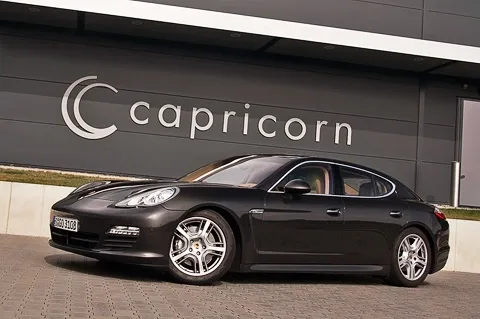
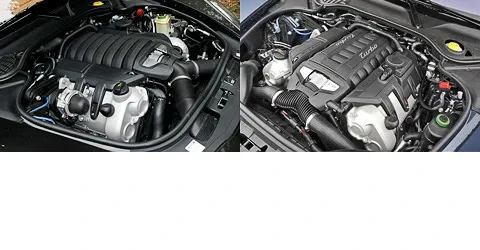
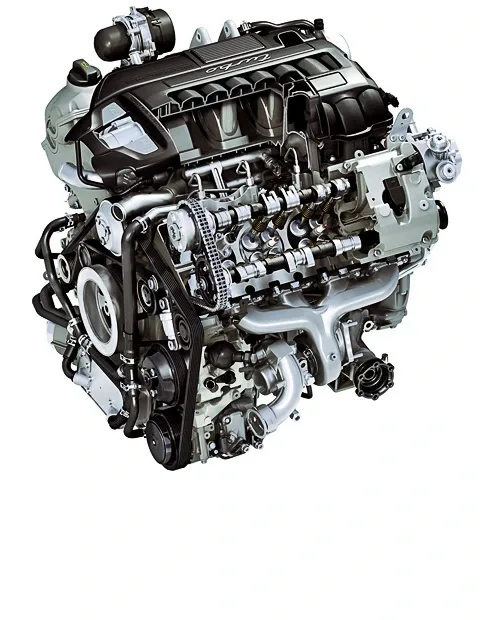
At the cutting edge of technology. Porsche Panamera S (factory designation Porsche 970) — this is a 400-horsepower V8 engine with direct injection, mechatronic chassis... And the building behind the Panamera is Capricorn Composite in the Nürburgring technology park: one of the most modern centers for working with composite materials. Behind the glass doors are huge autoclaves, where under pressure of 16 atm at a temperature of 450 degrees, objects up to four meters long and two meters wide can be baked. Composite's products are used by major sports teams, small-scale automakers, and also in other industries, such as medicine.
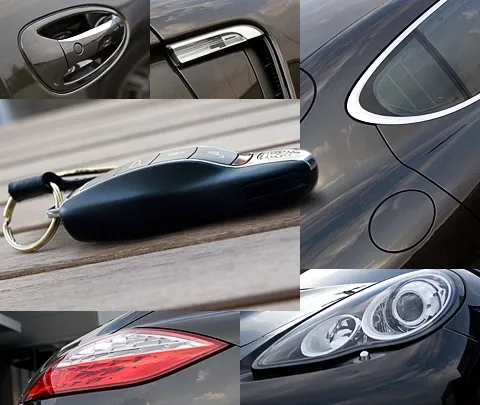
Above the Porscheplatz looms the glass bulk of the museum-temple. The church of one icon — the Porsche 911. The entire square is flooded with its crystal light. It somehow unexpectedly comes to mind that the name Panamera is consonant with the Russian word "peremena" (change)... And so I pass by the factory treasury — to the checkpoint of the First Factory. There I need to exchange a couple of autographs for a hefty transponder key-sculpture: a miniature Panamera made of expensive plastic with an inlaid crest on the hood.
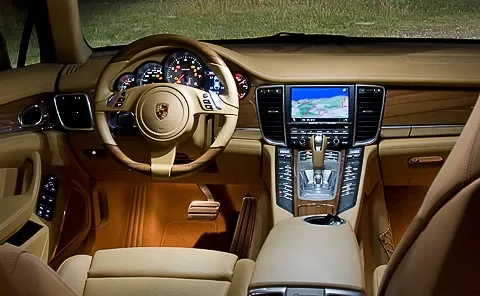
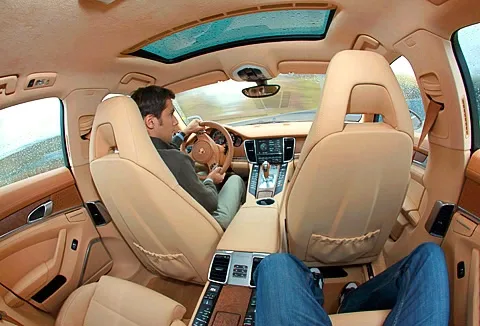
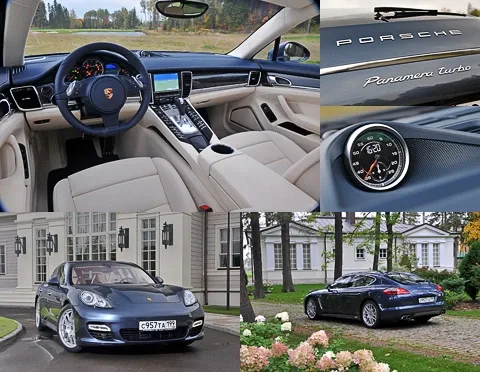
Interestingly, for illuminating the interior, finished in warm beige tones, along with traditional yellow light bulbs, sterile white lamps are used. A slight disharmony is felt.
The door with a handle like the "nine-eleven" is perfectly fitted and doesn't need a soft-close. Behind it — fine leather, light walnut, polished aluminum, the monolith of the center console with inclusions of common Porsche hardware. The feeling of quality, tightness of joints, the spicy smell of natural material — all this is purely Porsche. Just the sight of the traditional instrument cluster with the tachometer in the center makes you want to drive immediately. Far and long, until the fuel runs out. Or until your back gives out: the seemingly excellent rigid seats turn out not to be the most comfortable on a long journey. And you have to drive almost 400 km — all the way to the Nürburgring.
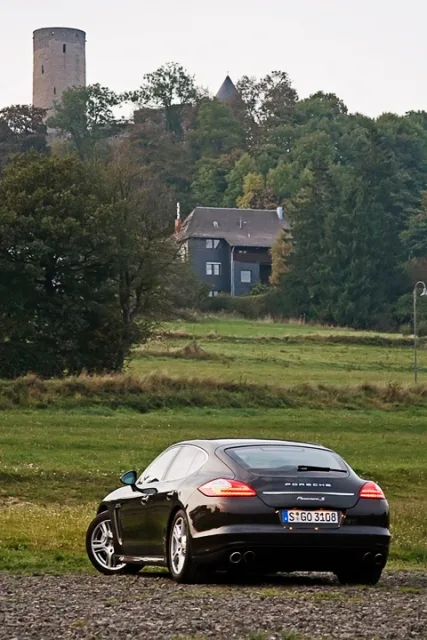
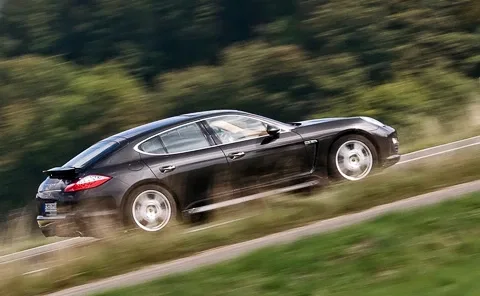
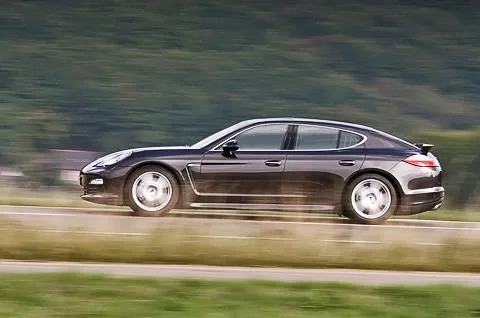
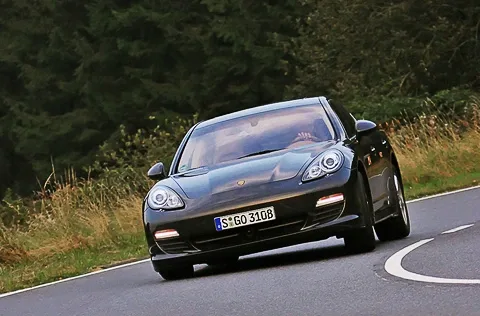
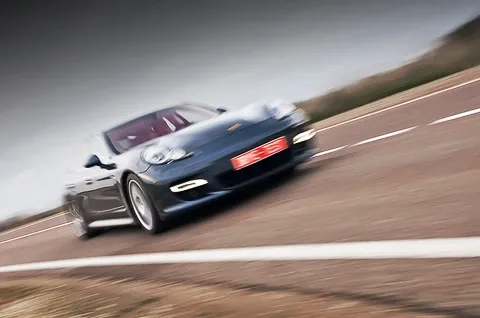
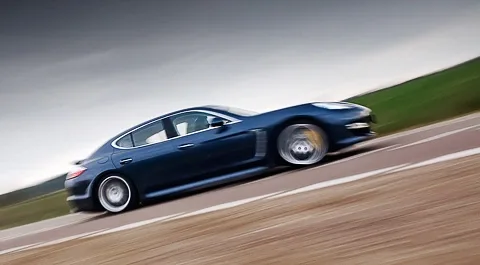
It's hard to call the Panamera a beautiful car, but its appearance harmonizes with the gloomy charm of the Eifel mountains. Nowadays, the owner of the Nürburg castle would definitely drive a Porsche.
In the windshield — the family rounded front end, the seating position is only slightly higher than in the Porsche 911, the steering wheel — from there too. Along with the cheap steering column stalks, by the way. And they are already below the Panamera's status... Where, by all indications, the trunk should be, a 400-horsepower "V8" awakens. Porsche's acoustics made the grumbling baritone sound like the dry coughing of the "boxers." A promising sound, though there's neither growling nor obvious aggression in it.
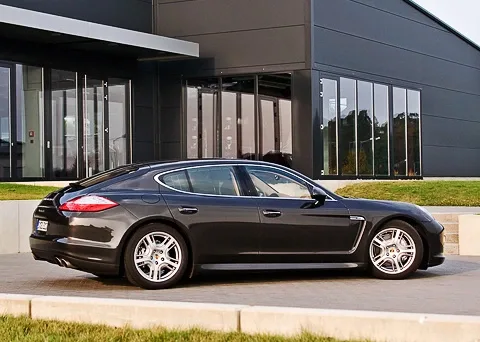
The five-door body masks the dimensions. In fact, the Panamera is longer than all German business-class cars — almost a Jaguar XF. But it's 5.6 cm wider!
Under load, the naturally aspirated 4.8 with direct injection sings in its own way, in bass, playfully throwing the tachometer needle past the 6500 rpm mark. The voice is soft, with overtones, not annoying, but not exactly beautiful either. Acceleration builds linearly, without surges, and is highly convincing. But somewhere in the back of my mind, the thought has already settled that two tons of curb weight is too much even for 400 horsepower from a V8.
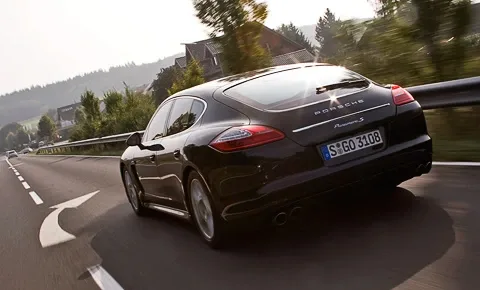
For an extra charge of 97,597 rubles, the Panamera with PDK is equipped with adaptive radar cruise control. It maintains the set distance to the car ahead and can brake to a complete stop, providing deceleration of up to 3.5 m/s
2. In principle, the system's operating range is 30–210 km/h, but a special "creep" function allows you to move in traffic jams with jerks, albeit with difficulty, on autopilot.
Cruise control can give a command to increase speed when you turn on the turn signal to overtake, and also reduce it in a corner based on signals from lateral acceleration sensors and steering wheel position — for extra safety. Even when switched off, cruise control can warn the driver of a dangerous approach to an obstacle.
Stuttgart moves. Not fast, but constantly. People don't pick their noses: at traffic lights, everyone starts off in a crowd as soon as it turns green... At the third intersection, it becomes clear that the god-fearing start/stop system needs to be turned off. The second needed to restart the engine and engage a gear is enough for the driver to feel like a slowpoke. By the way, in the Russian specification, the start/stop system is deactivated by default.
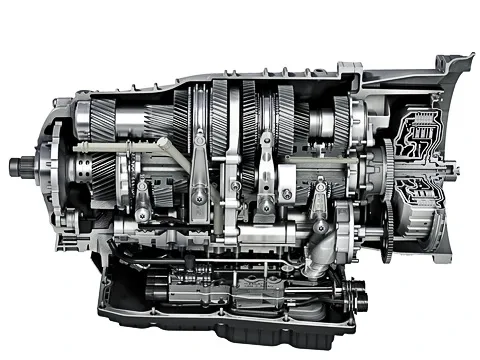

Mindful of my experience with the preselective "robot" PDK, I immediately switch the gearbox to Sport mode — otherwise the accelerator responses are un-Porsche-like languid, the gearbox hesitates to shift down one gear, takes a long time to prepare for kick-down. But in Sport mode, there's angelic mutual understanding: fewer jerks when changing gears, predictable engine braking. The main thing is not to succumb to the temptation to take manual control of the gearbox: the algorithm of the paddle shifters in manual mode is designed for one-armed residents of the looking glass.
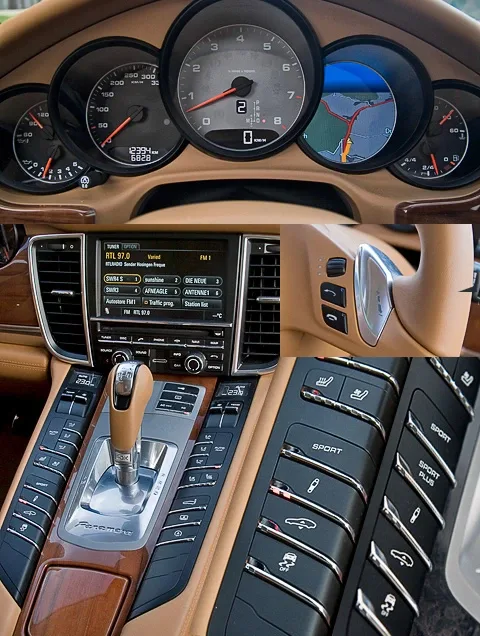
- The tachometer in the center of the instrument panel is a tribute to tradition here, not a functional necessity. The PDK gearbox is quite independent. Using manual mode is inconvenient. The speedometer is optimistically marked up to 330 km/h, although the top speed falls short of 280 km/h.
- The PCM multimedia system with a confusing interface is like the Porsche 911's. The auxiliary buttons for controlling the suspension and transmission are located too low, and meanwhile the Panamera constantly requires adjustment: sometimes you want to speed up throttle responses, sometimes make the suspension softer...
- The lower button to the right of the gear selector turns off (and in Russia, on the contrary, turns on) the start/stop function, which saves up to 1.8 liters of fuel per 100 km in the city.
- In the photo at the bottom right — the button combination of the Turbo version with the Sport Chrono package: the additional Sport Plus button engages the fastest PDK mode and activates launch control.
The wooden inserts on the firm steering wheel seem quite appropriate: you don't have to turn it at large angles — the five-meter hatchback has a very "quick" rack, two and a half turns of the wheel from lock to lock. Although the reactions are not sharp. And yet, in the city, the Panamera is not entirely white and fluffy. Stuttgart's streets abound with long, gentle curves that need to be taken at the required 50–70 km/h without straying beyond the narrow lanes. That's where the treacherously empty steering lets you down.
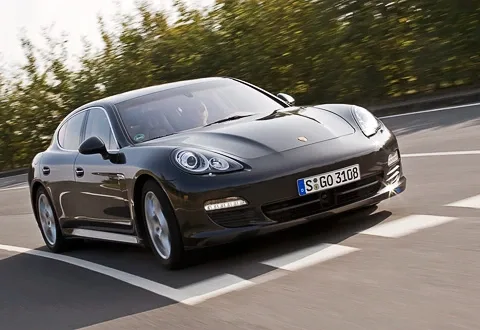
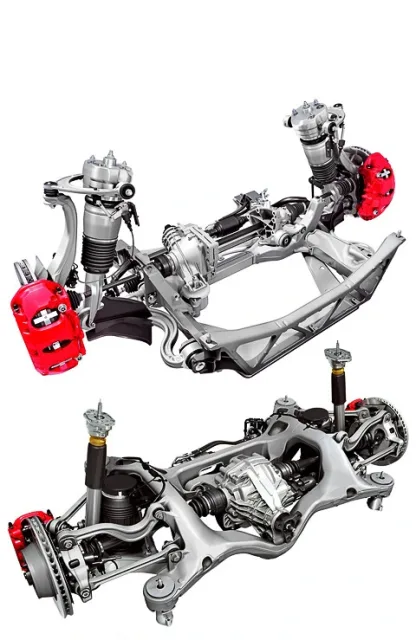
The Panamera's steering mechanism has variable gear ratio. In addition, for an extra charge on European cars (and in Russia by default), a power steering pump with variable output depending on speed is used. In my opinion, that's the problem. In the city, only Sport mode saves from the steering's numbness — and even then, only slightly. At the same time, the active stabilizers tighten, and the steering wheel becomes barely noticeably heavier.
Looking ahead, I'll say that in Moscow, the Panamera's power steering no longer draws much attention. Whether it's due to higher city speeds and mostly straight roads. Or maybe it's the wider tires of the Turbo version.
The Panamera could be an academic example of understeer (don't confuse it with a tendency to plow!). In standard modes, even when entering a slow and gentle turn, a moment passes before the steering impulse overcomes the inertia of the two-ton car. It lacks responsiveness. It's good when an "understeering" car provides a sufficient level of steering feedback. But the Panamera in urban conditions forces constant searching steering at small angles due to extremely low self-centering force. The light steering wheel, of course, partly masks the car's mass, but it also confuses and steals part of the pleasure.
The autobahn makes the Panamera feel closer to the driver after a shared hundred kilometers per hour. The steering effort becomes denser, although for intuitive understanding you need to add another hundred. Without that, in gentle arcs there remains a slight detachment in the reactive action, although other information — in the form of vibrations — is sufficient at the wheel. A surprise is a slight course instability when driving in a straight line. Even following a barely noticeable transverse profile, the car widens the dynamic corridor, shifting from side to side, requiring constant steering correction. Maybe another seventy? To the brim?
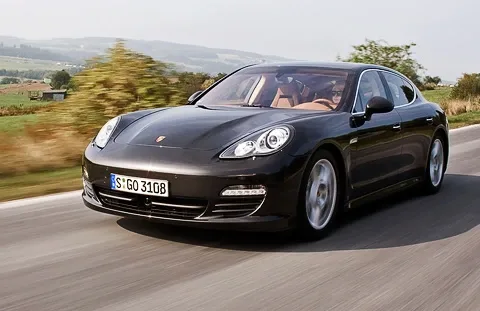
In everyday life, the Panamera turns out to be surprisingly agreeable — you don't need to get used to it. Even a fragile girl like our Nastya Korolkova, as it turned out, quickly gets the hang of driving a Porsche and confidently handles a large car.
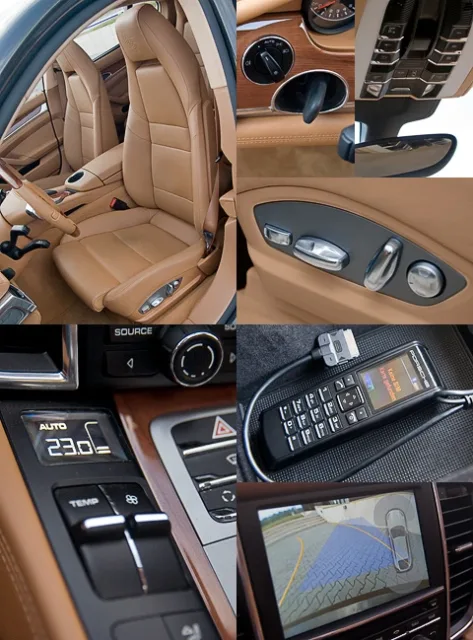
- The driver in the Panamera sits three centimeters higher than in the Porsche 911, but the seating position is still low and sporty. The front seats have wide adjustment ranges, including lateral support. However, the rigid seat profile is designed more for short trips than for long hauls.
- Keyless access (option for 52,509 rubles) includes a decorative plug instead of the ignition switch, which, as is customary for Porsche, is located to the left of the steering wheel.
- On the overhead console — a control unit for the sunroof and lighting, as well as a remote for garage doors.
- After each engine start, the climate control resets to the factory 22 degrees. You can remember the last settings only through the PCM menu. The climate keys themselves are rocker-type, convenient to use.
- The rear-view camera with trajectory hints is a real lifesaver.
- In the armrest box hide a wireless handset for the built-in phone and USB and iPhone connectors.
Acceleration to the limit is already the concern not of fifth gear (it works up to 188 km/h on the speedometer), but of sixth. Seventh is not suitable for speed — only for fuel economy. The problem is different: to reach the limiter, you need time, and on German autobahns today there are too few unlimited sections and too many cars. Over eight hundred kilometers, I never managed to accelerate the S to the maximum — I barely got fifth gear engaged. Constantly someone slow changes into the left lane, forcing you to slow down, overloading the not-so-durable brakes and making the car dip its nose unpleasantly. However, colleagues from Autoreview on the dynamometer road of the Dmitrov test site squeezed 268.5 km/h out of the Panamera.
With increasing speed, the Panamera does not become softer, maintaining its sports car image. Even at over two hundred, it transmits all the smallest surface irregularities into the cabin through its relatively high-profile tires. The seats constantly vibrate from high-frequency accelerations. It turns out autobahns are terribly rough! To choose the Panamera for grand touring, you need to be a die-hard Porsche fan. And the Germans expect that most buyers are exactly the newly converted. Will they like such a massage?
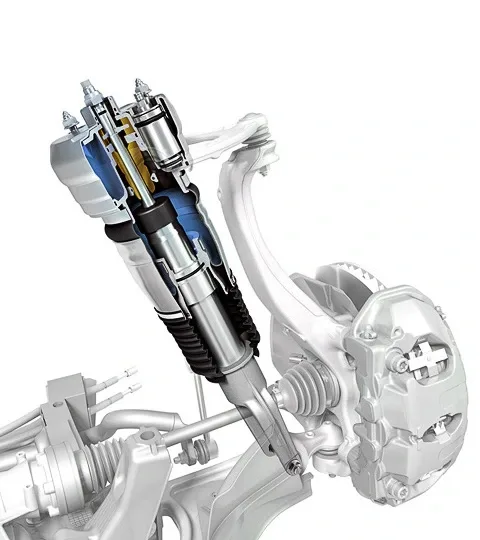
Changing the suspension modes fundamentally changes nothing. A slight damping of vibrations can be noticed only if you jump, say, from Sport Plus directly to Comfort, skipping Sport. Then an additional chamber is connected in the air springs, and the ground clearance increases. But with a sequential transition from Comfort to Sport and then to Sport Plus, the difference is barely perceptible. In any mode, the Panamera remains stiff. Only the degree of this stiffness changes.
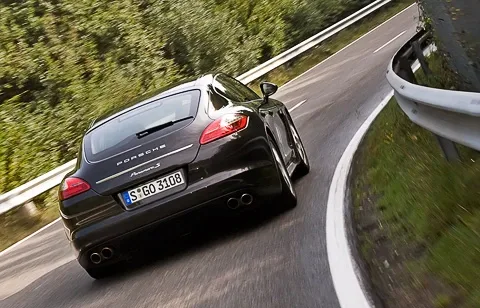
To maneuver lively on narrow roads in a car almost two meters wide, you need composure. Good that the Panamera holds the arc confidently, and the front and side dimensions are well readable.
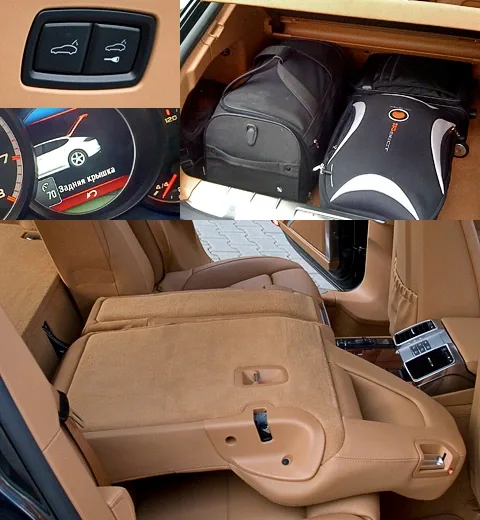

What is harmful for the image is useful in everyday life. The Panamera is a hatchback. And that's very convenient! The rear seatbacks fold in unequal parts flush with the trunk floor. Without that, the cargo compartment volume is 445 liters. The servo drive for the fifth door is an option for 31 thousand rubles. The removable cover is another seven and a half thousand. True, everything that fit under it also fit into the trunk of an ordinary Fiesta. Without the need to fold the rear seatbacks and without harming visibility.
Under the floor — no spare tire. Only a repair kit that allows you to chew a punctured tire to the mounting at speeds up to 80 km/h.
But from the separate rear seat, the Panamera is subjectively perceived as a bit more comfortable. First, the seating geometry here is more relaxed: in the back you can sit longer than in the front — tested. Second, there is no vibration-loaded steering wheel in your hands, and the nature of vertical accelerations is different — the amplitude is smaller. This is the case, however, exactly as long as the road remains straight and smooth. As soon as a pronounced transverse profile appears, passengers have to regret that they cannot grab the steering wheel. It sways considerably. And the backrest of the front passenger seat constantly trembles before your eyes...
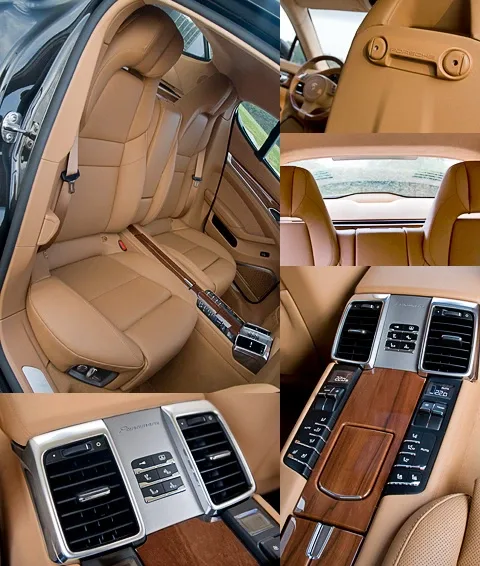
- Space in the back — almost like in the new Mercedes E-class. On seats equipped with servos, you can settle in much more comfortably than in the front. Here there is its own separate climate control and a control unit for the front passenger seat. However, all this grace — for an extra charge. Even the rear side airbags are an option. In the photo above — universal mounts for monitors (or hangers).
- The integrated headrests of the front seats take revenge on passengers for the poor rear visibility. Despite the sloping roof, there is enough air above the heads thanks to a special recess.
And yet I am sure: the most valuable experience that the Panamera gives is connected precisely with traveling in the back. In my opinion, what is super unusual in it is not the body type, not the layout, not the Vertu of the central tunnel. Unique is... the ability to watch the driver from the rear seat. Ha, you will say, admire the chauffeur if you like, even in a Logan taxi, even in a BMW 7 Series! You see, we are in a purebred Porsche, not in some Cayenne — you should not be behind the pilot. And you are also lounging in a comfortable seat. Haven't you had to ride in the embryo position on the passenger bench in a 911? That's it. Until now, you could comfortably watch the process of driving a Porsche only sitting in front of a gaming monitor. Exactly: the rear passenger of the Panamera lacks a joystick!
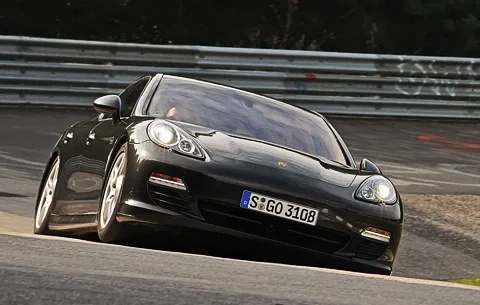
The first lap on the North Loop of the Nürburgring showed that you also need to enjoy driving the Panamera on a race track from the back. There — all the sharpness of experiences. Especially on the Nordschleife, abundant with blind corners. You constantly fall from somewhere, fly up somewhere, you are thrown from side to side, either hanging on the belt or pressing into the seat. And the person behind the wheel at this time realizes with annoyance that the large hatchback has more sporting flair than real data.
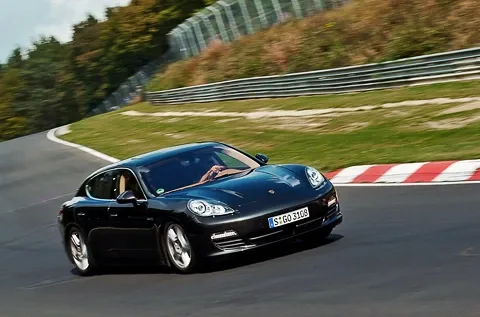
You need to steer the Panamera into a corner with a slight lead, accounting for the mass.
The vibration of heated brakes, which manifests as a fine tremor even on the autobahn during prolonged decelerations, intensifies on the Nordschleife and is accompanied by a frightening hum. Fortunately, this does not affect efficiency, but the extra jitter gets on your nerves. And we are driving by no means on the edge. Carefully. For the sake of science. Still, the Panamera feels heavy here, and the active stabilizers clamped to the limit allow noticeable body rolls.
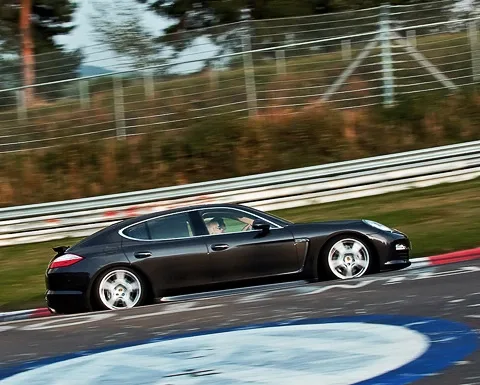
Here the Panamera can already be called a comfortable car. It handles the complex terrain of the Nordschleife excellently.
But how well the Panamera holds the line! The handling settings in extreme modes — if not sorcery, then the creation of a genius of purely angelic nature. Random slides do not occur in principle. If the front end drifts or the rear wheels spin, it means the pilot wanted it so. Losing grip by mistake is impossible: at high speed, the car requires an unambiguous clear command. Foolproofing here is embedded not in the brains of the stability system, but primarily in the elastokinematics of the suspensions.
The engine is not bad either. When accelerating flat out, the Panamera S still seems underpowered, but in traffic on the Nürburgring, the 400-horsepower V8 is an argument even at this weight. Pushing off from the lowest point of the track at Bergwerk, the car with passengers briskly climbs the hill, leaving behind the annoying Mégane R26s, which, like little piranhas, harass the Panamera's bulk on winding descents.
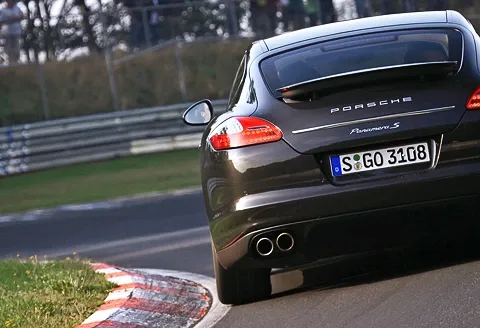
In sport modes, the Panamera feels larger and heavier than in everyday driving...
Oh, if only I could be at the Nordschleife behind the wheel of its record holder there — the Turbo with its 500-horsepower twin-turbo engine and carbon-ceramic brakes. Even if our colleagues' measurements proved that the fabulously expensive "ceramics" offer no advantage over cast iron, they do survive the most brutal treatment without consequences. And the dynamics — 100 km/h in a laughable 4.1 seconds, and the throttle response is angrier than the naturally aspirated version. The French upstarts like rivals would only be left to pound their aluminum suspension knuckles against the curbs in impotent rage... But in reality, I first needed to return to Moscow and digest the impressions of the naturally aspirated Panamera to fully feel all the devilish power of the forced-induction modification.
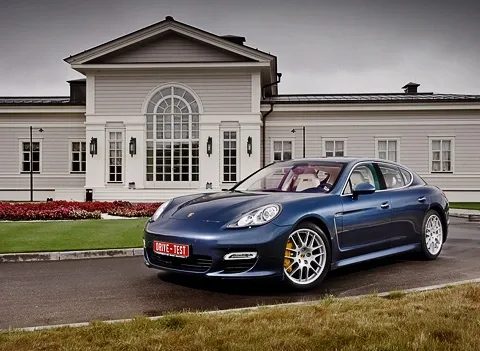
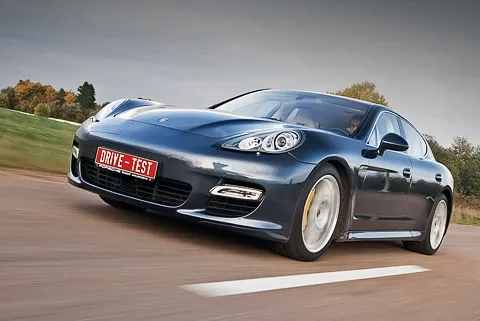
- From the outside, the Panamera Turbo is recognizable by the air intake slits in the front bumper and the LED "parallelograms" of the daytime running lights. The rear is marked by four exhaust tips.
- Yellow calipers are a sign of the optional carbon-ceramic brakes for 385,000 rubles. In terms of effectiveness, they barely outperform the standard ones, but they forgive the most sadistic braking methods.
Adults, playing with little ones, like to gently toss children up in their arms. Now imagine those same children becoming projectiles in a hellish competition of "who can throw the toddler higher." That's exactly the difference with the Turbo version. It shoots you forward without even thinking about catching you. The Panamera Turbo launches from a standstill as if erasing the starting point into oblivion. Once you leave home in the 500-horsepower Panamera, there's no way back.

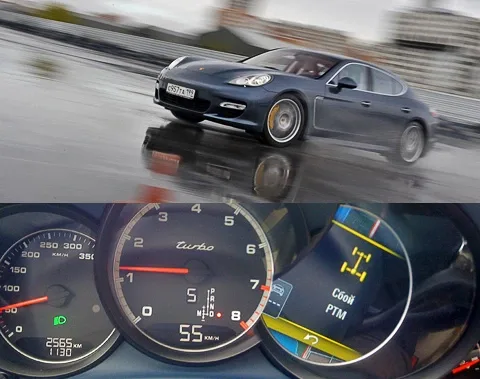
The instrument cluster here has black dials, and the speedometer scale tops out at an unattainable 350 km/h.

Wings of a demon. On the Turbo version, the spoiler in its deployed state turns into a full-fledged rear wing: it doesn't just cancel out lift at the rear but creates downforce. In Sport Plus mode, the wing immediately assumes a combat position at the maximum angle.
It might seem that an extra hundred "horses" for such a behemoth is a mere trifle. But in overboost mode, the forced-induction engine unleashes all 770 N·m — 270 N·m more than the "S"! And when this insane torque is managed by the extremely aggressive transmission mode, you start to think that between the Panamera S and Panamera Turbo, a couple more intermediate versions could easily fit. Judge for yourself: the Turbo reaches 250 km/h from a standstill in 1,350 meters, while the "S" needs a full two kilometers!
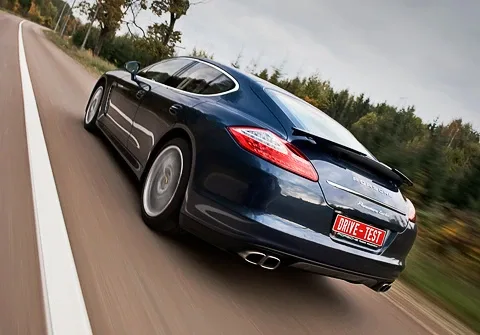
When you feel the torque punching through the pauses between shifts, you begin to understand why Lucifer was cast down to hell. With such power, it's very easy to imagine yourself above God.
The exhaust note of the car the color of a stormy sky matches its appearance. Instead of the brass section of a symphony orchestra, the trumpets of archangels come into play. Compared to the V8s from AMG or Maserati, it's certainly not music. But, friends, near cemeteries, it's better to be careful with the gas pedal — otherwise, the quartet of exhaust tips with its heavy seismic vibrato might raise someone unwanted. Old ladies cross themselves when a Panamera thunders past along Vagankovo. The photographer on a Moscow-region roadside crosses himself too when, a meter away from him, the all-wheel-drive monster kisses an invisible apex in third gear...
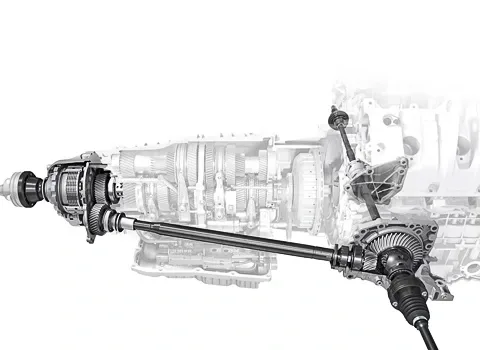
And again — not the slightest hint of a breakaway. The grip is simply mythical. The all-wheel drive with a connectable front axle and electronically controlled rear differential lock pulls the Panamera into the corner so that the universal fashion for torque vectoring seems like mere child's play. Again and again, I increase the speed, open the throttle on the arc earlier and more boldly — the Panamera Turbo holds on like a Carrera. No, not like a Porsche 911, but like a toy slot car from the Carrera brand that runs on a plastic track with guides. There, you can't find that very limit beyond which centrifugal force would fling the model off the track. You just need to know. That's probably how it is with the Panamera. Fortunately, my own limit of capabilities is much closer than the limit of Porsche's inhuman power.

The display in the instrument panel and the wheel on the right steering wheel spoke allow you to quickly navigate through the sections of the onboard computer, multimedia, and navigation.
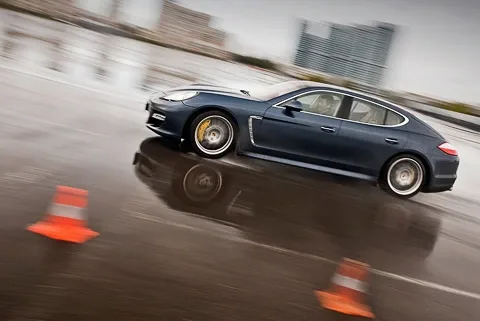
But on surfaces with a low coefficient of friction, the Panamera breaks into a slide with no effort at all and handles it magnificently — it simply glides over the road. Nose up, like a hydroplane. The slides are stretched, and the heavy hatchback takes a wider radius than you'd like. But in principle, in winter, this should be fantastic fun! The deactivated stability system only wakes up during braking until the ABS kicks in.
Oh no, the forced-induction Panamera doesn't have to go crazy all the time. The boost gauge ribbon only unfurls elastically at mid-range revs. You can drive all day on a third of the pedal, enjoying the feeling of superiority. The dynamics are enough. With the wings folded, the Turbo is no more temperamental than the "S." The same weightless steering, the same transmission hesitating until you put it in "Sport." The same expensive, seemingly driver-oriented city car... A Panamera is a Panamera. Almost an "atmospheric," almost an angel. But press the accelerator to the click — and the bridge you were calmly walking across the abyss suddenly disappears from under your feet.
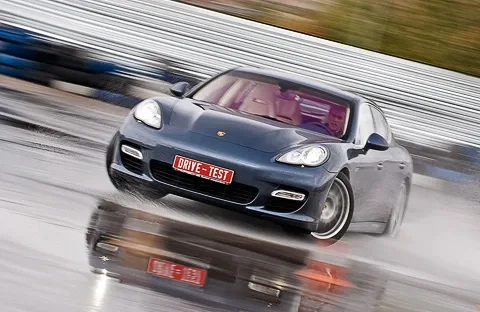
The power of the Turbo version is self-destructive. The price of a beautiful shot is the stripped splines of one of the front drive shafts. And this despite a water cushion under the wheels: when it's impossible to grip the asphalt, the Panamera is ready to gnaw at itself.
Perhaps the naturally aspirated Panamera fits better into urban aesthetics than the forced-induction one. The less powerful version is more balanced; it doesn't give the unpleasant feeling of sunbathing on tracks where a "Shinkansen" is racing. But the emphasis in this car doesn't seem harmonious to me. Yes, the Panamera S has taken the niche of a driver's car that the BMW "Seven" long ago voluntarily vacated. However, in the city, you want a bit more composure from a Porsche, and on the highway, comfort. The track, alas, is foreign territory.
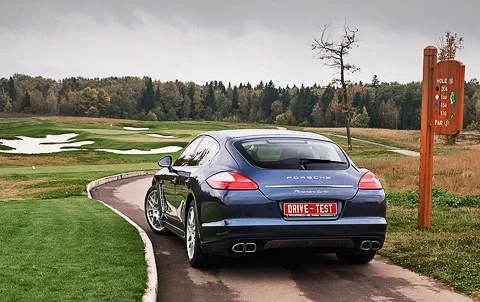
Now I know: on Porsche's family tree, the Panamera hatchback stands closer to the 911 coupe than to the Cayenne.
The Panamera Turbo, however, is magnificent in its madness. For that madness is one hundred percent functional: as befits a demon, the Panamera Turbo seduces. The vain are drawn in by the dazzling status of the top model. I can recommend the "S" only to those who park at the Cathedral of Christ the Savior. The rest — burn under excess pressure. Tell me, is there anything more attractive than absolute brilliant evil? Especially when it's also the fastest in its class.
Specifications
| Model | Panamera S | Panamera Turbo |
|---|
| Body |
|---|
| Body type | hatchback | hatchback |
| Number of doors/seats | 5/4 | 5/4 |
| Length, mm | 4970 | 4970 |
| Width, mm | 1931 | 1931 |
| Height, mm | 1418 | 1418 |
| Wheelbase, mm | 2920 | 2920 |
| Track front/rear, mm | 1658/1662 | 1656/1646 |
| Curb weight, kg | 1770 (1800)* | 1970 |
| Gross weight, kg | 2375 (2405) | 2500 |
| Trunk volume, l | 445–1263 | 432–1250 |
| Drag coefficient Cx | 0.29 | 0.30 |
| Engine |
|---|
| Type | petrol, with direct fuel injection | petrol, with direct fuel injection and turbocharging |
| Location | front, longitudinal | front, longitudinal |
| Number and arrangement of cylinders | 8, V-shaped | 8, V-shaped |
| Number of valves | 32 | 32 |
| Displacement, cm3 | 4806 | 4806 |
| Compression ratio | 12.5:1 | 10.5:1 |
| Max power, hp/rpm | 400/6500 | 500/6000 |
| Max torque, N•m/rpm | 500/3500–5000 | 700(770**)/2250–4500 |
| Transmission |
|---|
| Gearbox | M6/A7 | A7 |
| Drive | rear | all-wheel |
| Chassis |
|---|
| Front suspension | independent, air, double wishbone | independent, air, double wishbone |
| Rear suspension | independent, air, multi-link | independent, air, multi-link |
| Front brakes | disc, ventilated | disc, ventilated |
| Rear brakes | disc, ventilated | disc, ventilated |
| Front tires | 245/50 ZR 18 | 255/45 ZR 19 |
| Rear tires | 275/45 ZR 18 | 285/40 ZR 19 |
| Ground clearance, mm | 144 | 144 |
| Performance characteristics |
|---|
| Maximum speed, km/h | 285 (283) | 303 |
| Acceleration time from 0 to 100 km/h, s | 5.6 (5.4***) | 4.2*** |
| Fuel consumption, l/100 km |
| — urban cycle | 18.8 (16.0) | 18 |
| — suburban cycle | 8.9 (7.9) | 8.9 |
| — combined cycle | 12.5 (10.8) | 12.2 |
| Toxicity standard | Euro-5 | Euro-5 |
| Fuel tank capacity, l | 80 | 100 |
| Fuel | AI-98 | AI-98 |
* In parentheses — data for version with PDK gearbox
**In Overboost mode for version with Sports Chrono Package
*** 5.2 s for Panamera S and 4.0 s for Panamera Turbo with Sport Chrono Package
M6 — manual, six-speed
A7 — automated, seven-speed
Trim levels
| Model | Panamera S | Panamera Turbo |
|---|
| Front airbags | + | + |
| Side airbags | + | + |
| Rear side airbags | O | O |
| Inflatable "curtains" | + | + |
| Knee airbags | + | + |
| Isofix child seat anchors | + | + |
| Isofix child seat anchors (on front seat) | O | O |
| ABS | + | + |
| Dynamic stability control | + | + |
| Traction control | + | + |
| Bi-xenon headlights | + | + |
| Adaptive headlights | O | + |
| Daytime running lights | + | + |
| Tire pressure sensors | + | + |
| Rain sensor | + | + |
| Fifth door wiper | O | O |
| Light sensor | + | + |
| Adaptive air suspension | O | + |
| Automated transmission | O | + |
| Electronically controlled rear differential | - | O |
| Sport Chrono Plus package with Launch Control mode | - | O |
| Ceramic composite brakes | - | O |
| Front and rear parking sensors | O | O |
| On-board computer | + | + |
| Adaptive cruise control | O | O |
| Four-zone climate control | O | + |
| Keyless entry system | O | + |
| Multifunction steering wheel | O | O |
| Heated steering wheel | - | O |
| Steering column with electric adjustment of tilt and reach | + | + |
| Heated and power-adjustable rearview mirrors | + | + |
| Electrochromic interior mirror | + | + |
| Multi-contour seats | O | + |
| Memory for front seats | O | + |
| Separate second-row seats | + | + |
| Power adjustment for rear seats | O | O |
| Heated front and rear seats | O | + |
| Ventilated front and rear seats | O | O |
| Sunshade for rear window | O | + |
| Rear sunshades with servo drive | O | - |
| Hi-End audio system | O | O |
| Navigation system | O | + |
| DVD changer | O | + |
| TV tuner | O | O |
| Built-in phone | O | O |
| Monitor for rear passengers | - | - |
| Voice control | O | O |
| Integrated Bluetooth hands-free system | O | O |
| Rearview camera | O | O |
| Connectors for external multimedia devices | O | O |
| Sunroof | O | O |
| Door closers | - | - |
| Power tailgate | O | + |
| Ski bag | O | - |
| Leather interior trim | + | + |
| Wood interior trim | + | + |
| Aluminum interior trim | O | O |
| Alcantara headliner | O | + |
| Alloy wheels | O (R19) | O (R20) |
| Metallic paint | O | + |
| Base trim price | 5 231 400 | 7 039 000 |
|---|
| Tested car price | 7 497 259 | 8 650 214 |
|---|
Legend:
+ — included in base trim;
- — not available;
o — option installed on the tested car.
Technology
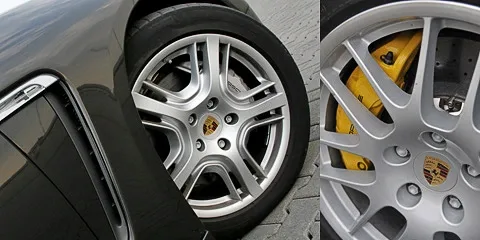
Front brake discs on the naturally aspirated version are 360 mm in diameter with rare notching, while on the Turbo they are composite, cast iron-aluminum, 390 mm in diameter. Optional composite perforated discs (410 mm for Turbo version — in photo) are 20 kg lighter per wheel! Calipers are six-piston at the front and four-piston at the rear (rear disc diameter — 330 × 350 mm depending on modification). Parking brake is electromechanical with automatic activation function.
The Panamera is not just another car, but a whole challenge to conventions. And although it may seem a controversial decision on the outside, behind the wheel you quickly understand that Porsche engineers have created something special. I spent time behind the wheel of both versions — the naturally aspirated S and the turbocharged Turbo — and I can say that this is one of the most interesting cars I have ever tested.
Let me start with the interior. The Panamera's interior can hardly be called minimalist — there are plenty of details, both functional and purely decorative. But the execution is of the highest level. Every element, be it plastic, wood trim, or polished aluminum, is made with impeccable quality. The base trim comes with dual-zone climate control, but if you opt for the four-zone version, each passenger can adjust the temperature, airflow direction, and fan intensity to their liking. The interior architecture is clearly inspired by the 2004 Carrera GT supercar.
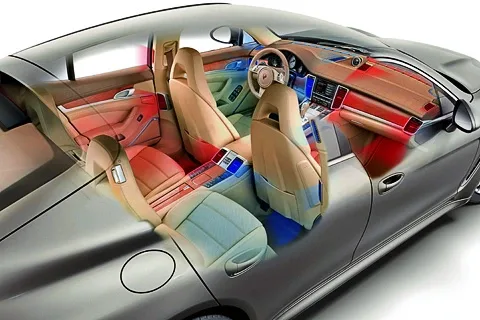
The base Panamera has dual-zone climate control. In the four-zone version, each passenger can adjust the temperature, airflow distribution, and fan intensity.
The five-door body, as expected, should be torsionally rigid, and here this figure is 25,000 N·m/deg. For comparison, the BMW X5 has 27,000 N·m/deg, and the Porsche 911 has all 34,000 N·m/deg. By combining different materials, the engineers aimed for the lowest possible center of mass and optimal weight distribution across the axles.
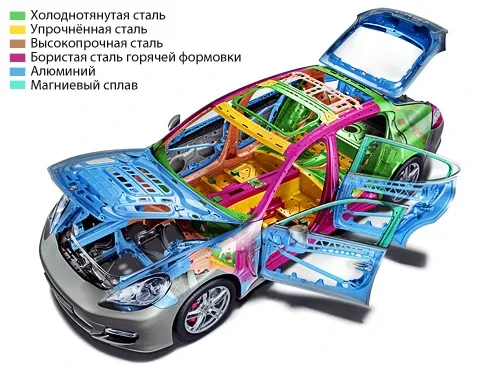
Achieving high torsional rigidity for a five-door body is not easy. The Panamera has 25,000 N•m/deg. For comparison, the BMW X5 has 27,000 N•m/deg, and the Porsche 911 has 34,000 N•m/deg. Using different materials, the engineers achieved the lowest possible center of mass of the body itself and optimal weight distribution across the axles.
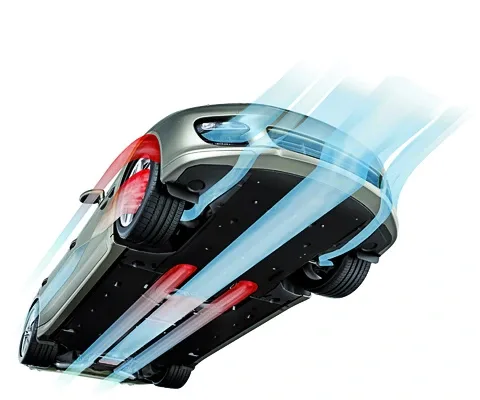
Aerodynamics here are also thought out to the smallest detail. In the S version, the retractable spoiler maintains a negative angle of attack of -3° in the range of 90–160 km/h, up to 205 km/h the angle increases to ten degrees, and then to 14. In the Turbo, the rear wing keeps -3° up to 205 km/h, and at higher speeds switches to ten degrees.

The retractable spoiler in the S version maintains a negative angle of attack (-3°) in the range of 90–160 km/h, up to 205 km/h the angle is ten degrees, and then 14.
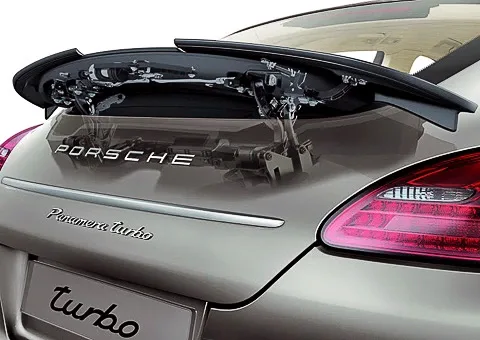
In the Turbo's rear wing, the angle of attack remains -3° up to 205 km/h, and at higher speeds reaches ten degrees.
The body can be forcibly raised by 20 mm at speeds up to 30 km/h — for example, to avoid scraping the "lip" on curbs. The lift takes four seconds. By the way, the adaptive cruise control radar is located right above this "lip" — and it seems to me that in Russian winter conditions it could become the first victim. Although, perhaps I'm overthinking it.

The body can be forcibly raised by 20 mm at speeds up to 30 km/h to avoid scraping the "lip" on curbs, for example. The lift time is four seconds. By the way, the adaptive cruise control radar, located right above this "lip" to not interfere with the cooling systems, seems to me a potential victim of the Russian winter.
Design
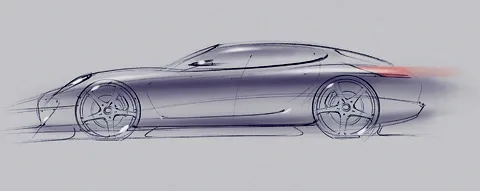
The first sketch of the Panamera was published in the summer of 2005, and the name Panamera was registered by Porsche in 2004, simultaneously with the name Cayman. The first prototypes were spotted on the Nürburgring Nordschleife in May 2007. Renderings immediately appeared. The official premiere took place at the Beijing Motor Show in 2009. In total, a billion euros were spent on developing the model and setting up production — several times less than the unsuccessful attempt to buy Volkswagen.
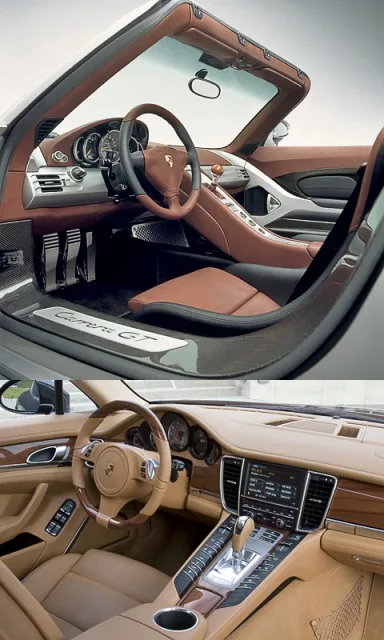
The prototype for the Panamera's interior architecture can be called the interior of the 2004 Porsche Carrera GT supercar (above).
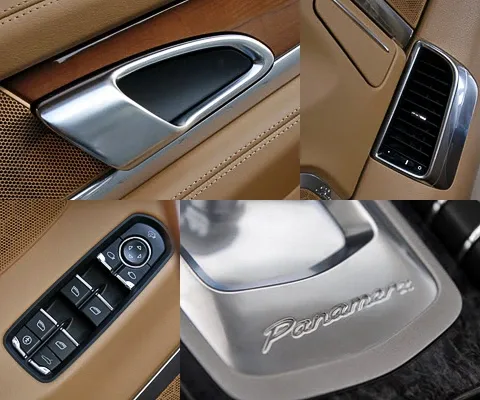
The Panamera's interior cannot be called laconic: there are many elements. Both functional and decorative. But the execution is with the highest attention to detail. Every fragment is quality itself, be it plastic, wood panels, leather, or polished aluminum inserts...
History
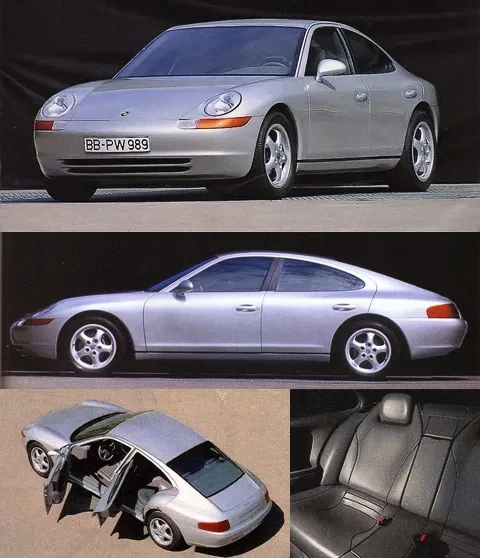
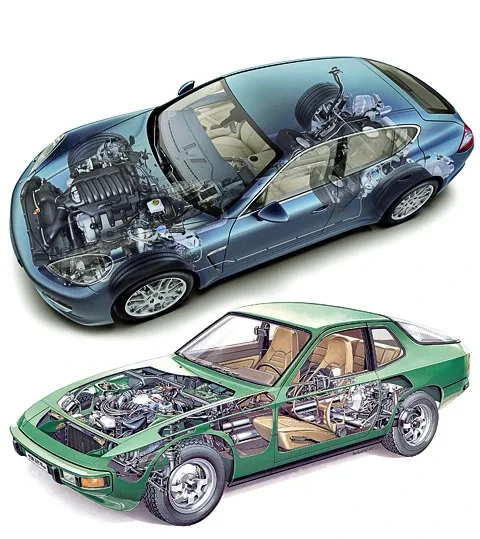
Yes, the Panamera also has a history! Even if it's not serial. Development of a rear-wheel-drive sedan with a classic layout began in 1989. Under the hood was a 300-horsepower V8 engine with an attached gearbox. However, in 1991, after the departure of the project's inspirer Ulrich Bez from Porsche, the program was shut down, citing financial difficulties. The technological and design developments were applied to the Porsche 911 of the 993 and 996 series.
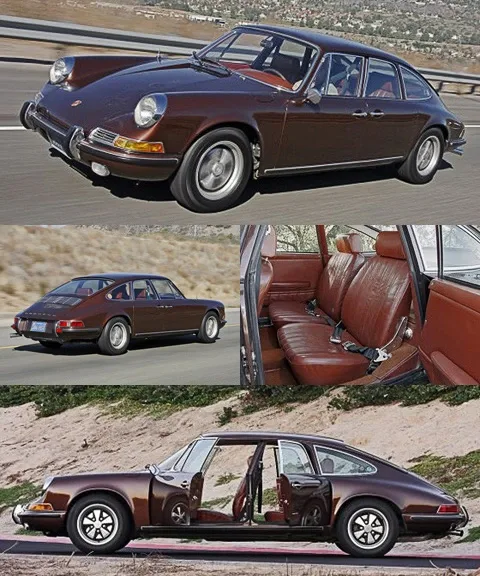
By the way, back in 1967, the Californian coachbuilding studio Troutman-Barnes built a four-door car from a pair of crashed "nine-elevens" (photo below). Moreover, they say that Porsche itself gave its approval for the project.
Photo: Tamerlane's Thoughts
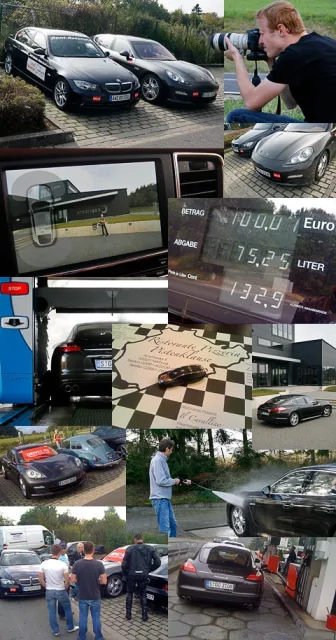
We also used the Panamera test as an excuse to gather a DRIVE2.RU community meetup at the Nürburgring. Thanks to those guys who came, and especially to those who helped us with the filming.
In Germany, the Panamera is a real head-turner: people look at it with such interest as if it were a Lambo or Ferrari. However, even Italian supercars don't get such looks. Do the Germans have a new idol? By the way, in the Nordschleife parking lot, the Panamera demonstrated another feature: Porsche won't let you move if the "parktronic" decides you are dangerously close to an obstacle. For example, another car.
The Porsche breakdown was a shock to us. What about the legendary reliability? Interestingly, the Panamera's onboard computer did not detect the transmission malfunction immediately, but when the car, "on one wing," had almost reached the press park. By that time, noises in the area of the right front wheel were heard not only in corners but also when driving straight. Porsche technicians declared a drive failure due to a torn boot. Strange. Usually, such damage leads to joint destruction as a result of prolonged use. And the test car's mileage was 2,500 km.
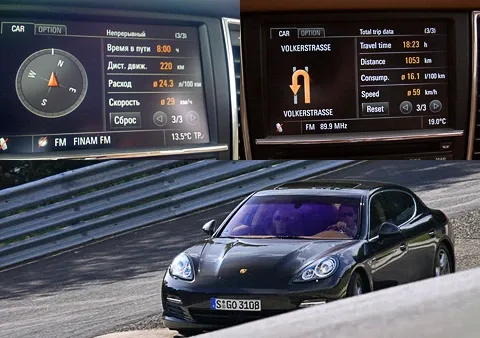
However, both cars in intense test mode showed quite moderate appetite: the average fuel consumption of the turbo version was 24.3 liters per 100 km, and the naturally aspirated "S" even 16.1 liters. But filling the huge tanks is still very costly.
We thank the hospitable "Golf and Polo Club Tseleevo" for their help in conducting the filming of the Panamera Turbo, as well as our regular partners — the Driving Art school.