
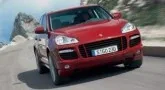
Every business has its own unwritten rules. Japanese manufacturers, due to their geographical distance from the main sales markets, have to be inventive and choose the most exotic corners of the planet for premiere tests. The Germans are much more pragmatic in this regard: usually everything is limited to their native Germany or neighboring Austria — cheap and cheerful. That is why the news that the first presentation of the Cayenne GTS would be held in the Portuguese Algarve came as a complete surprise. And only when the plane landed in Faro did everything fall into place. The answer turned out to be ridiculously simple: the five-star hotel Vila Vita Parc, where the test team settled for three weeks, is located on the outskirts of the village of Porches. Porsche in Porches — sounds intriguing, you must agree! But, as the next day showed, the marketers chose this place not for the sake of a pun. The German sports SUV looked surprisingly organic here. The Porsche Cayenne GTS seemed to combine the unbridled power of the Atlantic Ocean and the imperturbable reliability of the coastal cliffs. And the winding serpentines of the Serra de Monchique, like litmus paper, revealed all the strengths and weaknesses of the fastest naturally aspirated Cayenne.
Although in terms of dynamics and power the new model sits in the family between the Cayenne S and the Cayenne Turbo, in spirit it is undoubtedly the most charged SUV in Porsche's history. And it's not just that the 4.8-liter engine now produces 405 hp — 20 "horses" more than the S version. The main highlight of the GTS is hidden in the chassis. This is the first Cayenne where steel springs work in conjunction with the active PASM damper stiffness control system. Previously, this scheme was used only on real Porsche sports cars.
The driver just needs to choose one of three damper modes: "Comfort", "Normal", or "Sport". Then PASM independently adjusts the stiffness to the road condition and driving style, damping longitudinal and lateral body sway.
But that's not all. Optionally, the GTS can be equipped with air suspension, which changes the ground clearance over a range of 64 mm, and the PDCC active stabilizer system, which reduces body roll. Hydraulic rotary mechanisms create a counteracting torque, almost completely eliminating lateral body tilt. However, even without PDCC, the new GTS has become noticeably sharper than the Cayenne S in handling and much more exciting in corners. The increased negative camber angle of the wheels allowed for higher lateral accelerations, and the stiff front stabilizer almost eliminated body roll.
In the mountains, even with an army of electronic assistants, it's better to keep your ears open with the Cayenne GTS. With too aggressive driving, the car's strengths can turn into problems. Firstly, as with any sports car, the line between justified risk and an accident is very thin here. Secondly, do not forget that this is not a passenger car, but an SUV. Powerful brakes (front discs 350/34 mm, rear — 330/28 mm) with an emergency pressure increase function when sharply releasing the gas pedal — this is wonderful, but the inertia of two and a half tons in the mountains is a serious opponent. The roads of the Algarve are frankly narrow for such a swift car; they do not forgive mistakes and require complete composure from the driver. A telling fact: by the finish at Cape Arrifana, two of the twelve test cars arrived with deep scratches on the right side. Passengers also have a hard time: even in sports seats with excellent lateral support, the GTS noticeably causes motion sickness on mountain bends, despite all the stabilization systems.
In Europe, the base for the GTS will be a 6-speed manual, but in Russia, where demand for manual transmissions has almost disappeared, the Tiptronic S automatic is already installed as standard. Given the sporty character of the new model, the final drive ratio compared to the Cayenne S has been slightly shortened, which had a positive effect on acceleration dynamics, especially in Sport mode. When the Sport button is pressed, the engine is not reprogrammed — only the logic of the automatic transmission and the response of the gas pedal change. At the same time, the back pressure in the exhaust system is reduced, and the engine begins to sound richer, emphasizing the racing temperament of the GTS.
Faster, lower, smarter
Like its predecessors, the GTS is optionally available with air suspension, but here it has much more sporty settings. In this configuration, the body is 20 mm lower than the Cayenne S (in the base version the difference is 24 mm). The air suspension increases the rebound travel of the rear suspension, maintains a constant ground clearance regardless of load, and changes the ride height depending on speed. In normal mode, the ground clearance is 195 mm. At a speed of 125 km/h, the car lowers by 9 mm, and at 210 km/h — by another 5 mm. But this is not the limit: in loading mode, the GTS drops 34 mm below normal. For off-road, two raising modes are provided: by 26 mm (up to 80 km/h) and by another 30 mm (up to 30 km/h). So the maximum ground clearance can reach 251 mm.
Driving
The sharpest and most aggressive representative of the Cayenne family. Fully justifies its sporty essence.
Interior
Luxurious leather upholstery and refined seats with electric adjustment in 12 directions.
Comfort
On mountain roads, passengers get motion sickness, but this is an inevitable price for the sporty character.
Safety
Overall — at the usual high level for Porsche.
Price
Porsche does everything to ensure that cars depreciate as slowly as possible. So the high price here is rather an advantage.
Pros and cons
+ Very smart suspension and lateral stabilization system are complemented by sharp steering.
- The huge inertia of the car has a not very pleasant effect during braking.
Specifications
Make and model — Porsche Cayenne GTS
Dimensions — 4795x1957x1675 mm
Engine — petrol, 4806 cm³, 405 hp/6500 rpm
Transmission — automatic, 6-speed
Dynamics — max 251 km/h; 6.5 s to 100 km/h
Competitors — Audi Q7 4.2 FSI, VW Touareg W12 Sport, Range Rover Sport
Our opinion
Of course, the new GTS cannot argue with the most powerful Cayenne Turbo. However, by bringing a sports SUV to the market, Porsche reasonably expects that the daring character and refined handling of the GTS will eventually attract not only Cayenne S owners, but also connoisseurs of premium station wagons of other brands.