
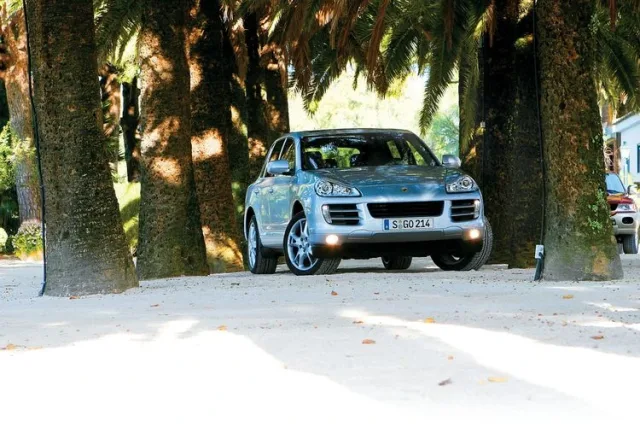
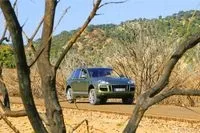
From the front, the Cayenne Turbo features enlarged air intakes, horizontal strips of LED indicators, and ribs on the hood
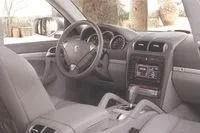
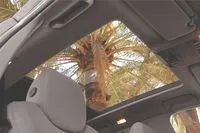
The interior hasn't changed, but the list of "interior" options has been supplemented with combined upholstery of black and brown leather; a huge four-section sunroof with an area of 1.4 m² — for an extra charge
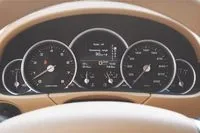
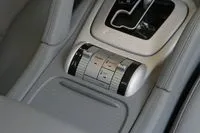
The instruments of the Turbo version — with two-color needles and a boost pressure gauge (on the right); the left Sport key switches the suspension, "automatic" and accelerator drive to sport mode, and the right one — only the shock absorbers
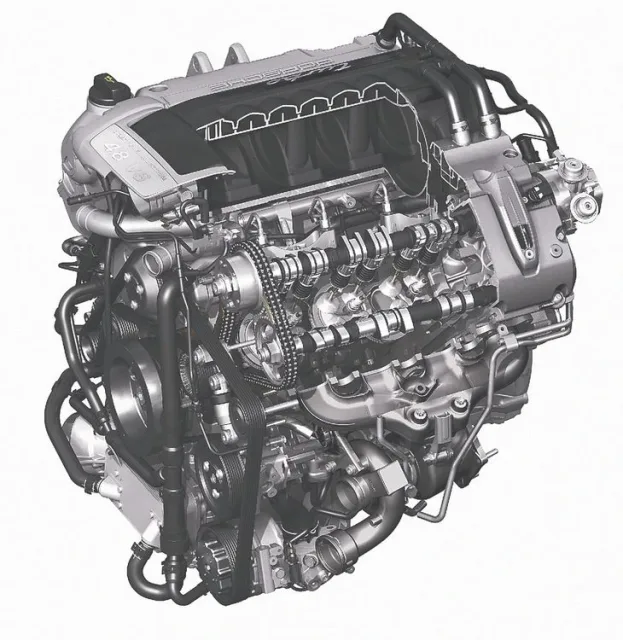
From now on, all Cayenne engines have direct injection. And the eight-cylinder engines of the Cayenne S and Cayenne Turbo versions (pictured) besides the increased displacement (from 4.5 to 4.8 liters) have acquired the proprietary "valve" system VarioCam — in the photo it can be identified by the "extra" cams of the "intake" camshaft
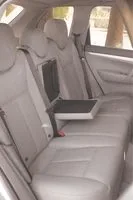

In the folding rear seat — an armrest with a box; front seats are comfortable but not sporty
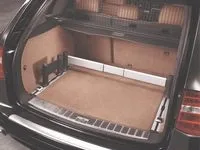
For an extra charge, the trunk lid is equipped with a hydraulic drive, activated by a button on the driver's door, key fob, or at the end of the lid (pictured); the retractable rear-view camera is practical!
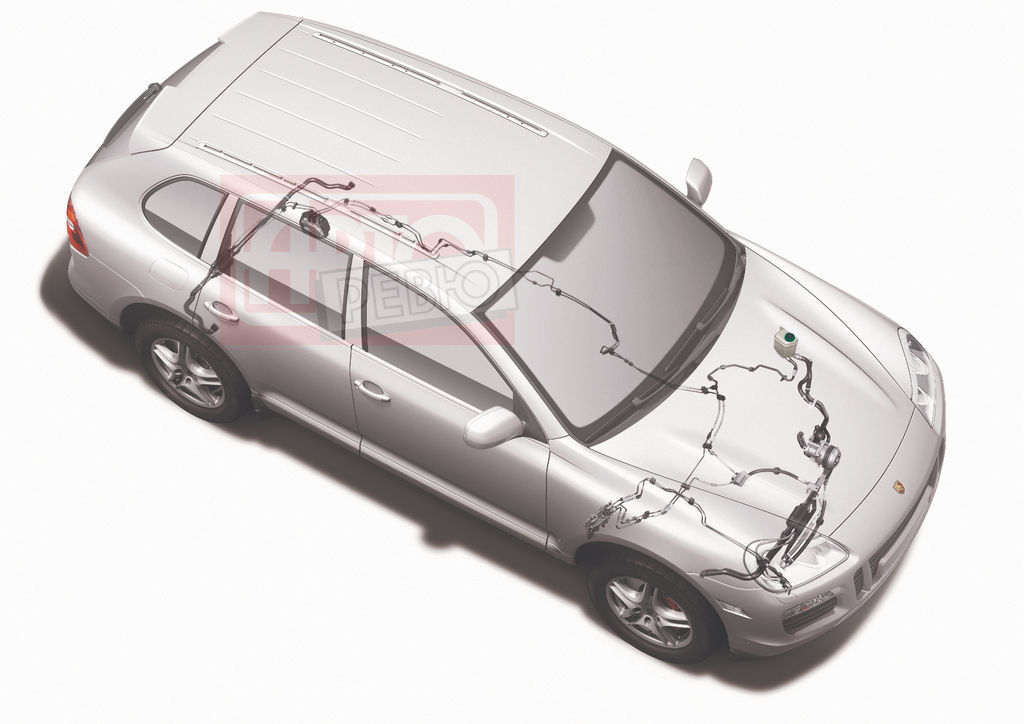 |
| Layout diagram of the PDCC system components in the car. Depending on the road situation, from 0.5 to 4 kW is spent on its operation |
And so, to catch your breath, you brake, step outside to get some air — legs are wobbly, head is buzzing… And the Cayenne stands nearby and squints.
What a ladies' man!
At the same time, it's a full-fledged SUV. The powertrain hasn't changed — with an asymmetric center differential distributing torque in a 38:62 ratio. You pull the "transmission" lever towards you — the low range is activated, and the active stabilizers "loosen", giving maximum suspension travel. Pressing again — the "center" is locked. And for an extra charge, a rear locking differential is also available. It remains to raise the air suspension to maximum (from the "standard" 215 to 271 mm) — and off you go.
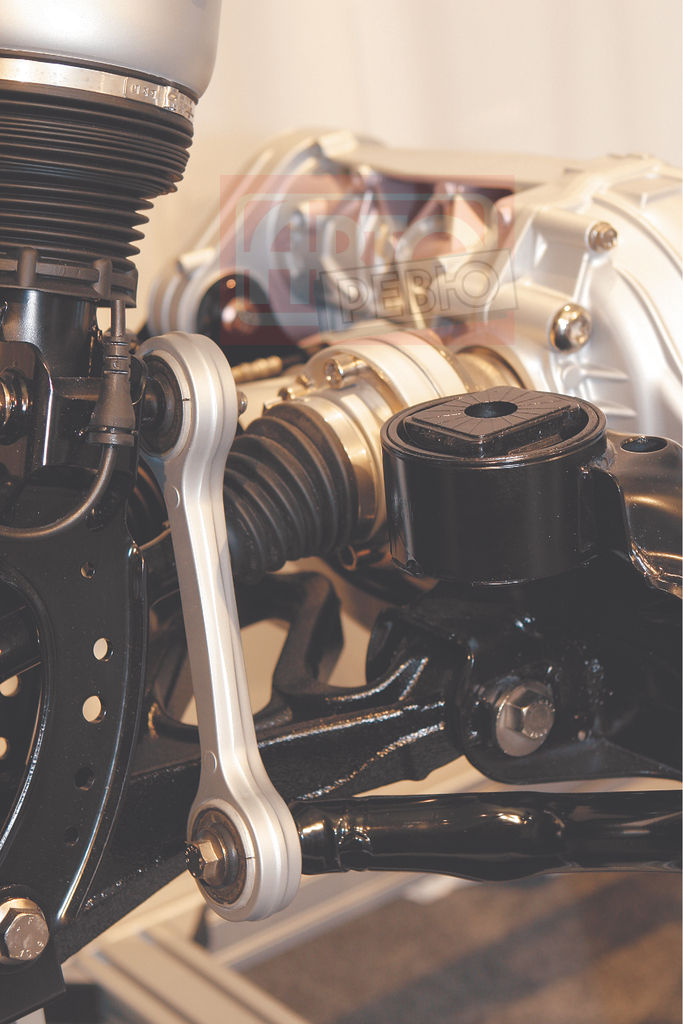 |
| The huge, connecting-rod-like link of the front stabilizer — isn't it a beauty? It connects the stabilizer directly to the air suspension strut |
In full combat readiness, we easily climbed an earthen mound left by an excavator and returned to the asphalt. Still, it's pointless to venture into serious off-road on "highway" tires. Especially since our Cayenne Turbo stood on Michelin Latitude Sport tires of maximum size 295/35 R21 — this latest development of French tire makers was created specifically for the Cayenne.
And in conclusion, I tried the most "modest" Cayenne — it's just a Cayenne with the base V6. The new all-Volkswagen "six", which debuted last year on the Passat, has a cylinder block with an increased bank angle of 15° — instead of the previous 10.6°. This allowed raising the displacement from 3.2 to 3.6 liters. Power increased by 40 hp — to 290 hp. By the way, under the hood of the updated Touareg, the same unit produces 10 hp less.
The 290-horsepower Cayenne pulls well! "In the base", naturally aspirated SUVs are equipped with a six-speed "manual". And, honestly, behind the wheel of the "manual" Cayenne, I almost experienced the same delight as in the "nine-eleven". I almost caught the spirit of Porsche.
But everything was spoiled by the mediocre gearshift mechanism — vague, with "cottony" efforts. And the clutch pedal turned out to be indistinct and too long-travel. Oh, if only there were a precise "manual" like in the Porsche 911. That would be a crazy car! An off-road sports car, not a sporty SUV — closer and closer to a "real" Porsche.
However, time heals — after a couple of generations, no one will remember the "illegitimacy" of the Cayenne model among the "true" Porsches. Especially if there is more and more Porsche spirit in them each time. And I have no doubt that this will be the case.
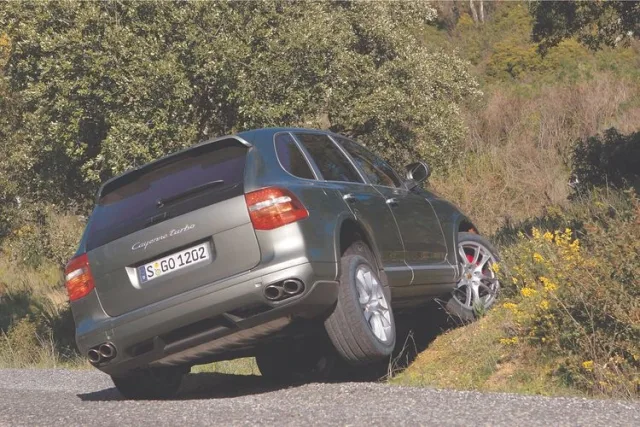
Off-road, the Cayenne is fully armed: air suspension that raises ground clearance, low-range gearing, locking of the center (and, on request, rear) differential. In the rear bumper, you can see a diffuser working in tandem with the transverse "can" of the exhaust system
Donatus Neudeck and his trained brakes
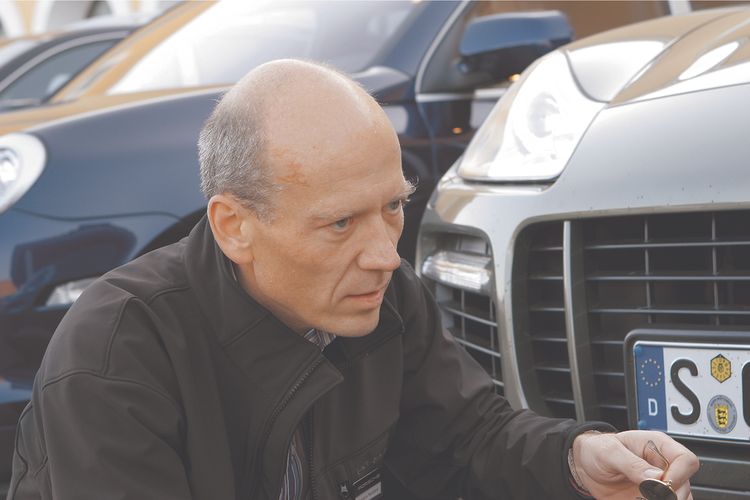 We were already acquainted with the head of Porsche's "brake" department, Donatus Neudeck, and this time we managed to talk to him again: Neudeck did not miss the opportunity to talk about his new creation — the most powerful front brakes of the Turbo Cayenne, whose aluminum calipers cover almost a third of the disc. The special feature of the turbo brakes is the maximum pad area with minimal dimensions: rigid monoblock six-piston calipers fit inside standard 18-inch wheels. According to Neudeck, such brakes are about 10% more thermally stable than previous ones, mainly due to reduced specific pressure in the disc-pad pair. Indeed, on a mountain serpentine, the braking efficiency remained consistently excellent.
Interestingly, what is wrong with huge calipers with two floating brackets, like on Mercedes-Benz AMG cars?
— They are too heavy, — Neudeck explained. — And they cannot be made entirely aluminum due to rigidity requirements.
And why doesn't Porsche use automatic brake drying, bringing the pads closer in the rain, as BMW engineers first started doing?
 |
|
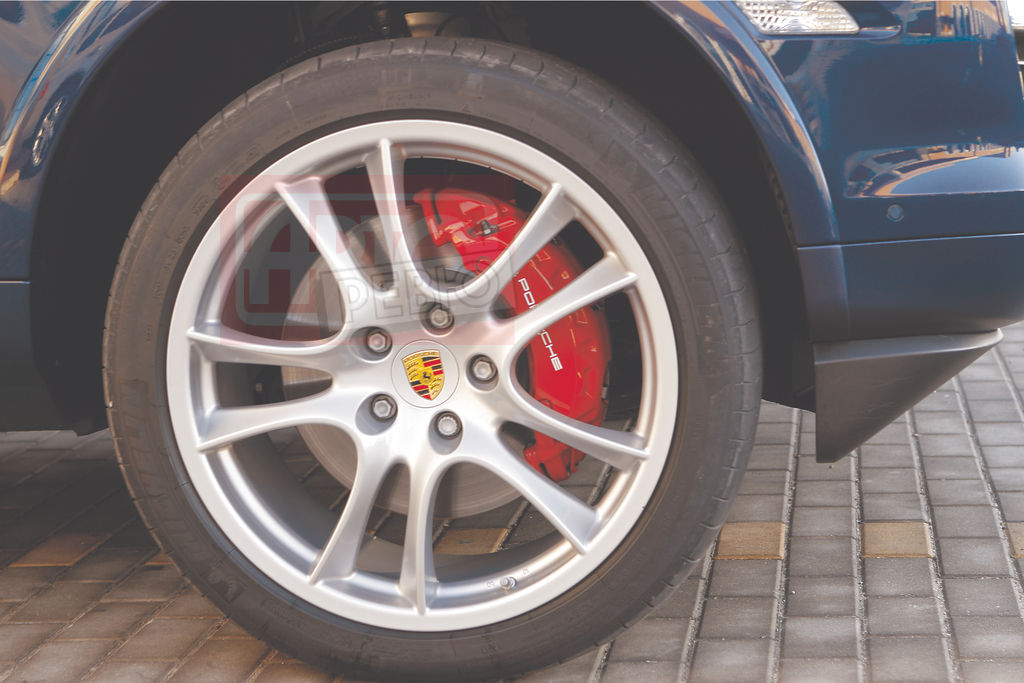
| The "coverage area" of the Turbo Cayenne pads is almost a third of the disc |
In the front bumper, there are air intakes for cooling the brakes. On the suspension arm, there is a spoiler that directs air flows to the center of the disc |
— That's all nonsense, — Neudeck replied without batting an eye. — To properly dry the disc, braking must be quite prolonged, and that would affect fuel consumption. No one will go for that. To dry the pads, we try to direct rainwater along with air — through the disc. For this, special air intakes appeared in the bumper of the updated Cayenne, and small spoilers on the front suspension arms.
Will ceramic brakes appear on the Cayenne?
— We plan to offer "ceramics" for all Porsche models, — says Neudeck. — But its use on an SUV is still difficult due to the problem of abrasive wear. After all, dirt and sand quickly disable "ceramics." Once we solve the problem, the Cayenne will have "ceramics" too.
What's the price?
In Russia, the updated Cayenne will appear at the end of February — from 57,850 euros for the base Cayenne, 72,800 euros for the Cayenne S, and 122,850 euros for the Turbo modification. For comparison, a new BMW X5 with a 4.8 engine (355 hp) will cost at least 115 thousand euros.
First, I figured out what is essentially the passport of this beast. We have three versions of the Porsche Cayenne, and all of them are five-door station wagons for five seats. The length of the base and S versions is 4798 mm, the Turbo is three millimeters less (4795 mm), the width is 1928 mm everywhere, but the height varies: 1699 mm for the naturally aspirated versions and 1694 mm for the Turbo. The wheelbase is the same — 2855 mm.
The ground clearance of the base and S versions is 218 mm, but for the Turbo it is regulated by air suspension in the range from 215 to 271 mm. The trunk in all cases holds from 540 to 1770 liters. The curb weight increases from 2160 kg for the initial version to 2355 kg for the top one, and the gross weight — from 2945 to 3080 kg.
The engines are only gasoline, with direct injection. The base version is a V6 with a volume of 3.6 liters (3598 cm³), producing 290 hp at 6200 rpm and 385 Nm at 3000 rpm. The compression ratio is 12.3:1. Next comes a V8 of 4.8 liters (4806 cm³) in two variants: the naturally aspirated Cayenne S with 385 hp and 500 Nm (compression ratio 12.5:1) and the biturbo Cayenne Turbo, where power reaches 500 hp at 6000 rpm, and torque — 700 Nm at 4500 rpm. The Turbo has a lower compression ratio — 10.5:1.
The gearboxes are six-speed: manual or Tiptronic S automatic for the initial versions, and only automatic for the Turbo. Drive is permanent all-wheel drive. The suspension of the younger versions is spring (front on transverse arms, rear multi-link), and the Turbo has air suspension. Brakes are disc ventilated everywhere. Tires — 235/65 R17 for the base version and 255/55 R18 for S and Turbo.
The dynamics are impressive: the base version accelerates to 100 km/h in 8.1 seconds (with automatic — in 8.5), top speed — 227 km/h. The Cayenne S does it in 6.6 seconds (with automatic — 6.8), and its limit is 252 km/h (with automatic — 250). The Turbo accelerates in 5.1 seconds and reaches 275 km/h.
Fuel consumption, of course, is not for the faint of heart. The base Cayenne in the city consumes 18.5 liters per 100 km (with automatic — 18.3), outside the city — 9.8 (with automatic — 9.9), in the combined cycle — 12.9. Cayenne S: 22.1 liters in the city (with automatic — 20.2), 10.8 outside the city (10.1 with automatic), 14.9 in the combined cycle. Turbo: 22.5 in the city, 10.5 outside the city, and 14.9 in the combined. The tank is 100 liters, fuel — only AI-98.
In general, the numbers speak for themselves: this is a heavy, powerful, and voracious beast, which, however, remains a Porsche.