
On one whale. Checking how the Porsche Cayenne GTS arrived in Russia
What is the Cayenne GTS? Some kind of yacht: light steering, comfort, vibroacoustic paradise... Don't get me wrong: it's not that I'm trying to refute everything written over five years about a stiff and sharp SUV — I just got here from a Porsche 911. And I already want to go back.
It's silly to look for flaws where there never were any. And indeed, I have no complaints about the seating position, ergonomics, or visibility of this two-ton German: the slightly larger-diameter steering wheel sits comfortably in your hands, and the side bolsters of the seats gently support your back. In the rearview mirrors, the abandoned Dyomino airfield gradually fades away...
Looking for some idea is also pointless—there's no trace of it left. The original concept of the GTS (Gran Turismo Sport) was aimed at a demanding driver who, for some reason, felt the urge to get an SUV. It rested on three pillars: coil spring suspension, a manual transmission, and a naturally aspirated engine. However, our market dealt with this concept with the cold-bloodedness of a seasoned whaler. Instead of steel springs, my example has air springs (in Europe, you have to pay extra for them), I couldn't order the six-speed manual even for an additional fee, and all the racing ambiance of the GTS turned into just an expensive set of decorations.
Only one "whale" surfaced—the internal combustion engine. And thank God! Because although the GTS with its V8 boosted to 405 hp loses to the Turbo version in acceleration, it has another advantage—responsiveness. There's no wild surge from a pair of turbos here, but you can meter the thrust with surgical precision at any rpm.
If I had a manual at hand, I could extract maximum benefit from this purity of response, but with a mediator in the form of a leisurely Tiptronic, all that's left is to watch the wildly spinning speedometer and... listen. Just press the large Sport button, and the exhaust bypass valve opens—and the V8 starts performing Wagner for the whole neighborhood.
Actually, all hope rests on that very Sport button. To make the PASM (Porsche Active Suspension Management) dampers stiffer, the PDCC (Porsche Dynamic Chassis Control) stabilizers "tighten up," and the air springs do something useful—for example, reduce ground clearance. Then I switch the automatic to manual mode, paying tribute to the buried manual, and...
Oh, Stavropol region! The two-ton SUV leaves the rare locals with their mouths open. You have good roads, guys, but why is the asphalt so wavy? Although there are no "sheep" visible. And the speedometer is already past 200: the Cayenne, lowered by 14 mm, cuts into the frozen sea like a cherry breakwater. I grip the steering wheel tighter, ready to dampen the rocking with the brakes. But the huge body swallows the road's sine wave without the slightest hint of anxiety. Come on, let me put the suspension back in Comfort—now we're rocking to our heart's content!
A series of corners ahead—okay, back to Sport! I delay braking as much as possible (the brakes here are from the regular "Eski"), my passenger clings to the door handle. Brake, turn in, gas—and the Cayenne carves an arc so imperturbably that I start doubting my own skill. No body roll, no hint of a slide. I'm driving too slowly for this car—I can be much bolder!
My colleague turns pale, and I alternately stomp on the brake and gas pedals. Faster, even faster, but there's no sense of a limit. The huge 21-inch wheels sized 295/35, with clearly negative camber both front and rear, hold on as if nothing bothers them. And on top of that, the active stabilizers work against my vestibular system... Super! And I keep dreaming of a manual and good old springs. It's not certain that an "analog" GTS would go faster here, but at least I could boast that I know everything about it.
However, everything has already been decided for us: we won't see the GTS as it was conceived in Zuffenhausen. Although I admit: even if only the horns and legs remain of the beautiful racing concept, the GTS in this form is still a true Porsche. It can drive damn fast, rewarding every slide with a gray hair on the head of the average owner. And I'd rather get back behind the wheel of the "nine-eleven"—to where the concept of "compromise" doesn't exist at all...
**Technical Specifications**
| Specifications | Porsche Cayenne GTS |
|---|---|
| **Body** | |
| Number of doors/seats | 5/5 |
| Length, mm | 4795 |
| Width, mm | 1957 |
| Height, mm | 1675 |
| Wheelbase, mm | 2855 |
| Track front/rear, mm | 1659/1682 |
| Curb weight, kg | 2225 |
| Gross weight, kg | 3080 |
| Trunk volume, l | 540 — 1749 |
| **Engine** | |
| Type | Gasoline, direct injection |
| Location | Front, longitudinal |
| Number and arrangement of cylinders | 8, V-shaped |
| Number of valves | 32 |
| Displacement, cm³ | 4806 |
| Max power, hp/rpm | 405/6500 |
| Max torque, Nm/rpm | 500/3500 |
| **Transmission** | |
| Gearbox | Automatic, 6-speed |
| Drive | Permanent all-wheel drive |
| **Chassis** | |
| Front suspension | Independent, air, double wishbone |
| Rear suspension | Independent, air, multi-link |
| Front brakes | Disc, ventilated |
| Rear brakes | Disc, ventilated |
| **Performance Characteristics** | |
| Maximum speed, km/h | 251 |
| Acceleration time 0-100 km/h, s | 6.5 |
| Fuel consumption, l/100 km | |
| Urban cycle | 20.6 |
| Extra-urban cycle | 10.2 |
| Combined cycle | 13.9 |
| Toxicity standard | Euro-4 |
| Fuel tank capacity, l | 100 |
| Fuel | AI-98 |
**Standard Equipment**
- Air suspension
- PSM stability system
- 6 airbags
- Anti-theft system
- Porsche CDR-23 radio with dual tuner, 12 speakers
- Automatic climate control
- Rain sensor
- Immobilizer
- Sport design package
- Interior: leather + Alcantara
- Ski bag
- Tiptronic S automatic transmission
- Permanent all-wheel drive
**Base price — 3,565,500 rubles**
**Technology**
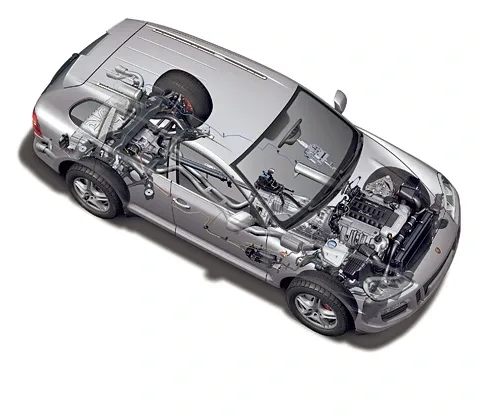
Under the hood of the GTS is the familiar 4.8-liter V8 with a new intake system (throttle body diameter increased by 6 mm) and reflashed control unit. Thanks to this, the engine crossed the 400 hp mark (+20 "horses"), while torque remained the same—500 Nm.
Behind the scenes
When you get behind the wheel, the first thing you catch your eye on is the unusual cockpit. The instrument panel seems to float above the dashboard, and the center console is turned toward the driver. Everything looks different from competitors, and at first it's even a bit unusual. But you quickly get used to it, especially since the ergonomics are well thought out: all buttons are at hand, and the control logic is intuitively clear.
I start the engine—and silence. The diesel runs so smoothly and quietly that it's almost inaudible at idle. This feeling only intensifies while driving: no vibrations on the steering wheel, no extra noise in the cabin. The machine was clearly created with long trips in mind, and you can feel it.
On the move, the car behaves confidently. The suspension is composed but not stiff: small joints and cracks in the asphalt pass unnoticed, but large potholes respond with a noticeable jolt in the body. However, in corners, body roll is minimal, and the car willingly turns where the steering wheel points. The steering is precise with informative effort—a pleasant surprise for this class.
Acceleration can't be called sporty, but there's enough reserve for overtaking on the highway. The gearbox shifts smoothly without jerks, and if you need to accelerate sharply—just press the pedal, and the automatic quickly drops a couple of gears. Fuel consumption pleases: on the highway, fitting into seven liters is quite realistic, and in the city the figure rises, but not catastrophically.
The cabin is spacious. Three people can sit comfortably in the back, with enough headroom and legroom even for tall passengers. The trunk is also large, and under the floor there's a neat organizer for small items. In general, the car turned out to be very practical.
In short—it's an honest workhorse with a claim to comfort. It doesn't try to be a sports car, but it doesn't look like a dull nag either. For its money, it offers a balanced set of qualities that's hard to ignore.
Source: DRIVE.ru
Comments
No comments yet. Say the first word.